SPHF Instalments in Sindh: Rs 75,000, Rs 100,000, Rs 100,000 and Rs 25,000, and How to Fix a Stuck Payment
SPHF pays the Sindh flood house grant in four instalments of Rs 75,000, 100,000, 100,000 and 25,000. See the stage each needs and how to fix a stuck payment.
The Sindh flood house grant from SPHF is paid in four instalments: Rs 75,000, Rs 100,000, Rs 100,000 and Rs 25,000, a total of Rs 300,000. Each one is released only after SPHF certifies a stage of the house. To see which instalments you have received, enter your CNIC on the SPHF Beneficiary Platform at sphf.gos.pk/beneficiary-status. For a stuck instalment, call 021 111 222 400.
Many families in Sindh say "the 75,000 came, then nothing". That gap is usually not a lost payment. The next instalment waits until the house reaches the next stage and that stage is checked.
| Instalment | Amount | Released after |
|---|---|---|
| 1st | Rs 75,000 | Damage assessment and reverification of the house |
| 2nd | Rs 100,000 | Plinth level work is verified as complete |
| 3rd | Rs 100,000 | Walls up to roof level are verified as complete |
| 4th | Rs 25,000 | The roof slab is verified as complete |
| Total | Rs 300,000 | All four stages certified by SPHF |
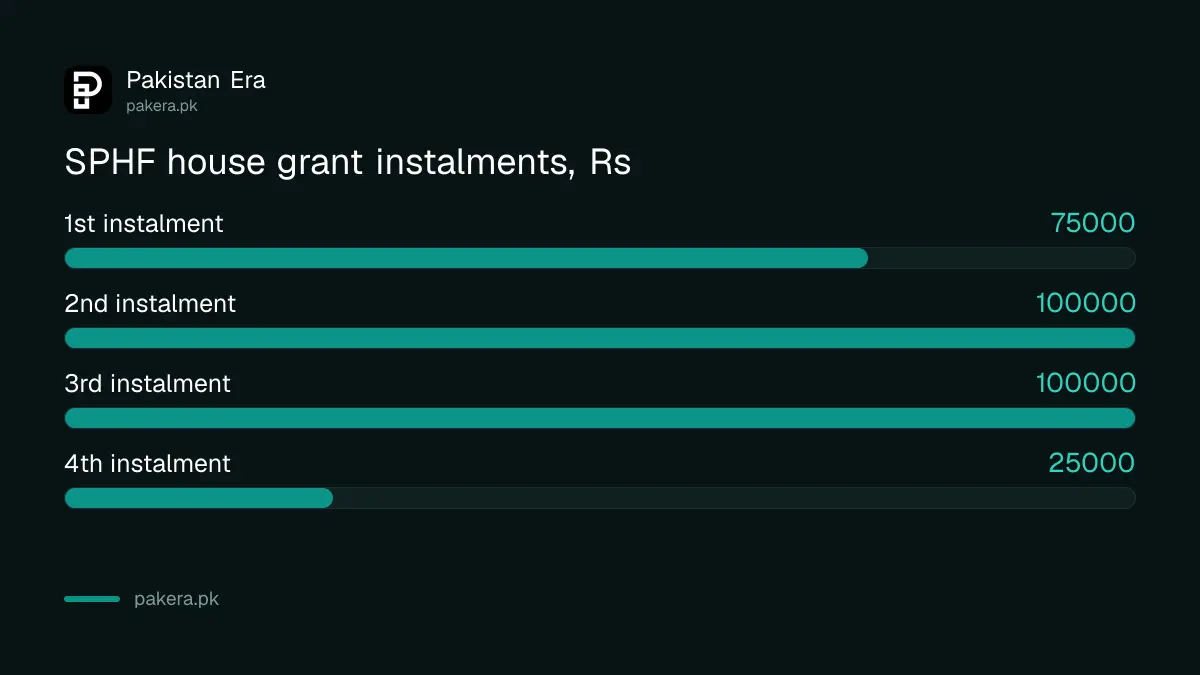
SPHF pays Rs 300,000 in four instalments tied to building stages
SPHF, the Sindh People's Housing for Flood Affectees, pays the housing grant in four parts that add up to Rs 300,000. The first part starts the work. Each later part is released only after SPHF certifies the stage before it.
SPHF's own grant poster, titled "Unlock your housing grant: a step by step guide to accessing funds", sets out the four steps. It also carries one line that explains most delays: "All the installments are subjected to the approval of respective certifications by SPHF."
The money goes into a bank account opened in the beneficiary's name. It is not paid in cash at the door. If someone offers to bring your instalment in cash for a fee, refuse.
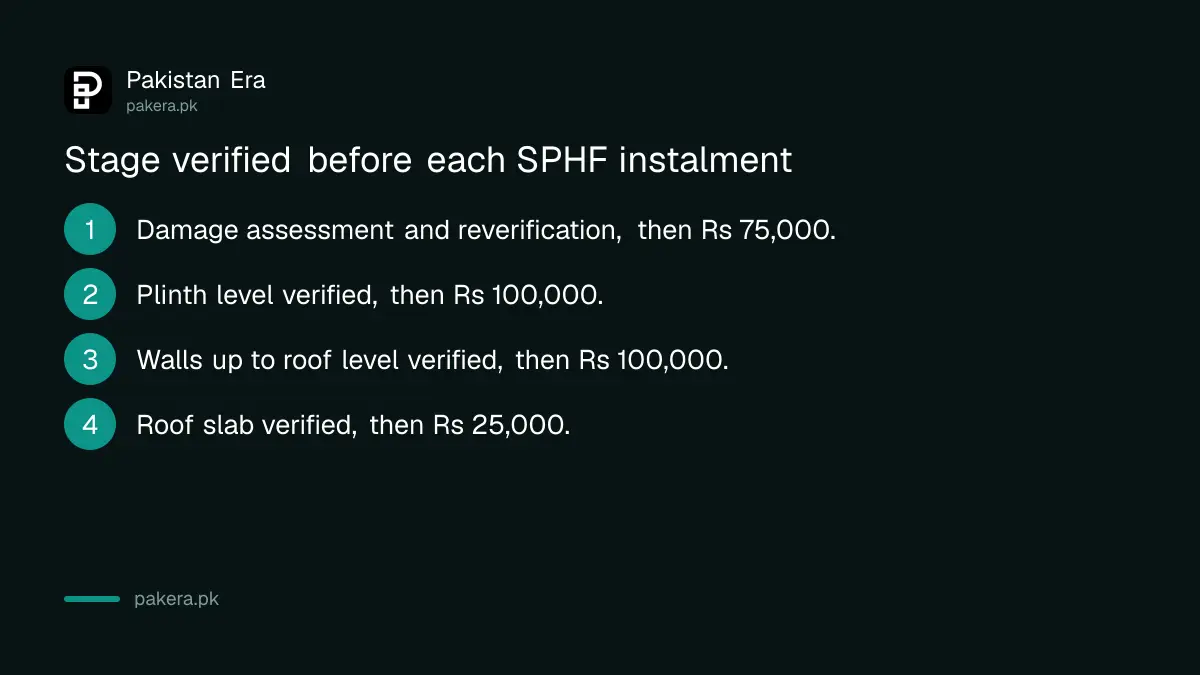
Each stage needs a verification before the next instalment
The first Rs 75,000 follows the damage assessment and reverification of your house. The second Rs 100,000 follows a verified plinth. The third Rs 100,000 follows verified walls up to roof level. The last Rs 25,000 follows a verified roof slab.
- Damage assessment and reverification. The survey team confirms the house was damaged in the 2022 floods and that you are the right beneficiary. Then Rs 75,000 is released to start the plinth.
- Plinth complete. The plinth is the raised base of the house. Once it is checked, Rs 100,000 is released for the walls.
- Walls up to roof level. Once the walls and the band above doors and windows are checked, Rs 100,000 is released for the roof.
- Roof slab complete. Once the roof is checked, the final Rs 25,000 is released to finish the house.
The checks look at more than height. SPHF's minimum building rules, such as a plinth at least 3 feet above ground and a reinforced band on the plinth, are set out in the guide to SPHF house minimum requirements. A stage built below those rules can hold up the next payment.
Check which instalments you have received with your CNIC
Open the SPHF Beneficiary Platform, type your 13-digit CNIC and press Enter. The result shows eligibility, account opening status and disbursement progress, which tells you how many instalments have gone into your account. The page is in English, Urdu and Sindhi.
Then match the result with your bank account. Ask your bank for a statement or check the account in its app. If the platform shows an instalment as paid and your account does not have it, you have a banking problem, not a construction problem. The full screen-by-screen steps are in the guide to check the Sindh flood house grant status by CNIC.
A stuck instalment usually has one of five causes
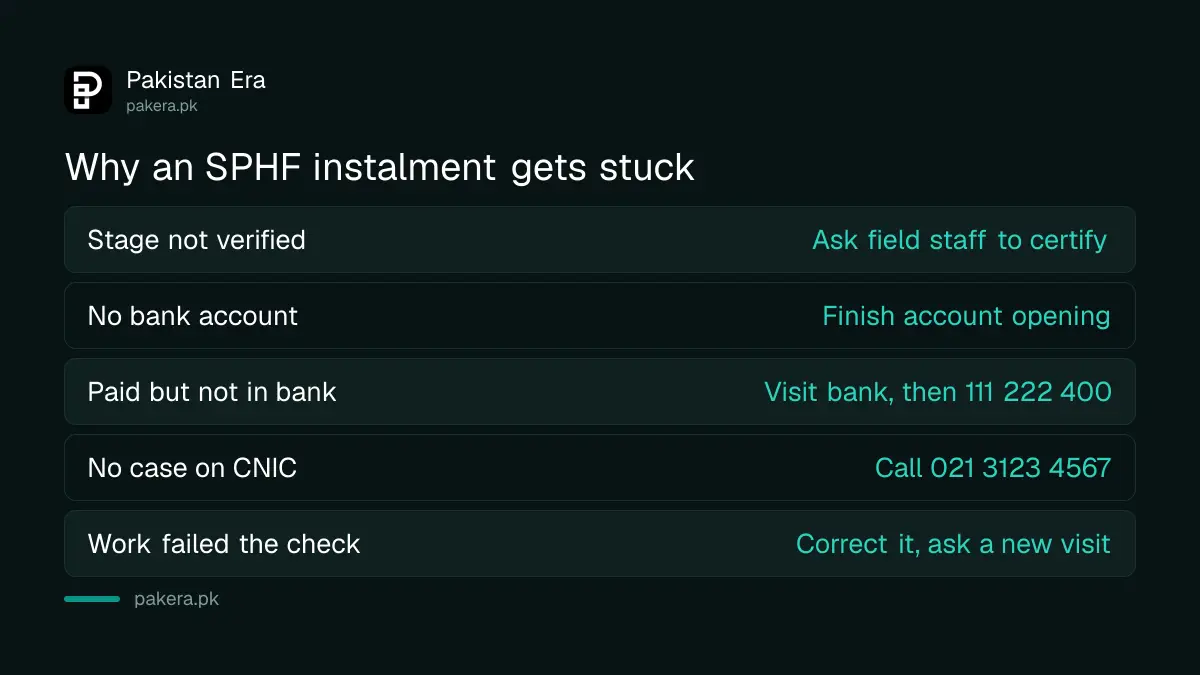
Most stuck instalments come from an uncertified stage, a missing or blocked bank account, a CNIC mismatch, a case missing from the system or a work standard that failed the check. Each cause has its own fix, and the table below shows which number or office to use.
| What you see | Likely cause | What to do |
|---|---|---|
| Stage finished but no new payment | The stage has not been verified yet | Ask the implementing partner's field staff to visit and certify the stage |
| Account opening not done | No bank account in your name yet | Visit the partner office with your original CNIC to finish account opening |
| Platform says paid, bank shows nothing | Banking or account issue | Take your CNIC to the bank, then call 021 111 222 400 if it is not solved |
| No case found for your CNIC | Case not in the system | Call +92 21 3123 4567, the number on the platform for this problem |
| Stage visited but not approved | Work below SPHF minimum standards | Ask what failed, correct it, and ask for a fresh visit |
A CNIC that has expired can also cause trouble at the bank. Renew it at NADRA before you chase the payment. The papers NADRA asks for are listed in the guide to NADRA documents for welfare schemes.
File a complaint and keep the token number
For a delayed instalment, call SPHF on 021 111 222 400 or email complaints@sphf.gos.pk. Give your CNIC, district, village and the stage your house has reached. SPHF's grievance system logs every complaint and sends a Grievance Token Number by SMS or email.
- Write down what the platform shows and the date.
- Take photos of the finished stage, such as the plinth or walls.
- Call 021 111 222 400 or email complaints@sphf.gos.pk.
- Ask for the token number and save the SMS.
- If nothing changes, call again with the token and ask for the case to move up.
You can also drop a written complaint in the box at the partner organisation's office or at SPHF's head office on Tipu Sultan Road, Karachi. The SPHF office numbers are 021 99334120 and 021 34300117.
Never pay anyone to release an instalment
SPHF's grant poster and complaint pages list no fee at any stage, from the survey to the last instalment. Anyone who asks for money to "pass" your stage or "release" your next payment is not following SPHF rules. Refuse and report it on 021 111 222 400.
Do not share the PIN or OTP of your bank account with field staff, neighbours or middlemen. The grant is meant for the beneficiary's own account, and a cash withdrawal made by someone else is hard to undo. If your house was damaged by a later disaster, the Sindh disaster authority's route for relief complaints on 1736 is separate from SPHF.
Common questions
How much is the first SPHF instalment?
Rs 75,000. It is released after the damage assessment and reverification of the house, and it is meant to start the plinth.
How many instalments does the SPHF house grant have?
Four: Rs 75,000, Rs 100,000, Rs 100,000 and Rs 25,000, a total of Rs 300,000.
Why did I get Rs 75,000 and then nothing?
The second instalment needs a verified plinth. If the plinth is done, ask the partner's field staff to certify it. If they already visited, ask whether the work failed a minimum standard.
Can I check my instalments online?
Yes. Enter your CNIC on sphf.gos.pk/beneficiary-status. It shows eligibility, account opening and disbursement progress.
What is the SPHF complaint number?
021 111 222 400, or email complaints@sphf.gos.pk. If your CNIC shows no case at all, call +92 21 3123 4567.
Is the grant paid in cash?
No. It goes into a bank account in the beneficiary's own name, one instalment at a time.
How we verified this
What we checked and where we read it.
Last checked 21 November 2026. The instalment amounts and stages come from SPHF's grant poster in the English IEC material on SPHF's IEC material page, dated June 2023. The poster spells the word "certications"; we quote it as "certifications".
We also checked the SPHF Beneficiary Platform on the same day for the CNIC lookup, the missing case number and the complaint number and email. The token number process and complaint boxes come from SPHF's grievance mechanism PDF on its project documents page. SPHF can change its process without notice, so check the platform before you act.
About the author

Fashion & Style Writer
Ayesha Mir is a fashion and style writer at Pakistan Era, joining the new lifestyle desk in November 2026.