How to Check Your Sindh Flood House Grant Status on the SPHF Platform With a CNIC
Enter your CNIC on the SPHF platform to see if your Sindh flood house grant is approved, your account is open and payments have begun, plus the numbers to call.
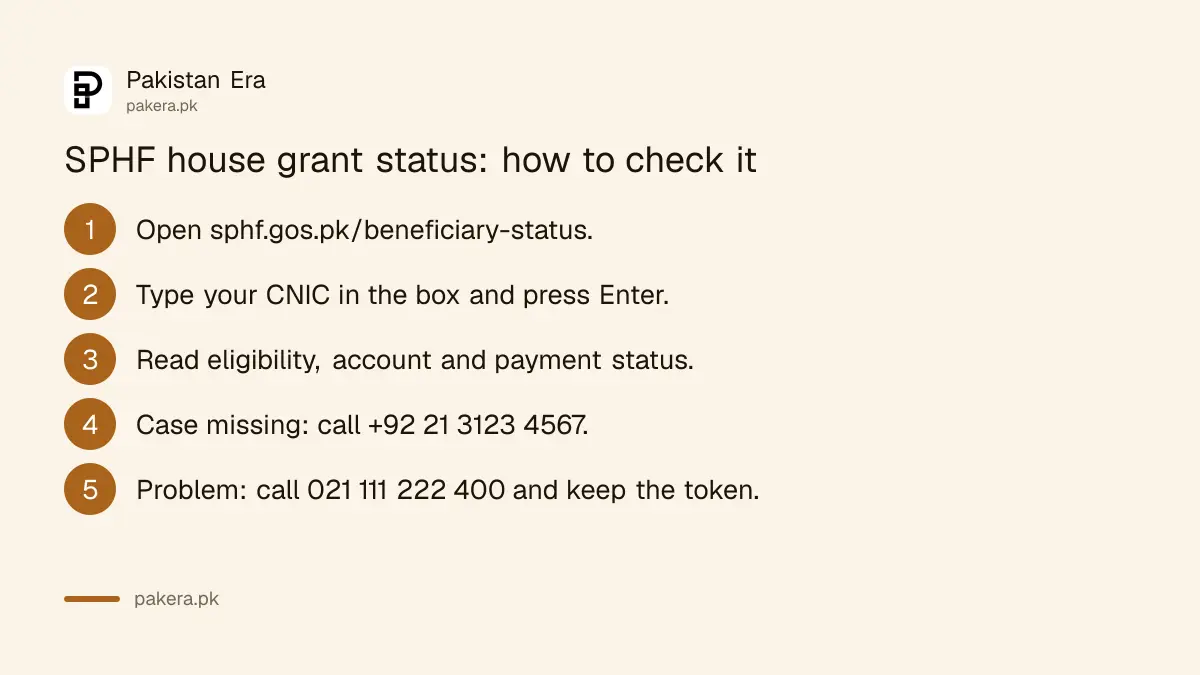
To check your Sindh flood house grant, open the SPHF Beneficiary Platform at sphf.gos.pk/beneficiary-status, enter your CNIC and press Enter. It shows whether you are eligible, whether your bank account is open and how far your payments have gone. If your case is missing, call +92 21 3123 4567. For a complaint, call 021 111 222 400 or email complaints@sphf.gos.pk.
The Sindh People's Housing for Flood Affectees, SPHF, is the company the Sindh government set up after the 2022 floods to rebuild houses. Its platform counter showed 1,000,000 houses completed when we read it on 19 October 2026. We read the Beneficiary Platform page, the project documents page and the World Bank appraisal document that SPHF publishes.
The platform takes one CNIC and returns eligibility, account and payment status
The page says: enter the CNIC to track the status of the case, including eligibility for the housing grant, account opening status and disbursement progress. There is one box and one Enter button. No mobile number, no password and no fee. It is in English, Urdu and Sindhi.
Those three results map to the three stages every beneficiary goes through. First the damage survey decides if the house qualifies. Then a bank account is opened in the beneficiary's name. Then the grant is paid into that account in parts as the house goes up.
| What the platform shows | What it means for you |
|---|---|
| Eligibility for the housing grant | Your house passed the damage assessment and verification survey |
| Account opening status | A bank account for the grant has, or has not, been opened in your name |
| Disbursement progress | How many payments have gone into that account so far |
| Case not available | Your CNIC is not in the system. Call +92 21 3123 4567 |
The platform page itself does not list the names of the construction stages. We describe the stages below from the appraisal document, not from the lookup screen.
The grant is paid in tranches into your own bank account, not in cash
The World Bank appraisal document says grants are released directly to the beneficiary's bank account in tranches, each linked to a verified stage of construction and to the resilient building standard. The implementing partner inspects the site and confirms the milestone before the next payment is released.
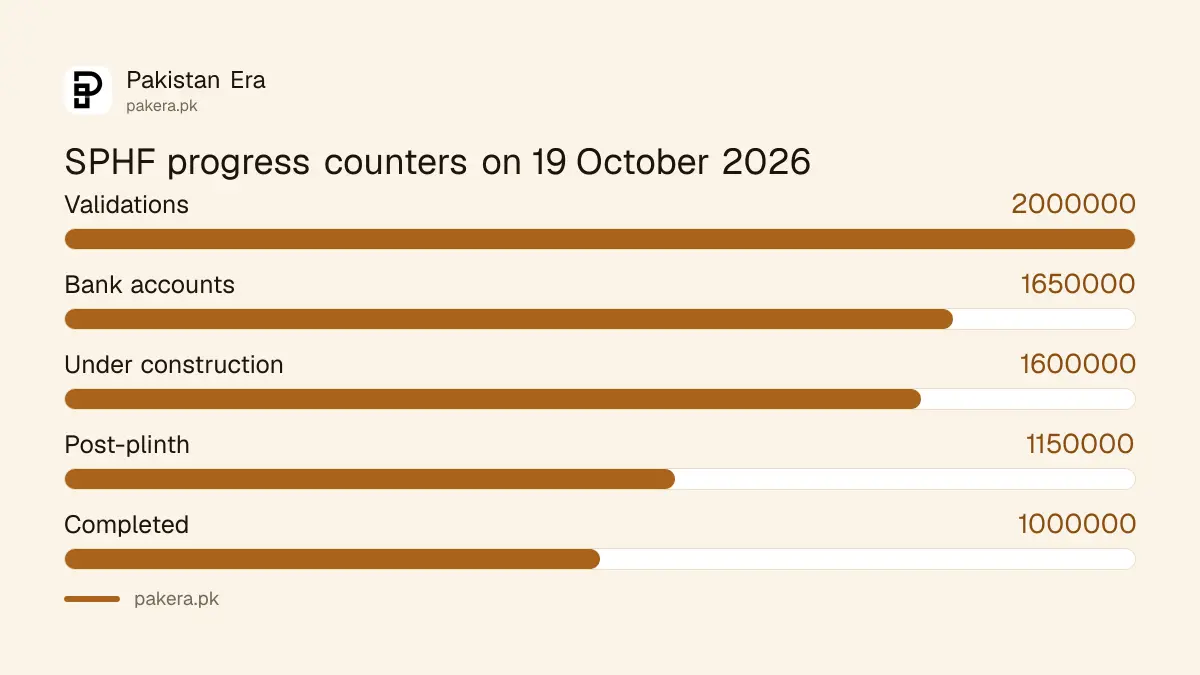
That is why "account opening status" matters so much. No account, no money. A woman who has never held an account can open an Asaan digital account with only a CNIC, which is the kind of simplified account the partners are meant to help with. The document says partners help eligible families open accounts under simplified rules, and the platform counter showed 1,650,000 bank accounts opened against 2 million validations.
The platform's own counters on 19 October 2026 read: 2 million validations completed, 1,650,000 bank accounts opened, 1,600,000 houses under construction, 1,150,000 post-plinth constructions and 1,000,000 houses completed. "Post-plinth" means the base of the house is finished and walls have started, which is the stage after the first payment.
Only houses with structural damage from the 2022 floods qualify
The appraisal document is clear on this. Cash grants go to houses with structural damage, to rebuild a destroyed house or restore a partly damaged one to a multi-hazard resilient core unit. Houses with only non-structural damage are not eligible under the component.
There is one more exclusion that surprises families. Houses in high flood risk zones, such as floodplains and stream beds, are not eligible for either grant. The document says these families are told their site cannot get immediate cash support and a process to find a safer site follows. If your status says not eligible and your house stood on a river bank, this may be the reason.
Families who lost documents, women heading a household and tenants without papers are meant to get help proving ownership through NADRA and district land offices. Where land is jointly owned, SPHF publishes a no objection format on its project documents page for the other owners to sign.
The grant amount is not published on SPHF's pages
We looked for the rupee amount of the grant on the Beneficiary Platform, the What We Do page, the project documents page and in the appraisal document, and none of them states it. The appraisal document says the grant partly finances the core unit and that the share between the project and the family is set in the programme guidelines.
A figure of Rs 300,000 per destroyed house has been widely reported since the programme began. We could not read it on an SPHF page, so treat it as reported, not confirmed. Ask the implementing partner in your taluka for the current grant size and the tranche split before you plan the build.
For comparison, Punjab's own flood scheme publishes its amounts, and the steps to claim flood damage compensation in Punjab show how a province can set a fixed figure per collapsed house. Khyber Pakhtunkhwa runs a separate route, and the papers needed to claim disaster compensation in KP go through the patwari and the district unit there.
Complaints get a token number by SMS, and there are numbers to call
SPHF's grievance mechanism, published as a PDF on its project documents page, says every complaint is logged in a web system and the complainant gets a Grievance Token Number by SMS or email. You use that number to follow up. Complaints can also be dropped in boxes at partner offices and at SPHF head office.
- Check your status on the platform and note what it says.
- If your case is missing, call +92 21 3123 4567 with your CNIC ready.
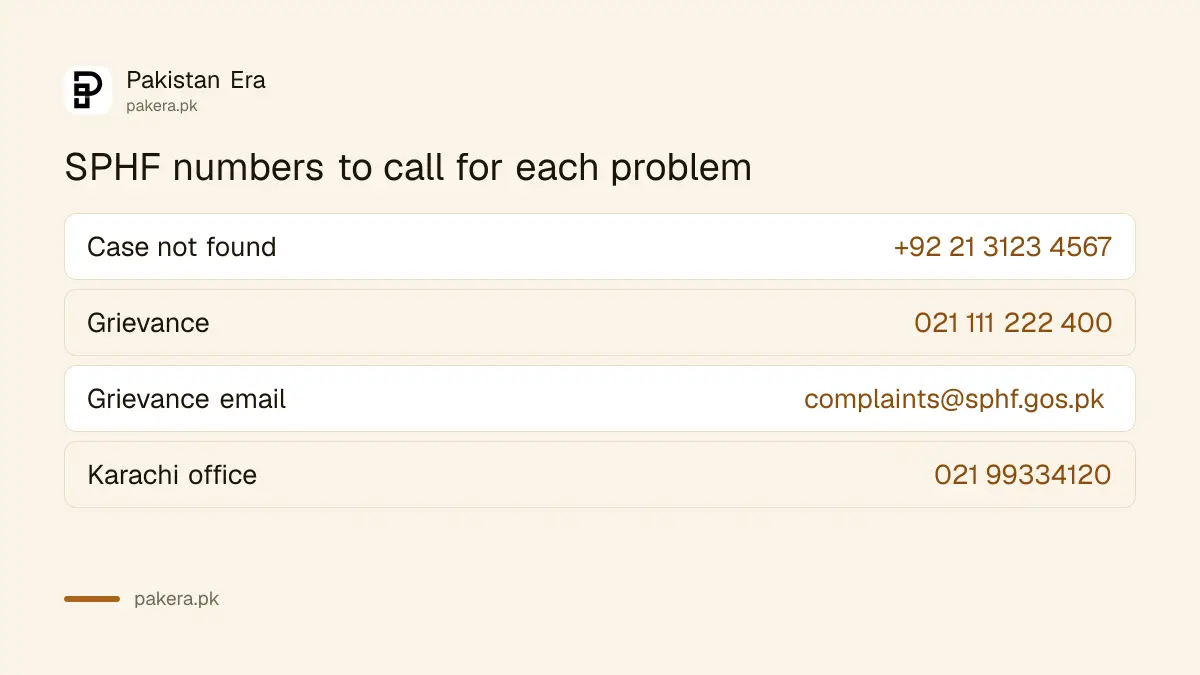
- For a wrong status, a delayed tranche or a problem with the partner, call 021 111 222 400 or email complaints@sphf.gos.pk.
- Ask for the token number and keep it.
- If the answer does not satisfy you, the mechanism escalates the case to the next level; say so and ask for the escalation.
The grievance document says each implementing partner sets up five phone or WhatsApp numbers covering five districts each. Those district numbers are not on the website, so ask the partner's field staff for the one that covers your taluka. The general office is on 021 99334120 and 021 34300117 at Tipu Sultan Road, Karachi.
Common questions
How do I check my SPHF house status?
Go to sphf.gos.pk/beneficiary-status, type your CNIC in the box and press Enter. It shows eligibility, account status and payment progress.
My CNIC shows no case. What do I do?
Call +92 21 3123 4567, the number the platform gives for eligible beneficiaries whose case is not in the system.
Why is my house not eligible?
The appraisal document excludes houses with only non-structural damage and houses in high flood risk zones such as floodplains and stream beds.
How much is the SPHF housing grant?
SPHF does not publish the figure on its pages. Rs 300,000 per destroyed house is widely reported but we could not verify it at source.
Is the grant paid in cash?
No. It goes into a bank account in the beneficiary's name, in tranches released after each construction stage is inspected.
Where do I complain about a delayed payment?
Call 021 111 222 400 or email complaints@sphf.gos.pk, and keep the token number you are given.
How we verified this
What we checked, where we read it, and what we could not confirm.
Last checked 19 October 2026. We read the SPHF Beneficiary Platform page, its What We Do page, its project documents page and its news page at sphf.gos.pk on 19 October 2026, and the World Bank project appraisal document and the grievance redress mechanism PDF that SPHF publishes there. The counters and the three phone numbers are from the platform page as it read that day. We could not run a CNIC lookup ourselves and did not see the result screen, so the exact labels it prints are not quoted. The grant amount per house, the tranche split and the district WhatsApp numbers are not published on SPHF's site and remain unverified.
About the author

Global Affairs & Political Economy Writer
Muhammad Hatim is a book lover who started writing because he enjoys it. At Pakistan Era he writes about international relations, geopolitics and the global economy, with a particular interest in South Asia and the forces behind current events.