How to Get Free Medicines in a Punjab Government Hospital Through the Medical Social Services Unit
Punjab runs 113 Medical Social Services Units in government hospitals that pay for medicines for poor patients. Where to find the office, what to bring, steps.
Poor patients in Punjab can get free medicines and help with treatment costs from the Medical Social Services Unit inside their government hospital. Punjab's Social Welfare Department runs 113 of these units in teaching, DHQ and THQ hospitals. Go to the unit's office in the hospital with the prescription, explain your situation, and the Medical Social Officer prepares your case. There is no fee.
A family that has spent its last money on a taxi to the hospital often does not know this office exists. It sits inside the hospital, usually away from the wards, and it is not well signposted. Ask any nurse or the hospital reception for the "Medical Social Officer" or the "social welfare office".
| Quick answer | Detail |
|---|---|
| Who runs it | Social Welfare and Bait-ul-Maal Department, Punjab |
| Where | 113 units in teaching, DHQ and THQ hospitals |
| What you can get | Free medicines and help with treatment costs |
| Who qualifies | Deserving and destitute patients |
| Fee | None |
| Helpline | Social Welfare 1312 |
Every big government hospital in Punjab has a Medical Social Services Unit
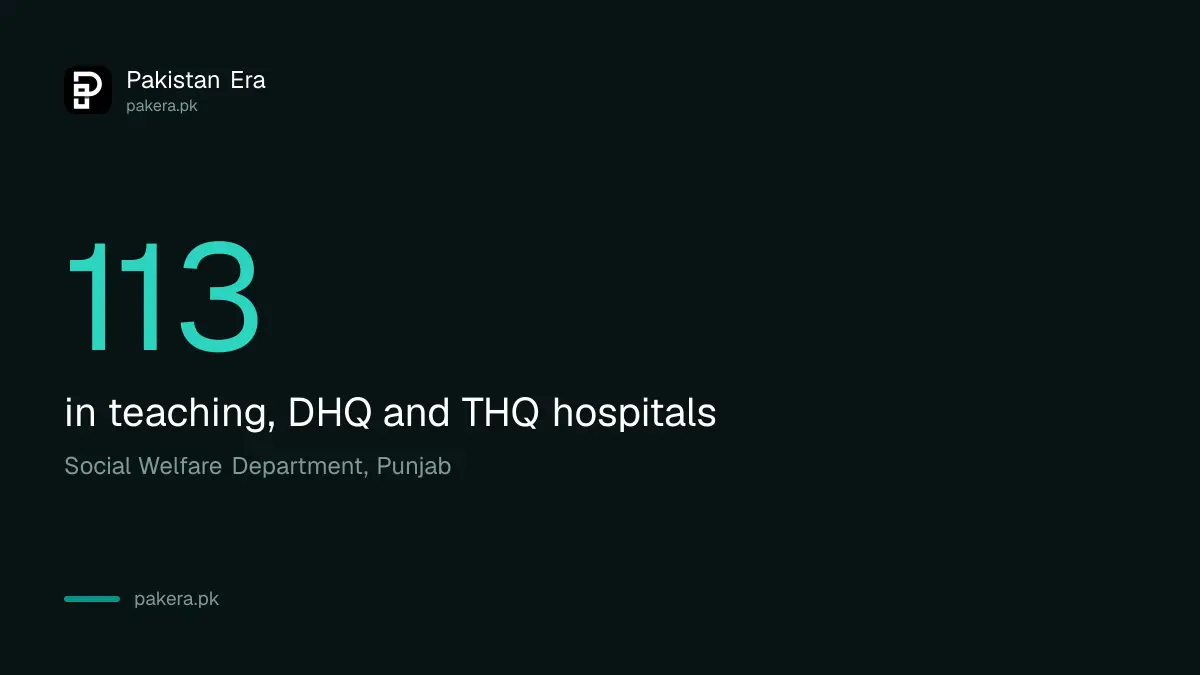
The department lists 113 Medical Social Services Units, called MSSUs, across Punjab. They sit in tertiary hospitals at division level and in District Headquarters and Tehsil Headquarters hospitals. Their job is to help needy and destitute patients pay for medicines and treatment they cannot afford.
The unit works for both outdoor patients, seen in the OPD, and indoor patients admitted to a ward. So a patient who has only been given a prescription at the OPD counter can still ask for help, not only someone who is admitted.
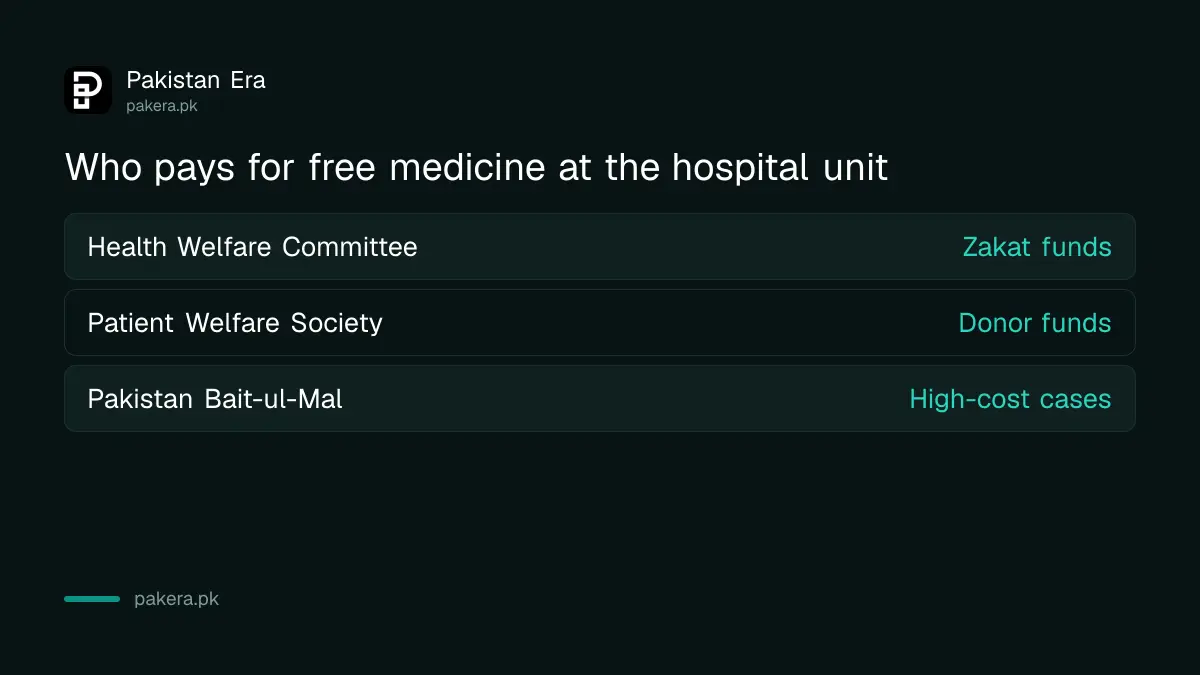
The money comes from Zakat, a patient welfare society and Bait-ul-Mal
The unit pays from three sources. A Health Welfare Committee spends Zakat funds under the Zakat Department's rules. A Patient Welfare Society, a registered charity funded by donors, pays when government money runs out. Very costly treatment is referred to Pakistan Bait-ul-Mal.
| Source | What it is | When it is used |
|---|---|---|
| Health Welfare Committee | Zakat funds, spent under Zakat Department rules | First call for medicines and treatment |
| Patient Welfare Society | Registered NGO funded by philanthropists | When government funds are not available |
| Pakistan Bait-ul-Mal | Federal welfare body | Treatment with very high cost, on referral |
Because Zakat money has its own rules, the committee may ask questions about your income and family. Answer them plainly. A referral to Bait-ul-Mal follows its own process and limits, explained in the guide to Bait-ul-Mal medical assistance.
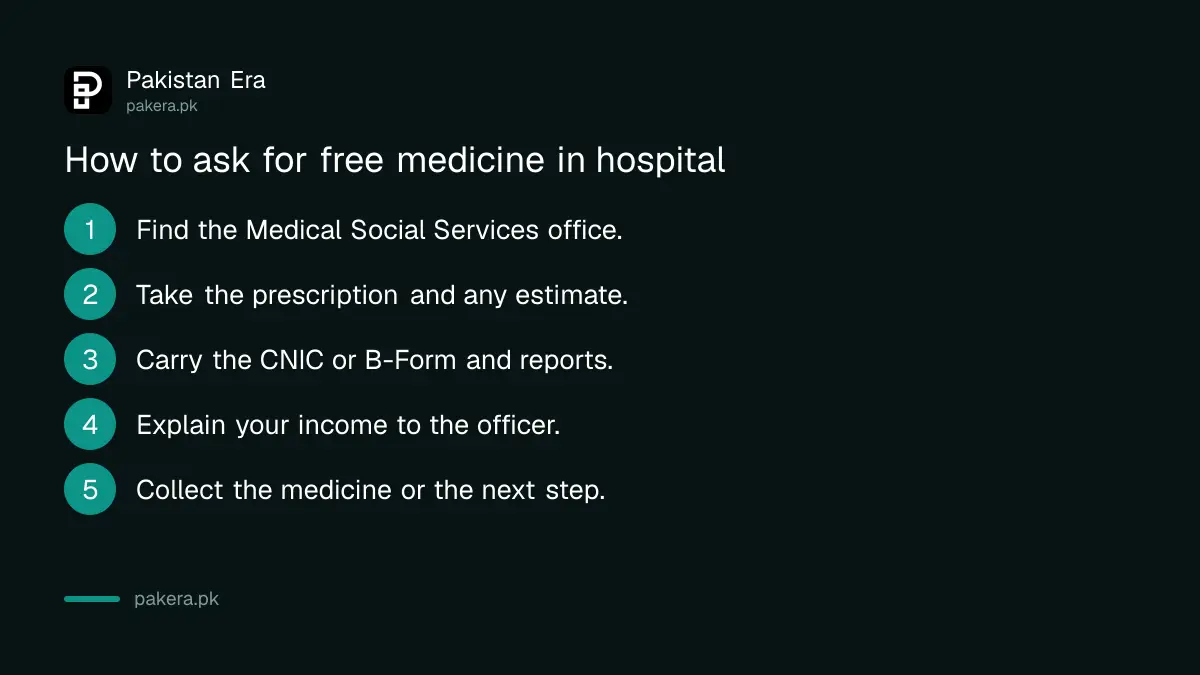
Ask for help in five steps
Start at the hospital, not at a district office. The Medical Social Officer in the unit writes a case history, checks whether the patient is deserving, and then arranges the medicine or the payment from one of the funds. Most families need only one visit to start the case.
- Ask the reception or a nurse where the Medical Social Services office is.
- Take the doctor's prescription, and the estimate if an operation or test is needed.
- Carry the patient's CNIC, or B-Form for a child, and any test reports.
- Explain your income and why you cannot pay. The officer prepares the case history.
- Collect the medicine or note what the officer tells you about the fund and the next step.
If the unit cannot help from its own funds, ask whether the case can be referred to Pakistan Bait-ul-Mal. Keep copies of every paper you hand over.
The unit also arranges blood donors, counselling and follow-up
The unit does more than pay for medicine. It registers blood donors and collects blood donations. It gives counselling to patients and their families. It also runs vocational training for some patients, refers recovered patients for jobs and follows up on their rehabilitation.
| Service | What it means for you |
|---|---|
| Medicines and treatment | Help for OPD and ward patients who cannot pay |
| Blood donors | Registration of donors and collection of blood |
| Counselling | Psycho-social support for the patient and family |
| Training and jobs | Vocational training and job referral after recovery |
| Follow-up | The unit keeps in touch during rehabilitation |
If you need blood for a patient and have no donor in the family, ask the same office before you pay anyone outside the hospital.
Use the Sehat Card and other schemes alongside the unit
The unit is one door among several. A patient who is admitted can use the Sehat Card at a listed hospital. Children with heart defects have a separate free surgery scheme. District Zakat offices give other Zakat help. Use the unit for what the other schemes do not cover.
The list of hospitals on the panel is in the Sehat Card hospital list for Punjab. For a child's heart operation, see free child heart surgery in Punjab. Addresses of the Zakat offices are in the list of district Zakat offices in Punjab.
What to do if the unit says no or there is no money
A refusal at the unit is not the end. Ask the officer to write the reason on your papers. Call the Social Welfare helpline 1312, or visit the district Social Welfare and Bait-ul-Maal office. Never pay an agent who promises free medicine for a fee.
District office numbers are in the list of Social Welfare office contact numbers in Punjab. If the hospital asks you to buy medicine from outside because the store is empty, keep the receipt and show it at the unit the same day.
Common questions
Is there a Medical Social Services office in every government hospital?
The department lists 113 units in teaching, DHQ and THQ hospitals. Smaller rural health centres are not on that list, so go to the nearest THQ or DHQ hospital.
Do I need to be admitted to get help?
No. The unit helps both outdoor (OPD) and indoor patients.
Who decides if I am deserving?
The Medical Social Officer prepares a case history and the committee that controls the fund decides. Zakat money follows the Zakat Department's rules.
Can non-Muslim patients get help?
Zakat funds follow Zakat rules. The Patient Welfare Society is funded by donors and is a separate source, so ask the officer which fund fits your case.
Is there any fee?
No. The department lists no fee for this help.
What if the treatment is very expensive?
The unit refers high-cost cases to Pakistan Bait-ul-Mal, which has its own forms and limits.
How we verified this
What we checked and where we read it.
We read the Punjab Social Welfare Department's Medical Social Services page and its home page, which gives helpline 1312, on 21 November 2026. The number of units, the three funding sources, the eligibility line and the list of services come from that page. The page does not list documents, so the papers in the steps are what a case history normally needs. For referrals, see Pakistan Bait-ul-Mal.
About the author
Public Services and Education Journalist
Fajr Riaz is a journalist and content writer at Pakistan Era, based in Lahore. She covers the questions people meet in everyday life in Pakistan: how a public service works, what a change in the rules means, and where to find a reliable answer.