SPSC CCE 2026 Last Date Extended to 11 November: Age Limit 33, Five Attempts, New Pass Mark
SPSC extended CCE-2026 applications to 11 November 2026, raised the age limit to 33 and allowed five attempts. See who can apply and the new 66 mark pass rule.
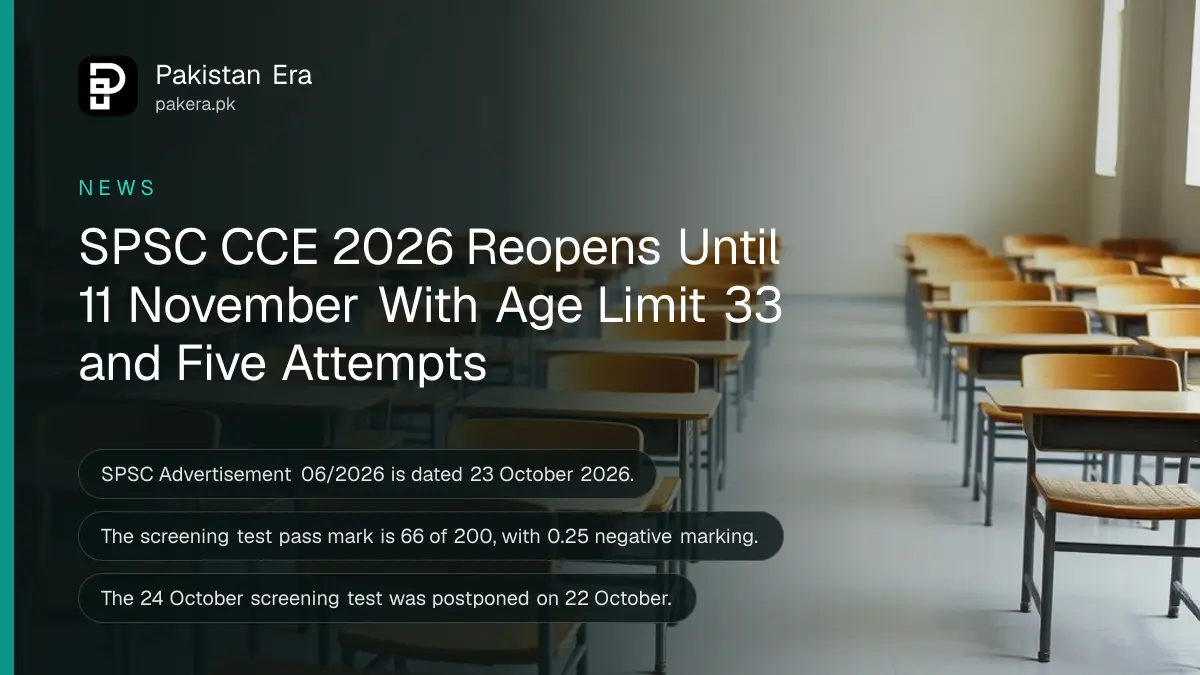
The Sindh Public Service Commission (SPSC) has reopened CCE-2026 applications until 11 November 2026, raised the upper age limit to 33, allowed five attempts instead of three, and cut the screening test pass mark back to 33 per cent with negative marking. The changes are in SPSC Advertisement No. 06/2026, dated 23 October 2026, which follows a Sindh cabinet decision of 20 October.
The screening test that was due on Saturday 24 October is off. SPSC postponed it in a public notice dated 22 October 2026 and said the new date, time and venue will be announced later. If you were turned away in September because you were 31, 32 or 33, you can now apply. If you already applied, you do not need to apply again.
We read both documents on SPSC's own website on 24 October 2026. Below is what changed, who gains, and what to do before 11 November.
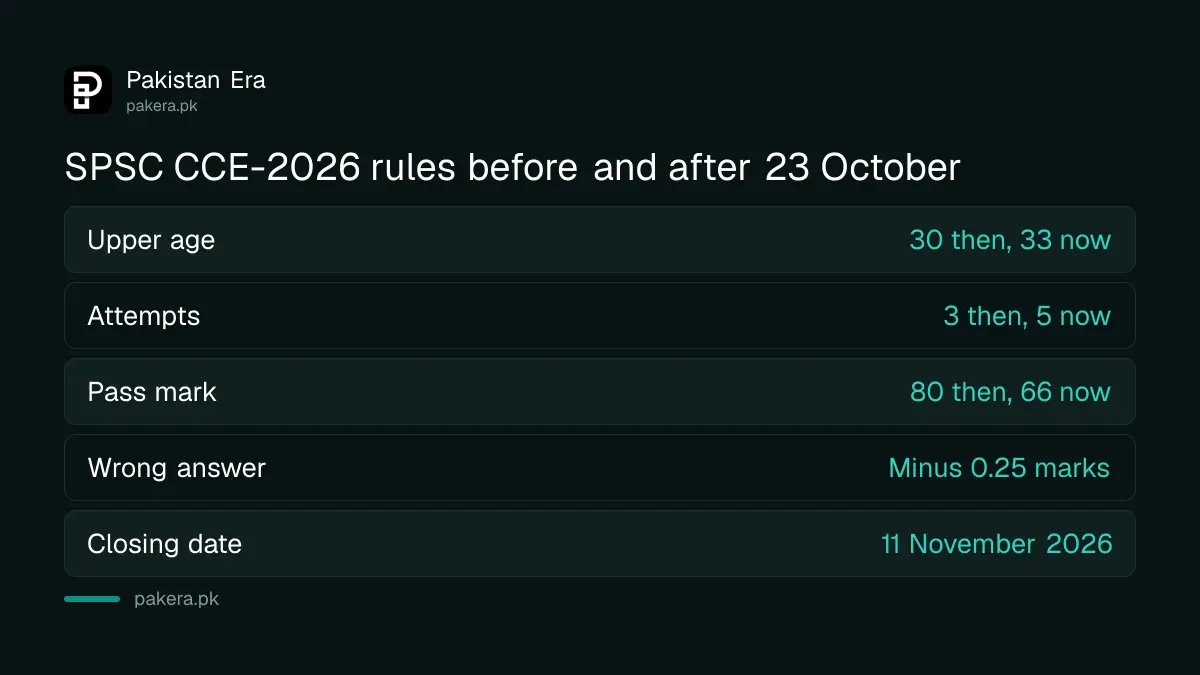
SPSC changed four rules for CCE-2026 on 23 October
Advertisement 06/2026 modifies the consolidated CCE-2026 advertisement of 19 August. It raises the upper age to 33, allows five attempts for three years, sets the screening pass mark at 33 per cent with a 0.25 penalty for each wrong answer, and extends the closing date to 11 November 2026.
Everything else in Advertisement 04/2026 stays the same, the new advertisement says. That includes the Rs 1,000 fee paid through a PSID, the four exam cities and the rule that only online applications count.
| Rule | Advertisement 04/2026 (19 August) | Advertisement 06/2026 (23 October) |
|---|---|---|
| Upper age limit | 30, counted on 1 September 2026 | 33, counted on 11 November 2026 |
| Lower age limit | 21 | 21, unchanged |
| Attempts allowed | Three, counted from CCE-2019 | Five, for a period of three years |
| Screening pass mark | 40 per cent (80 of 200) | 33 per cent (66 of 200) |
| Negative marking | Not mentioned | 0.25 marks for each wrong answer |
| Closing date | 23 September 2026 | 11 November 2026 |
The age limit is now 33, counted on 11 November 2026
You can apply if you are at least 21 and not older than 33 on 11 November 2026. SPSC says later CCE exams will count age on 1 September of their own year. The age is no longer counted on 1 September 2026 for this exam.
That date change matters. A candidate born on 15 October 1993 was 32 on 1 September 2026 and would have been rejected under the old rule. On 11 November 2026 that person is 33, which is still inside the new limit. Check your own date of birth against 11 November, not against September.
Advertisement 04/2026 also gave serving federal and Sindh government employees with four years of regular service an upper limit of 35. The new advertisement does not mention that concession, so we read it as unchanged. SPSC's rules on how your matric certificate decides your age are explained in the steps to check SPSC age rules.
Five attempts are allowed for the next three years
SPSC has raised the CCE attempt limit from three to five for a period of three years. The three-attempt condition in Advertisement 04/2026, applied since CCE-2019 under a Supreme Court order of 2017, stands amended. Candidates who used all three attempts can sit again.
The advertisement does not say from which exam the three-year window starts or ends. Read literally, it covers CCE-2026 and two more yearly exams. We could not find a separate SPSC notice that spells this out, so treat the end date as unconfirmed.
Sitting the screening test has never counted as an attempt under SPSC's syllabus rules. Only the written part does.
The screening test pass mark is 66 of 200, with negative marking
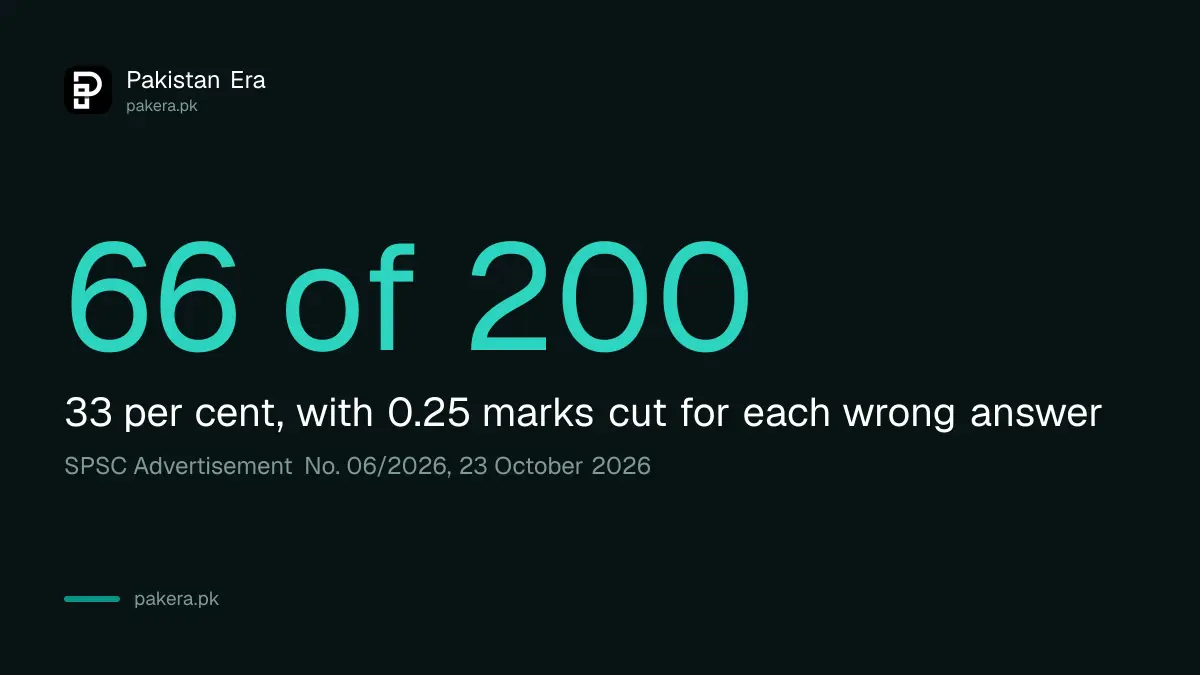
To pass the CCE-2026 screening test you now need 33 per cent, which is 66 marks out of 200. Each wrong answer costs 0.25 marks. This replaces the 40 per cent (80 marks) rule that SPSC brought in with the August advertisement.
Negative marking changes how you should sit the paper. Four wrong guesses cancel one correct answer. If you can rule out two of four options, a guess still makes sense. A blind guess on a question you have not read properly usually does not.
The 24 October screening test is postponed with no new date yet
SPSC's public notice No. PSC/EXAM(C.S)/2026/236, dated 22 October 2026, postponed the CCE-2026 screening test that was fixed for Saturday 24 October. It says the revised date, time and venue will be communicated later. Nothing newer was on the website when we checked.
A new test date is likely to come after the 11 November closing date, because new applicants must be able to sit it. That is our reading, not an SPSC statement. Do not travel to a centre on the strength of an old admission slip.
What to do before 11 November
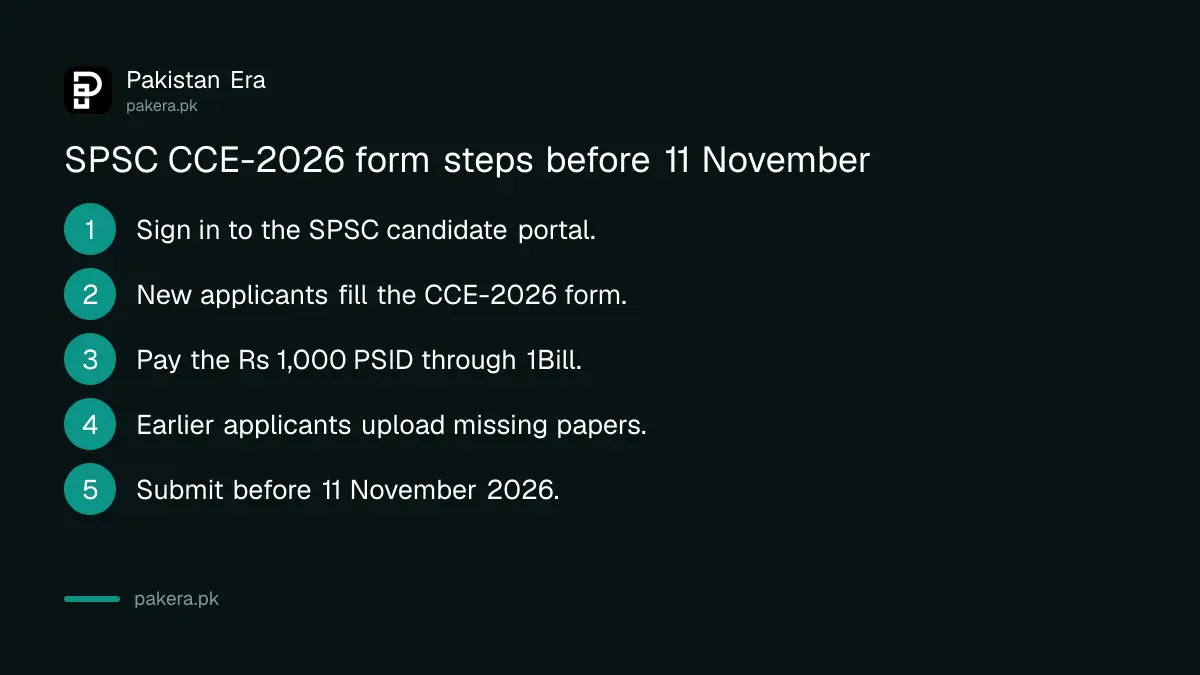
New applicants apply online. Earlier applicants check and fix their form. Both groups must finish before the closing date of 11 November 2026, because SPSC does not accept manual forms.
- Open the SPSC candidate portal from SPSC's website and sign in or create an account.
- If you are new, fill in the CCE-2026 form and generate a PSID for the Rs 1,000 fee.
- Pay the PSID through any online channel using the 1Bill invoice option.
- If you applied before, open your form and upload any missing documents or fix mistakes.
- Check your CNIC number and date of birth. A wrong entry leads to rejection.
- Save a copy of the submitted form and the paid challan.
Domicile, PRC Form-D, urban or rural quota, exam centre and optional subjects cannot be changed after the closing date. The SPSC rules on those fields are in the guide to the SPSC domicile and PRC rules.
Who should apply now and who should wait
Apply now if you are 31 to 33 on 11 November, if you used up three attempts, or if you missed the September window. Earlier applicants only need to check their form. Nobody has to pay the fee twice.
| Your situation | What to do |
|---|---|
| Applied before 23 September | Do not apply again. Check documents and fix errors. |
| Aged 31 to 33 on 11 November 2026 | Apply as a new candidate. |
| Used three CCE attempts already | Apply. Five are now allowed. |
| Missed the September deadline | Apply before 11 November. |
| Over 33 and not a government servant | Not eligible under either advertisement. |
One point is unclear. Advertisement 04/2026 required Sindh domicile and permanent residence as on 23 September 2026. The new advertisement keeps all other terms, so that date may still apply to new applicants. Get your PMS Sindh application papers ready and call SPSC on 022-9200694 if your domicile was issued after 23 September.
Common questions
What is the last date for SPSC CCE-2026?
11 November 2026. SPSC extended it from 23 September 2026 in Advertisement 06/2026.
What is the new age limit for SPSC CCE-2026?
21 to 33 years, counted on 11 November 2026.
Do I need to apply again if I applied in September?
No. SPSC says earlier applications stay valid under the new terms. You may upload missing documents or correct mistakes before 11 November.
How many attempts are allowed in the Sindh CCE now?
Five, for a period of three years. The old limit was three.
Is there negative marking in the SPSC screening test?
Yes. SPSC now deducts 0.25 marks for each wrong answer, and the pass mark is 66 of 200.
When is the new CCE-2026 screening test date?
SPSC has not announced it. The 24 October test was postponed on 22 October, and SPSC said it will share the new date later.
How we verified this
What we checked, where we read it, and what we could not confirm.
Last checked 24 October 2026 at about 18:45 PKT. We read SPSC Advertisement No. 06/2026 dated 23 October 2026, SPSC public notice No. PSC/EXAM(C.S)/2026/236 dated 22 October 2026 and SPSC Advertisement No. 04/2026 dated 19 August 2026, all as scanned documents on spsc.gos.pk. The worked age example is our own. We could not confirm when the three-year window for five attempts ends, whether the 35-year limit for government servants changes, or whether the 23 September domicile date applies to new applicants, because the new advertisement does not say. We did not apply.
About the author

Tax, Bills and Technology Writer
Ali Akhtar is a young and curious voice here at Pakistan Era. He is currently pursuing his A-Levels and has a growing interest in Pakistan’s changing industrial landscape and educational trends. Ali likes to write in a way that helps him explain and explore the world around him. His writing reflects the perspective of the new generation navigating the evolving trends of Pakistan where technology, youth innovation, and shifting opportunities are reshaping the country’s future.