How a Farm Tenant in Balochistan Gets a Wrongful Ejectment Reversed: Restoration in 30 Days
Farm tenant in Balochistan removed without a court order? Section 41 of the Tenancy Ordinance lets you complain and get the tenancy restored within 30 days.
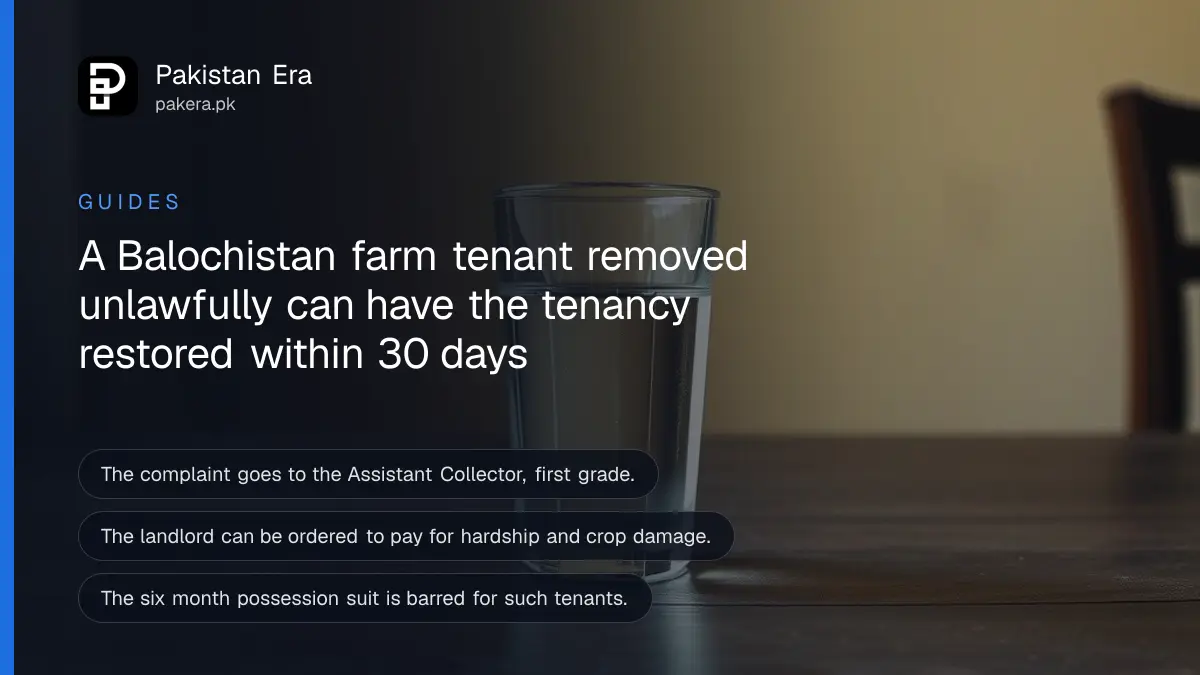
A farm tenant in Balochistan who has been thrown off the land unlawfully can complain in writing to the Revenue Officer with Assistant Collector first grade powers, and if the tenant wins, the tenancy must be restored within 30 days of the order. The Balochistan Tenancy Ordinance, 1978 also lets the officer order the landlord to pay compensation for the hardship and for crop damage.
We read the full Ordinance on the Balochistan Code, the provincial law portal, on 21 October 2026. It covers land farmed by a tenant, not a rented house. The landlord's side, with the lawful grounds for removing a tenant, is in the guide to evicting a farm tenant through the Revenue Court.
Section 41 gives a wrongly removed tenant a written complaint to the Assistant Collector
Section 41 says a tenant who has been ejected or dispossessed in an unauthorised manner may apply in writing to the Revenue Officer with the powers of an Assistant Collector of the first grade. That officer hears the tenant and the landlord, makes enquiries and passes an order.
The word that matters is unauthorised. An ejectment that followed a court order, a show cause notice and the 30 day notice is authorised. One done by force, by a threat or with no order at all is not.
A winning tenant gets the land back in 30 days and compensation
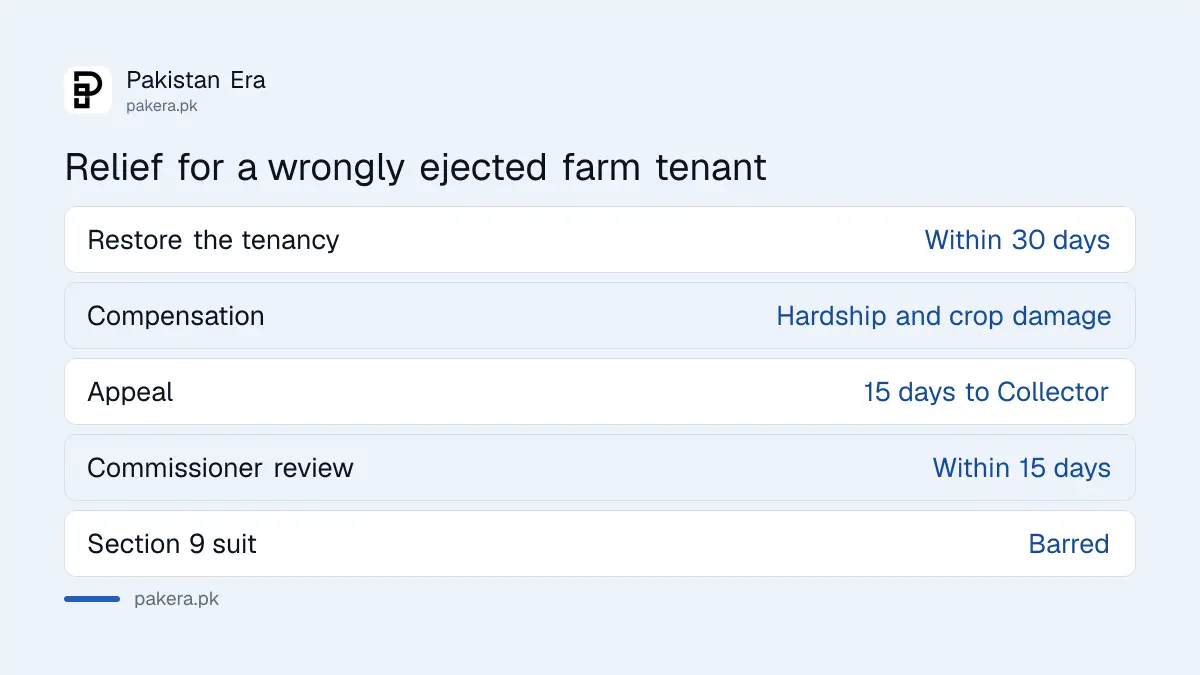
If the officer decides for the tenant, he must see that the tenancy is restored within 30 days of the order. If the landlord appeals or seeks revision, the District Collector must see it restored within 30 days of the appeal or revision order.
The officer, or the higher court, may also order the landlord to pay for the hardship caused and for damage to crops or land while the tenant was out. This is recovered as arrears of land revenue. The landlord gets no compensation for improvements he made in that time and cannot remove anything from the land after the first order against him (section 41(4)).
| Step | Time limit | Who acts |
|---|---|---|
| Written complaint of unlawful ejectment | No time limit is stated in section 41 | Assistant Collector, first grade |
| Restore tenancy after the order | 30 days | Revenue Officer |
| Appeal against the Assistant Collector's order | 15 days to the Collector | Either side |
| Commissioner's review on tenant's application | Within 15 days of the order | Commissioner |
Section 41 sets 15 days for these appeals, while the general appeal rule in section 68 sets 30, 60 and 90 days. We read the specific 15 day period as the one that governs this complaint, but a revenue lawyer should confirm it for your case. Act inside 15 days to be safe.
You cannot use the six month possession suit instead
Section 42 says a tenant dispossessed of his tenancy cannot recover possession through section 9 of the Specific Relief Act, 1877. That is the quick six month possession suit used in ordinary property cases, explained in the guide to suing for possession under section 9.
So a tenant must use the revenue route in section 41. Going to a civil court first wastes time. The tenant's rights under this Ordinance are separate from the general civil rules on time limits to sue.
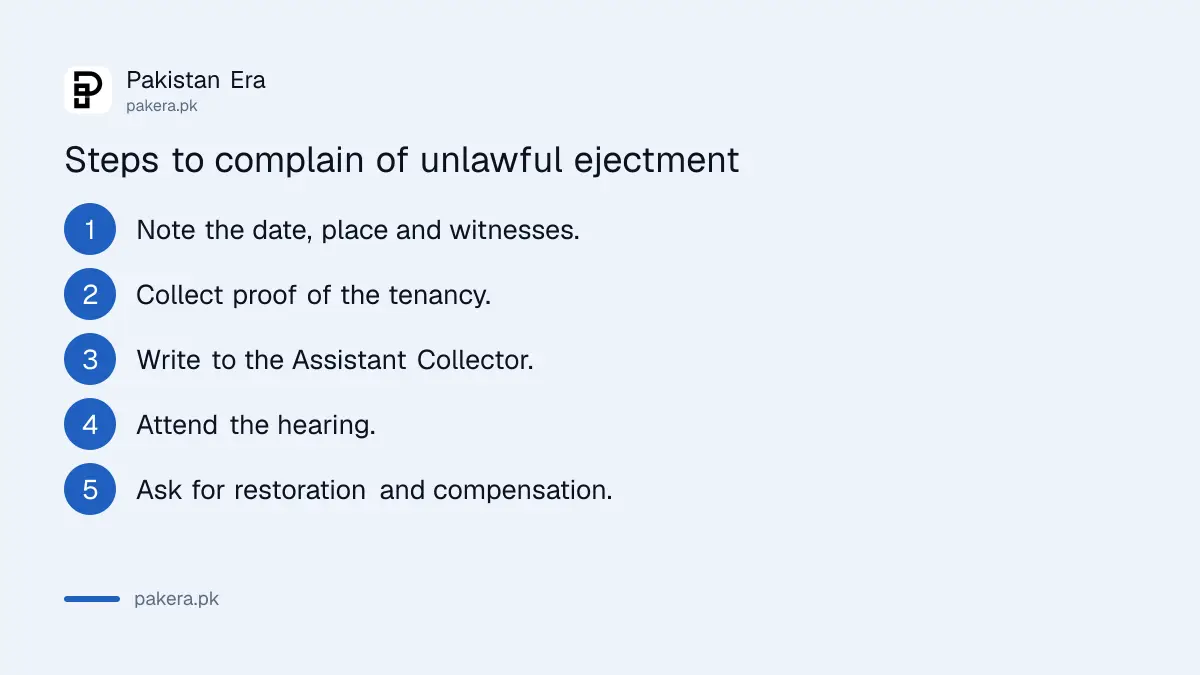
- Write down the date, place and who removed you, with witnesses.
- Collect proof of tenancy, such as the Girdawari entry, rent receipts or crop records.
- Write a complaint to the Assistant Collector, first grade.
- Attend the hearing with witnesses and documents.
- Ask for restoration within 30 days and for compensation for crop damage.
- If you lose, appeal to the Collector within 15 days.
Know the rent rules before a dispute starts
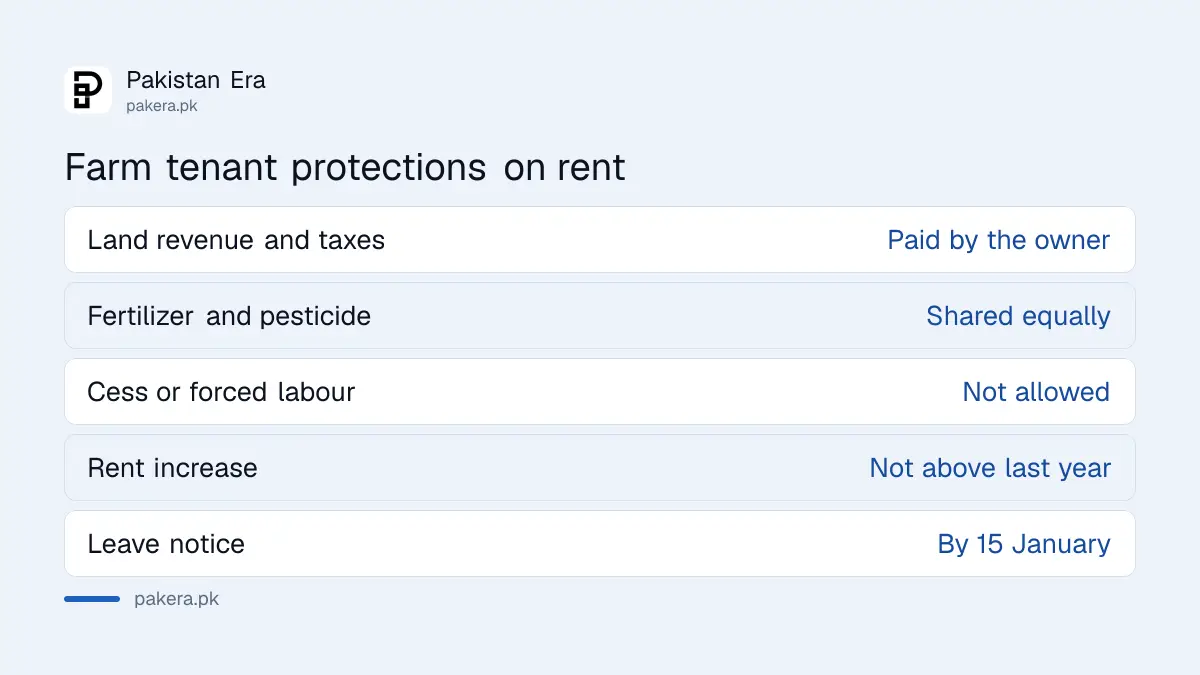
Several rules protect tenants before any eviction. The landlord must pay land revenue and other taxes on the land (section 10(2)). Fertilizer and pesticide costs are shared equally between owner and tenant (section 10(4)). No owner may levy any cess on a tenant or take labour from him (section 10(5)).
Where rent is taken in produce, by rate or in gross, and there is no contract or decree to the contrary, the tenant cannot be made to pay a higher rate than the year before (section 11(2)). A rent dispute goes to the Revenue Officer under section 63.
If a landlord refuses to take rent in money, or refuses a receipt, the tenant can ask the Revenue Officer for leave to deposit it there. The deposit then counts as payment to the landlord (sections 24 and 25). A tenant who wants to leave must give notice on or before 15 January to end the tenancy at the close of the agricultural year, or pay rent for part of the next year (section 28).
Common questions
Who hears a wrongful ejectment complaint?
The Revenue Officer with the powers of an Assistant Collector of the first grade, under section 41 of the Balochistan Tenancy Ordinance, 1978.
How fast must the tenancy be restored?
Within 30 days of the order. If there is an appeal or revision, within 30 days of the appellate or revisional order.
Can I get money for the lost crop?
Yes. The officer or higher court may order the landlord to pay for hardship and for damage to crops or land during the period you were out.
Can I go to a civil court instead?
You cannot use the section 9 possession suit. The Ordinance bars it for tenants dispossessed of their tenancy, so use the revenue complaint.
What if the landlord will not take my rent?
Apply to the Revenue Officer for leave to deposit the rent in his office. The deposit counts as a payment to the landlord.
When must I give notice to leave a tenancy?
On or before 15 January in any year, to leave at the end of that agricultural year, unless you hold for a fixed term under a contract or decree.
How we verified this
What we checked, where we read it, and what we could not confirm.
We read the full text of the Balochistan Tenancy Ordinance, 1978 on the Balochistan Code on 21 October 2026. The PDF text is partly garbled, so we matched each section to its heading. We could not confirm whether the Provincial Government has notified different dates under section 43, and we do not state any court fee. This is general information, not legal advice.
About the author

Tax, Bills and Technology Writer
Ali Akhtar is a young and curious voice here at Pakistan Era. He is currently pursuing his A-Levels and has a growing interest in Pakistan’s changing industrial landscape and educational trends. Ali likes to write in a way that helps him explain and explore the world around him. His writing reflects the perspective of the new generation navigating the evolving trends of Pakistan where technology, youth innovation, and shifting opportunities are reshaping the country’s future.