Succession Certificate in Punjab: NADRA Fee Rs 20,000 or Rs 10,000, Documents and the Civil Court Option
NADRA's succession certificate fee in Punjab is Rs 20,000 or Rs 10,000 by property value. See the 4 documents, the 14 day notice and when a court is needed.
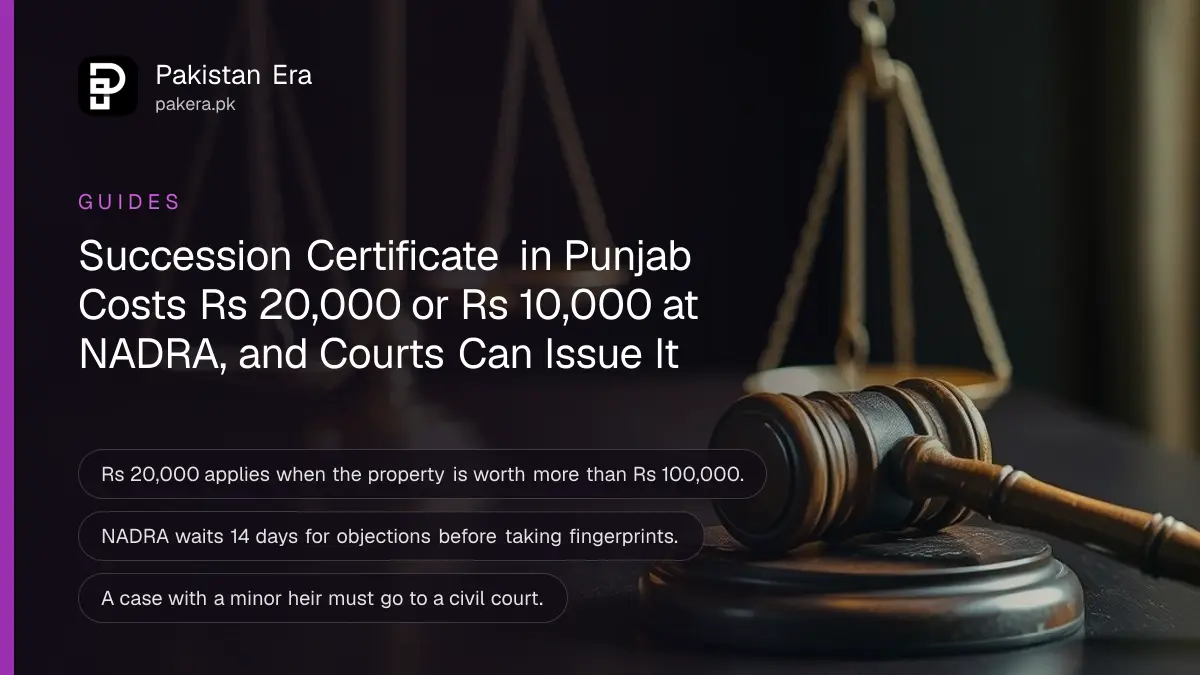
In Punjab, NADRA charges Rs 20,000 for a succession certificate or letter of administration when the property is worth more than Rs 100,000, and Rs 10,000 when it is worth less. Since 31 July 2025, a civil court can issue the same documents again, so heirs in Punjab now have two routes. Which one fits depends on whether any heir is a minor or disputes the shares.
We read the Punjab Letters of Administration and Succession Certificates Act 2021, its 2025 amendment, its 2021 rules and the commencement notification on the Punjab Code, the provincial government's law site, on 31 October 2026. The fees, forms and 14 day clock below are from those texts.
NADRA's Punjab fee is Rs 20,000 or Rs 10,000, and Rs 5,000 for a duplicate
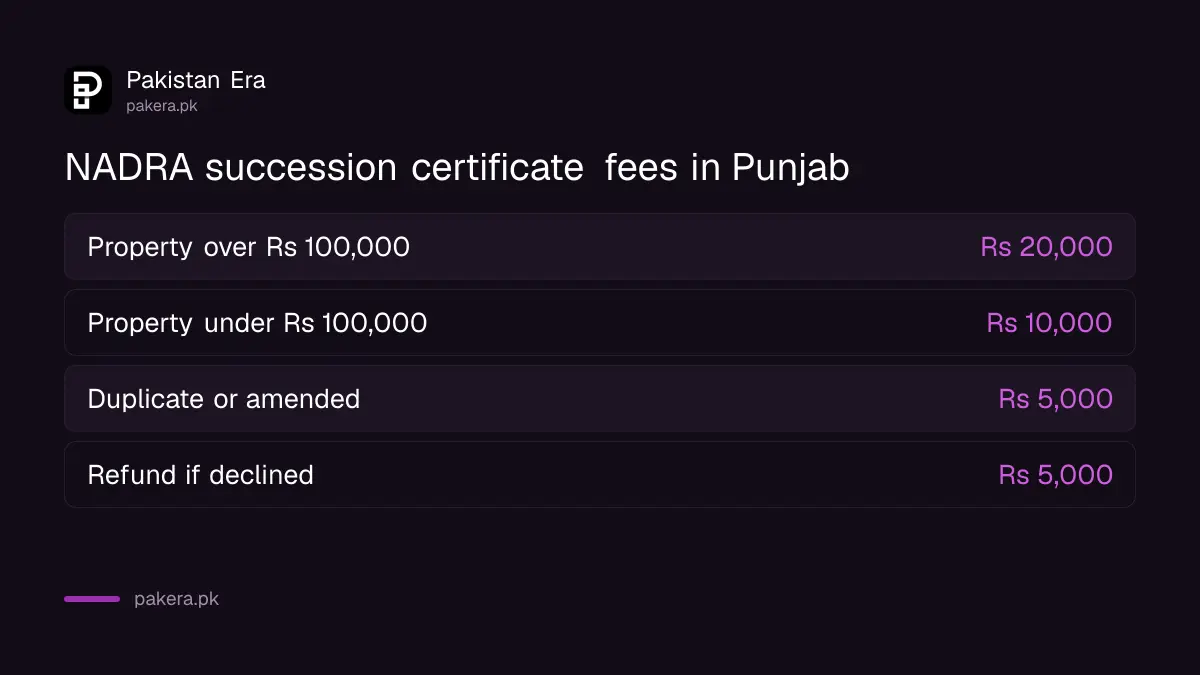
Schedule IV of the Punjab rules sets Rs 20,000 for a first application where the property is worth more than Rs 100,000, and Rs 10,000 where it is worth less. A duplicate or amended certificate costs Rs 5,000. If NADRA declines your case, Rs 5,000 is refunded.
| Item | Fee or rule in Punjab |
|---|---|
| First application, property worth more than Rs 100,000 | Rs 20,000 |
| First application, property worth less than Rs 100,000 | Rs 10,000 |
| Duplicate or amended certificate | Rs 5,000 |
| Refund if NADRA declines the application | Rs 5,000 |
| How to pay | Pay order, demand draft, bank challan or another mode NADRA allows |
| Objection window after the public notice | 14 days |
Read the refund line carefully. The schedule says Rs 5,000 is refunded on a decline, not the whole fee. So on a Rs 20,000 application that NADRA turns down, by our arithmetic you lose Rs 15,000. The schedule also does not say what happens when the property is worth exactly Rs 100,000.
A succession certificate covers money, a letter of administration covers land
The two documents look alike but cover different assets. The Punjab forms issue a succession certificate for movable property, such as a bank account, and a letter of administration for immovable property, such as a house or plot. Ask for the one your asset needs.
A bank will ask for a succession certificate before it releases a dead person's balance. A land registry or housing society will ask for a letter of administration before it transfers a plot. If the deceased left both, list both kinds of property on the application. Both documents name every legal heir and their share, worked out under the personal law of the person who died.
The Act says a certificate from NADRA has the same effect as one issued under the Succession Act 1925. So a bank cannot insist on a court certificate just because yours came from NADRA.
Four documents go with a Punjab application
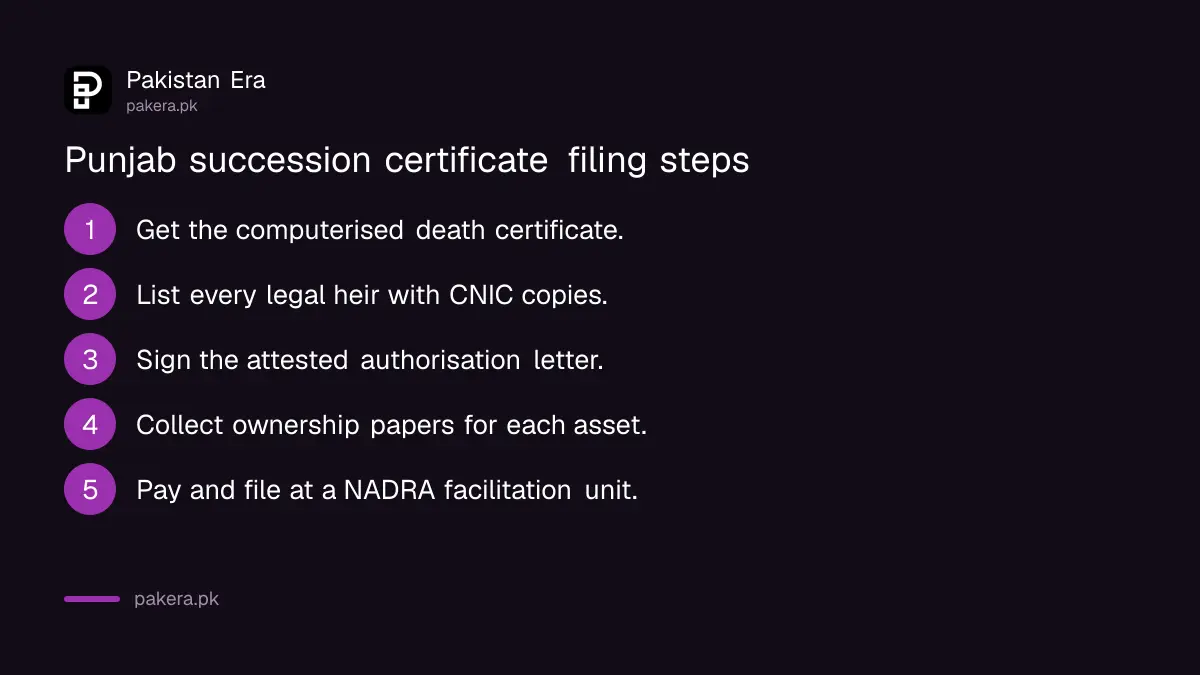
The rules list four: the death certificate, a list of all legal heirs with copies of their CNIC or NICOP, a letter of authorisation signed by the heirs, and proof of ownership of every property you want covered. File at a NADRA office notified as a Succession Facilitation Unit.
- Get the computerised death certificate from the union council. In Punjab, the route and the 60 day rule are in getting a death certificate in Punjab.
- Make a list of every legal heir, with their CNIC or NICOP copies. Leaving an heir out is the fastest way to a rejected case.
- Fill in the Schedule I letter of authorisation, naming one heir to apply for all, with each heir's share, phone and signature. It must be attested by an oath commissioner.
- Collect ownership papers: the property address and area for land, the account number for a bank account, and the share if the asset was jointly owned.
- Pay the fee and file at the NADRA office where the deceased normally lived, or where the property is.
NADRA works out the heirs from its Family Registration Certificate, the Act says. If your family record is wrong, fix it before you apply. A missing child or an ex-spouse still listed will hold the case up, and the fixes are in correcting a wrong Family Registration Certificate.
NADRA publishes a notice and waits 14 days before fingerprints
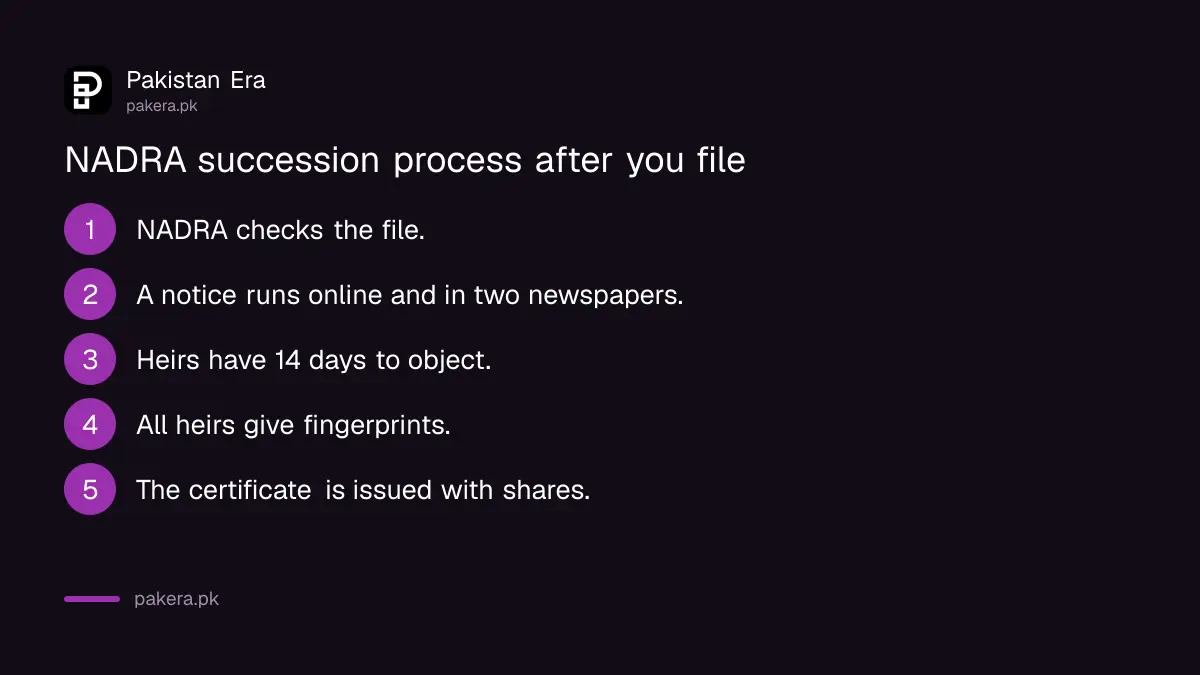
After it accepts the file, NADRA publishes a public notice on its web portal and in one English and one Urdu daily newspaper. If no objection arrives within 14 days, the applicant and every legal heir give fingerprints at a NADRA office. The certificate follows.
Heirs abroad do not have to fly home. The Act says biometric verification can be done at any notified NADRA office in Pakistan or abroad. Pakistan's missions in London and Washington both list it as a service.
If an heir's fingerprints do not match, NADRA can call that heir in person on a fixed date. It can also use "any other modern device" to confirm identity, the Act says. Then the applicant appears on a date NADRA sets and collects the certificate.
A minor heir or a dispute sends the case to a civil court
NADRA must decline any case with a "factual controversy". The Act defines that to include an objection by an heir, a dispute over who the heirs are, anything needing evidence, and any case where at least one legal heir is a minor. Those cases go to court.
The minor rule surprises many families. If a parent dies leaving a child under 18, the NADRA route is closed by law, however peaceful the family is. File in a civil court under the Succession Act 1925 instead.
The 2025 amendment made that court route plain. It inserted the words "or a civil court" into section 3, so the Act now says NADRA or a civil court may issue these documents in Punjab, and a court follows the Succession Act 1925. The amendment also omitted section 10 of the Act. It came into force at once, from its publication on 31 July 2025.
Somebody who objects after NADRA has issued a certificate can still seek remedies under other laws, the Act says. A certificate is not the end of a real dispute.
A lost certificate needs a police report before NADRA replaces it
NADRA can issue a duplicate for a lost, stolen, destroyed or damaged certificate, for Rs 5,000. For a lost or stolen one, attach a police report or FIR. For a damaged one, hand in the original. An error can be fixed the same way, by surrendering the original for an amended copy.
The rules for Balochistan carry the same fee and the same 14 day notice, which we set out in the Balochistan succession certificate. The national overview is in getting a succession certificate from NADRA.
Common questions
How much is the NADRA succession certificate fee in Punjab?
Rs 20,000 if the property is worth more than Rs 100,000, and Rs 10,000 if it is worth less.
How long does a NADRA succession certificate take in Punjab?
The law sets a 14 day objection window after the public notice. Biometrics and issue follow, and no total time is fixed in the Act or rules.
Can a civil court still issue a succession certificate in Punjab?
Yes. The 2025 amendment says NADRA or a civil court may issue it, and a court follows the Succession Act 1925.
Can NADRA issue a certificate if one heir is a child?
No. A case where at least one legal heir is a minor counts as a factual controversy, and NADRA must decline it.
Do overseas heirs need to come to Pakistan?
No. Biometric verification can be done at a notified NADRA office abroad.
What if NADRA declines my application?
Rs 5,000 is refunded and you can file afresh in a civil court under the Succession Act 1925.
How we verified this
What we checked, where we read it, and what we could not confirm.
Last checked 31 October 2026. The process, documents, objection window, controversy rule and court route come from the Punjab Letters of Administration and Succession Certificates Act 2021 (IX of 2021) and the amendment Act of 2025 (LXII of 2025). The fees, forms and refund come from the Punjab Letters of Administration and Succession Certificates Rules 2021, notified on 16 June 2021, and the Act's commencement from the notification of 26 June 2021, all on the Punjab Code site, read on 31 October 2026. We could not read NADRA's website, which refuses automated requests, to check its current list of Succession Facilitation Units in Punjab or any processing time it publishes. We could not see the text of the omitted section 10.
About the author

Public Services and Education Journalist
Fajr Riaz is a journalist and content writer at Pakistan Era, based in Lahore. She covers the questions people meet in everyday life in Pakistan: how a public service works, what a change in the rules means, and where to find a reliable answer.