Supreme Court of Pakistan: Eyewitnesses Need Not Count Shots Exactly, Murder Conviction Upheld
The Supreme Court of Pakistan upheld a 2017 murder conviction and said exact recall of shots and injuries is an unnatural demand on eyewitnesses. What it means.
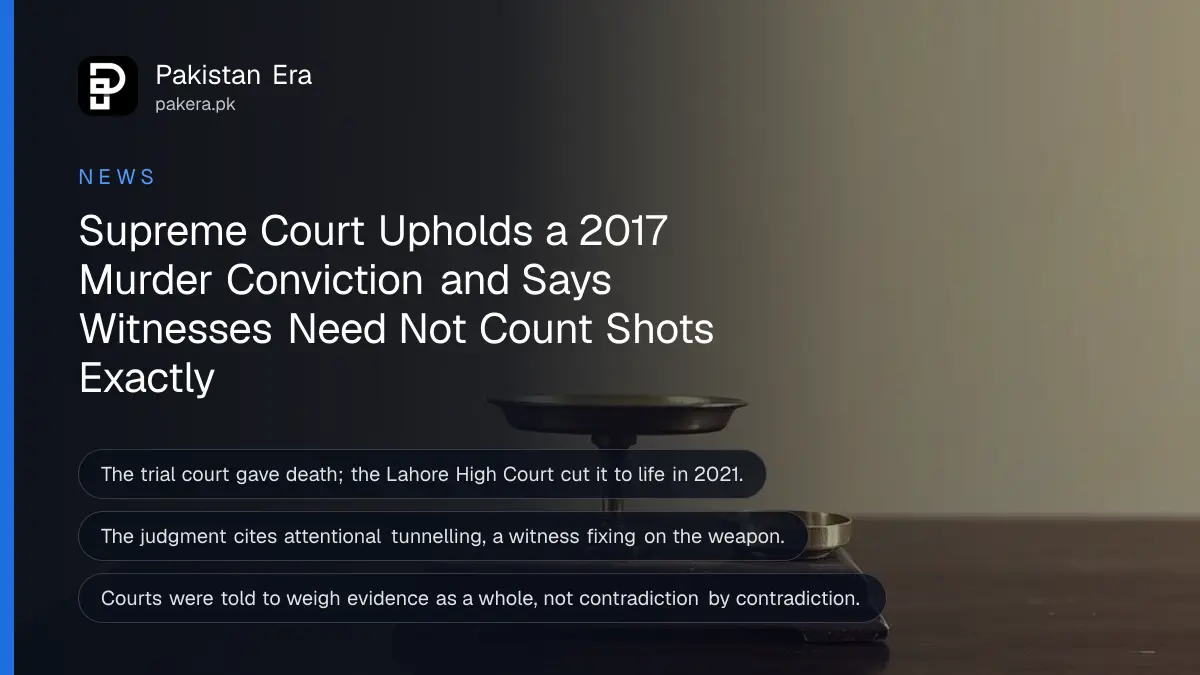
The Supreme Court of Pakistan has upheld a murder conviction and said courts should not expect eyewitnesses to recall the exact number of shots or the exact place of each injury. The judgment, reported on 17 October 2026, dismissed the appeal of Muhammad Azhar against his conviction for the 2017 murder of Sakhian Bibi. It says small differences in what witnesses remember under stress are natural and do not by themselves make their evidence unreliable.
We could not open the judgment itself. The Supreme Court's judgment pages were blocked to us on 19 October 2026, so the ruling, the bench and the quotations below are as reported by a national daily that day. The practical effect for anyone fighting a criminal case is real, and that is what this page explains.
The court said exact recall of shots and injuries is an "unnatural" demand
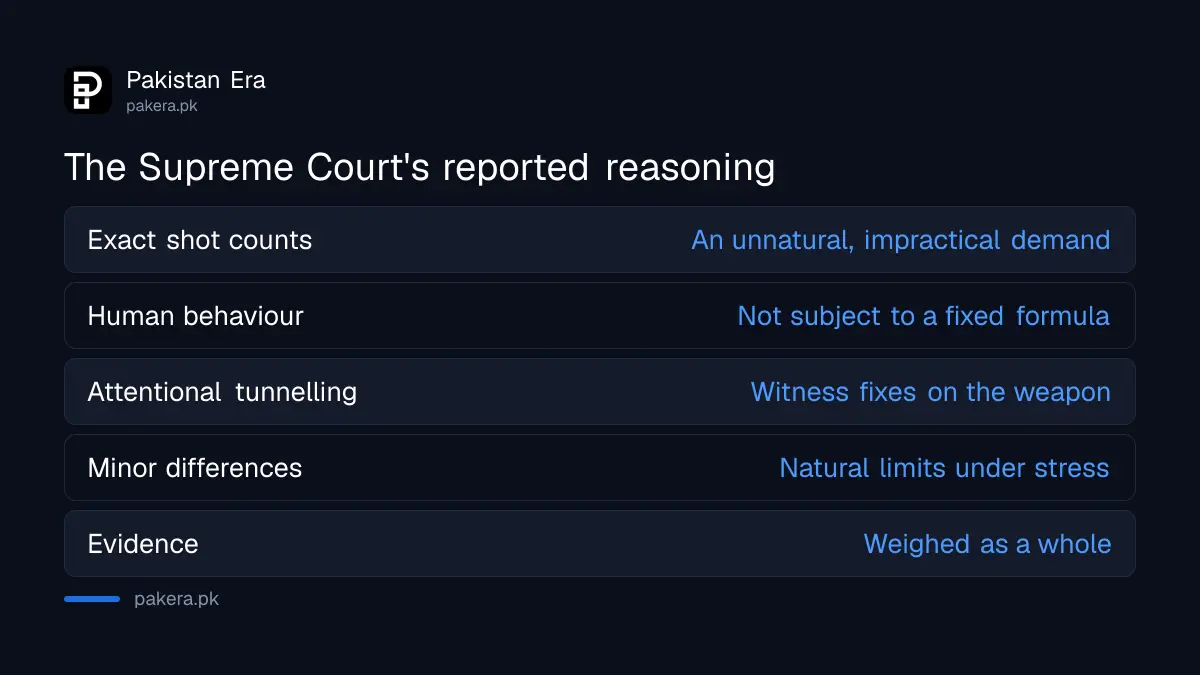
A three-judge bench headed by Justice Muhammad Hashim Khan Kakar decided the appeal, and Justice Ishtiaq Ibrahim wrote the judgment. The court is reported to have said that to expect "mathematical precision regarding the number of firearm shots or the exact location of injuries" from a witness is unnatural and impractical in a traumatic event.
A second line, also reported, is the one lawyers will quote: "In criminal jurisprudence, human behaviour should not be subjected to a fixed formula." Different witnesses see and remember the same event differently, and that difference is not proof that one of them is lying.
The judgment is reported to cite the psychologist Elizabeth Loftus and the idea of "attentional tunnelling". A person facing a gun fixes on the weapon and takes in less of the scene around it. That is why a truthful witness can get the count of shots wrong.
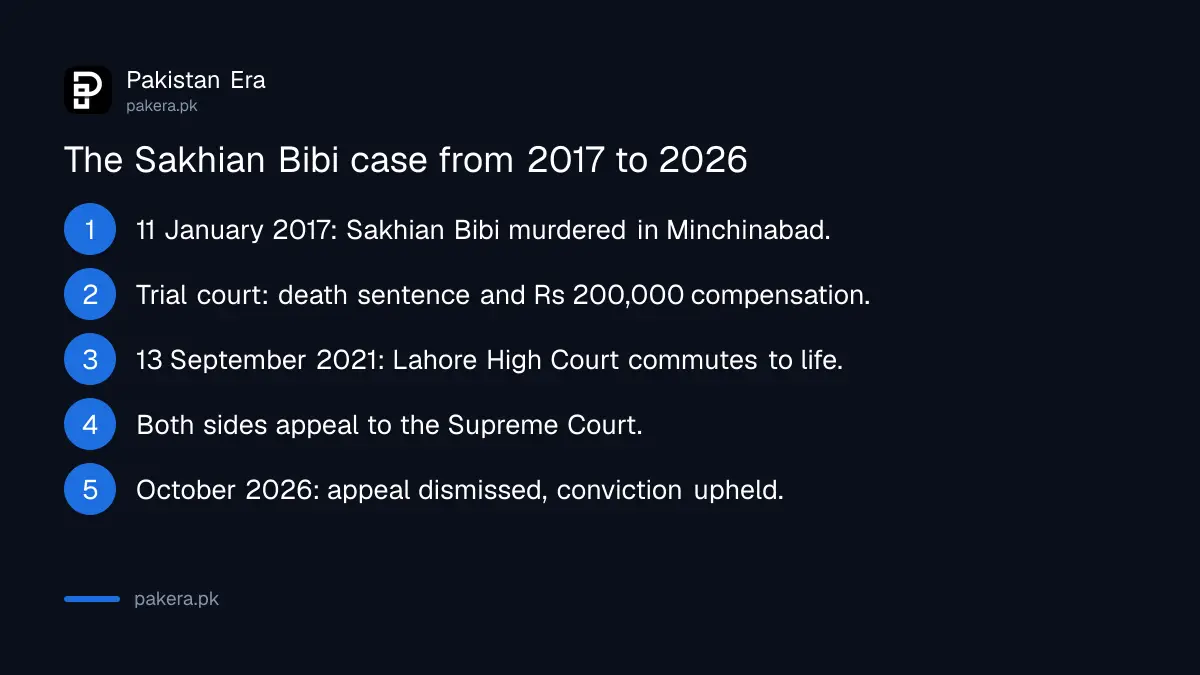
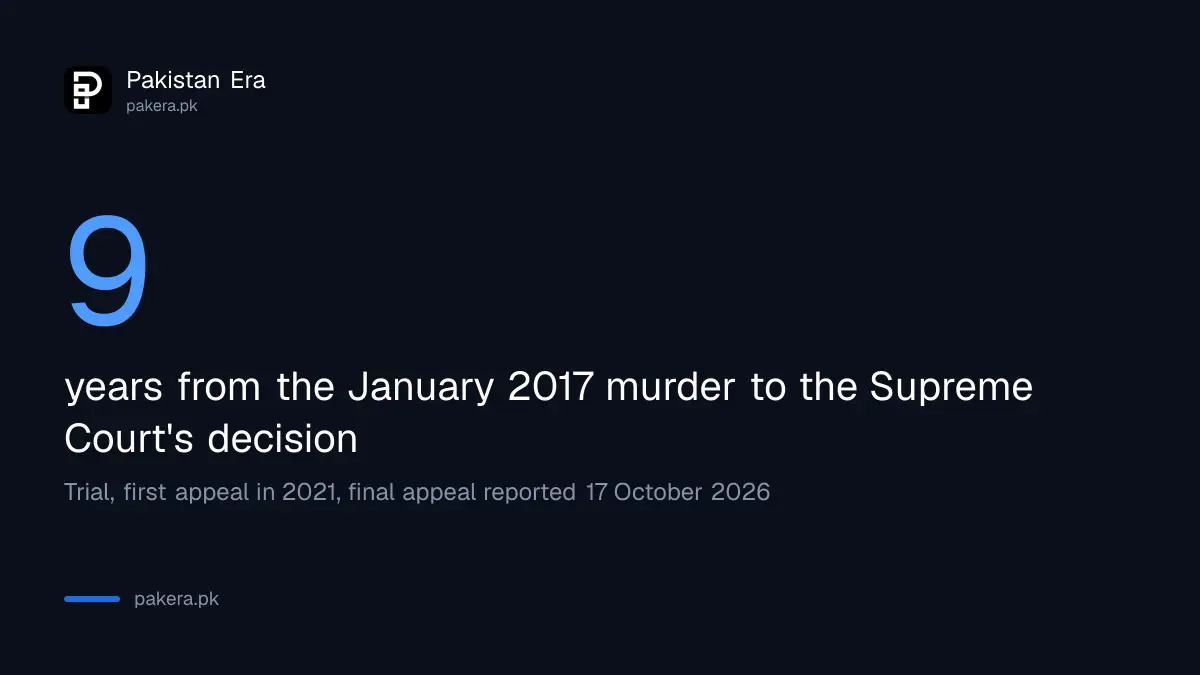
The case ran nine years, from a 2017 murder to a 2026 appeal
Sakhian Bibi was murdered on 11 January 2017. The trial court, an additional sessions judge at Minchinabad in Bahawalnagar district, convicted Muhammad Azhar and sentenced him to death, with Rs 200,000 compensation payable to the victim's legal heirs. On 13 September 2021 the Lahore High Court's Bahawalpur bench reduced the death sentence to life imprisonment.
Both sides then went to the Supreme Court. Azhar appealed against his conviction. The State filed a petition asking for the death sentence to be restored. The Supreme Court dismissed Azhar's appeal and kept the conviction. The reports we read do not say how the court dealt with the State's petition, so the final sentence is not confirmed here.
| Stage | Court | Date | Result |
|---|---|---|---|
| Murder | Minchinabad, Bahawalnagar | 11 January 2017 | Case registered |
| Trial | Additional sessions judge, Minchinabad | Not reported | Death sentence, Rs 200,000 compensation |
| First appeal | Lahore High Court, Bahawalpur bench | 13 September 2021 | Death reduced to life imprisonment |
| Final appeal | Supreme Court, three judges | Reported 17 October 2026 | Appeal dismissed, conviction upheld |
Nine years from crime to final appeal is not unusual in a murder case. The stages and time limits for each step are set out in how to appeal a criminal conviction in Pakistan and how to appeal to the Supreme Court.
Evidence must be weighed as a whole, not line by line
The court is reported to have told trial courts to weigh evidence cumulatively. A contradiction about whether three or four shots were fired is to be read against everything else: the medical report, the recovery of a weapon, the motive, the time the report was lodged. One mismatch does not cancel the rest.
This matters because the defence in a Pakistani murder trial often rests on exactly such mismatches. Cross-examination hunts for the witness who said "two shots" when the post-mortem shows three wounds, and then argues that the whole account falls. The Supreme Court has now said, in reported words, that courts should consider the natural limits of memory under stress before accepting that argument.
What this means for an accused, a complainant and a witness
For a complainant's family, a witness who gets a detail wrong is no longer an automatic loss. For an accused, the defence has to show that the contradictions go to the heart of the story, not its edges. For a witness, the lesson is simple: say what you remember and do not guess at numbers to sound certain.
- Read the witness statements recorded by the police before trial; you can get free copies of the FIR and witness statements under the criminal procedure code.
- List every contradiction between the statements, the FIR and the medical report, and sort them into "detail" and "substance".
- Expect the court to weigh "detail" contradictions, such as shot counts, against the rest of the evidence rather than on their own.
- Build the defence or the prosecution on the "substance" contradictions: presence at the scene, timing, motive, the weapon.
- If you are a witness, answer only what you saw; a guessed number is the easiest thing for the other side to attack.
Article 189 of the Constitution, which we read in the text published by the National Assembly, makes a Supreme Court decision binding on all other courts in Pakistan to the extent that it decides a question of law or sets out a principle of law. A lawyer will need the reported citation and the full text, which the Supreme Court publishes on its website once uploaded, to rely on it in court.
Common questions
What did the Supreme Court decide?
It dismissed Muhammad Azhar's appeal and upheld his conviction for the murder of Sakhian Bibi in 2017, as reported on 17 October 2026. The sentence outcome on the State's petition is not reported.
Does a wrong shot count make a witness unreliable?
Not on its own, according to the reported judgment. The court said such precision is an unnatural expectation and evidence must be read as a whole.
Who were the judges?
A three-judge bench headed by Justice Muhammad Hashim Khan Kakar; Justice Ishtiaq Ibrahim wrote the judgment. The third judge is not named in the report we read.
Is the full judgment available?
Not to us on 19 October 2026. The Supreme Court's judgment search pages were blocked. It will appear on the court's website once uploaded.
What is attentional tunnelling?
A term from memory research, cited in the reported judgment, for the way a person facing a weapon focuses on it and notices less of the surroundings.
Can this be used in a pending trial?
Yes, once the text is available. Supreme Court decisions bind all other courts in Pakistan under Article 189 of the Constitution.
How we verified this
What we checked, where we read it, and what we could not confirm.
Last checked 19 October 2026. The decision, the bench, the case history and the quoted lines come from a national daily's report of 17 October 2026, because the Supreme Court of Pakistan website judgment search and latest judgments pages returned access denied and a security block when we tried them, so everything about the ruling is reported. Article 189 on binding effect is from the Constitution text on the National Assembly website. We could not confirm the third judge, the judgment date, the case number or the outcome of the State's sentence petition, and we say so above. This is general information, not legal advice.
About the author

Global Affairs & Political Economy Writer
Muhammad Hatim is a book lover who started writing because he enjoys it. At Pakistan Era he writes about international relations, geopolitics and the global economy, with a particular interest in South Asia and the forces behind current events.