Supreme Court: A Shrine on Private Land in Punjab Does Not Make It Waqf, Auqaf Must Return Hafizabad Plot
The Supreme Court ruled a shrine over a grave on private land is not waqf and told Auqaf Punjab to return a Hafizabad plot within 30 days. What owners can do.
The Supreme Court of Pakistan has ruled that building a shrine over a grave on private land, and letting devotees visit and leave offerings, does not turn that land into waqf property. It declared the Punjab Auqaf Department's takeover of 5 kanals and 3 marlas in Hafizabad district illegal and ordered the land returned to its owner within 30 days. The judgment was reported on 24 November 2026.
For any family in Punjab that has buried a relative on its own land and built a mazar or shrine there, this is the rule that now matters: the land stays yours unless you permanently dedicated it for a religious or charitable purpose.
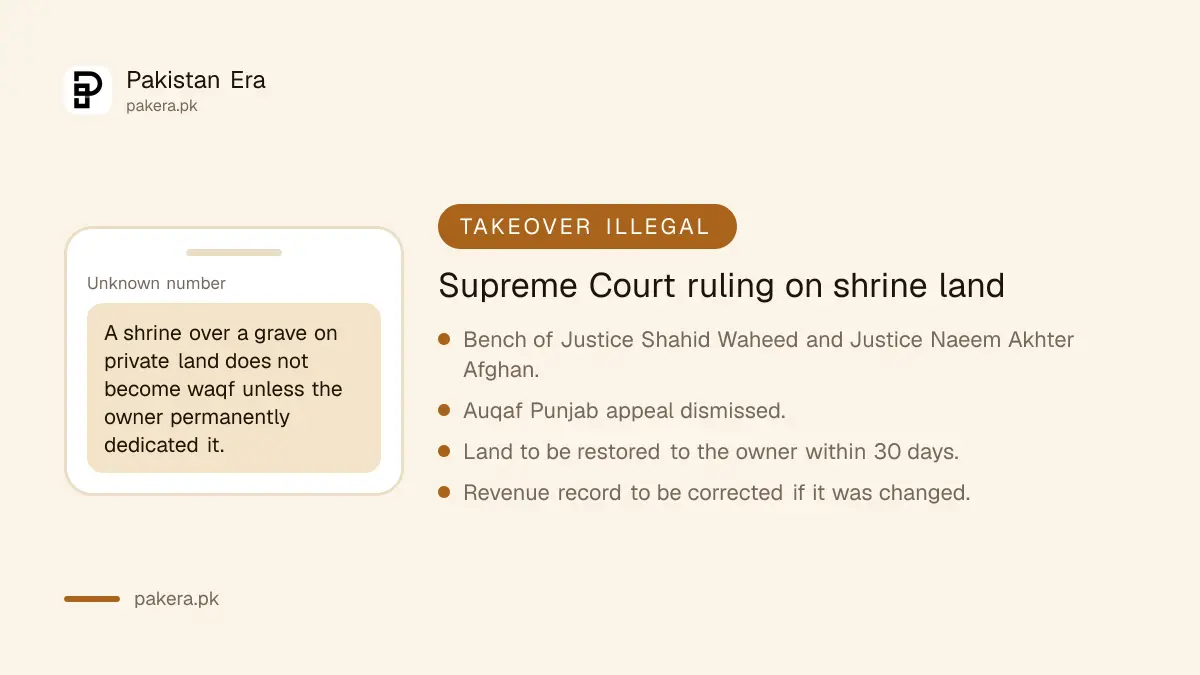
The Supreme Court ruled a shrine does not make private land waqf
The court held that a shrine on privately owned land does not become waqf property, even if the public visits and leaves offerings, unless the owner permanently dedicated it. Without proven waqf, the Auqaf Department had no power to take the land over.
A two-member bench of Justice Shahid Waheed and Justice Naeem Akhter Afghan dismissed an appeal by the Chief Administrator of Auqaf Punjab. Justice Shahid Waheed wrote the judgment. The appeal was against a Lahore High Court judgment that had already declared the Auqaf takeover notification illegal.
The land is in Tawaley Wali, Tehsil Pindi Bhattian, District Hafizabad. The Chief Administrator had issued a takeover notification in 2003 under section 7 of the Punjab Waqf Properties Ordinance 1979, covering the shrine and the whole plot.
How the Hafizabad land became a dispute
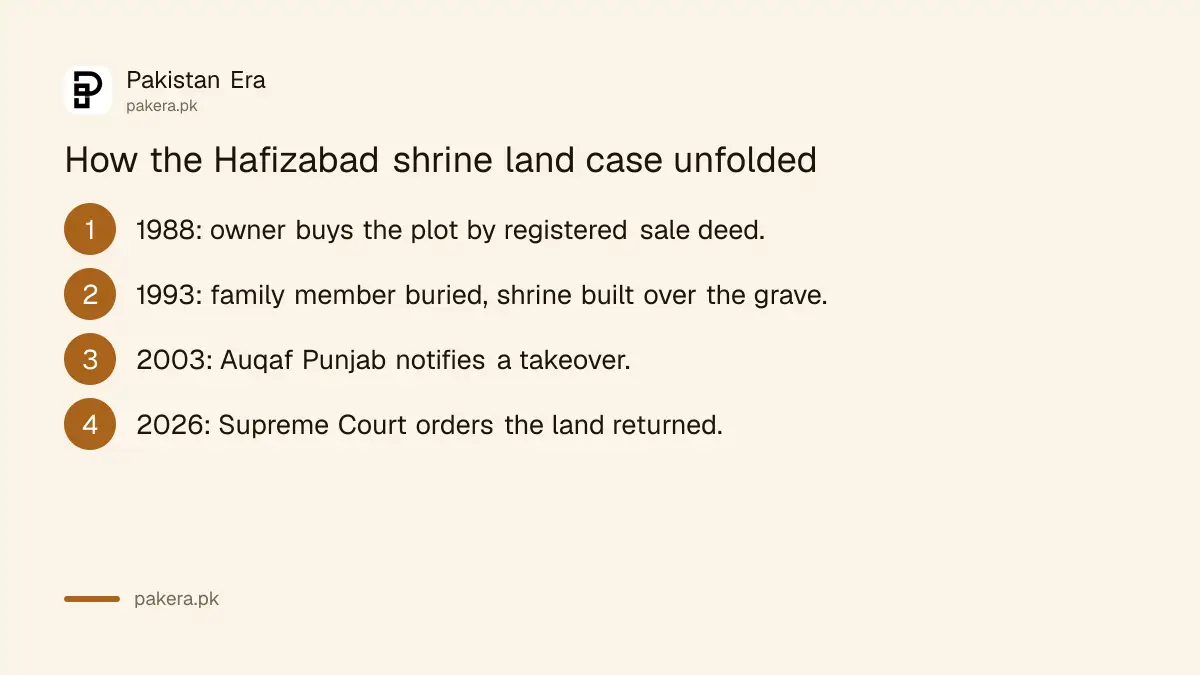
The owner bought the land by a registered sale deed in 1988. A family member was buried there in 1993 with permission, and a shrine was later built over the grave. Visitors began coming, and in 2003 Auqaf notified a takeover of the whole plot.
| Year | What happened |
|---|---|
| 1988 | Owner buys the 5 kanal 3 marla plot through a registered sale deed |
| 1993 | Family member buried on the land with permission, shrine built over the grave |
| 2003 | Chief Administrator Auqaf Punjab notifies takeover under section 7 of the 1979 Ordinance |
| Later | Lahore High Court declares the takeover notification illegal |
| November 2026 | Supreme Court dismisses the Auqaf appeal and orders the land returned within 30 days |
The court found the evidence showed neither a permanent dedication by the owner nor religious use of the land from time immemorial, the two ways the law recognises waqf in a case like this.
Permanent dedication is the test for waqf
Under section 2(e) of the Punjab Waqf Properties Ordinance 1979, land is waqf only if it has been permanently dedicated for a religious, pious or charitable purpose. A written deed is not required, but the intention to dedicate and give up ownership must be proved.
The court set out what does and does not prove waqf:
- Not enough on its own: a grave, a shrine built over it, public visits, offerings, or the words shrine or darbar in the revenue record.
- Can prove waqf: a written deed of dedication, an oral declaration, or conduct that clearly shows the owner gave the land away permanently for a religious or charitable use.
- Required before takeover: the property must first be waqf. The Chief Administrator cannot gain the power to take over simply by declaring private land to be waqf.
The court also ordered the revenue authorities to correct the land record if any entry had been changed because of the takeover notification.
What landowners with a shrine or family grave should do
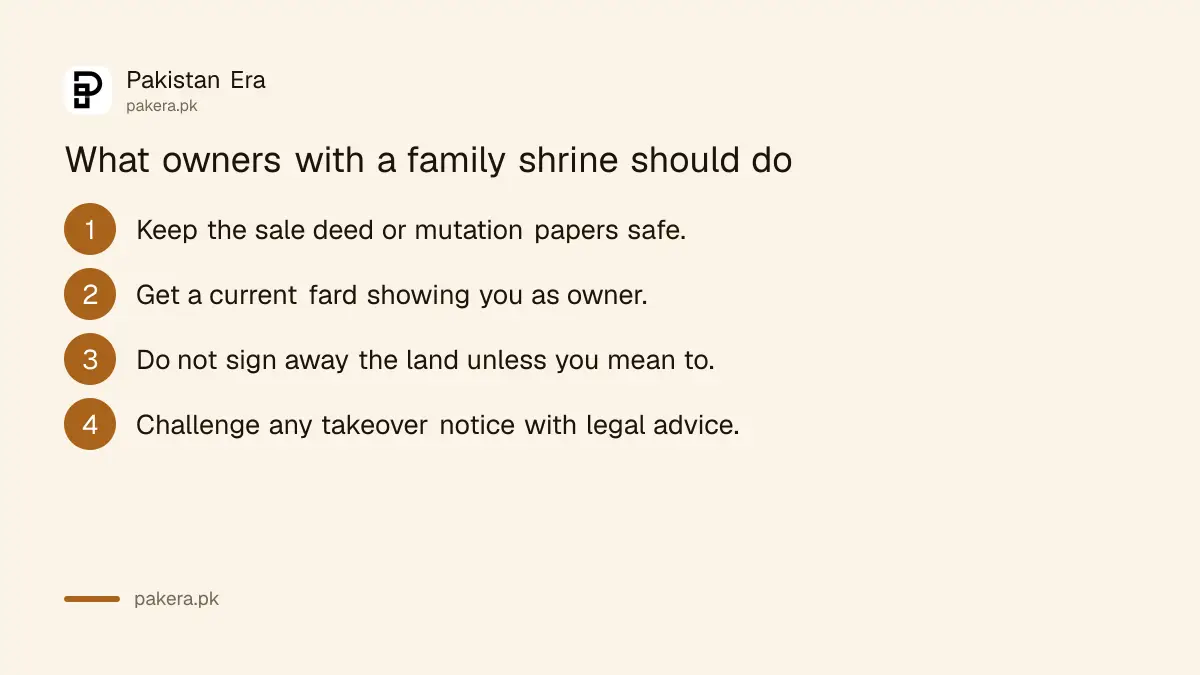
Keep your title papers safe and make sure the land record shows you as owner. If Auqaf issues a takeover notice, you can challenge it, and this ruling puts the burden on the department to prove a permanent dedication.
- Keep the registered sale deed, inheritance mutation or other title document in a safe place, with copies.
- Get a current fard to confirm your name is in the ownership column. The steps to get a fard online in Punjab work for most districts.
- Check whether the record shows a shrine or darbar entry. The guide to reading a fard, khewat and khasra explains each column.
- Avoid signing any paper, or making any public statement, that gives the land to the shrine permanently unless you mean to.
- If you receive a section 7 takeover notification, take legal advice quickly and cite this Supreme Court judgment in the Chief Administrator Auqaf Punjab appeal from Hafizabad.
Shrines that Auqaf already manages lawfully are not affected. Visitor services at those shrines are listed in the page on Punjab Auqaf shrine facilitation desks.
What the ruling does not change
The ruling does not stop anyone from dedicating land as waqf by choice. It also does not hand back shrines that were properly dedicated or used for religious purposes from time immemorial. Each takeover still turns on its own evidence.
It applies the Punjab Waqf Properties Ordinance, so its direct effect is in Punjab. Other provinces have their own waqf laws, though courts there may look at the Supreme Court's reasoning on permanent dedication.
Common questions
Does a grave on my land make it waqf property?
No. The Supreme Court said a grave, a shrine over it, and public visits do not make private land waqf. Only a permanent dedication by the owner, or religious use from time immemorial, does.
Can Auqaf take over a shrine on private land in Punjab?
Only if the land is proved to be waqf. The court said the Chief Administrator cannot take over private land just by declaring it waqf in a notification.
Is a written waqf deed needed?
No. Dedication can be proved by an oral declaration or by conduct. But the intention to dedicate and to give up ownership must be shown.
How long does Auqaf have to return the Hafizabad land?
The court gave the Chief Administrator of Auqaf Punjab 30 days from receiving the judgment to restore possession, control and administration to the owner.
Does the word darbar in the land record prove Auqaf ownership?
No. The court said a mention of a shrine or darbar in the revenue record does not by itself establish that the land belongs to Auqaf.
How we verified this
What we checked and where we read it.
This report covers the Supreme Court of Pakistan judgment in the appeal of the Chief Administrator Auqaf Punjab over the Hafizabad shrine land, written by Justice Shahid Waheed and made public on 24 November 2026. The bench, the 30-day order, the 1988 sale, the 1993 burial and the section 2(e) test are as consistently reported by the state news agency and national outlets on 24 November 2026. The legal test is from section 2(e) and section 7 of the Punjab Waqf Properties Ordinance 1979. The Punjab Auqaf and Religious Affairs Department is the respondent authority. Last checked 25 November 2026.
About the author

Global Affairs & Political Economy Writer
Muhammad Hatim is a book lover who started writing because he enjoys it. At Pakistan Era he writes about international relations, geopolitics and the global economy, with a particular interest in South Asia and the forces behind current events.