Google's Free SynthID Detector Now Checks AI Photos and Videos in Pakistan
Google opened SynthID Detector to everyone on 7 October 2026. Check if a photo, video or voice note was made by Google or OpenAI AI, free, and what it misses.
Google opened its SynthID Detector to everyone on 7 October 2026. It is a free website, synthid.com, where anyone in Pakistan can upload a photo, video or audio clip and check if it carries the hidden watermark that Google, OpenAI, NVIDIA and Kakao put into AI-made media. It works in English for now.
A fake video of a politician, a cloned voice note from a "relative" asking for money, a photo of a flood that never happened. These now reach Pakistani family WhatsApp groups every week. Until this week, there was no simple public tool to check whether a big AI company made a file.
We read Google's announcement and the SynthID Detector page on 9 October 2026. Here is what the tool checks, how to use it, and where it falls short.
Google's SynthID Detector is now open to the public worldwide
Google DeepMind launched SynthID Detector as a standalone website on 7 October 2026. Google says it is free, open to the general public and to journalists, and launched globally in English. Pakistan is not excluded, so Pakistani users can use it today.
SynthID is a watermark. When a partner company's AI makes an image, video or sound, SynthID hides a signal inside the pixels or the audio. People cannot see or hear it. The detector looks for that signal.
Google says it has watermarked more than 180 billion images and videos since SynthID started in 2023, plus about 240,000 years of audio. It also says the checks already built into Google Search, the Gemini app and Chrome handle more than 1 million requests a day. The new website puts the same check in one place, for anyone.
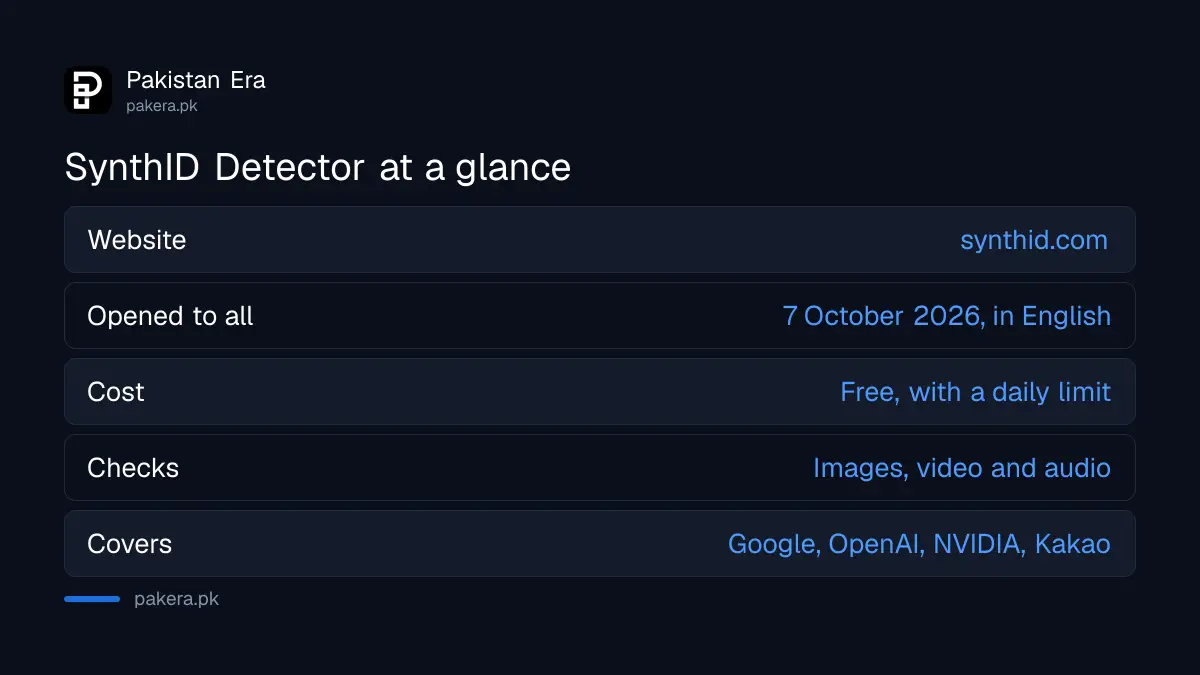
| Detail | What Google says |
|---|---|
| Website | synthid.com |
| Launched to everyone | 7 October 2026, globally, in English |
| Cost | Free |
| Media it checks | Images, video and audio |
| Companies it covers | Google, OpenAI, NVIDIA and Kakao, with Apple "soon" |
| Limit | A daily usage quota per user, number not published |
The detector only finds media from five companies' AI tools
SynthID Detector is not a general AI detector. It can only spot media made by companies that use the SynthID watermark. Today that is Google, OpenAI, NVIDIA and Kakao. Google says Apple will join soon. Media from other AI tools will not show up.
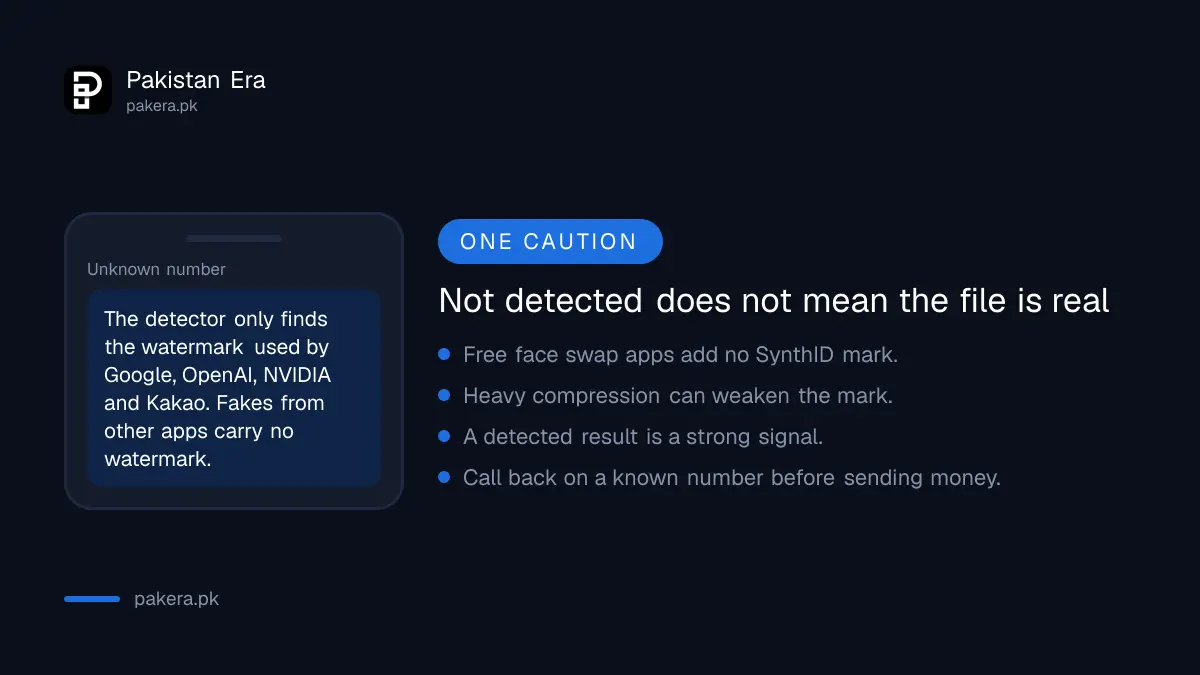
The site says this in plain words: "This is not a general AI detector." So a fake made with an open-source app on someone's laptop will come back as "not detected", even if it is completely fake.
That matters in Pakistan. Many scam videos are made with free face-swap apps and voice-cloning tools that do not add any watermark. A clean result does not mean the video is real. It only means none of these companies' tools made it, or that the mark was damaged.
A positive result is much stronger. If the detector finds the watermark, the file was very likely made or edited by one of those companies' AI models.
How to check a photo, video or audio clip in Pakistan
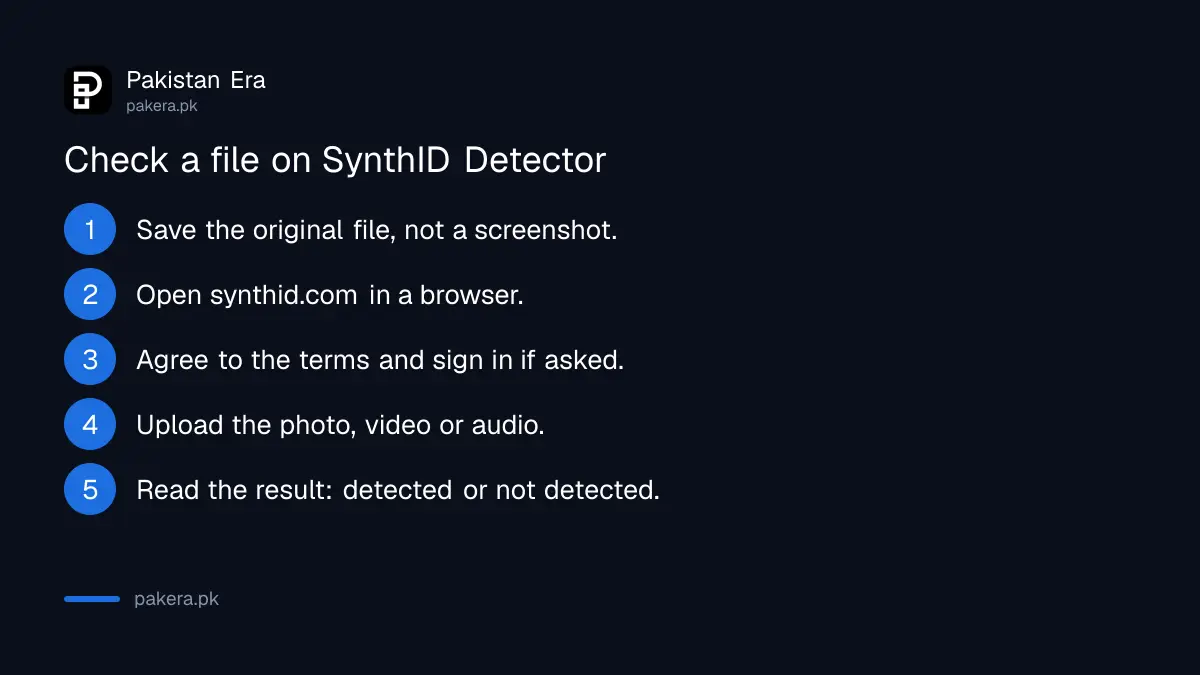
Open synthid.com in a browser, accept the terms, upload the file, and read the result. It takes a few seconds. Use the original, best-quality file you have, because heavy compression can weaken the watermark.
- Save the file you want to check. On WhatsApp, open the photo or video and use the save or download option, so you have the actual file and not a screenshot.
- Open synthid.com in Chrome, Safari or any modern browser on your phone or computer.
- Read the terms and tap "Agree and continue". You may be asked to sign in, because Google applies a daily limit to each user.
- Upload the file. The page accepts images such as JPG, PNG, WEBP and HEIC, videos in MP4, MOV and WEBM, and audio in MP3, WAV, OGG, FLAC, AAC and M4A.
- Read the result: "watermark detected" or "not detected". For video and audio, it marks the parts that carry the watermark.
One practical tip for WhatsApp users. A forwarded video has often been squeezed several times. If you can, ask the sender for the original, or find where it was first posted. A cleaner copy gives a more reliable answer.
Google's privacy notice says uploaded files are deleted as soon as the result is shown. It keeps a digital signature of the file for 24 hours to enforce the daily quota, then deletes that too.
A "not detected" result does not prove a file is real
"Not detected" means no confident watermark was found. The file could still be AI-made by a tool outside the partner group, or edited so heavily that the mark broke. Google itself advises collecting more evidence before deciding.
Google lists two main reasons for a false "not detected":
- The file was made by a model without SynthID, either from a company that is not a partner or before that company adopted it.
- Heavy changes, such as many rounds of compression, cropping or filters, weakened the signal.
It also says that in very rare cases the detector can wrongly flag a file that has no watermark. So treat the result as one strong clue, not a court verdict.
For a video call or voice note asking for money, the detector is not the first step. Call the person back on a number you already have. The warning signs of a cloned voice or face swap are set out in how to spot a deepfake scam video or cloned voice call, and they work even when no tool can help.
Who in Pakistan should use SynthID Detector
The tool is most useful for journalists, teachers, shop owners and anyone who runs a big family or community WhatsApp group. It answers one narrow question well: did a major AI tool make this file?
Some everyday uses:
- Viral photos: a dramatic picture of a disaster, a protest or a celebrity before you forward it.
- Product photos: an online seller's "real" photo that looks too perfect.
- Student work: an image a student hands in as their own photography.
- Voice notes: an audio clip that sounds like a famous person saying something shocking.
Images made with ChatGPT carry the SynthID watermark, since OpenAI is a partner. That includes pictures from the new GPT-6 rollout to free ChatGPT users. Images from Gemini carry it too.
For screenshots of payments, the detector is the wrong tool. Fake payment screenshots are usually edited by hand, not made by AI, so you need to check your own bank or wallet app. The steps are in verify a payment before you hand over goods.
Common questions
Is SynthID Detector free in Pakistan?
Yes. Google says the detector is free for everyone and launched globally on 7 October 2026. There is a daily usage limit per user, but Google has not published the number.
Can SynthID Detector tell if any photo is AI-made?
No. It only finds the watermark used by Google, OpenAI, NVIDIA and Kakao. Media from other AI tools will show "not detected" even if it is fake.
Does it work in Urdu?
Not yet. Google launched it in English. The file check itself works on any photo, video or audio, whatever language is spoken in it.
Does Google keep the files I upload?
Google says uploaded files are deleted once the result is shown. It keeps a digital signature of the file for 24 hours to enforce the daily limit, then deletes it.
Can I check a WhatsApp video with it?
Yes, if you save the video as a file first. MP4, MOV and WEBM are accepted. A heavily forwarded video may give a weaker result, so use the best copy you can find.
How we verified this
What we checked, where we read it, and what we could not confirm.
We checked on 9 October 2026. The launch date, the global and English-only availability, the partner list and the watermark figures are from Google's announcement, We're making it easier to identify AI-generated content globally, dated 7 October 2026. The file types, how to read the result, the limits and the privacy notice are from the SynthID Detector page itself. We opened the detector page but did not upload a test file, and Google has not published the size of the daily quota.
About the author

Technology Journalist & Multimedia Producer
Ahmad Ali is a technology journalist and multimedia producer at Pakistan Era, joining the team in October 2026. He covers consumer technology and digital life for Pakistani readers, combining research with hands-on product testing.