US Proposes Tariffs on 14 Economies: Pakistan Not on List, Bangladesh and India Are
USTR proposed tariffs of up to 35% on 14 economies on 25 November 2026, including Bangladesh, India and Vietnam. Pakistan is not on the list. Dates and rates.
یہ صفحہ اردو میں پڑھیں
Short answer: On 25 November 2026 the US Trade Representative (USTR) proposed new tariffs on 14 economies, from up to 15 per cent for the EU and Japan to up to 35 per cent for Vietnam. Pakistan is not on the list. Bangladesh (up to 18 per cent), India (up to 25 per cent) and Vietnam, three of Pakistan's biggest rivals in clothing and home textiles, are. Nothing changes for Pakistani goods today. They still pay the 10 per cent Section 301 duty that started on 24 July 2026.
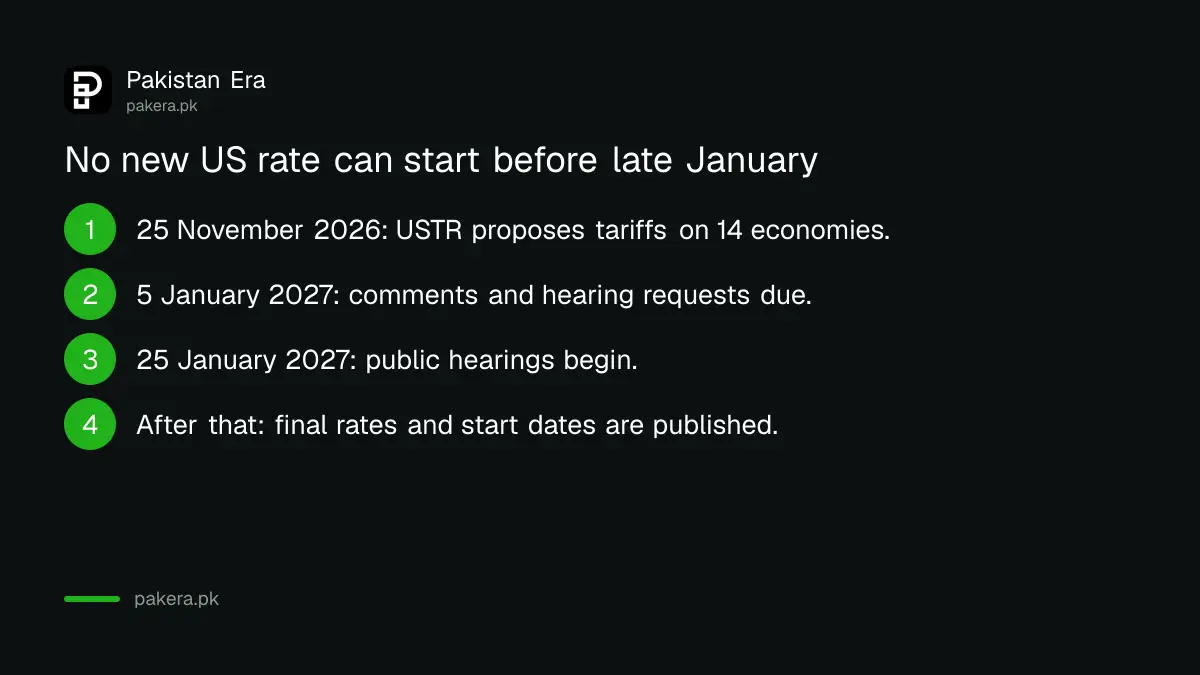
These are proposals, not final duties. USTR takes written comments until 5 January 2027 and holds public hearings from 25 January 2027. So no new rate can start before late January.
The US named 14 economies, and Pakistan is not one of them
USTR found that 14 economies build too much factory capacity through state support, cheap credit and weak labour protection, and that this hurts US makers. The 14 are China, the EU, Singapore, Switzerland, Indonesia, Malaysia, Cambodia, Thailand, Korea, Vietnam, Taiwan, Bangladesh, Japan and India.
The legal tool is Section 301 of the US Trade Act of 1974. It lets the US answer foreign practices that it calls unfair. USTR opened these "structural excess capacity" cases on 11 March 2026 against 16 economies. Pakistan was never one of the 16. Mexico and Norway were, but USTR made no finding on them this time.
We checked the full list in USTR's release and each country entry. Pakistan does not appear anywhere in the action.
Proposed rates run from 15 to 35 per cent
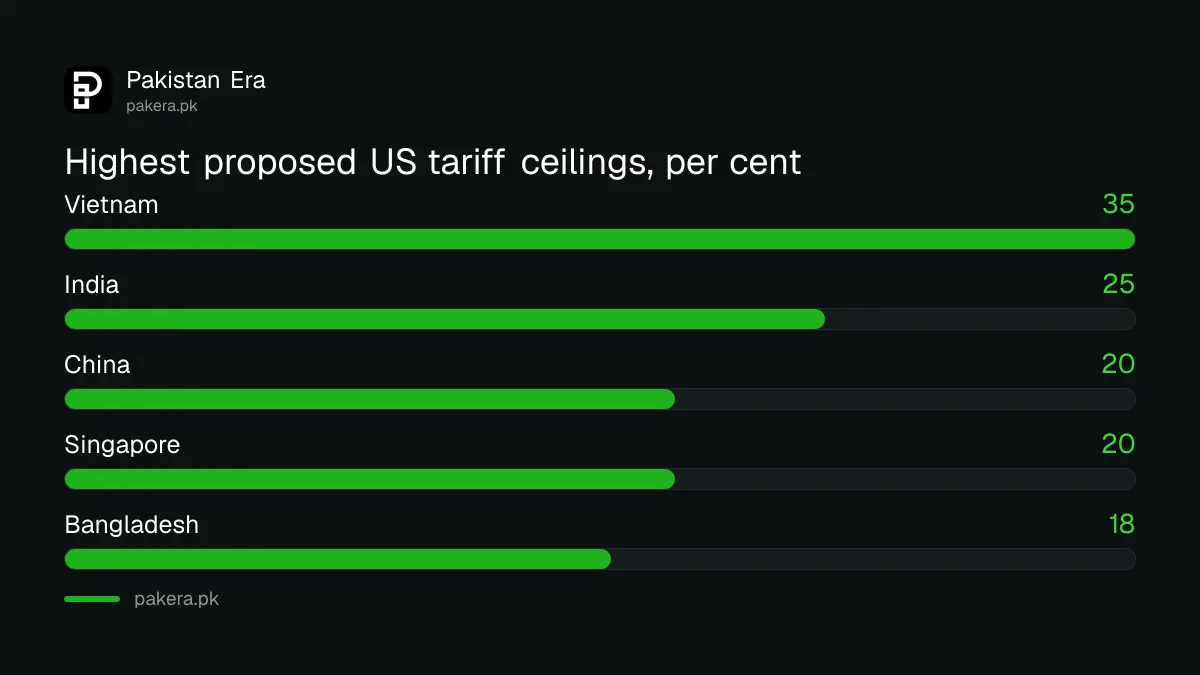
Every rate in the proposal is a ceiling ("up to"). USTR says each one takes account of Section 301 duties already in place and of the trade deals some countries have signed. Several countries get a lower rate if they sign or keep a deal with the US.
| Economy | Proposed tariff on its goods | Sectors USTR singled out |
|---|---|---|
| Vietnam | Up to 35% (20% with a new deal) | Textiles, apparel, footwear, ships, cement |
| India | Up to 25% (17% with a new deal) | Pharmaceuticals, steel, solar, ICT |
| China | Up to 20% | Steel, solar, textiles, electronics and 18 more |
| Singapore | Up to 20% (10% with a new deal) | Electronics, health, petrochemicals |
| Bangladesh | Up to 18% (up to 20% if talks fail) | Ready-made garments and apparel |
| Cambodia | Up to 18% | Apparel, solar, tyres |
| Indonesia | Up to 18% | Textiles and apparel, metals |
| Malaysia | Up to 18% | ICT, automotive |
| Thailand | Up to 18% | Electronics, cars, machinery |
| EU, Japan, Korea, Switzerland, Taiwan | Up to 15% | Cars, chips, steel, pharmaceuticals |
The Bangladesh notice, for example, exempts goods already under US Section 232 tariffs, books and other informational material, donations and travellers' baggage.
Pakistan's clothing rivals face the biggest proposed rates
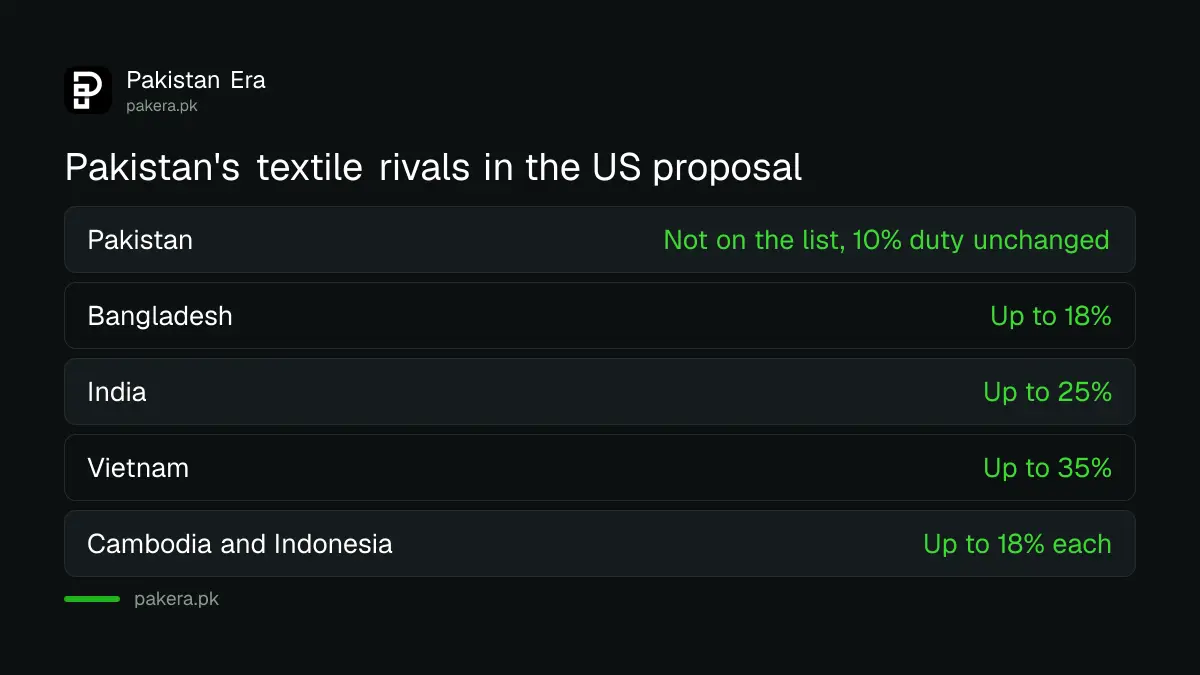
Bangladesh, Vietnam, India, Cambodia and Indonesia all sell the same cotton clothing, towels and bed linen that Pakistan sells in the US. USTR's own text names apparel or textiles for four of them. If these duties start, US buyers may look for cheaper sources, and Pakistan is not on the list.
That is an opening, not a promise. Three things can shrink it:
- The rates are ceilings. Countries in talks with Washington, Bangladesh and India among them, can end up much lower.
- USTR's notice for Bangladesh asks for views on a "textile mechanism", a set volume of clothing that would enter at a lower Section 301 rate. If it is set up, that clothing gets cheaper again.
- Pakistan already pays its own Section 301 duty of 10 per cent, set in the separate forced labour case. The 10 per cent US duty on Pakistani goods covers most products, with some exemptions.
The US is a large market for Pakistan
USTR estimates that the US bought $5.4 billion of Pakistani goods in 2025, up 5.9 per cent on 2024. It sold Pakistan $3.1 billion. Total goods and services trade between the two came to about $11.5 billion. Those figures are on USTR's Pakistan country page.
The full breakdown is in US trade with Pakistan in 2025. Pakistan's own figures for the last financial year are in Pakistan's trade with America in FY26.
The timetable runs to late January 2027
Nothing in the proposal is charged yet. USTR first takes comments, then holds hearings, then decides. Any final tariff would come in a later notice in the US Federal Register, with its own start date.
- 25 November 2026: USTR publishes its findings and proposed tariffs for 14 economies.
- 5 January 2027: deadline for written comments and for requests to speak at the hearings, through USTR's comments portal.
- 25 January 2027: public hearings begin in Washington and continue as needed.
- After the hearings: USTR decides final rates and publishes them, with a start date.
What Pakistani exporters should do now
Keep shipping on current terms. The 10 per cent duty still applies, and no new charge has been added. Use the next eight weeks to talk to buyers who source from Bangladesh, Vietnam or India, and to price offers for the period after January.
- Ask your US buyers whether they plan to move orders out of the countries on the list. Some will wait for the final rates.
- Price for the current duty only. Do not quote on a guess about what rivals will pay.
- Check your product is not on a Section 232 list, which works under different rules.
- Keep clear origin papers. A US duty attaches to the country of origin, and goods routed through a listed country can be treated as that country's goods.
- If you sell to Europe as well, the EU GSP Plus rules from 2027 matter just as much for next year's prices.
Anyone, including a Pakistani company or trade body, can file a comment on USTR's portal. The Bangladesh case, for example, takes comments in docket USTR-2026-0727.
Common questions
Will Pakistani goods pay a new US tariff from January?
Not under this action. Pakistan is not one of the 14 economies named on 25 November 2026. Pakistani goods still pay the 10 per cent Section 301 duty in force since 24 July 2026.
Why is Pakistan not on the list?
Pakistan was not one of the 16 economies USTR investigated for excess factory capacity in March 2026. You cannot be named in a case that was never opened against you.
Does this mean US orders will move to Pakistan?
Possibly, for some clothing and home textiles, if the duties start at or near the proposed ceilings. But rates may fall after talks, and a textile quota could help rivals. No order shift is guaranteed.
When could the new tariffs start?
Not before the comment period ends on 5 January 2027 and hearings begin on 25 January 2027. USTR has to publish a final notice with a start date after that.
Can a Pakistani exporter comment on the proposal?
Yes. USTR invites comments from any interested person through its online portal, by 5 January 2027. Each economy has its own docket number, listed in its Federal Register notice.
Is the 10 per cent duty on Pakistan changing?
No. This proposal does not touch it. That duty comes from a separate Section 301 case on forced labour import bans, and it stays as it is.
How we verified this
What we checked and where we read it.
We checked these official sources on 27 November 2026:
- USTR press release of 25 November 2026, "USTR Makes Determinations and Proposes Actions in 14 Section 301 Investigations Relating to Structural Excess Capacity and Production in Manufacturing Sectors", on ustr.gov: the 14 economies, every proposed rate, the sectors named, the 5 January and 25 January 2027 dates, and the 16 economies investigated from 11 March 2026.
- USTR's pre-publication Federal Register notice for Bangladesh: the docket numbers, the up to 20 per cent fallback rate, the exemption list and the textile mechanism question.
- USTR's Pakistan country page for the 2025 trade figures.
The proposal says each rate is set "net of" existing Section 301 tariffs. How that works for each product will be clear only in the final notices, so this page does not add the old and new rates together.
Free on WhatsApp
Get the next change first on WhatsApp
Price changes, new rules and deadlines that affect your money, in a few short posts a day.
Follow Pakera on WhatsAppOther followers cannot see your number.
About the author

Global Affairs & Political Economy Writer
Muhammad Hatim is a book lover who started writing because he enjoys it. At Pakistan Era he writes about international relations, geopolitics and the global economy, with a particular interest in South Asia and the forces behind current events.