The US Visa Bond of Up to $20,000 Does Not Apply to Pakistan, and Here Is the Detail
The State Department's visa bond took effect 1 August for 50 countries. Pakistan is not one. What the program is and who it actually covers.
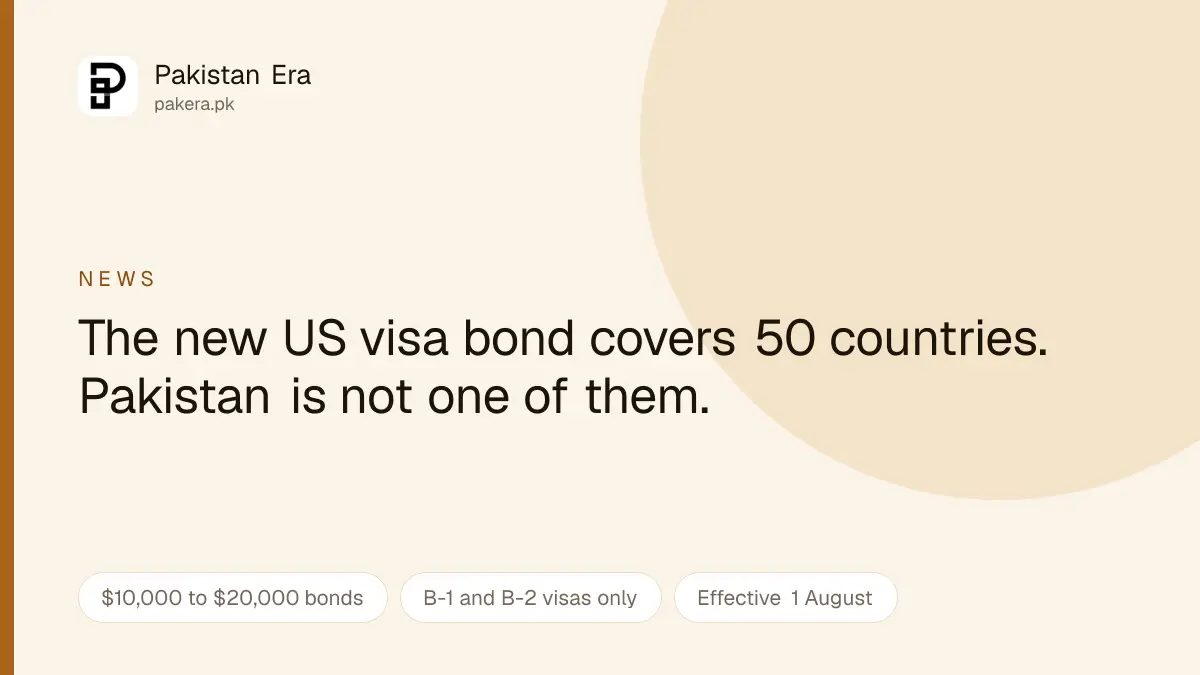
A new American rule letting visa officers demand a deposit of up to $20,000 took effect on 1 August, and the screenshots circulating in Pakistani WhatsApp groups have predictably skipped the one detail that matters here: Pakistan is not on the list.
We read the program's actual shape so you can stop at the facts rather than the forwards.
What the program is
The State Department ran a pilot in 2025 under which consular officers could require a refundable financial bond from some visitor visa applicants. The pilot, in the department's words, significantly reduced overstays and improved compliance, so it has been made permanent, effective 1 August 2026.
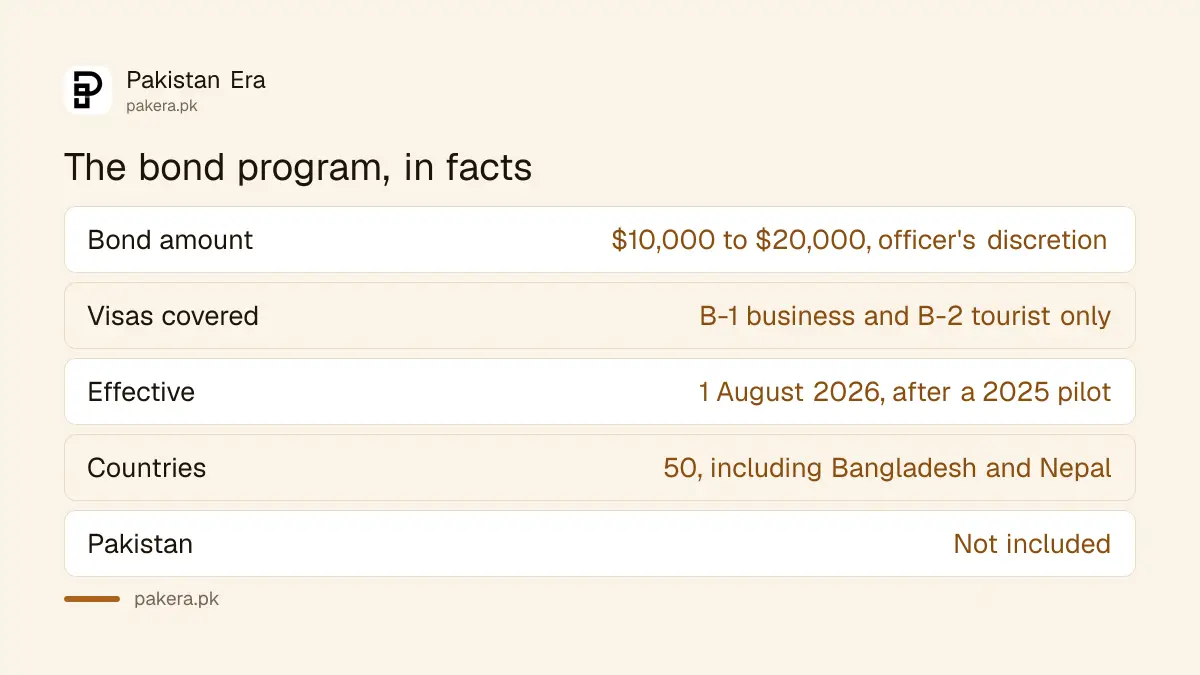
| Element | Detail |
|---|---|
| Bond amount | $10,000 to $20,000, with the ceiling recently raised from $15,000; the pilot floor was $5,000 |
| Visas covered | B-1 business and B-2 tourist only |
| How it is applied | Case by case, at the consular officer's discretion, not automatically |
| Refund | Returned if you leave before your authorised stay ends; forfeited if you overstay |
| Countries | 50, including Bangladesh and Nepal in South Asia; India is not on it either |
So even inside the 50 countries, this is not a fee on every applicant. It is a lever an officer can pull where they judge overstay risk high, and money you get back by following the rules.
What it means for a Pakistani passport
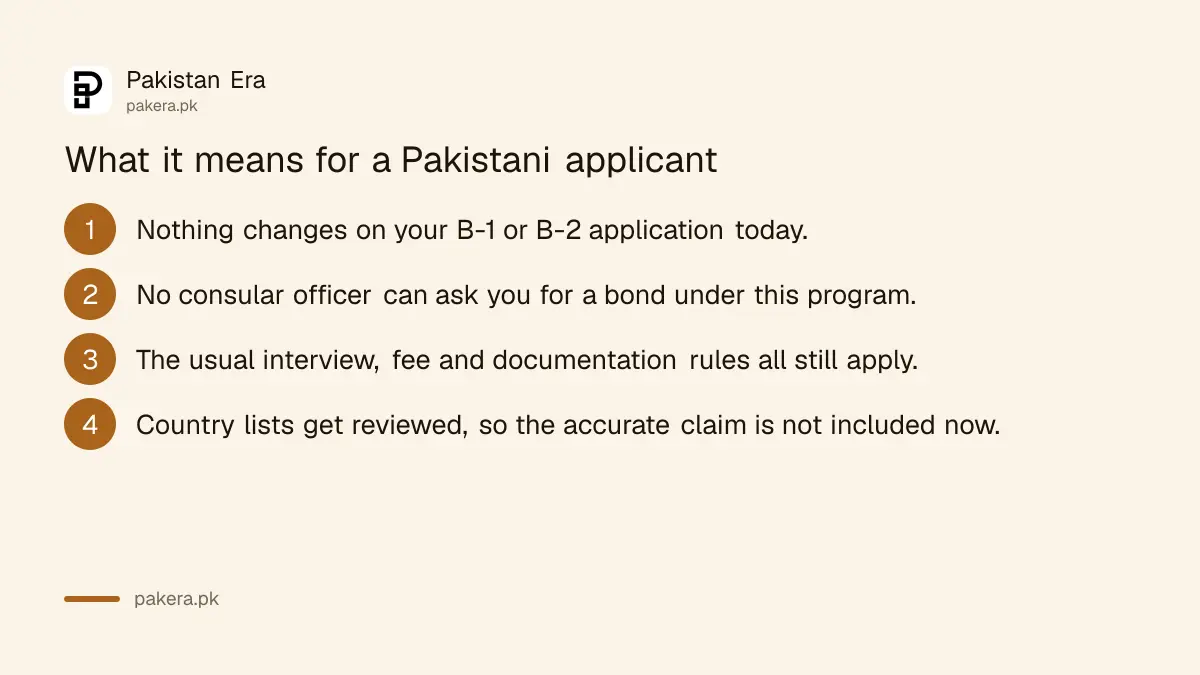
Nothing, today, and it is worth being precise about the word.
A Pakistani applying for a B-1 or B-2 visa faces exactly the process that existed in July: the DS-160, the fee, the interview, the documentation of ties, and the officer's ordinary discretion to approve or refuse. No officer can require a bond from a Pakistani applicant under this program, because the program's authority extends only to its listed countries.
The honest caveat is one sentence: country lists get reviewed, and "not included" means not included now, not exempt forever. If the list changes, the change will be announced formally, not through a WhatsApp forward, and we will cover it when it is real.
Why Pakistan is not on it, as far as the record shows
The department has not published a country-by-country rationale, so anything definitive would be invented, and we will not. What the design tells you is that the list is built around visitor-visa overstay data, and inclusion follows those numbers rather than diplomatic warmth: Bangladesh and Nepal are on it while India and Pakistan are not, a split that tracks no political alignment.
What we can say is what this is not: it is not a ban, not a fee increase for anyone, and not a change to student, work or immigrant visa categories anywhere. Those have their own rules, and for Pakistani students the current position is the one we documented in the US student visa rules guide.
Why the bond model exists at all
A refundable deposit is immigration policy borrowed from economics: instead of refusing risky-looking applicants outright, the system prices the risk and hands the money back when the traveller behaves. The State Department's own reading of the pilot, that overstays fell significantly among bonded travellers, is why the tool graduated to a permanent program.
For countries on the list, that cuts both ways. It keeps a door open that might otherwise have closed, and it also puts legitimate travel behind a five-figure deposit that many honest applicants simply cannot park for months. Pakistan being off the list means Pakistani applicants face neither the barrier nor the backstop, and the visa interview carries the whole weight, exactly as before.
The practical read for travellers
- Applying for a US visit visa? Proceed as before. Nothing about your application changed on 1 August.
- Seen a forward saying Pakistanis must deposit $20,000? It is wrong, and now you know precisely why.
- Travelling on other routes? The paperwork that actually gates most journeys from Pakistan is closer to home: a passport in date, which tracks by one SMS, and for the Gulf corridor, the visa rules we covered for the UAE, which resumed visit visas this week.
- If a bond ever does apply to you in a listed country's consulate, it is paid through official channels named by the consulate, never to an agent promising to arrange it.
That last line is the standing rule for every announcement like this one. Within days of any visa news, the agent market repackages it as urgency, and the defence is the one that works on every scam we document: verify on the official source, act through official channels, and treat anyone rushing you as the warning itself.
Questions readers are asking
Does the US visa bond apply to Pakistan?
No. Pakistan is not among the 50 countries covered by the program that took effect on 1 August 2026. Applications from Pakistan proceed under the unchanged normal process.
What is the bond amount?
$10,000 to $20,000 at the consular officer's discretion, for applicants from listed countries only, on B-1 and B-2 visas. It is refunded on compliant departure.
Which nearby countries are included?
In South Asia, Bangladesh and Nepal are on the list. India, like Pakistan, is not.
Does this affect US student or work visas?
No. The program covers B-1 business and B-2 tourist visas only. Student and work categories run under their own rules.
Could Pakistan be added later?
Lists of this kind are reviewed, so the accurate statement is that Pakistan is not included now. Any addition would be announced formally, and this page will be updated if that happens.
Is every applicant from a listed country charged the bond?
No. Officers impose it case by case where they judge the risk warrants it, so even within the 50 countries many applicants are never asked for one.
About the author

Public Services and Education Journalist
Fajr Riaz is a journalist and content writer at Pakistan Era, based in Lahore. She covers the questions people meet in everyday life in Pakistan: how a public service works, what a change in the rules means, and where to find a reliable answer.