Vehicle Registration Terms in Pakistan: HPA, HPT, LTT, CVT and Form F Explained
What HPA, HPT, LTT, MVT, CVT, Form F, Form T.O., ETO, MVE and PSID mean on a Pakistani registration book or excise challan, with the fees that go with them.
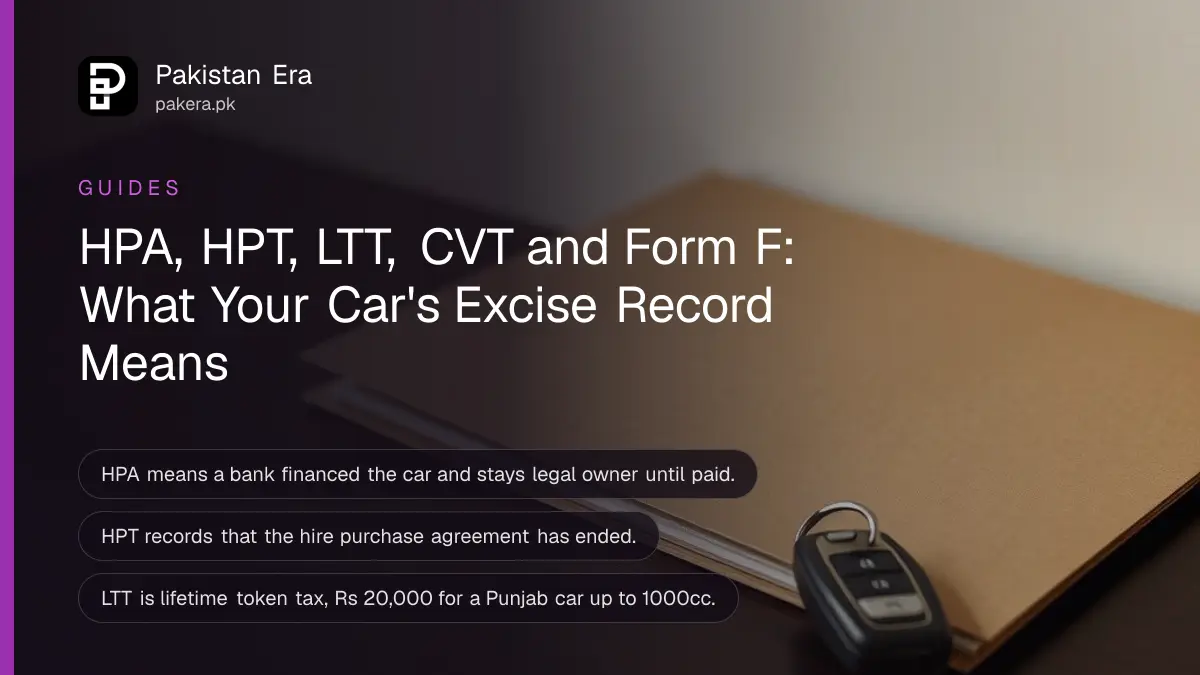
HPA means Hire Purchase Agreement, the bank's lien recorded on a financed vehicle. HPT means Hire Purchase Termination, the entry that removes it. LTT is Lifetime Token Tax, CVT is Capital Value Tax and MVT is Motor Vehicle Tax, the yearly token tax. Form F is the registration application and Form T.O. is the transfer order.
These short forms appear on registration books, smart cards, excise challans and fee tables across Pakistan. Most buyers meet them for the first time at the excise counter, which is the worst moment to learn. The table below gives every common term, what it means and where you see it.
| Term | Full form | What it means for you |
|---|---|---|
| HPA | Hire Purchase Agreement | A bank or leasing company financed the car and is recorded as its legal owner until paid off |
| HPT | Hire Purchase Termination | The lien has been removed after full payment |
| LTT | Lifetime Token Tax | Token tax paid once for the vehicle's life, for bikes and small cars |
| MVT | Motor Vehicle Tax | The yearly token tax |
| CVT | Capital Value Tax | A tax on the value of some vehicles, listed in Punjab's Excise rates |
HPA and HPT show whether a bank still owns the car
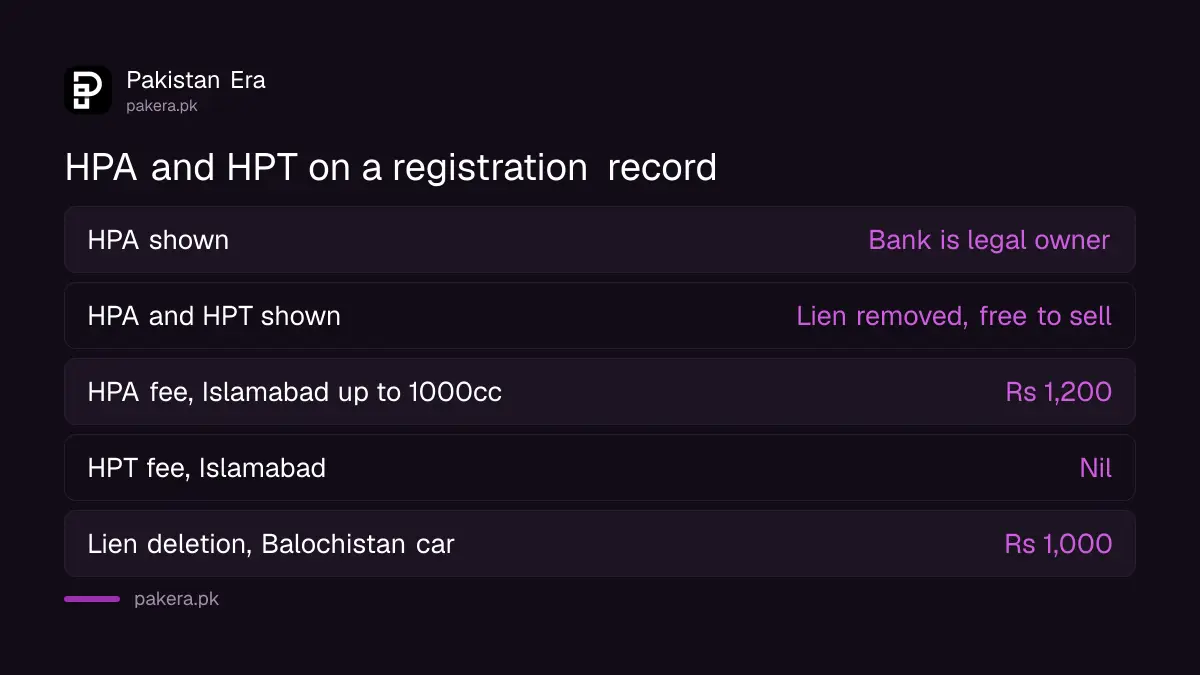
HPA on a registration record means the vehicle was bought on bank finance and the lender is recorded as legal owner until the loan is paid. HPT means the agreement has been terminated and the lien lifted. A car showing HPA without HPT cannot be sold cleanly.
Islamabad Excise explains that Section 51 of the Motor Vehicles Ordinance 1965 covers vehicles under hire purchase, lease or hypothecation. The registering authority records the agreement on the registration certificate. The financier stays the legal owner until full payment, then sends the authority an NOC.
Islamabad charges an HPA fee of Rs 1,200 up to 1000cc, Rs 2,000 for 1001cc to 1800cc and Rs 3,000 above that, and no fee for HPT. Balochistan charges a hire purchase deletion fee of Rs 1,000 for a car. Removing the lien is set out in removing a bank lien in Islamabad and removing a bank lien in Punjab.
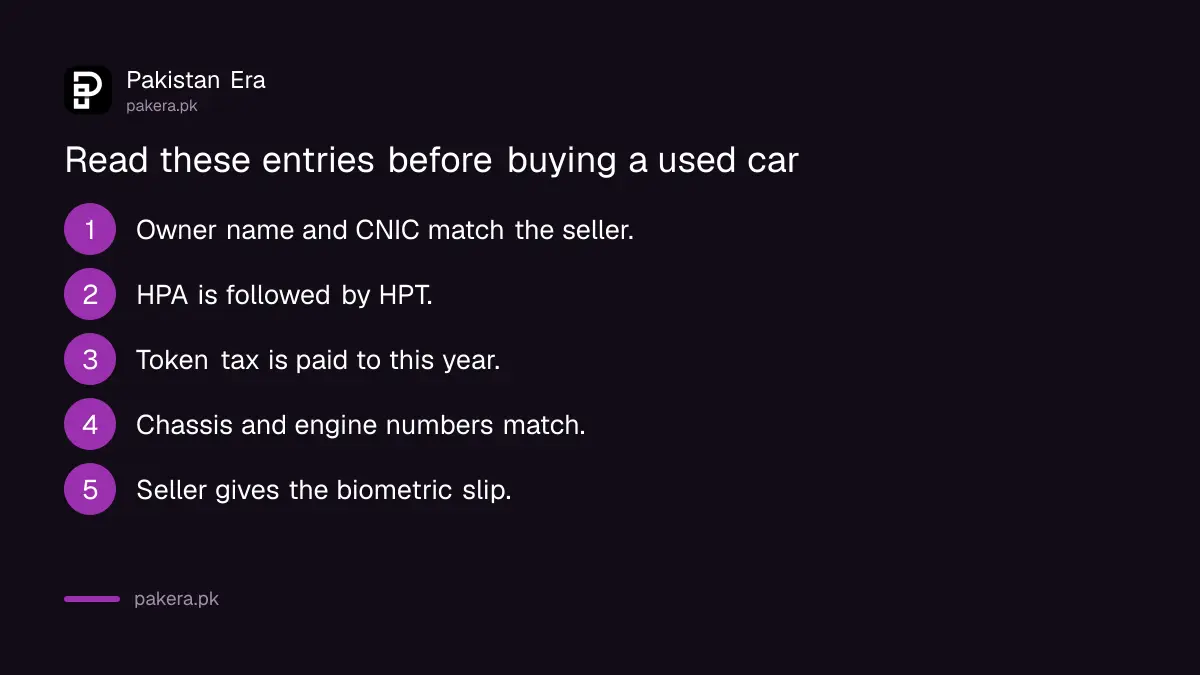
Before you pay for a used car, read these entries on its record in this order:
- Owner name and CNIC: do they match the seller?
- HPA: if it shows, is HPT recorded after it?
- Token tax (MVT or LTT): is it paid up to this year?
- Chassis and engine numbers: do they match the car?
- Biometric slip: is the seller ready to give it before you pay?
LTT, MVT and CVT are three different vehicle taxes
MVT is the motor vehicle tax, the token tax you pay every year. LTT is the lifetime token tax, a one time payment that replaces the yearly tax for motorcycles and small cars. CVT is a capital value tax on a vehicle's value, separate from both.
Punjab's Excise rates show all three. Motorcycles pay Rs 1,500 at registration, and cars up to 1000cc pay Rs 20,000. When such a vehicle is transferred within ten years of registration, Punjab charges the lifetime token again, with a rebate of 10 per cent for each year since registration.
| Tax | How often | Example from Punjab rates |
|---|---|---|
| MVT (token tax) | Every year | 0.3 per cent of invoice price for 1001 to 1199cc in 2026-27 |
| LTT (lifetime token) | Once | Rs 20,000 for a car up to 1000cc |
| LTT on transfer | On a transfer within 10 years | Rs 20,000 less 10 per cent a year |
| Professional tax | Yearly, with token tax | Rs 200 |
| CVT | On some purchases and transfers | Rates listed separately by Excise |
Punjab's full transfer charges, including LTT and CVT, are worked through in the Punjab vehicle transfer fee guide.
Form F, Form T.O. and the other excise forms
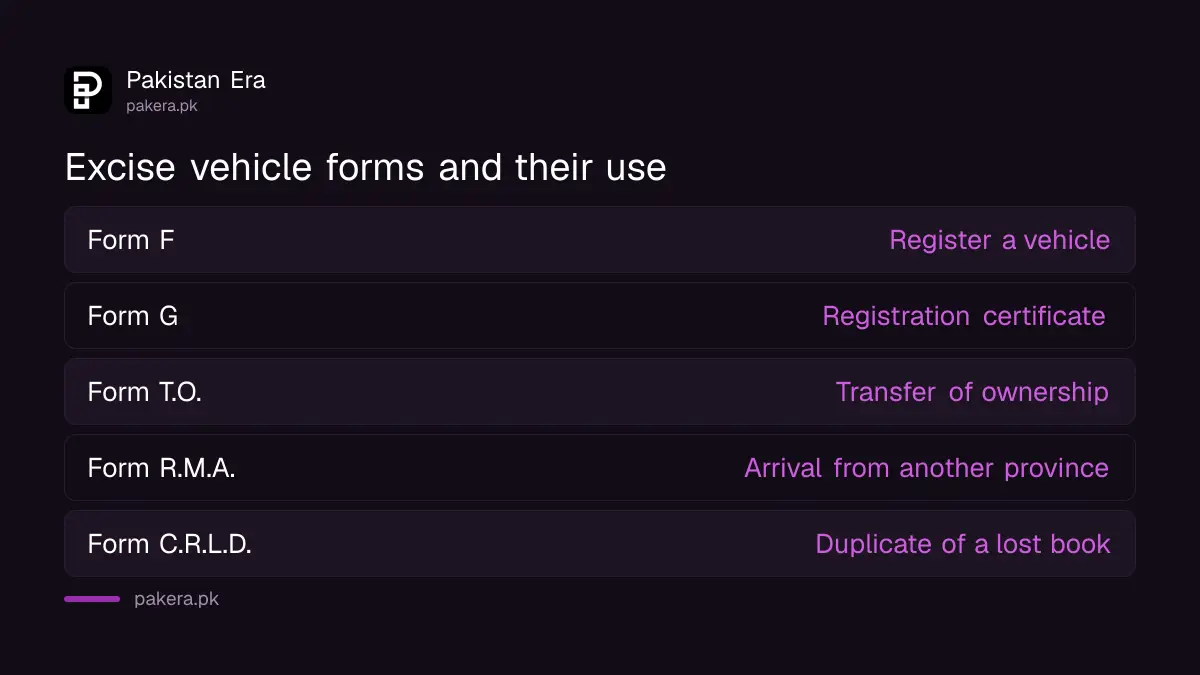
Form F is the application to register a vehicle, required by Section 25 of the Motor Vehicles Ordinance. Form T.O. is the transfer order signed by seller and buyer. Form G is the registration certificate itself. Balochistan adds Form R.M.A. for arrivals and Form C.R.L.D. for a lost book.
| Form | Used for | Who signs |
|---|---|---|
| Form F | New registration, and some alterations in Punjab | Owner |
| Form G | The certificate of registration (book or smart card) | Issued by the authority |
| Form T.O. and Transfer Letter | Transfer of ownership | Seller and buyer |
| Form R.M.A. | Reporting a vehicle's arrival from another province, in Balochistan | Owner |
| Form C.R.L.D. | Duplicate of a lost registration book, in Balochistan | Owner |
The forms change names slightly between provinces, but the job is the same. Punjab's own list of papers for each task is in the Punjab Excise document checklist.
ETO, MRA, MVE and PSID are the people and codes you deal with
The ETO is the Excise and Taxation Officer who approves your case. The MRA is the Motor Registration Authority, the office that registers vehicles. An MVE is a Motor Vehicle Examiner from the police who inspects commercial vehicles. A PSID is the payment slip ID you pay against online.
- ETO, Excise and Taxation Officer. Signs off transfers, duplicates and alterations at the district office.
- ETI, Excise and Taxation Inspector. Physically checks a private vehicle's chassis and engine numbers.
- MRA, Motor Registration Authority. The registering office. Balochistan's personal number rules refer to its approval.
- MVE, Motor Vehicle Examiner. A police officer who checks commercial vehicles and some conversions.
- PSID, Payment Slip ID. The number DLIMS and Punjab Excise generate so you can pay by ATM, online or mobile banking.
- DVRS, Dealer Vehicle Registration System. Punjab's system that lets an authorised dealer register a new car for you.
Other words you see on a registration record
A few other words come up when buying a used car: a smart card, a biometric verification slip, an attractive or personalised registration mark, and supardari. Each one decides whether a sale can go ahead, so learn them before paying a seller.
- Smart card. The plastic registration certificate that replaced the paper book in Punjab and Islamabad. The Ordinance allows the certificate to be "a data embedded card".
- Biometric verification slip. Proof that the seller's thumb was verified with NADRA for the transfer. Balochistan fines Rs 2,000 for a car if it expires before filing.
- Attractive or personalised registration mark. A chosen number, sold by e-auction in Punjab. In Balochistan, a personal number now stays with the owner's CNIC.
- Supardari. A court order releasing a recovered or seized vehicle to its owner while a case goes on. It is explained in reporting a stolen car.
Common questions
What does HPA mean on a car registration?
Hire Purchase Agreement. A bank or leasing company financed the vehicle and is recorded as its legal owner until the loan is paid.
What does HPT mean in excise?
Hire Purchase Termination. It records that the finance agreement has ended and the lien has been removed.
What is LTT in a transfer fee?
Lifetime Token Tax. In Punjab it is charged again on a transfer within ten years of registration, less 10 per cent a year.
What is MVT?
Motor Vehicle Tax, the yearly token tax. Punjab's Excise tables label token tax as MVT.
What is Form F?
The application to register a motor vehicle under Section 25 of the Motor Vehicles Ordinance 1965.
Can I buy a car that still shows HPA?
Only after the bank issues its NOC and the excise office records HPT. Until then the bank is the legal owner.
How we verified this
What we checked and where we read it.
Last checked 24 November 2026. We read Islamabad Excise's hire purchase service text and its HPA and HPT fee schedule on islamabadexcise.gov.pk, the Punjab Excise motor vehicle tax rates (MVT, lifetime token on transfer, professional tax, CVT heading), the Balochistan Excise FAQ, forms page and fee schedule, the DLIMS FAQ on PSID payment, and the Provincial Motor Vehicles Ordinance 1965 (Sections 2(4), 25 and 51) as published by the Punjab Transport Department. The Punjab rates page lists a CVT heading but its rates did not appear in the page text, so no CVT figure is given.
About the author
Senior Writer, Public Services and Technology
Shahid joined us in 2024 as an author. He is a senior contributor to Pakistan's leading technology websites. He writes detailed articles, mostly covering his expertise in the latest tech, mobiles, apps, gadgets, and step-by-step guides. His ideology is to help people understand the latest trends and explain complex methods through very easy-to-understand guides.