Solar System Making Low Units in Pakistan: How to Check and Fix It
Check if your solar system in Pakistan makes too few units: compare units per kW with your city, then fix dirt, shade, noon inverter tripping or a bad string.
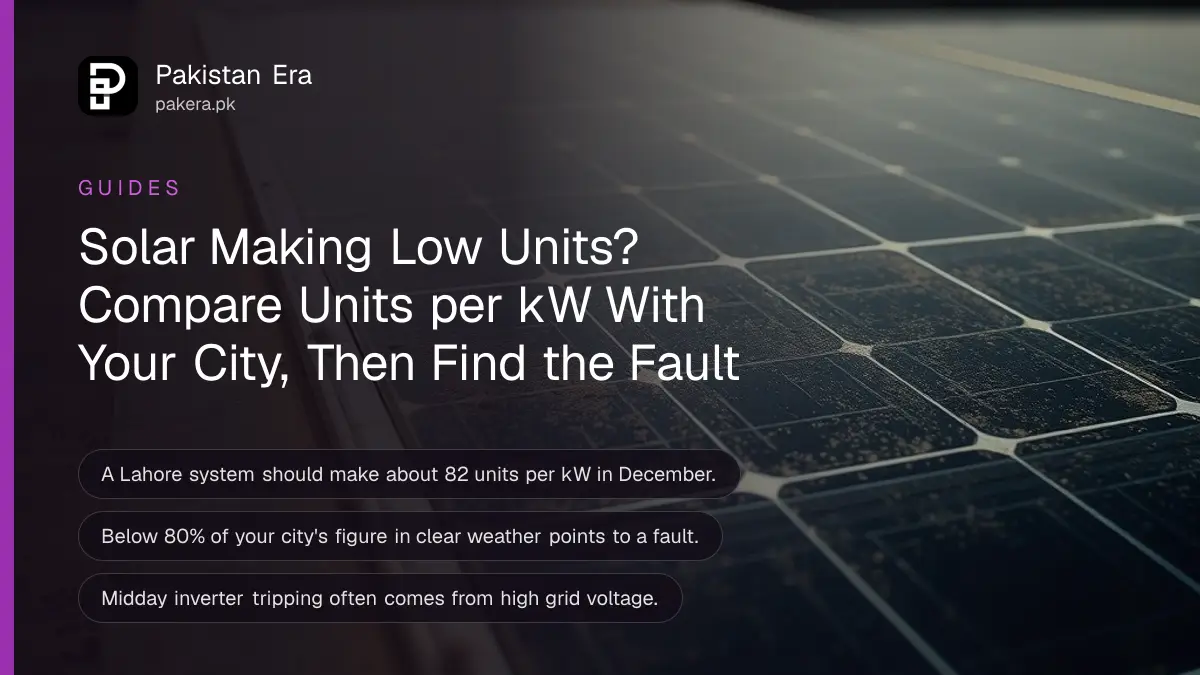
To check if your solar system in Pakistan is producing too few units, divide last month's units by your system size in kW and compare with your city: on a yearly average about 117 per kW in Lahore, 119 in Islamabad and 131 in Karachi; in December about 82, 86 and 107. Below 80% of that in clear weather points to shade, dirt, inverter tripping or a faulty string.
Most "low output" worries in winter are the season, not a fault. But real faults are common too, and an inverter that trips off every noon can lose a large share of your best hours without any warning light. The checks below take about 20 minutes and need only the inverter app and a look at the roof from a safe spot.
Compare your units with what your city should make
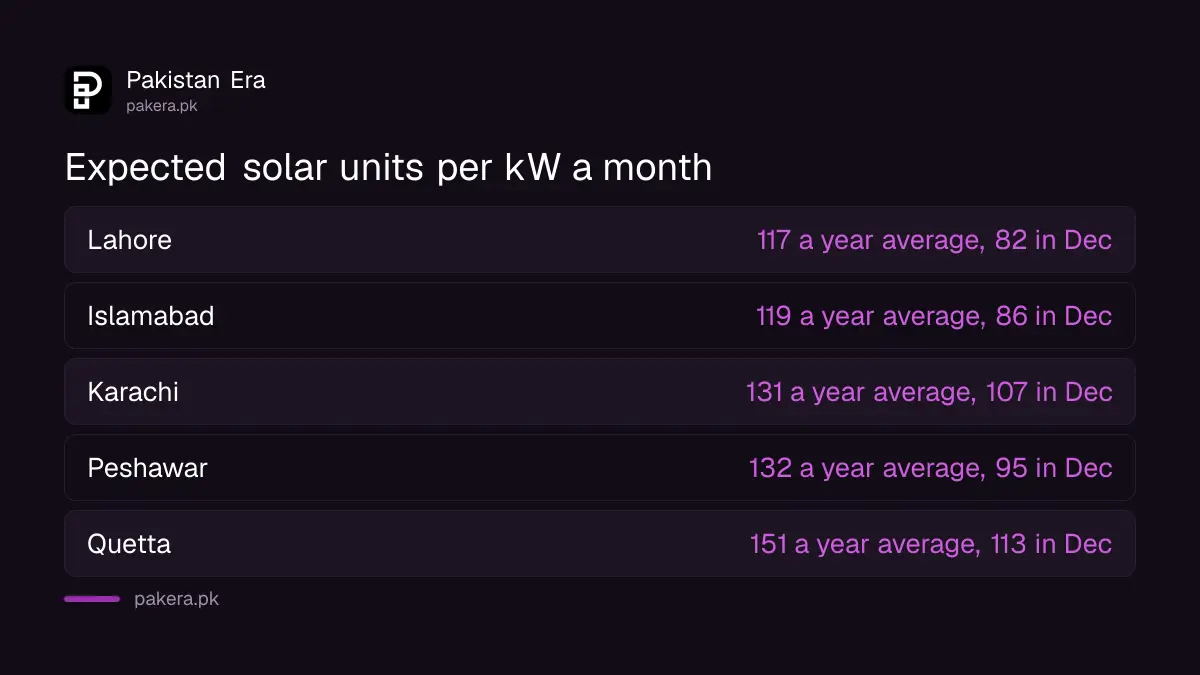
Take the units your inverter recorded in the last 30 days, divide by the system size in kW, and compare with the table. A working system on a normal month should reach at least 80% of the figure for that month.
| City | Year average, units per kW a month | December, units per kW | May, units per kW |
|---|---|---|---|
| Lahore | 117 | 82 | 158 |
| Islamabad and Rawalpindi | 119 | 86 | 158 |
| Faisalabad | 112 | 75 | 156 |
| Multan | 117 | 84 | 153 |
| Karachi | 131 | 107 | 156 |
| Peshawar | 132 | 95 | 169 |
| Quetta | 151 | 113 | 179 |
Example: a 6 kW system in Lahore that made 390 units in December gives 65 per kW. The December figure is 82, so it is at 79%. That is worth checking. The same system making 470 units would be at 96%, which is fine.
Find the cause in six checks
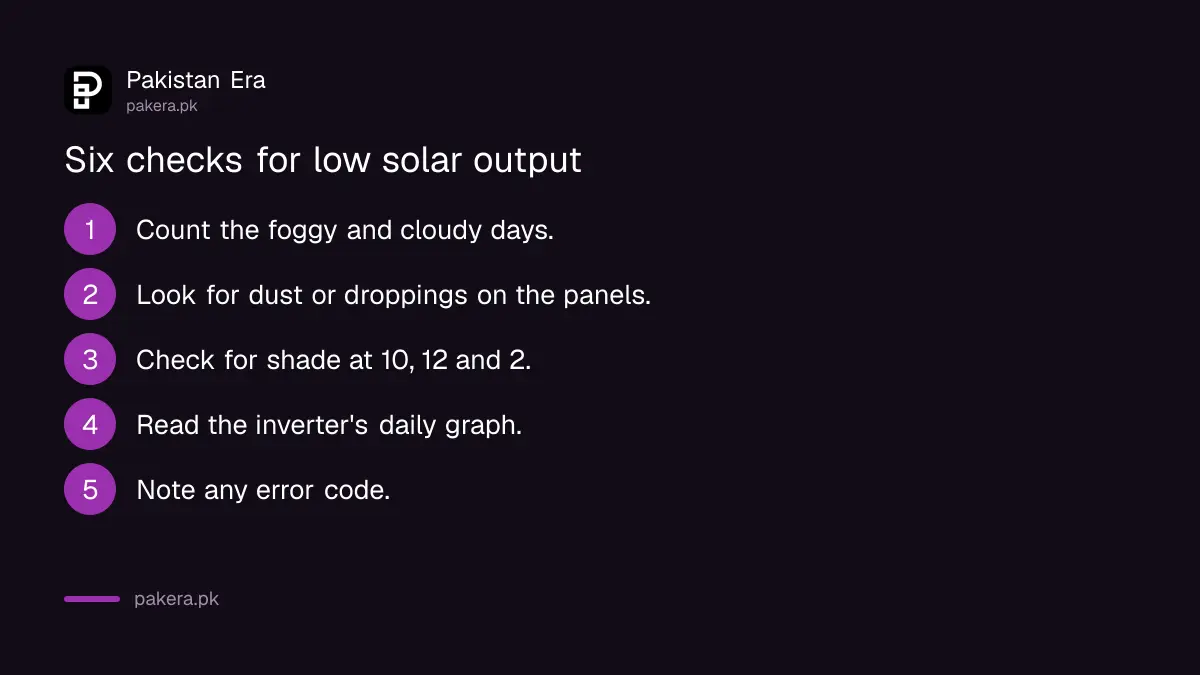
Work from the easiest check to the hardest: weather, dirt, shade, inverter errors, each string's output, and finally the panels. Most problems show up in the first four. Never climb onto the panels or open the inverter or the DC box yourself.
- Weather. Count the foggy or cloudy days last month. A week of thick fog in Punjab can pull a month well below average.
- Dirt. Look at the panels from a safe spot. A grey film from smog or dust, or bird droppings, cuts output.
- Shade. Check the roof at 10 am, 12 noon and 2 pm. In winter the low sun makes long shadows from tanks, walls and trees.
- Inverter history. Open the app's daily graph. A smooth curve is healthy. A curve that drops to zero at midday and comes back means the inverter is tripping.
- Error codes. Note any code on the inverter screen or app, with the date and time, and look it up in the inverter manual.
- Strings. If the app shows each string (each chain of panels) separately, compare them. One string far below the others points to a loose connector, a blown fuse or a faulty panel in it.
Common faults and their fixes
The most common causes are dirt, new shade, an inverter that trips on high grid voltage, and a loose connection in one string. The table matches what you see in the app with the likely cause and who fixes it.
| What you see | Likely cause | Fix |
|---|---|---|
| Output low on every sunny day, curve smooth | Dirt, wrong angle or shade | Clean with plain water, trim shade, check the tilt |
| Curve drops to zero at midday, then returns | Inverter trips on high grid voltage | Installer checks settings; report voltage to your DISCO |
| Curve flat-topped at midday | Inverter smaller than the panels | Normal in a small amount; ask the installer if large |
| One string far below the others | Loose connector, fuse or a faulty panel | Installer tests that string |
| Inverter off, error code shown | Earth fault, insulation fault or grid loss | Switch off safely; call the installer with the code |
| App shows units, bill shows no export | Net meter or billing problem | Complain to the DISCO, then NEPRA |
Midday tripping is common on streets with a lot of rooftop solar. When many homes export at once, the voltage on the line can rise until inverters switch off to protect themselves. The installer can check the inverter's grid settings, but must keep them within the limits the DISCO approved. Report persistent high or low voltage to your DISCO on 118. The route from the DISCO to NEPRA is set out in the steps to report low voltage and sparking to NEPRA.
Safety comes first with rooftop solar
Solar panels make dangerous DC voltage whenever light falls on them, even with the inverter off. Do not open the DC combiner box, pull connectors or walk on panels. Clean from the edge with a long soft brush, early in the morning.
Turn off the system in the order the inverter manual gives before any cleaning that brings water near the wiring. Keep children off the roof. After a storm, check the frame from a distance and call the installer if any panel has moved, because a loose panel can fall in the next strong wind. If a panel has cracked glass, do not touch it.
When to claim the warranty or complain
If the checks show a faulty panel, string or inverter, contact the installer in writing with dates, units and photos of the error codes. If the problem is the net meter or missing export credit, complain to your DISCO and then to NEPRA.
Panels and inverters usually carry separate warranties from the maker, with different periods for faults and for power output. Read both on the datasheets and warranty cards you got at installation. Keep a monthly note of units per kW, because a steady fall year on year is the evidence a power output claim needs. If you are unsure whether your panels are genuine, the checks for original solar panels in Pakistan come first.
For a net meter that shows exports with no credit on the bill, follow the steps for a defective net meter and missing export credit. If the DISCO does not act, the NEPRA net metering complaint form is the next step.
To set your expectations first, see how many units a kW makes in your city, what winter output looks like and the best tilt angle for your city.
Common questions
How many units should a 5 kW solar system make in Pakistan?
On a yearly average about 585 units a month in Lahore, 595 in Islamabad, 655 in Karachi and 755 in Quetta. In December, about 410 in Lahore and 535 in Karachi.
Why does my solar inverter turn off at noon?
Usually because the grid voltage rises too high when many nearby homes export, and the inverter trips to protect itself. Ask the installer to check, and report the voltage to your DISCO.
How much does dust reduce solar output?
It depends on how thick the film is. A visible grey layer after a smog spell is worth rinsing off with plain water, early in the morning.
Is my solar system faulty if it makes less in winter?
Not on its own. In Punjab, December output is about half of May. Compare with the December figure for your city, not the summer one.
How do I know if one solar panel is bad?
If your app shows strings separately, one string far below the others points to a fault in it. The installer can then test each panel in that string.
Who do I complain to about my solar net meter?
First to your DISCO. If it does not fix the meter or the credit, file a complaint with NEPRA.
How we verified this
What we checked and where we read it.
The expected units per kW are our own estimates from monthly solar irradiance climatology (January 2001 to December 2025) downloaded on 24 November 2026 from the NASA POWER project, for south-facing panels, with 25% allowed for losses. The year average uses the best fixed angle for each city; the month figures use a tilt of latitude minus 15 degrees. The 80% threshold is our own working rule for a normal month. The complaint routes are those set out by NEPRA for distribution companies.
About the author

Tax, Bills and Technology Writer
Ali Akhtar is a young and curious voice here at Pakistan Era. He is currently pursuing his A-Levels and has a growing interest in Pakistan’s changing industrial landscape and educational trends. Ali likes to write in a way that helps him explain and explore the world around him. His writing reflects the perspective of the new generation navigating the evolving trends of Pakistan where technology, youth innovation, and shifting opportunities are reshaping the country’s future.