Stamp Duty on a Power of Attorney in Punjab: Rs 2,000, Rs 3,000 or 2 to 3 Percent
Stamp duty on a power of attorney in Punjab: Rs 2,000 general, Rs 3,000 to sell between close family, 2% of DC value to others and 3% if given for money.
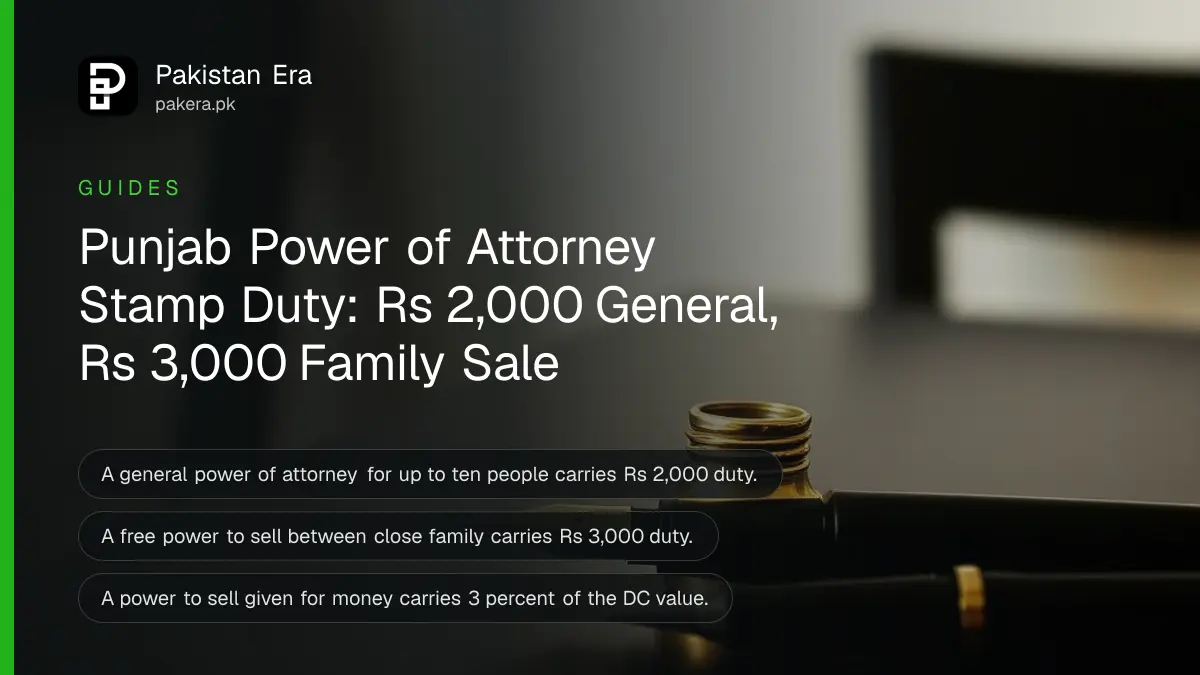
In Punjab, a general power of attorney for up to ten people carries Rs 2,000 stamp duty. A power of attorney to sell property, given free between close family, carries Rs 3,000. Given free to anyone else, it carries 2 percent of the property's DC value, and given for money it carries 3 percent. These rates are in Article 48 of the Stamp Act 1899 as it applies in Punjab.
The gap between those numbers is large. On a house with a DC value of Rs 10 million, a sale power of attorney to your brother costs Rs 3,000 in stamp duty. The same document to a friend costs Rs 200,000, and Rs 300,000 if the friend has paid for the right to sell.
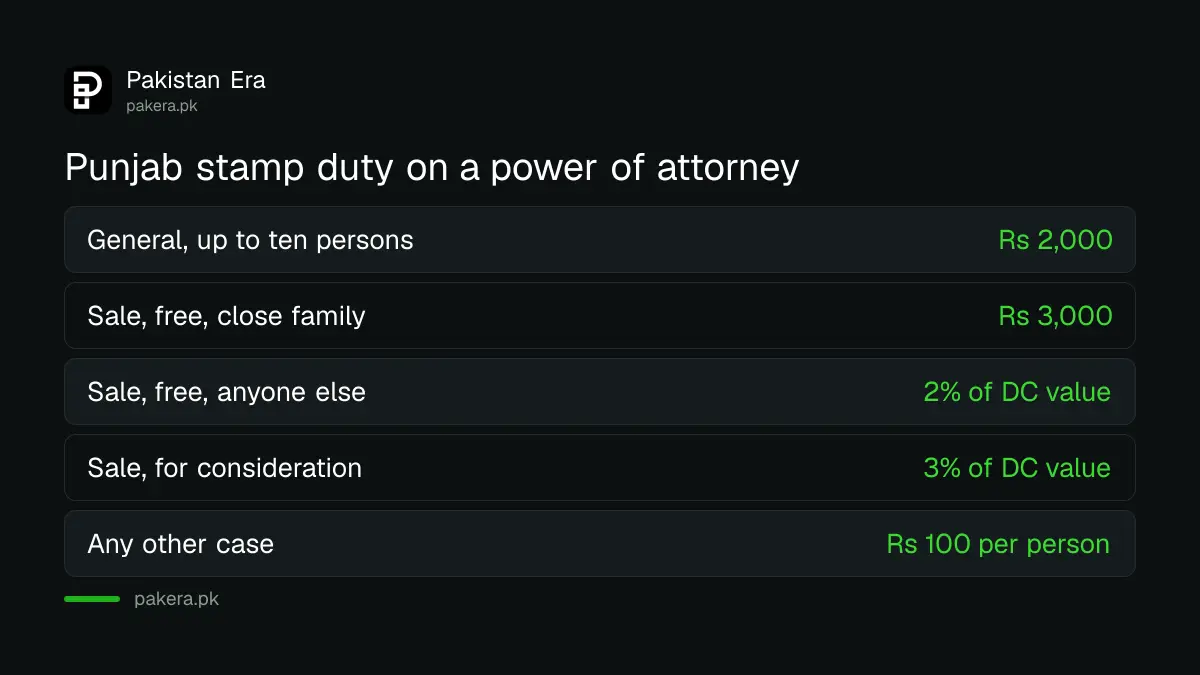
| Type of power of attorney in Punjab | Stamp duty (Article 48) |
|---|---|
| General, for up to ten persons | Rs 2,000 |
| To sell property, no consideration, close family | Rs 3,000 |
| To sell property, no consideration, anyone else | 2% of the DC value |
| To sell property, given for consideration | 3% of the DC value |
| Any other case, such as more than ten persons | Rs 100 for each person authorised |
Four kinds of power of attorney carry four different duties
Article 48 sorts a power of attorney by what it allows and whether money changed hands. A general power to manage affairs pays a flat Rs 2,000. A power to sell immovable property pays a flat Rs 3,000 within close family, and a percentage of the DC value otherwise.
A "general" power of attorney lets someone act for you: deal with offices, collect rent, sign routine papers. It does not need to mention a sale. If you want the attorney to sell a house, plot or land, that power must be written in, and the higher sale rates then apply.
"Consideration" means money or value given for the power. A power of attorney "for consideration" is often a disguised sale: the buyer pays the owner and takes a power to sell the property onward. That is why it pays 3 percent, more than the 2 percent sale deed rate for urban property.
The Rs 3,000 family rate covers close relatives only
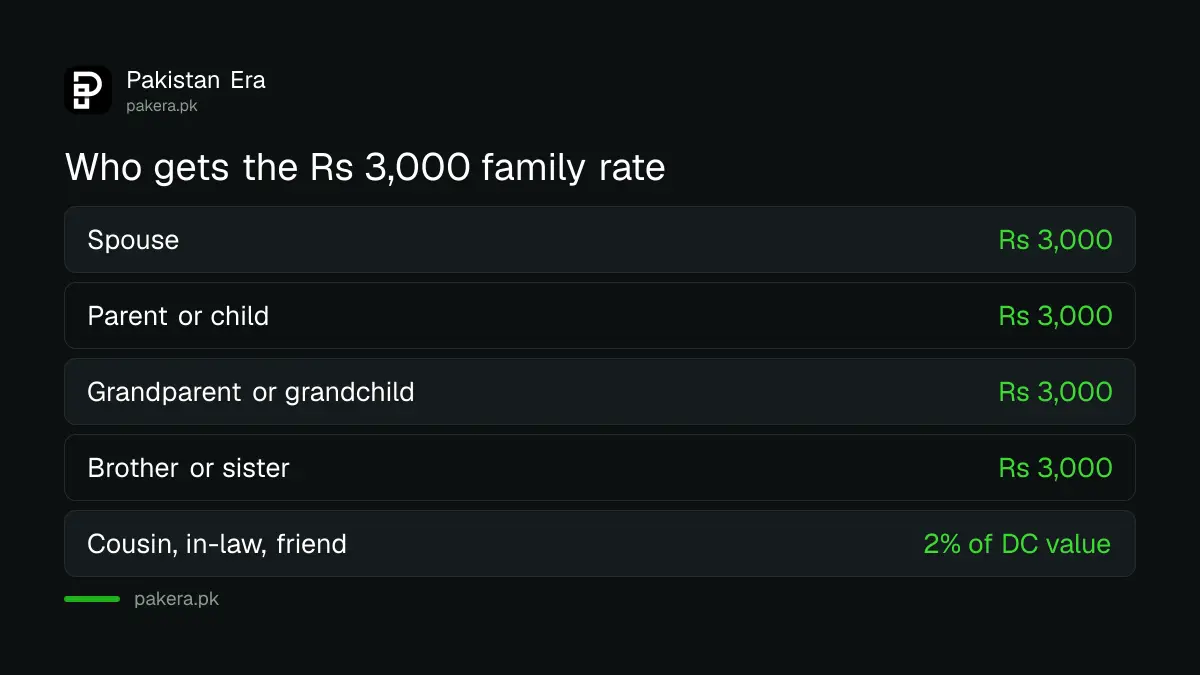
A sale power of attorney given without consideration pays Rs 3,000 only between the relatives named in Article 48(bb). They are spouses, co-wives or widows of the same husband, father, mother, son, daughter, grandparents, grandchildren and siblings. Uncles, cousins, in-laws and friends pay 2 percent.
| Relationship to the owner | Duty on a free power to sell |
|---|---|
| Husband or wife | Rs 3,000 |
| Father, mother, son, daughter | Rs 3,000 |
| Grandparent or grandchild | Rs 3,000 |
| Brother or sister | Rs 3,000 |
| Uncle, cousin, in-law, friend or agent | 2% of the DC value |
That makes the family rate the usual choice for an owner abroad who wants a brother or son in Pakistan to sell. If the attorney is a property dealer or a friend, budget for 2 percent, and check whether a sale deed signed in person on a later visit would cost less overall.
Work out the duty from the DC value, not the price
The percentage rates in Article 48 are worked out "according to the value notified by the District Collector", the DC valuation table. Find the DC rate for your area and the property's size, multiply them, then apply 2 or 3 percent. The e-stamp challan shows the final figure.
- Find the property's DC value: the DC rate for the area times the land area, plus any building value the table sets.
- Decide the type: general, family sale, other sale without money, or sale for money.
- Apply the rate: Rs 2,000, Rs 3,000, 2 percent or 3 percent.
- Add the registration duty if you will register it: Rs 25 on the general and family types, and Rs 500 or Rs 1,000 on a sale power given for money (Rs 1,000 above Rs 500,000).
- Generate the Punjab e-stamp challan for that amount and pay at the bank.
| DC value of the property | Family, free | Others, free (2%) | For consideration (3%) |
|---|---|---|---|
| Rs 2,500,000 | Rs 3,000 | Rs 50,000 | Rs 75,000 |
| Rs 5,000,000 | Rs 3,000 | Rs 100,000 | Rs 150,000 |
| Rs 10,000,000 | Rs 3,000 | Rs 200,000 | Rs 300,000 |
Check the e-stamp before anyone signs on it, using the steps to verify a Punjab e-stamp paper.
A power of attorney to sell must be registered
Section 17(1)(bb) of the Registration Act 1908, as it applies in Punjab, makes registration compulsory for an instrument granting power to an attorney over immovable property worth Rs 100 or more. Present it at the Sub-Registrar within four months of signing.
Stamp duty and registration are two separate steps. Paying the right stamp duty makes the document valid as evidence. Registering it at the Sub-Registrar makes it usable for a sale, and buyers and banks will ask for the registered copy. The registration steps and the four-month rule are covered in registering an agreement to sell or power of attorney in Punjab.
A power of attorney signed abroad works differently. Under section 18 of the Stamp Act, a document signed outside Pakistan may be stamped within three months after it first arrives in Pakistan. The attestation route at the embassy is in making a power of attorney from abroad.
Fix the mistakes that cost the most
The costly errors are using the wrong type, paying on a price instead of the DC value, and assuming a cousin counts as family. Each one either overpays duty or leaves a document a Sub-Registrar or buyer will reject. Check these before you print the stamp paper.
- A general power used for a sale. A Rs 2,000 general power that does not mention sale will not let the attorney sell. Write the sale power in and pay the sale rate.
- A cousin, nephew or son-in-law as attorney. They are not on the Article 48(bb) list, so the free sale power costs 2 percent, not Rs 3,000.
- Money paid, but written as free. If the attorney paid you, the 3 percent rate applies. Writing it as free to save duty leaves the document open to challenge as under-stamped.
- Under-stamped paper. Section 35 of the Stamp Act bars an under-stamped instrument from evidence until the duty and penalty are paid.
A gift of the property itself, rather than a power to sell it, is charged under a different article. Those rates are in the guide to a hiba (gift) deed in Punjab.
Common questions
How much stamp paper is needed for a general power of attorney in Punjab?
Rs 2,000 for a power of attorney authorising up to ten people, under Article 48(a). Registration adds Rs 25 of stamp duty.
What is the stamp duty on a power of attorney to sell property to my son?
Rs 3,000, if no money is paid for it. Son, daughter, spouse, parents, grandparents, grandchildren and siblings all get the Rs 3,000 rate under Article 48(bb).
Is a power of attorney to my cousin charged at the family rate?
No. Cousins are not on the list. A free power to sell given to a cousin pays 2 percent of the DC value.
Why does a power of attorney for consideration cost 3 percent?
Article 48(b) charges 3 percent of the DC value when the power to sell is given for money. It is treated like a sale, because the attorney has paid for the right to sell.
Do I have to register a power of attorney in Punjab?
Yes, if it lets the attorney sell or deal with immovable property worth Rs 100 or more. Section 17(1)(bb) of the Registration Act makes that compulsory.
Does the duty use the market price or the DC rate?
The DC value. Article 48 says the percentage is worked out on the value notified by the District Collector.
How we verified this
What we checked and where we read it.
Last checked 24 November 2026. We read Schedule I, Article 48, and sections 18 and 35 of the Stamp Act 1899 as it applies in Punjab, and section 17 of the Registration Act 1908 as it applies in Punjab, on the Punjab Code. The consolidated Stamp Act carries amendments up to the Stamp (Amendment) Act 2026. The Rs 2,000 and Rs 3,000 rates were set by the Punjab Finance Act 2024, which we also read. The worked examples are our arithmetic. The e-stamp portal gives the final figure on the challan.
About the author

Senior Writer, Public Services and Technology
Shahid joined us in 2024 as an author. He is a senior contributor to Pakistan's leading technology websites. He writes detailed articles, mostly covering his expertise in the latest tech, mobiles, apps, gadgets, and step-by-step guides. His ideology is to help people understand the latest trends and explain complex methods through very easy-to-understand guides.