How to Register a Hiba Gift of Property in Punjab
Register a hiba gift of property in Punjab: 2% stamp duty urban, 1% elsewhere, Sub-Registrar within four months, then mutation. The steps we read in the law.
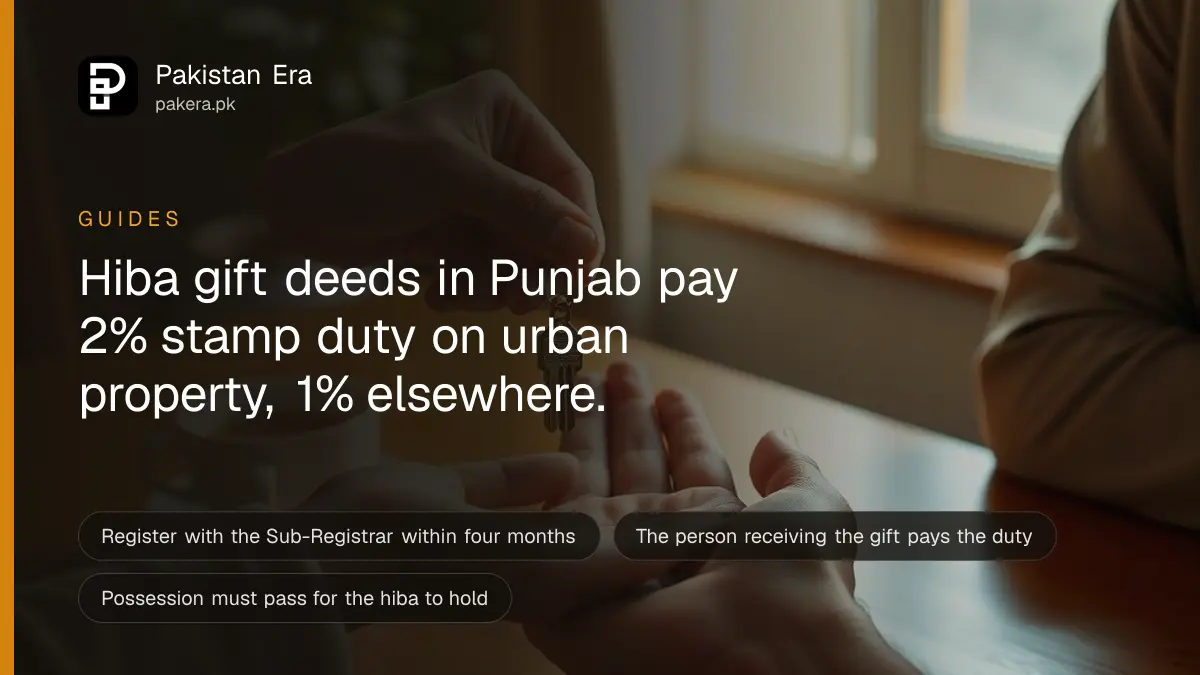
To gift property in Punjab, write a hiba (gift) deed, pay stamp duty of 2% of the value for urban property or 1% elsewhere, and register it with the Sub-Registrar within four months of signing. Then get the mutation entered in the land record, so the new owner's name actually shows.
A hiba is a gift of property made during the giver's lifetime, with nothing asked in return. Parents use it to give a house to a daughter. Husbands use it to give a plot to a wife. It is common, and it goes wrong often, usually because one of the steps above was skipped.
We read the Stamp Act 1899, the Registration Act 1908, the Transfer of Property Act 1882 and the Punjab Land Revenue Act 1967 on the Punjab Code on 1 October 2026. All four are shown with amendments up to 2026.
A valid hiba needs three things before any paperwork
Under Muslim personal law, a hiba needs a clear offer by the giver, acceptance by the person receiving it, and delivery of possession. Paperwork records the gift. It does not replace these three steps, and a gift without possession is easy to challenge.
- Offer. The giver clearly says they are giving the property now, as a gift.
- Acceptance. The person receiving it, called the donee, accepts the gift.
- Possession. The donee actually takes control, for example by moving in, receiving the rent, or holding the keys.
Section 129 of the Transfer of Property Act says its gift chapter does not affect any rule of Muslim law. That is why an oral hiba can be valid. But oral is risky. Twenty years later, nobody remembers who said what, and other heirs may claim the property. A written and registered deed is the safer route.
Stamp duty on a gift deed in Punjab
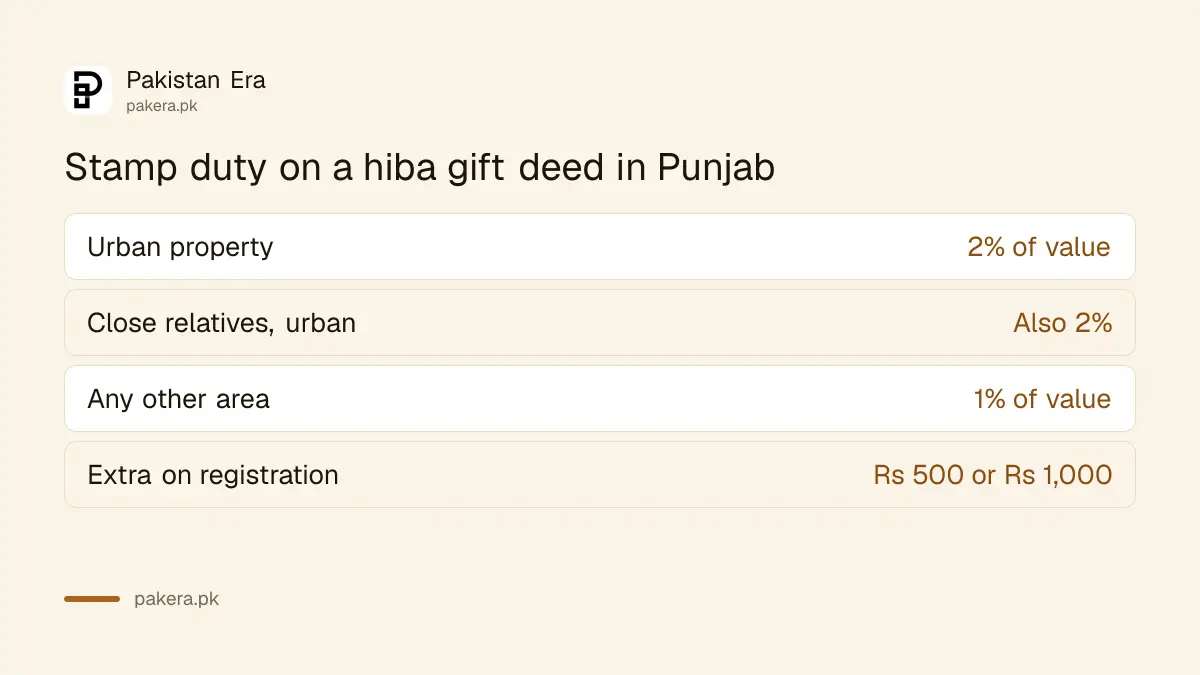
The Punjab Stamp Act charges 2% of the property value on a gift deed for urban property and 1% in other areas. Registering the deed adds Rs 500 or Rs 1,000 more. The person receiving the gift pays the duty.
| Item | What the Stamp Act says |
|---|---|
| Gift deed, urban property | 2% of the value of the property |
| Gift deed between close relatives, urban | Also 2% |
| Gift deed, any other area | 1% of the value of the property |
| Extra duty when the deed is registered | Rs 500 up to Rs 500,000, Rs 1,000 above that |
| Who pays | The person in whose favour the gift is made |
These rates are in Article 33 of Schedule I of the Stamp Act 1899 as it applies in Punjab. The rate for other areas was cut from 3% to 1% by the Stamp (Amendment) Act 2026, published in the Punjab Gazette on 6 May 2026. Section 29 puts the duty on the donee.
One detail surprised us. The law still has a separate line for gifts between spouses, parents, children, grandparents and siblings. But since 2022 that line also says 2%, the same as the general urban rate. So, on the text we read, family gifts of urban property get no lower rate.
The value is worked out from the district's valuation table, not the price you write. You buy the stamp as an e-stamp paper. The steps to issue an e-stamp paper are the same as for any other deed.
How to register a hiba deed, step by step
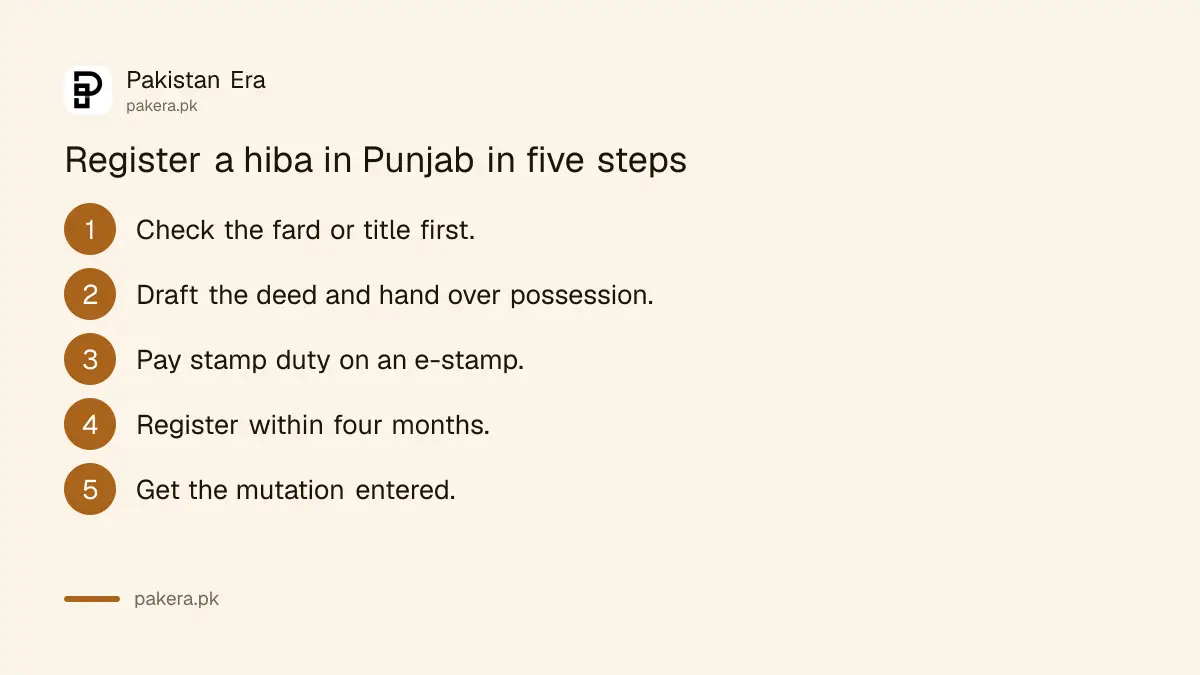
Check the land record, draft the deed, pay the stamp duty, present the deed to the Sub-Registrar within four months, then apply for the mutation. Both the giver and the person receiving the gift should attend with their original CNICs.
- Check the land record first. Make sure the giver is the recorded owner and there is no loan or court order on it. Get a fard for land, or the title papers for a house.
- Draft the deed. Name both people with CNIC numbers, describe the property exactly, and state that possession has been handed over.
- Pay the stamp duty on an e-stamp paper in the donee's name.
- Sign before two witnesses. Section 123 of the Transfer of Property Act needs a gift of immovable property to be signed by the giver and attested by at least two witnesses.
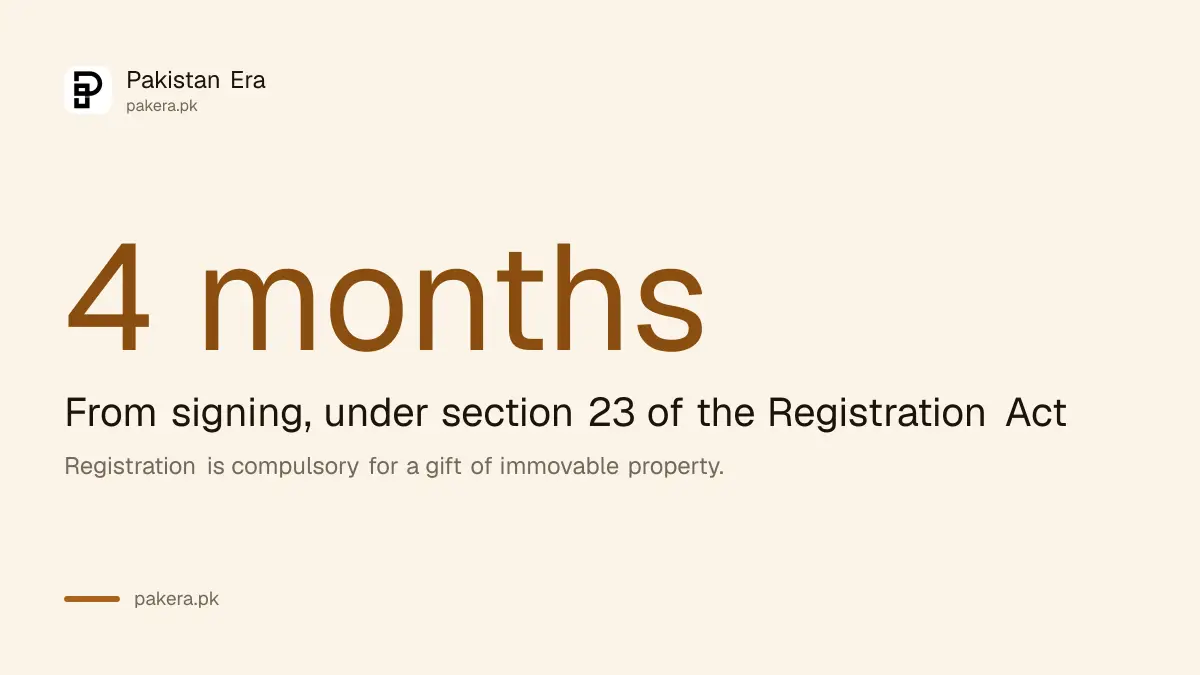
- Present it to the Sub-Registrar within four months. Section 23 of the Registration Act gives four months from the date of signing. Section 17 makes registration compulsory for a gift of immovable property.
- Get the mutation entered. For land, the registered deed goes to the Arazi Record Centre so the record changes to the new owner's name.
- Keep the originals safe. Keep the registered deed, the e-stamp, and a copy of the new fard or title.
Registration in Punjab is moving online
The Registration (Amendment) Act 2026, published on 14 May 2026, says documents are presented electronically and adds biometric checks against NADRA records. Ask your Sub-Registrar office whether the online system is live there before you go.
We read the amended Registration Act 1908. It now defines biometric verification as matching fingerprints or face against NADRA data. It also says documents are presented through an electronic record registration system. We could not confirm from an official page which districts have switched over, so we do not say it is live everywhere.
For land, the Land Revenue Act already works this way. Section 42 says a person transferring land by gift must report it to the registering authority. That authority then sends it to the Arazi Record Centre to enter the mutation. The same route is used to transfer inherited land.
Common hiba mistakes that cause disputes
Most hiba disputes start with no possession, no registration, or a gift signed under family pressure. Each one gives other heirs a reason to go to court. Fix them at the time, not after the giver has died.
- The deed is signed, but the giver keeps living there and collecting rent. Without possession, the gift is open to challenge.
- The deed is never registered. An unregistered gift deed of immovable property is a weak document.
- The mutation is never done. The record still shows the old owner, and that owner's heirs may inherit it.
- A sister gives her share to a brother under pressure. A woman pushed to give up her property can complain to the Punjab women's property ombudsperson.
- The hiba is used to cut out an heir. A gift made during life is not the same as a share by inheritance. The fixed inheritance shares apply only to what is left at death.
Federal taxes on transfers have changed in recent budgets. We did not check how they apply to gifts, so ask the Sub-Registrar or a tax adviser. The rules for tax when you buy or sell property are a starting point.
Common questions
Is an oral hiba valid in Punjab?
It can be, because the Transfer of Property Act does not override Muslim law on gifts. But it is hard to prove. A registered written deed is much safer.
How much is stamp duty on a gift deed in Punjab?
2% of the value for urban property and 1% in other areas, under Article 33. Registration adds Rs 500 or Rs 1,000.
Is there a lower rate for gifts to family?
Not for urban property on the current text. The family line also says 2%.
Who pays the stamp duty on a hiba?
The person receiving the gift. Section 29 of the Stamp Act says so.
How long do I have to register a gift deed?
Four months from the date it is signed, under section 23 of the Registration Act.
Can a hiba be cancelled later?
It depends on the facts, such as the relationship and whether possession was given. Get legal advice before you sign, not after.
How we verified this
What we checked, where we read it, and what we could not confirm.
Last checked on 1 October 2026. On punjablaws.punjab.gov.pk we read Article 33 of Schedule I and section 29 of the Stamp Act 1899 as amended to May 2026, and sections 2, 17, 23 and 32 of the Registration Act 1908 as amended by the Registration (Amendment) Act 2026. We also read sections 122, 123 and 129 of the Transfer of Property Act 1882 and section 42 of the Punjab Land Revenue Act 1967. We could not confirm which districts run fully electronic registration, the registration fee charged on top of stamp duty, or how federal advance taxes apply to gifts.
About the author

Public Services and Education Journalist
Fajr Riaz is a journalist and content writer at Pakistan Era, based in Lahore. She covers the questions people meet in everyday life in Pakistan: how a public service works, what a change in the rules means, and where to find a reliable answer.