Best Solar Panel Tilt Angle in Pakistan by City, for Winter and Summer
The best fixed solar panel angle in Pakistan is 23 to 29 degrees facing south: 25 in Lahore, 23.5 Karachi, 27 Islamabad. Winter and summer angles by city too.
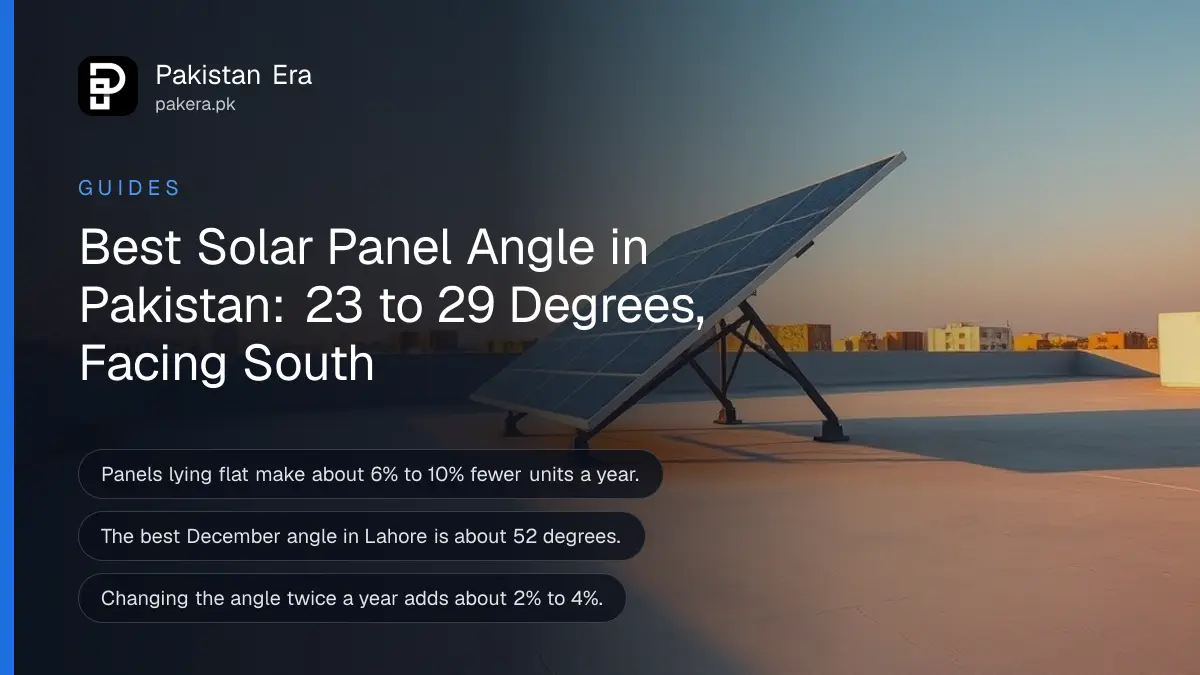
The best fixed solar panel angle in Pakistan is about 23 to 29 degrees, facing south: 23 in Karachi, Hyderabad and Faisalabad, 24 in Multan, 25 in Lahore, 27 in Islamabad, 28 in Quetta and 29 in Peshawar. If your frame can move, set it to about 40 to 49 degrees from October to March and 10 to 19 degrees from April to September.
We worked these out from NASA's 25-year solar records for each city. A fixed panel at the right angle beats a flat one by about 6% to 10% over a year. Changing the angle twice a year adds another 2% to 4%, and much more in the winter months.
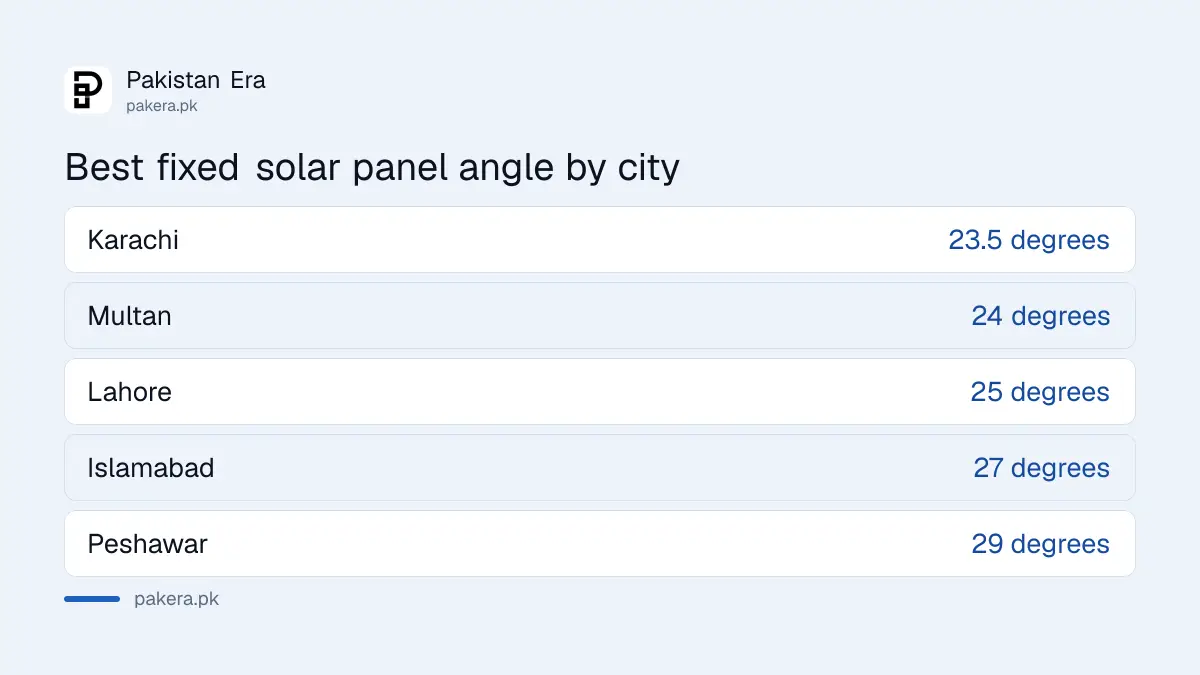
The best year-round angle is 23 to 29 degrees, depending on your city
For a frame you set once and leave, use 23 degrees in Karachi, Hyderabad and Faisalabad, 24 in Multan, 25 in Lahore, 27 in Islamabad and Rawalpindi, 28 in Quetta and 29 in Peshawar. Point the panels to true south.
| City | Best fixed angle | Best December angle | Best June angle | Loss if panels lie flat |
|---|---|---|---|---|
| Karachi | 23.5 degrees | 48.5 degrees | About 0 | 6.0% |
| Hyderabad | 23 degrees | 48.5 degrees | About 0 | 5.6% |
| Faisalabad | 23 degrees | 50 degrees | 1.5 degrees | 5.6% |
| Multan | 24 degrees | 51 degrees | 1 degree | 6.0% |
| Lahore | 25 degrees | 52 degrees | 1 degree | 6.8% |
| Islamabad and Rawalpindi | 27 degrees | 55.5 degrees | 2 degrees | 8.2% |
| Quetta | 28 degrees | 58 degrees | About 0 | 8.7% |
| Peshawar | 29 degrees | 59 degrees | 2 degrees | 9.6% |
For a town not in the table, use the nearest city. The rule of thumb is close: the best fixed angle is a little below your latitude. Lahore is at about 31.5 degrees north and its best angle is 25.
Changing the angle twice a year adds about 2% to 4%
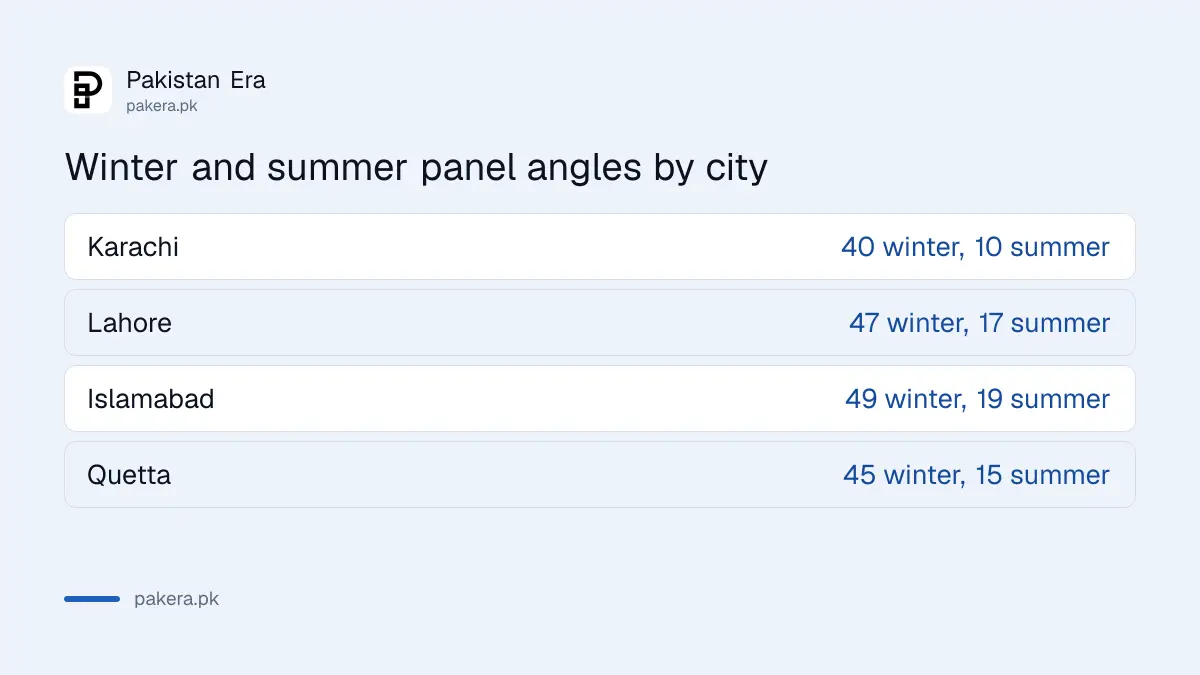
If your frame is adjustable, set it to your latitude plus 15 degrees from October to March and your latitude minus 15 degrees from April to September. Over a year that makes about 2% to 4% more units than the best fixed angle.
The gain is small across a full year but large in winter, when output is lowest. Over October to March, the steep winter setting makes about 6% to 14% more than leaving panels at the low summer angle. Quetta and Peshawar gain most because they are further north and get clear winter sun.
| City | Winter setting (October to March) | Summer setting (April to September) | Yearly gain over best fixed angle |
|---|---|---|---|
| Karachi | 40 degrees | 10 degrees | 2.9% |
| Lahore | 47 degrees | 17 degrees | 2.6% |
| Multan | 45 degrees | 15 degrees | 2.3% |
| Islamabad | 49 degrees | 19 degrees | 3.1% |
| Peshawar | 49 degrees | 19 degrees | 3.9% |
| Quetta | 45 degrees | 15 degrees | 4.1% |
Set or check the angle in five steps
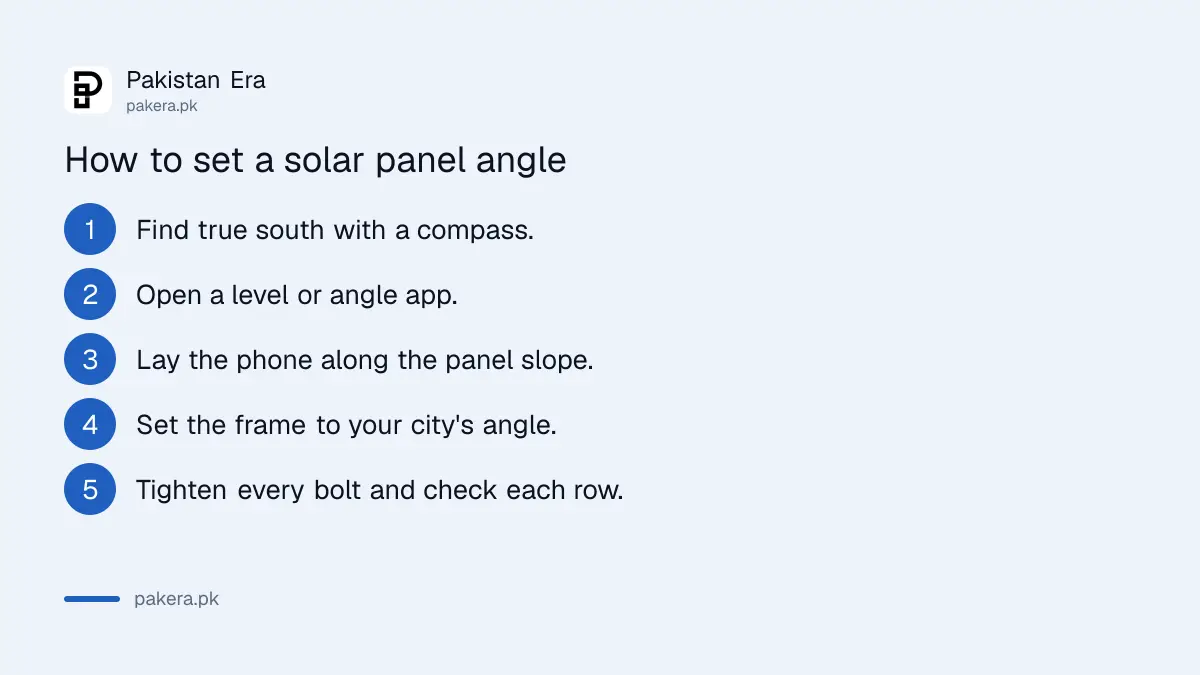
Find true south, measure the panel's slope with a phone level app or an angle gauge, and set the frame to your city's figure. Do it on a calm, dry day, with someone holding the frame and the system switched off if the manual says so.
- Find true south with your phone's compass. Panels should face south, not towards the street or the neighbour's wall.
- Open a level or angle app, or use a spirit-level angle gauge.
- Lay the phone flat on the panel frame, along its slope, and read the angle.
- Loosen the frame's adjustment bolts and set it to your city's winter or summer figure.
- Tighten every bolt fully and check that each panel row has the same angle.
Most rooftop frames in Pakistan are fixed and not built to move. If yours is fixed, do not force it. Ask the installer whether the frame and its roof fixings are rated for a steeper angle, because a steeper panel catches more wind.
Wind, shade and roof space matter as much as the angle
A steeper panel catches more wind and casts a longer shadow on the row behind it. In winter, when the sun is low, rows placed too close shade each other. That can cost more than the angle gains.
Leave enough gap between rows that the front row's shadow does not reach the back row at midday in December. If roof space is tight, a slightly lower angle with no shading is better than the ideal angle with shading. And check the frame after every storm. The NDMA windstorm advice for rooftop panels sets out what to tighten and when to stay off the roof.
The angle is only one part of what a system makes. How many units to expect per kW in your city, and how to size the system from your bill, depend on your sun hours and your sanctioned load as well. The legal limits on size are in the 2026 net billing rules, and the installer check is on the PPIB certified solar installer list.
Common questions
What is the best solar panel angle in Lahore?
25 degrees facing south for a fixed frame. With an adjustable frame, about 47 degrees from October to March and 17 degrees from April to September.
What is the best solar panel angle in Karachi?
About 23.5 degrees facing south for a fixed frame. Adjustable frames can go to about 40 degrees in winter and 10 degrees in summer.
Which direction should solar panels face in Pakistan?
True south. Pakistan is north of the equator, so the sun crosses the southern sky all year. Use a compass to find it, not the direction of the street.
Is it bad to lay solar panels flat?
Flat panels make about 6% to 10% fewer units a year in Pakistani cities, and collect more dust and rainwater. A small tilt also helps rain wash them.
What angle should solar panels be in winter in Pakistan?
The best December angle is about 48 to 52 degrees in Karachi, Lahore and Multan and about 55 to 59 degrees in Islamabad, Peshawar and Quetta.
How often should I change the solar panel angle?
Twice a year is enough for most homes: in early October and in early April. Changing it every month adds only about 1% more than twice a year.
How we verified this
What we checked and where we read it.
On 24 November 2026 we downloaded monthly solar irradiance climatology (January 2001 to December 2025) for eight cities from the NASA POWER project, which gives sunlight on a south-facing surface at flat, latitude minus 15, latitude, latitude plus 15 and the best angle for each month and the year. The yearly gains and losses in the tables are our own sums from those figures, weighted by the days in each month. Wind safety guidance is from the National Disaster Management Authority's rooftop panel advisory.
About the author

Tax, Bills and Technology Writer
Ali Akhtar is a young and curious voice here at Pakistan Era. He is currently pursuing his A-Levels and has a growing interest in Pakistan’s changing industrial landscape and educational trends. Ali likes to write in a way that helps him explain and explore the world around him. His writing reflects the perspective of the new generation navigating the evolving trends of Pakistan where technology, youth innovation, and shifting opportunities are reshaping the country’s future.