Watercourse Lining in Punjab (Khal Pakka Scheme): Government Pays Materials, Farmers Pay Labour, How to Apply Through OFWM
Punjab's OFWM pays all materials to line a canal watercourse while farmers pay the labour. See who qualifies, which stretches get lined and how to apply.
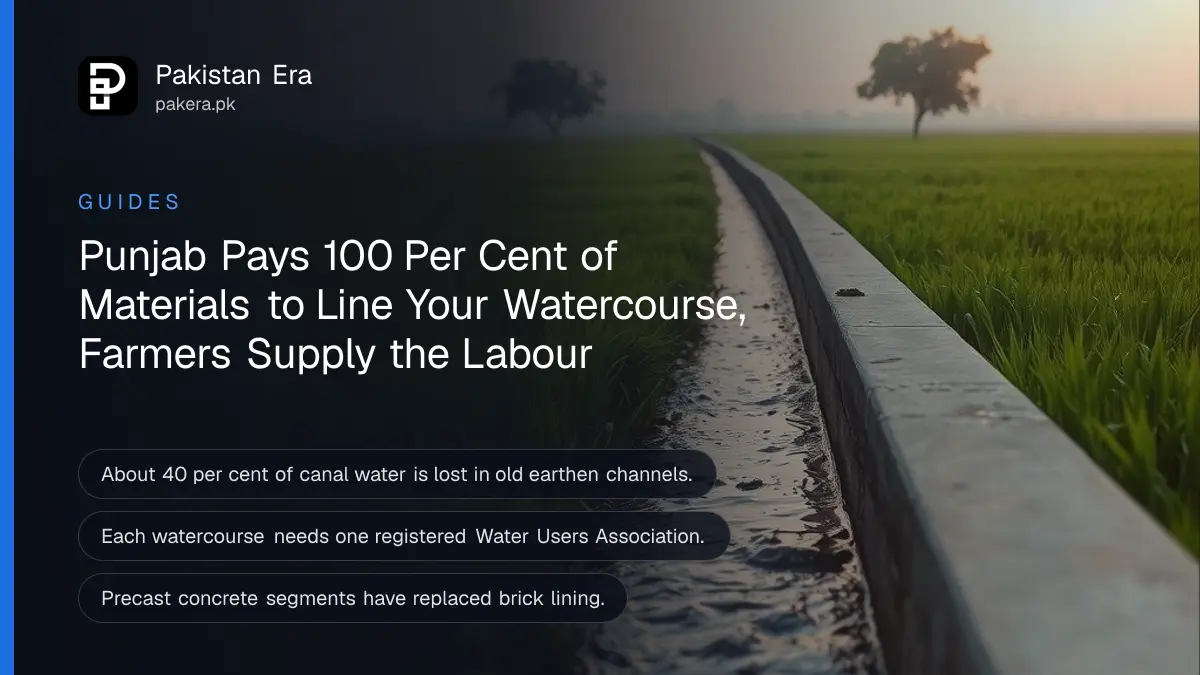
Under Punjab's On-Farm Water Management (OFWM) programme, the government pays the full cost of materials to line a canal watercourse, and the farmers on it pay for all the labour. To apply, the shareholders form a Water Users Association (WUA) and collect the form from the Deputy or Assistant Director Agriculture (OFWM) office in their district. Below is who qualifies, what each side pays, which stretches get lined and how to start.
The department says about 40 per cent of canal water is lost in old earthen watercourses before it reaches the field. With this rabi season already short of water, a lined khal is one of the cheapest ways to get more of your share to the crop. We read the OFWM pages on agripunjab.gov.pk on 1 November 2026.
The government pays for materials, farmers pay for labour
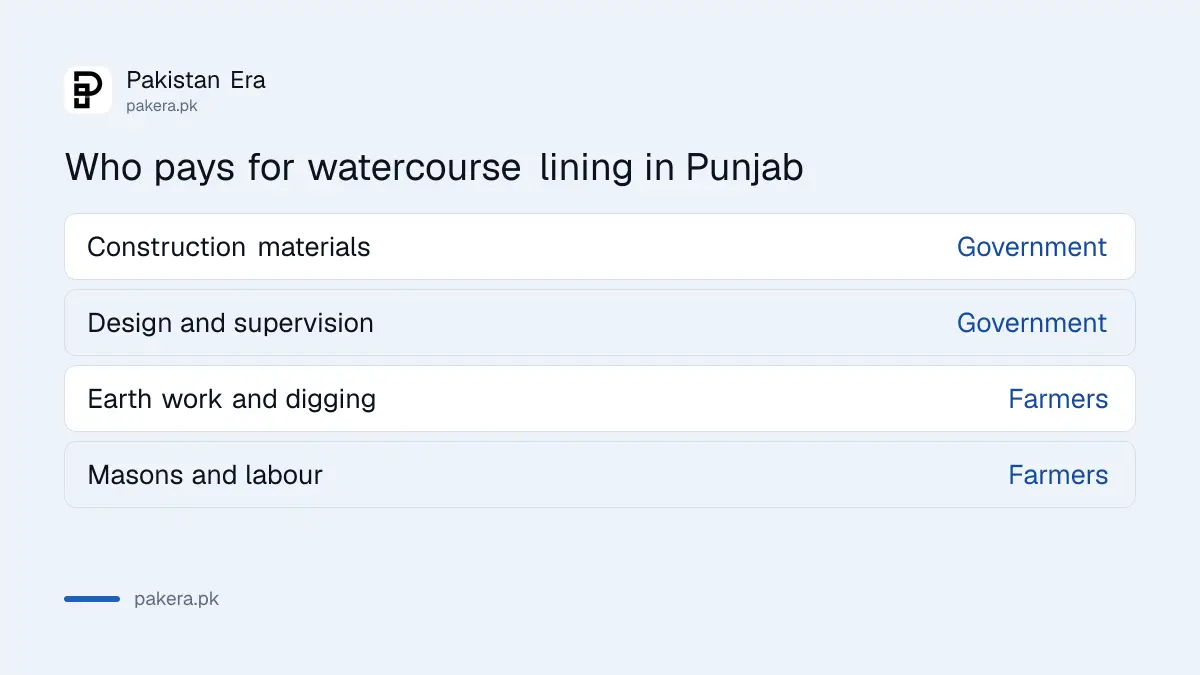
OFWM's cost sharing is simple. The government provides the entire cost of construction materials and the technical guidance. The farmers on the watercourse provide the entire labour cost, both skilled masons and unskilled workers, for the earth work and the civil work.
| Item | Who pays |
|---|---|
| Construction materials (lining segments, bricks, cement, nakkas) | Government |
| Technical design and supervision | Government (OFWM staff) |
| Demolishing and rebuilding the katcha (earthen) watercourse | Farmers |
| Digging the stretch to be lined | Farmers |
| Back-filling earth around structures and lining | Farmers |
| Masons and unskilled labour for all civil works | Farmers |
The page does not put a rupee value on either share. It does say that associations across Punjab have so far put in about Rs 2.3 billion of skilled and Rs 2.1 billion of unskilled labour for civil works, which gives a sense of the scale.
Unlined watercourses and willing farmers get priority
OFWM gives priority to watercourses that were never improved, or that are lined along less than half their length. The farmers must form a WUA, agree to the cost sharing, and agree to rebuild the earthen part before any lining starts.
Not the whole channel is lined. OFWM picks the stretches where lining saves the most water or prevents the most damage:
- the head reach, where use and flow are highest
- raised sections that leak, overtop or spill
- stretches that cross or run along villages and roads
- sections on sandy or porous soil
The rest of the channel is rebuilt in earth to the engineering design. So expect a mix of lined and earthen stretches on your khal, not concrete from end to end.
One Water Users Association is formed for each watercourse
Every canal watercourse in the programme gets one Water Users Association, registered under the On-Farm Water Management and Water Users' Associations Ordinance of 1981, amended in 2001. The association, not a single farmer, carries out the work with OFWM supervision.
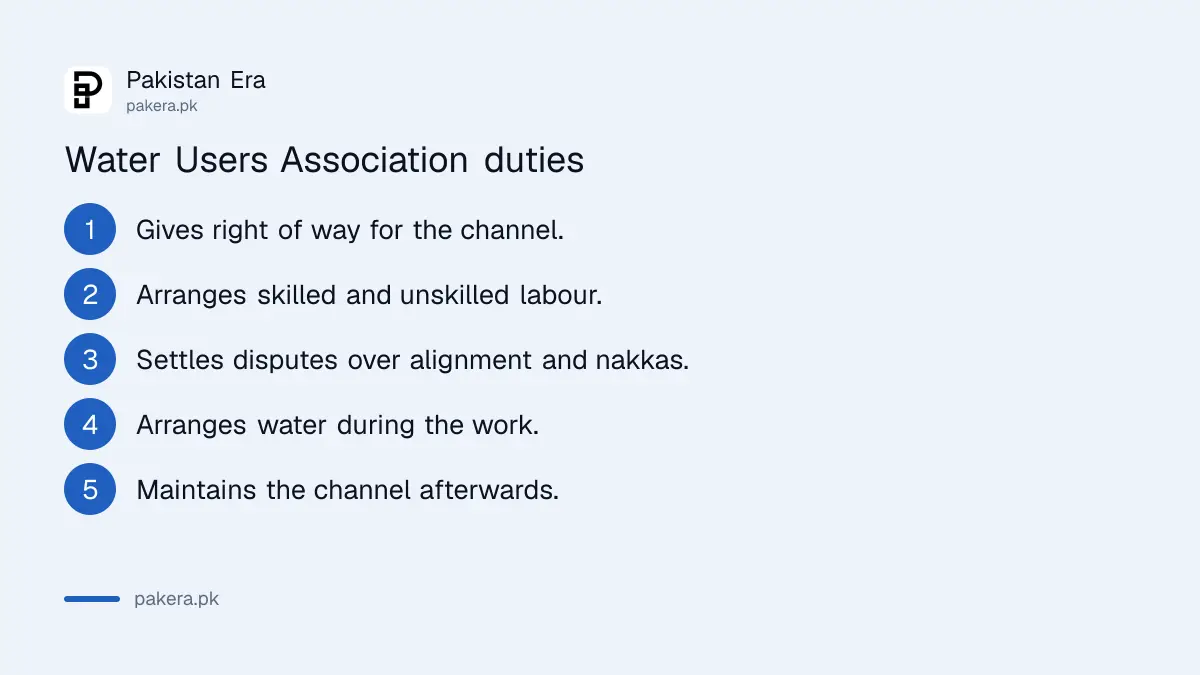
The association's duties are written down by OFWM. It gives the right of way for the channel, arranges skilled and unskilled labour, handles procurement of materials for the civil works, settles disputes between shareholders over alignment and nakkas, and arranges water during construction. After the work it maintains the watercourse.
Because settling disputes is the association's job, agree the alignment and the nakka positions among the shareholders before you apply, not after the materials arrive.
Precast concrete segments have replaced brick lining
The old standard was brick lining: 23 cm double brick walls on a 7 cm brick bed, plastered inside. OFWM says all its development projects now use precast concrete parabolic segments, which it describes as durable and easy to install.
Precast nakkas, the outlets that let water into each field, are installed at authorised places. The standard is one nakka for every 25 acres, with extra ones where land is split among many owners or the ground is uneven. Culverts go in at major crossings.
OFWM can also add buffalo baths and laundry places where a watercourse runs through a village. The department says washing places and lined village stretches bring public health benefits too.
How to apply for watercourse improvement
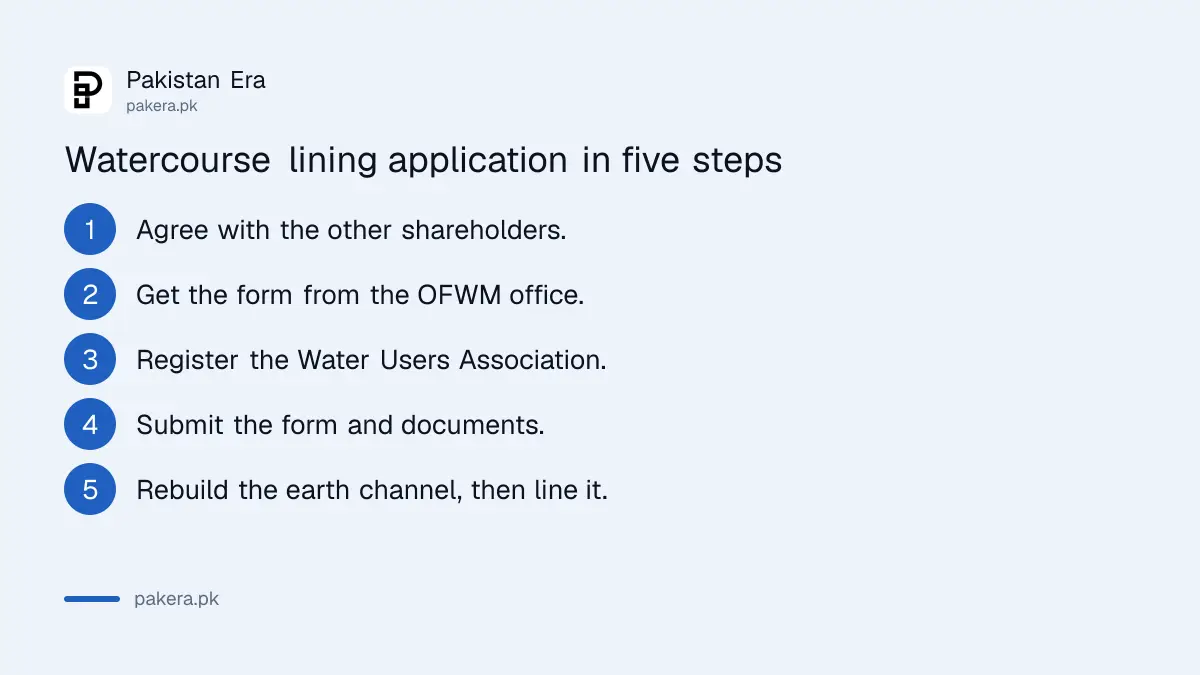
The application starts at the district or tehsil OFWM office. You can collect the form from the Deputy Director or Assistant Director Agriculture (OFWM), or download it from the OFWM website, then submit it with the required documents for an eligibility review.
- Meet the other shareholders on your watercourse and agree to take part and share labour.
- Visit the Deputy Director or Assistant Director Agriculture (OFWM) office for your district and ask for the application form.
- OFWM staff help the shareholders organise and register the Water Users Association.
- Fill in the form, attach the documents OFWM asks for, and submit it.
- After approval, rebuild the earthen channel, then lining and nakkas follow under OFWM supervision.
The head office is the Directorate General Agriculture (Water Management) at Agriculture House, 21-Davis Road, Lahore, phone (042) 99200703. District and tehsil office numbers are listed on the OFWM contact pages.
Water saved in the channel goes further with better field methods. Drip and sprinkler systems have their own drip irrigation subsidy in Punjab, and a level field wastes less water, which is the aim of the laser land leveller grant. This season's canal supply is set out in IRSA's rabi water plan.
Common questions
Who pays for watercourse lining in Punjab?
The government pays for all construction materials and technical guidance. The farmers on the watercourse pay all labour costs, including earth work, digging, back-filling and masons.
Can one farmer apply alone?
No. OFWM works through a Water Users Association, one for each watercourse. The shareholders must form and register it and agree to the cost sharing.
Is the whole watercourse lined?
No. OFWM lines the stretches that lose the most water, such as the head reach, raised sections, sandy soil and village crossings. The rest is rebuilt in earth.
Where do I get the OFWM application form?
From the Deputy Director or Assistant Director Agriculture (OFWM) office in your district, or from the OFWM website, the department says.
Does this cover tubewell watercourses?
Yes. OFWM also improves tubewell watercourses and irrigation schemes outside canal areas, often with pipes. There, the association also pays any material cost above the government's share.
How we verified this
What we checked, where we read it, and what we could not confirm.
We read the Punjab Agriculture Department's OFWM services page on 1 November 2026 for the cost sharing, selection rules, association duties, lining design and application steps, and the Directorate General contact page for the head office. The page gives no rupee cost per watercourse, no list of required documents and no waiting time, and we could not confirm current funding or open districts.
About the author

Global Affairs & Political Economy Writer
Muhammad Hatim is a book lover who started writing because he enjoys it. At Pakistan Era he writes about international relations, geopolitics and the global economy, with a particular interest in South Asia and the forces behind current events.