Which Fire Extinguisher for Your Home in Pakistan: NDMA's Five Fire Classes and How to Use One
Pick the right fire extinguisher for a home in Pakistan: NDMA's fire classes A, B, C, D and K, why ABC dry powder suits most homes, PASS steps and checks.
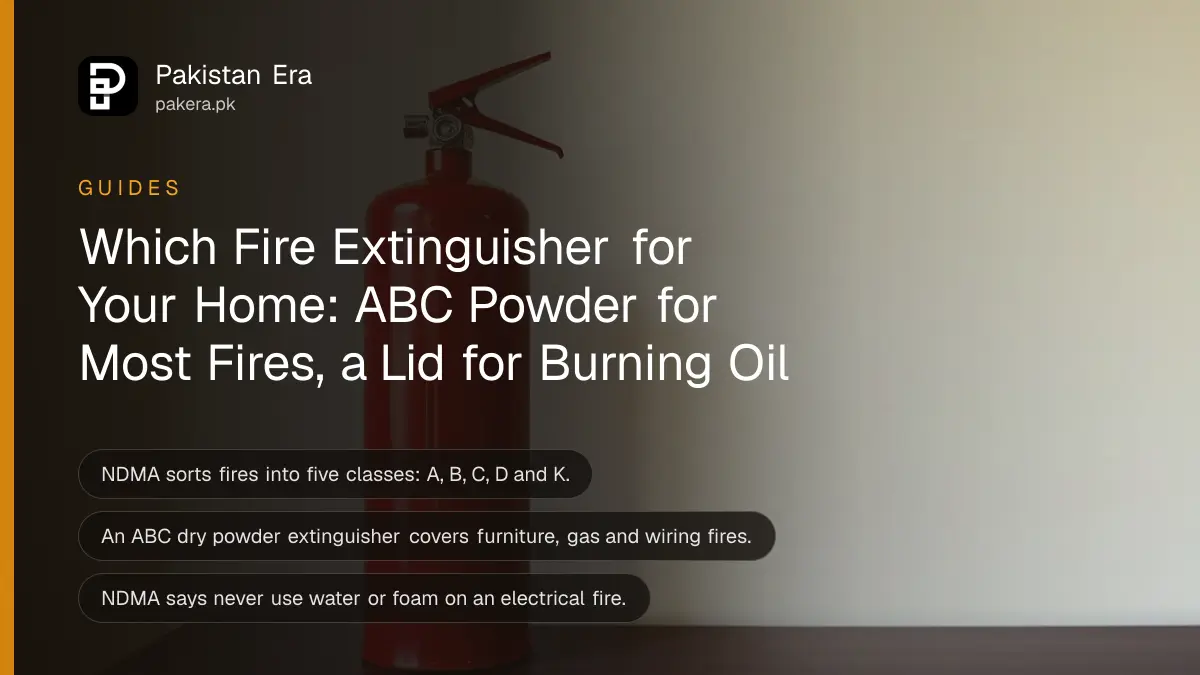
For most homes in Pakistan, an ABC dry powder extinguisher covers the common fires: paper, wood and cloth (Class A), gas and petrol (Class B) and wiring or appliances (Class C). NDMA's fire guidelines add two rules: never use water or foam on an electrical fire, and never use water on a burning pan of oil. If the fire is bigger than a waste bin, or the room is filling with smoke, leave and call 1122.
NDMA (the National Disaster Management Authority) tells households to keep an extinguisher near the stove and to know how to use it. Its Urban Fire Safety Guidelines, issued on 16 March 2026, sort fires into five classes and say which extinguisher fits each. The table below puts that on one screen.
NDMA sorts fires into five classes, and each needs a different extinguisher
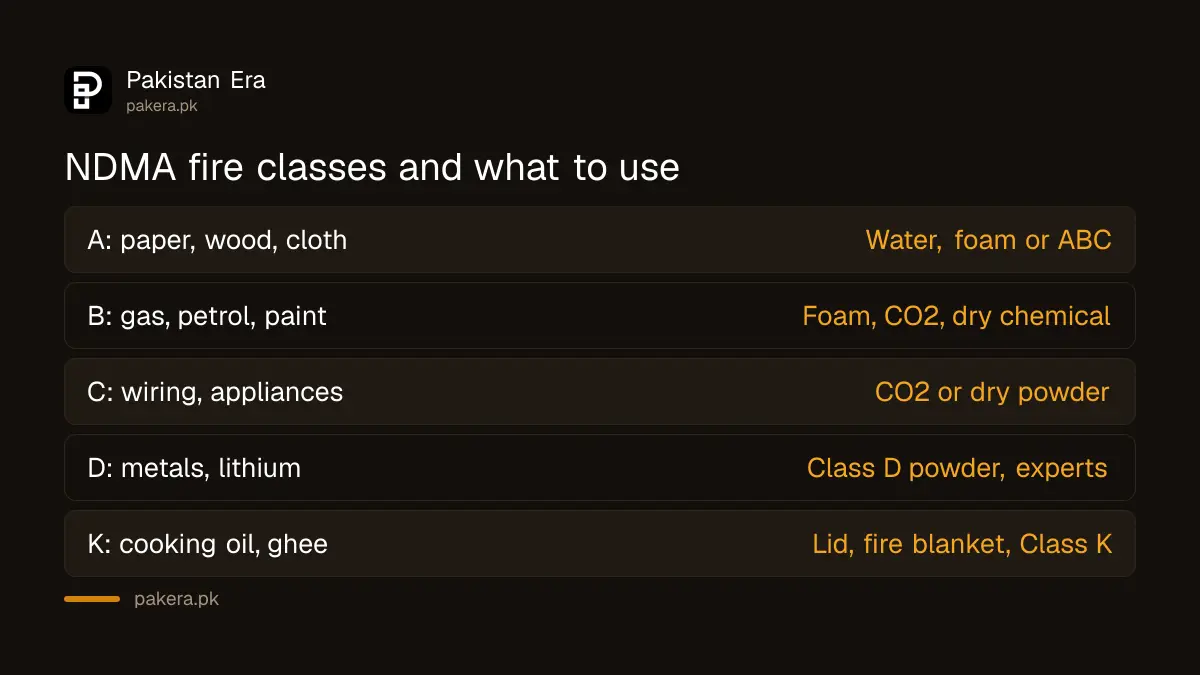
NDMA lists five fire classes: A for ordinary materials, B for flammable liquids and gases, C for electrical fires, D for metals and K for cooking oil. Using the wrong extinguisher can spread the fire, so match the class first.
| Class | What is burning | Use | Never use |
|---|---|---|---|
| A | Paper, wood, cloth, plastic, furniture | Water, foam or ABC extinguisher | Do not ignore smoke |
| B | Petrol, LPG, Sui gas, paint, alcohol, chemicals | Foam, CO2 or dry chemical | Water, which spreads burning liquid |
| C | Wiring, switches, appliances, transformers | CO2 or dry powder, after switching off the mains | Water or foam |
| D | Metals such as magnesium, sodium, lithium | Class D dry powder only, by trained staff | Water, foam or CO2 |
| K | Cooking oil, ghee, fryers | Metal lid, fire blanket or Class K wet chemical | Water, foam, CO2 or dry powder |
Class D fires are rare in homes. The one most families meet is a lithium battery, in a phone, power bank or e-bike. NDMA's advice for metal fires is to move away and call the fire brigade, not to fight it yourself.
An ABC dry powder extinguisher suits most Pakistani homes
An ABC dry powder extinguisher works on Class A, B and C fires, which covers furniture, a gas leak flame and a sparking heater. That makes it the practical single choice for a flat or house. Keep a lid or fire blanket for oil.
The letters on the label tell you what it is rated for. Look for "ABC" or the A, B and C pictograms on the body. A CO2 extinguisher, the one with a horn-shaped nozzle, is good for electrical fires and leaves no powder on equipment, but it is weak on Class A materials like a burning sofa.
Here is how the three common types compare for a home:
- ABC dry powder: covers A, B and C. Leaves a fine powder that needs cleaning. Best single choice.
- CO2: best for electrical and B fires. No residue. Not for oil pans, and less useful on wood or cloth.
- Water or foam: for paper, wood and cloth only. NDMA calls water and foam dangerous on Class B, C and K fires.
None of these is right for a pan of burning oil. NDMA says to turn off the heat and cover the pan with a metal lid or fire blanket, and its chart lists foam, CO2 and dry powder as the wrong tools there. Never carry the burning pan outside, and never throw water on it.
Use an extinguisher only on a small fire, with your exit behind you
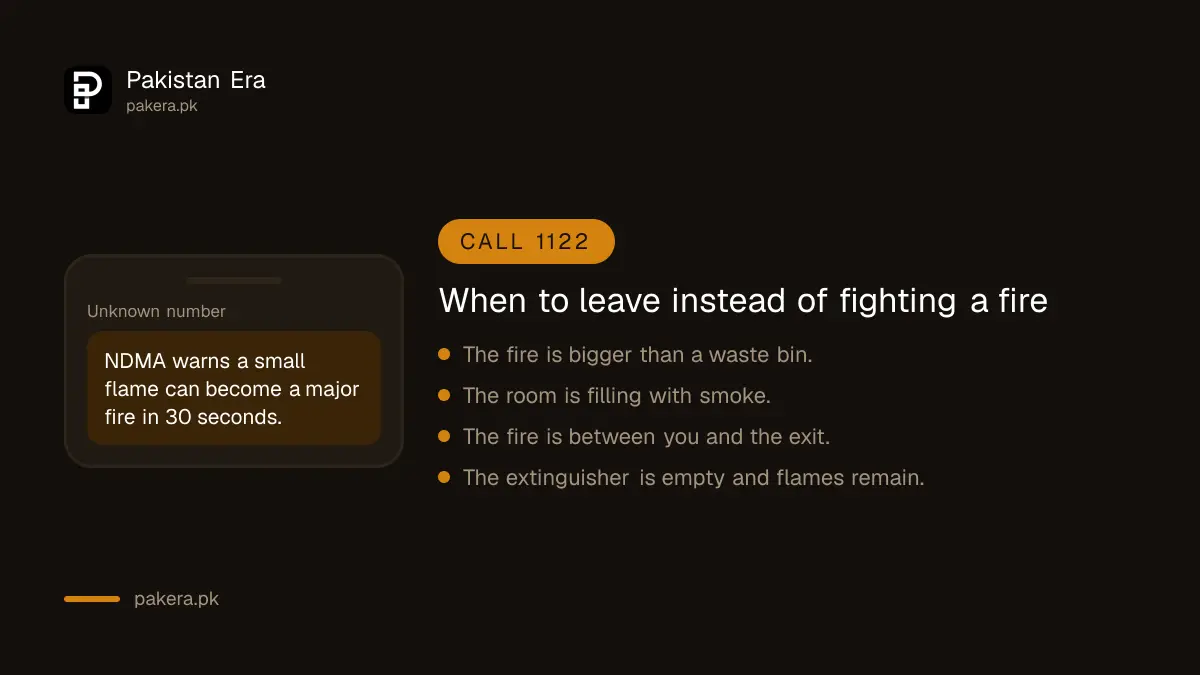
An extinguisher is for a fire the size of a waste bin, not a burning room. NDMA warns that a small flame can become a major fire with thick black smoke in 30 seconds. If it is spreading, leave, close the door and call 1122.
Before you pick it up, check three things:
- Everyone else is leaving or already out.
- The door or exit is behind you, not behind the fire.
- The room is not filling with smoke.
Then use the standard four steps, often remembered as PASS:
- Pull the safety pin. This breaks the seal.
- Aim the nozzle or horn low, at the base of the flames, not at the smoke.
- Squeeze the handle slowly and evenly.
- Sweep from side to side across the base until the fire is out.
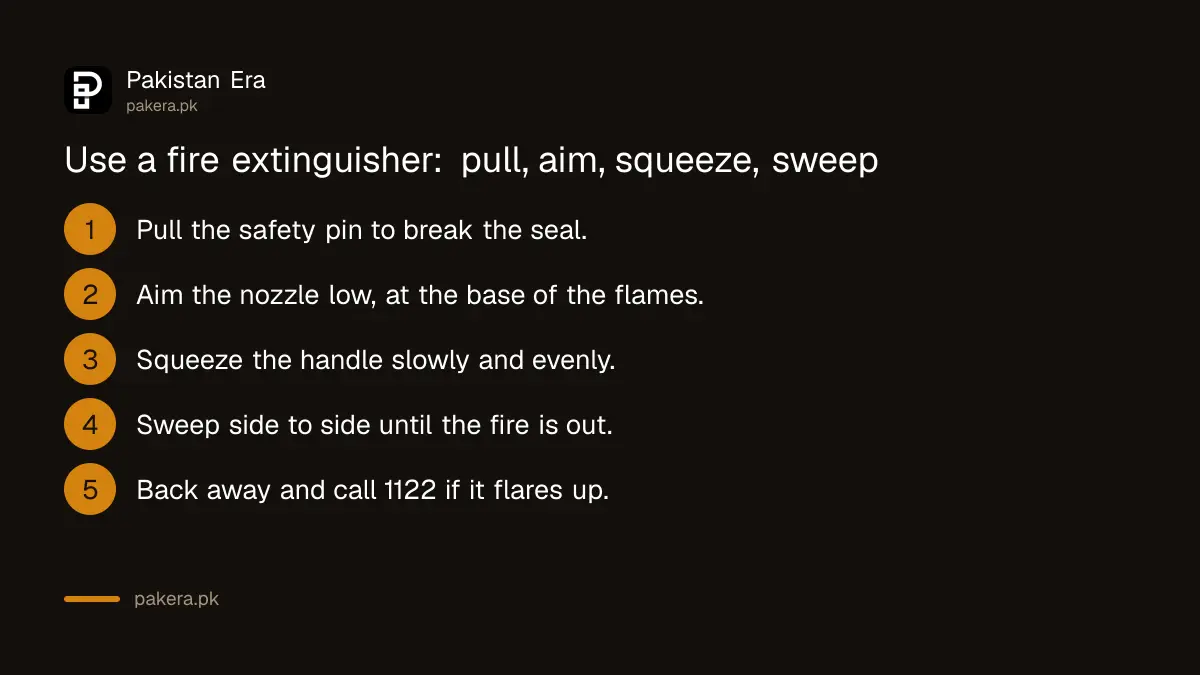
Back away once the flames are out, and keep watching. A small home extinguisher empties quickly, so if it runs out and the fire is still burning, get out. On an electrical fire, switch off the main breaker first if you can reach it safely. NDMA also says to cut off the fuel supply, such as the gas valve, on a gas fire. If you smell gas, do not touch any electric switch nearby.
Keep it near the stove and the exit, and check it every month
NDMA's daily safety habits say to keep a fire extinguisher near the stove. Mount it on a wall near the kitchen door, not behind the stove, so you can reach it while moving away from the fire. Check the gauge every month.
A simple monthly check takes a minute:
- The pressure gauge needle sits in the green band. Red means it needs a refill.
- The safety pin and its seal are in place.
- The hose or horn has no cracks and nothing blocks it.
- The body has no rust or dents.
- Everyone at home over school age knows where it is.
After any use, even a short burst, get it refilled. A half-used cylinder can lose pressure. Refilling and servicing are done by fire safety shops in most cities; ask for the service date to be written on the tag.
Commercial buildings in Punjab have their own rules. Rescue 1122 inspects buildings under the Punjab Community Safety Act 2021, and taller buildings need a safety certificate, covered in the Rescue 1122 building safety certificate.
Call 1122 first when the fire is bigger than you
Rescue 1122 runs emergency services in Punjab and several other regions. Dial 1122, or 16 for the fire brigade, give your full address and say what is burning. Do not go back inside.
| Need | Number |
|---|---|
| Fire, rescue, ambulance | 1122 |
| Fire brigade | 16 |
| Gas leak (SNGPL and SSGC) | 1199 |
| Police | 15 |
For the full escape plan, crawling low under smoke and what to do if trapped, see NDMA's house fire rules. If someone is burned, cool the burn under running water as set out in burn and scald first aid.
Common questions
Which fire extinguisher is best for a home in Pakistan?
An ABC dry powder extinguisher, because it works on ordinary materials, gas and electrical fires. Add a metal lid or fire blanket in the kitchen for oil fires.
Can I use water on an electrical fire?
No. NDMA lists water and foam as dangerous on electrical fires. Switch off the main breaker and use a CO2 or dry powder extinguisher.
Can a dry powder extinguisher put out a burning karahi?
NDMA's chart says not to use dry powder, CO2 or foam on cooking oil. Turn off the heat and cover the pan with a metal lid or fire blanket, or use a Class K wet chemical extinguisher.
How do I know if my fire extinguisher still works?
Check that the gauge needle is in the green, the pin and seal are intact and the hose is clear. Get it refilled after any use or if the needle is in the red.
Where should I keep the extinguisher at home?
Near the stove, as NDMA advises, but on the exit side of the kitchen so you can grab it while moving away from the fire.
What number do I call for a fire in Pakistan?
Dial 1122 for fire and rescue, or 16 for the fire brigade. For a gas leak, call your gas company on 1199.
How we verified this
What we checked and where we read it.
We checked the NDMA Urban Fire Safety Guidelines (dated 16 March 2026) on the NDMA guidelines page on 25 November 2026: the five fire classes, the do's and don'ts for each, and the daily habit of keeping an extinguisher near the stove. Rescue 1122's role and the Punjab Community Safety Act 2021 are from the Rescue 1122 building safety page. The PASS steps are the standard operating method for portable extinguishers. Last checked 25 November 2026.
Free on WhatsApp
Get last dates and rule changes on WhatsApp
We post new last dates, fee changes and fixes for common problems, a few short posts a day.
Follow Pakera on WhatsAppOther followers cannot see your number.
Pakera Solves It
Which online process wasted your time this week?
A portal that will not load, a form nobody explains, a complaint that went nowhere. Tell us. Every week we pick one, solve it step by step and publish the answer.
About the author

Lifestyle & Clothing Writer
Mahnoor Siddiqui is a lifestyle and clothing writer at Pakistan Era, joining the new lifestyle desk in November 2026.