Stamp Duty on an Assignable Deed in Punjab: 1% Within 12 Months, 2% After
Stamp duty on an assignable deed in Punjab is 1% within twelve months and 2% after, on each assignment, at the DC valuation table value. Rates and examples.
In Punjab, an assignable deed, the paper that passes your rights in a plot or house to someone who can pass them on again, now carries stamp duty of 1% of the property's value if the assignment is made within twelve months, and 2% beyond twelve months. The duty is charged on each assignment, on the District Collector's valuation table value or the deed price, whichever is higher.
| Item | Rule in Punjab |
|---|---|
| Law | Stamp Act 1899, Schedule I, Article 11-AA, added by the Stamp (Amendment) Act 2026 |
| In force from | Punjab Gazette of 6 May 2026 |
| Within twelve months | 1% of the value of the property |
| Beyond twelve months | 2% of the value of the property |
| Charged | On each assignment or transfer |
| Value used | DC valuation table, or the deed price if higher |
Until May 2026, the Stamp Act in Punjab had no separate line for this kind of deed. The 2026 amendment gave it its own definition, its own article and its own rate. If you are buying or selling property rights through a deed that lets the buyer sell them on, this is the rate you pay.
An assignable deed passes property rights that can be passed on again
The Stamp Act in Punjab defines an assignable deed as an instrument by which a person assigns his rights, title and interest in urban or rural property to another person, and entitles that person to reassign or transfer them to someone else or into his own name.
In plain words, it is the paper used when a property changes hands before, or instead of, a final registered sale deed, and the buyer keeps the right to sell it on. The key test is that onward right. A deed that sells property outright to you is a conveyance, which has its own rate, covered further down.
Because each new buyer can assign again, one plot can move through several assignable deeds. The Act charges duty "on each instance of assignment or transfer", so every link in that chain pays.
The rate is 1% within twelve months and 2% after twelve months
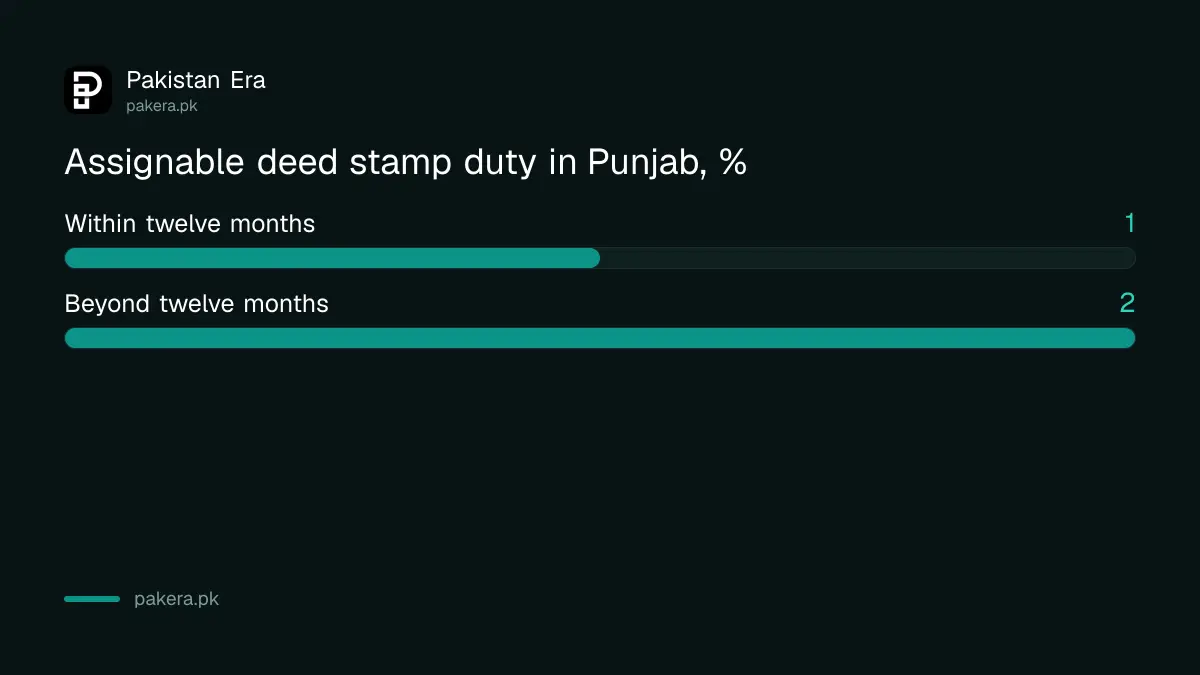
Article 11-AA sets two rates. An assignment within twelve months pays 1% of the value of the property. One made beyond twelve months pays 2%. Both apply to each assignment separately, and both are worked out on the valuation table value set by the District Collector.
| Value of the property | Within twelve months (1%) | Beyond twelve months (2%) |
|---|---|---|
| Rs 2,500,000 | Rs 25,000 | Rs 50,000 |
| Rs 5,000,000 | Rs 50,000 | Rs 100,000 |
| Rs 10,000,000 | Rs 100,000 | Rs 200,000 |
| Rs 20,000,000 | Rs 200,000 | Rs 400,000 |
The examples are our own arithmetic at the two rates. The Schedule does not print a date from which the twelve months run, so keep the dates of every earlier deed in your chain and ask the e-stamp officer or Sub-Registrar which date they measure from before you buy the stamp paper. On a Rs 10 million plot, the difference between the two rates is Rs 100,000.
The value comes from the DC valuation table, not your agreed price
Section 27-A of the Stamp Act now lists Article 11-AA among the instruments valued by the District Collector's valuation table for the area. If the price written in your deed is higher than the table value, the higher deed price is used instead. You cannot pay on a lower figure.
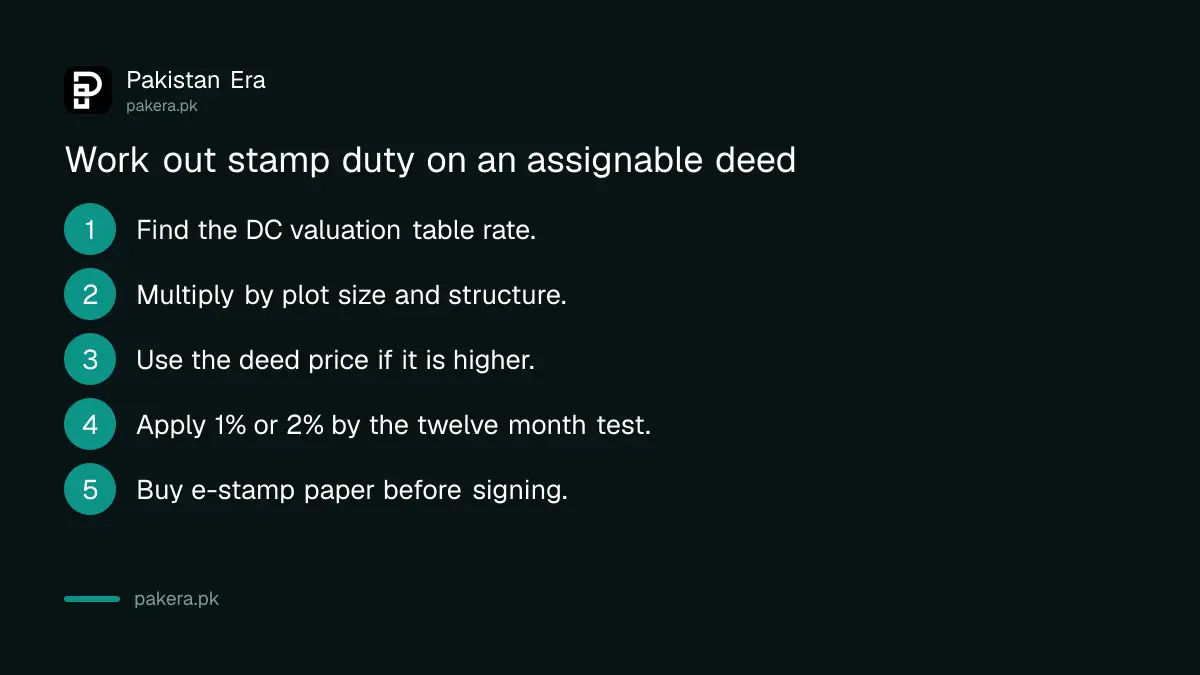
- Find the per marla or per square foot rate for your locality in the district's notified valuation table, explained in DC valuation of property.
- Multiply it by the size of the plot, and add the structure at its covered area if there is a building.
- Compare that figure with the price in your deed and use the higher one.
- Apply 1% or 2%.
Where a building has no approved plan, section 27-A adds a further two percent of the land value as duty. If you think the table value for your area is wrong, the Act lets you appeal to the Commissioner within thirty days of the table being notified, and the Commissioner must decide within fifteen days.
A final sale deed pays 2% in urban areas and 1% elsewhere
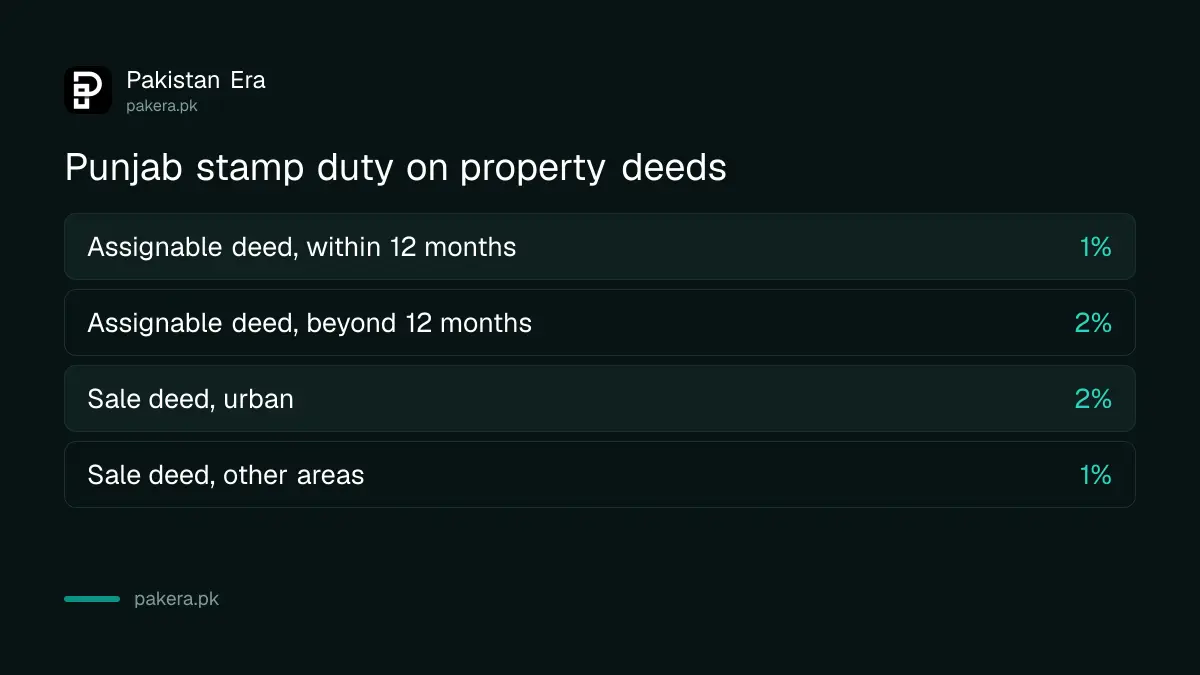
When the property is finally sold outright, the sale deed is a conveyance under Article 23, not an assignable deed. It pays 2% of the value for urban property and 1% in other areas. The same 2026 Act cut the rate for non-urban property from 3% to 1%.
| Instrument in Punjab | Stamp duty |
|---|---|
| Assignable deed, within twelve months | 1% of value |
| Assignable deed, beyond twelve months | 2% of value |
| Sale deed (conveyance), urban property | 2% of value |
| Sale deed (conveyance), other areas | 1% of value |
| Extra duty when a conveyance is registered | Rs 500 up to Rs 500,000, Rs 1,000 above |
So an investor who assigns rights twice and then lets the last buyer take a sale deed can pay duty three times. A buyer who plans to live in the property avoids those repeated charges by taking a direct sale deed. Registration of the sale deed is a separate step, set out in PLRA e-registration of property. Federal taxes on the sale are separate again, as explained in property transfer tax in Pakistan.
Pay the duty on e-stamp paper before you sign
Stamp duty in Punjab is paid through an e-stamp paper bought for the exact amount before the deed is signed. An instrument that is not duly stamped cannot be used as evidence, and it can be impounded with a penalty when it is produced before an officer or court.
- Work out the value from the valuation table and the deed price, and pick the higher.
- Work out 1% or 2% depending on the twelve month test.
- Generate the e-stamp paper for the assignable deed in the names of both parties.
- Pay at the bank or online and print the paper.
- Write and sign the deed on it, with witnesses.
- Check the e-stamp is genuine, and keep copies of every earlier deed in the chain.
A fake or reused stamp paper leaves the deed unstamped in law. Before you hand over money, check the Punjab e-stamp paper is genuine using its number.
Common questions
What is the stamp duty on an assignable deed in Punjab?
1% of the property's value for an assignment within twelve months, and 2% beyond twelve months, under Article 11-AA.
When did the assignable deed rate start?
It was added by the Stamp (Amendment) Act 2026, published in the Punjab Gazette on 6 May 2026.
Is the duty paid only once on a plot?
No. It is charged on each assignment or transfer, so every sale of the rights pays again.
Which value is used, the DC rate or my price?
The valuation table value, unless the price in your deed is higher. Then the deed price is used.
Is the sale deed stamp duty in Punjab 1% now?
Only for property outside urban areas. Urban property still pays 2% on a sale deed.
Does the assignable deed rate apply to rural land?
Yes. The definition covers property in urban or rural areas, and Article 11-AA has the same 1% and 2% rates for both.
How we verified this
What we checked and where we read it.
We checked these on 25 November 2026: the Stamp Act 1899 as applicable in Punjab on the Punjab Code, consolidated to the Stamp (Amendment) Act 2026 (XXIV of 2026, Punjab Gazette Extraordinary, 6 May 2026, pages 5839 and 5840): section 2(1) for the definition of an assignable deed, section 27-A for valuation and appeals, section 35 on unstamped instruments, and Schedule I Articles 11-AA and 23. The rupee examples are our arithmetic at the printed rates. The Schedule gives the twelve month test as "within twelve months" and "beyond twelve months" without naming the starting date, which is why we advise confirming it at the counter. The Punjab Code portal holds the consolidated text.
Free on WhatsApp
Get last dates and rule changes on WhatsApp
We post new last dates, fee changes and fixes for common problems, a few short posts a day.
Follow Pakera on WhatsAppOther followers cannot see your number.
Pakera Solves It
Which online process wasted your time this week?
A portal that will not load, a form nobody explains, a complaint that went nowhere. Tell us. Every week we pick one, solve it step by step and publish the answer.
About the author

Senior Writer, Public Services and Technology
Shahid joined us in 2024 as an author. He is a senior contributor to Pakistan's leading technology websites. He writes detailed articles, mostly covering his expertise in the latest tech, mobiles, apps, gadgets, and step-by-step guides. His ideology is to help people understand the latest trends and explain complex methods through very easy-to-understand guides.