Who Can Collect Your Passport in Pakistan: You or a Blood Relative, DGI&P Says
Who can collect your Pakistani passport? DGI&P says only you or a blood relative, on the given date, and each person needs their own booklet. See rules.
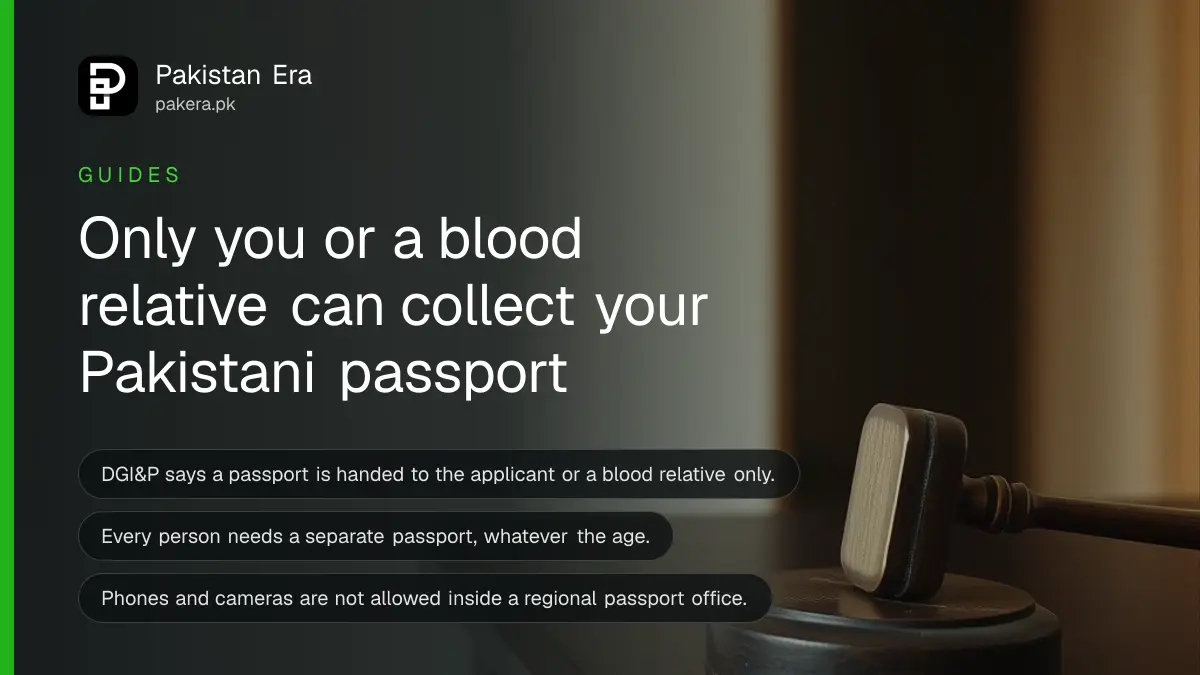
Short answer: DGI&P says a passport is handed over only to the applicant or a blood relative, on the date given. It will not give it to an "irrelevant person". Every person needs a separate passport, and children's names cannot be added to a parent's machine-readable passport.
A brother stands in a queue for you. A cousin offers to pick up a passport on the way home. A neighbour says he knows the staff. The passport office has one clear rule for all of them, and it is stricter than most people expect.
We read the Directorate General of Immigration and Passports (DGI&P) page on ordinary passports on 14 October 2026. Its General Guidelines list the collection rules. We did not test them at a counter.
Only you or a blood relative can collect it
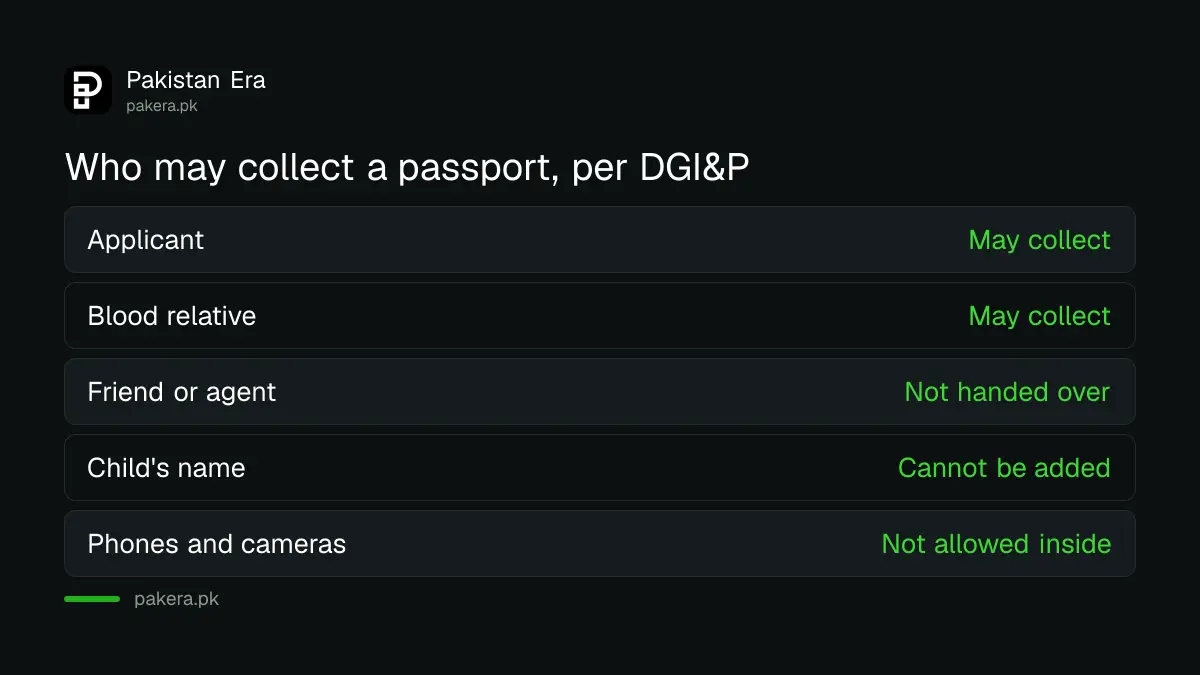
DGI&P's guidelines say a passport will be delivered only to the applicant, or to his or her blood relatives, on the given date. Passports to "irrelevant persons" would not be delivered. A friend, an agent or a neighbour does not qualify.
The page does not define blood relative or list what proof the relative must bring. We could not confirm whether a letter, an authority paper or the relative's own CNIC is needed. Ask the office what it checks, and bring more than you think you need.
The simplest plan is to collect it yourself, or choose delivery to your door. Our guide to passport home delivery through TCS shows how.
Every person needs a separate passport
DGI&P says a separate passport is issued to each applicant, whatever the age. All endorsements, including the names of children on a parent's passport, are not allowed in the machine-readable passport. A baby needs a booklet of its own.
Plan this when you travel as a family. Each child needs documents and a visit, and the parents' papers must come too. Read the guide to getting a passport for a child, and for separated parents, the custody papers DGI&P asks for.
| Rule | What DGI&P says |
|---|---|
| Who collects | The applicant or a blood relative, on the given date |
| Other people | No delivery to irrelevant persons |
| One passport each | A separate passport for every applicant, any age |
| Children on a parent's book | Not allowed in the machine-readable passport |
| Phones and cameras | Not allowed inside a regional passport office |
| Companions | Only the applicant should enter; others wait outside |
Two delivery times appear on the same page
DGI&P's page gives two sets of figures. A table says normal passports take 21 working days and urgent ones 5, and Fast Track 2. The General Guidelines say delivery comes after four working days for urgent and ten for normal. The page does not explain the gap.
Our reading is that the table counts the full cycle and the guideline counts a stage of it, but DGI&P does not say so, and we cannot confirm. Use the 21 and 5 day figures when you plan travel, and treat anything faster as a bonus. Check your status with passport tracking in Pakistan.
Also watch the clock after your passport is ready. Do not leave a ready passport waiting at the office. Our note on the six month rule for uncollected passports explains the limit.

Follow these steps on collection day
Go on the date you were given, bring your slip and your CNIC, and take only what you need. If a relative collects, send them with a copy of your CNIC and their own original CNIC. Leave phones and cameras at home or in the car.
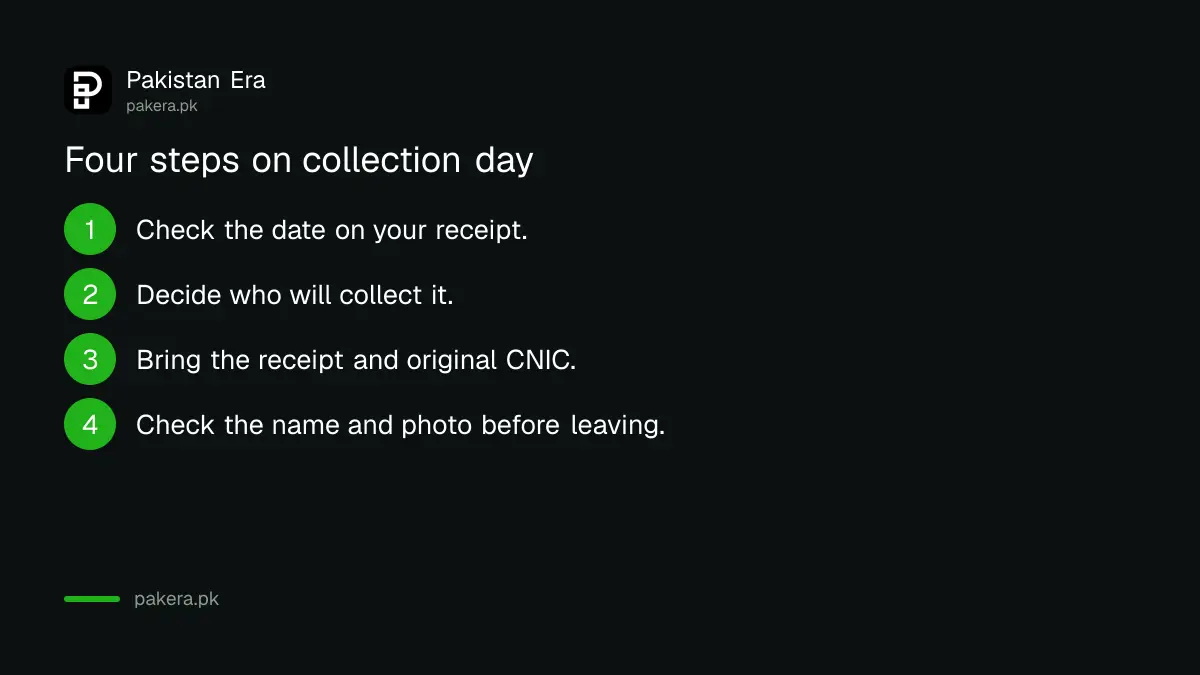
- Check the date on your receipt and track the status first.
- Decide who will collect: you, or one blood relative.
- Bring the receipt, the original CNIC of the collector and a copy of yours.
- Leave arms, phones and cameras outside, because DGI&P prohibits them inside.
- Check the name, number and photo on the passport before you leave the counter.
If something is wrong, file a passport complaint with DGI&P at once.
Avoid agents who promise to collect it
Some people pay an agent to join the queue or collect the passport. DGI&P's rule does not mention agents, and says a passport is given to the applicant or a blood relative. An agent may be turned away at the counter, and you may lose your slot and your money.
If you live abroad and cannot attend, use the options DGI&P offers instead: the online renewal portal for overseas applicants, or the nearest Pakistan mission. Never hand your CNIC and receipt to a stranger.
Common questions
Can my friend collect my passport?
No. DGI&P says it is delivered only to the applicant or a blood relative.
Can my child be added to my passport?
No. DGI&P says endorsements, including children's names, are not allowed in the machine-readable passport, and each person gets a separate one.
What proof does a relative need?
DGI&P's page does not say. Bring the relative's original CNIC and a copy of yours, and ask the office.
How long does delivery take?
The table on DGI&P's page says 21 working days for normal, 5 for urgent and 2 for Fast Track. The guidelines give shorter figures. Plan with the longer ones.
Can I take my phone inside?
No. DGI&P says bringing arms, a camera or a mobile phone into a regional passport office is prohibited.
How we verified this
What we checked, where we read it, and what we could not confirm.
Last checked on 14 October 2026, Pakistan time. We read DGI&P's ordinary passport page. We could not find what proof a relative must show or why the two delivery times differ, and we did not test collection at a counter. Confirm both at your office.
About the author

Tax, Bills and Technology Writer
Ali Akhtar is a young and curious voice here at Pakistan Era. He is currently pursuing his A-Levels and has a growing interest in Pakistan’s changing industrial landscape and educational trends. Ali likes to write in a way that helps him explain and explore the world around him. His writing reflects the perspective of the new generation navigating the evolving trends of Pakistan where technology, youth innovation, and shifting opportunities are reshaping the country’s future.