How to Get a Child's Passport in Pakistan When Parents Are Divorced or Separated
Child passport in Pakistan with divorced parents: DGI&P asks for court custody papers and the other parent's presence or stamp paper consent. See steps.
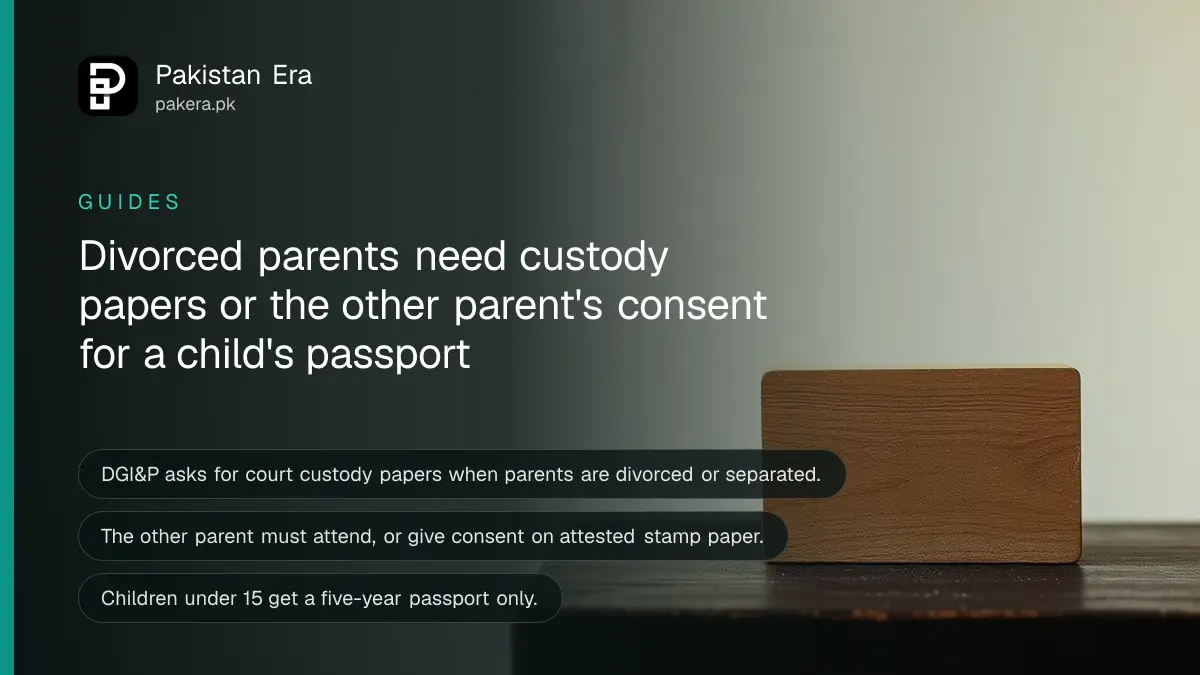
Short answer: If a child's parents are divorced or separated, DGI&P wants the court's custody papers. If only one parent applies, the other parent must come in person, or send consent on attested non-judicial stamp paper. A guardian needs a court guardianship certificate. Children under 15 get a five-year passport.
A child's passport is simple when both parents live together and walk in with a folder. It gets hard when the parents have split and one of them is abroad, silent or unwilling. A father waiting at the counter with a mother's missing signature is a common story.
We read the Directorate General of Immigration and Passports (DGI&P) page on ordinary passports and its FAQ on 14 October 2026. The rules below come from that page, which cites the Passport Rules 2021. We did not file a child's application ourselves.
Both parents' papers are the starting point
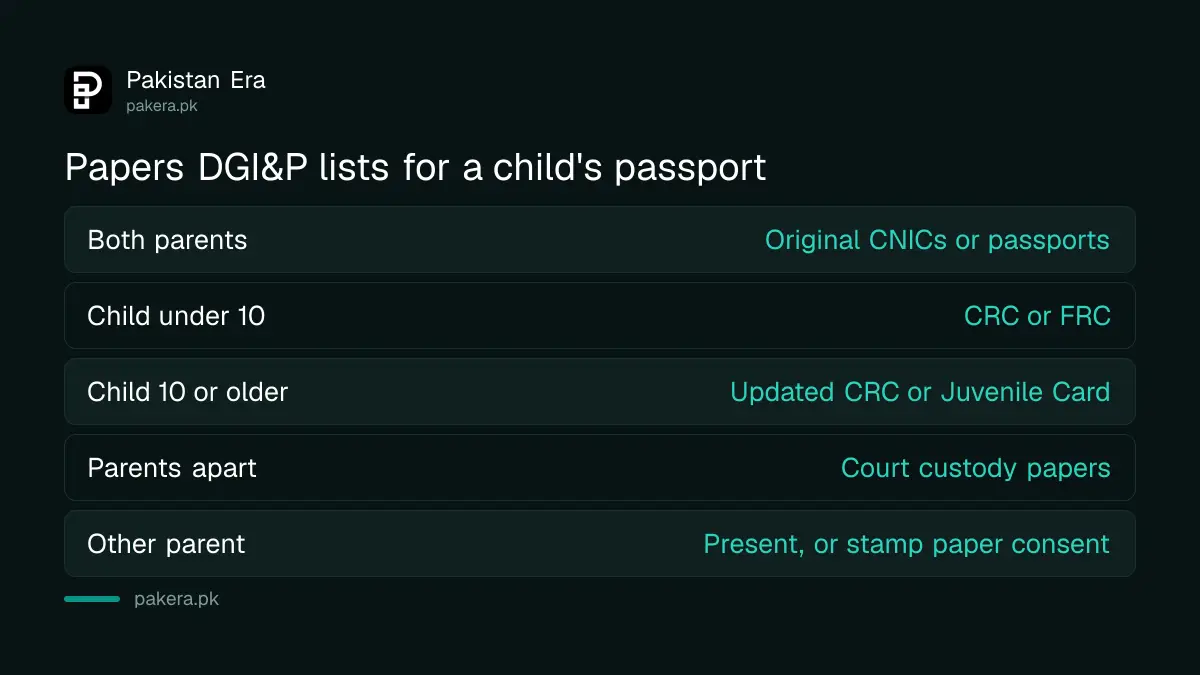
DGI&P says a minor must be accompanied by either parent or a court-appointed legal guardian, with the original valid CNICs or passports of both parents. This is the rule even for a married couple, so a separated parent must still produce the other parent's documents or the proof set out below.
The child needs a document too. DGI&P, citing NADRA's revised policy, says a child aged 10 or older must bring an original updated Child Registration Certificate (CRC) with fingerprints and photograph, or a Juvenile Card. A child under 10 can bring a CRC (Form B) or a Family Registration Certificate (FRC).
Our guide to getting a passport for a child in Pakistan covers the plain case. This page covers what changes when the parents are apart.
Custody papers and the other parent's consent decide the case
DGI&P says that if the parents are separated or divorced, you bring custody papers granted by a court of law. If either parent applies alone, the other parent must be physically present, or must give consent on duly attested non-judicial stamp paper.
| Situation | What DGI&P asks for |
|---|---|
| Parents divorced or separated | Custody papers granted by a court |
| One parent applies alone | Other parent present in person, or consent on attested non-judicial stamp paper |
| A guardian applies | Court guardianship certificate, and the guardian attends with the child and original CNIC |
| One parent has died | Original death certificate with a photocopy |
| Child has a dual nationality | Foreign passport and a photocopy |
| Earlier passport was lost | Police report that gives the old passport number |
If custody is still being argued, the court route comes first. Read how child custody works in a Punjab family court and how guardianship differs from custody, because DGI&P asks for the court's paper and not for a family agreement alone.
Follow these steps at the passport office
Collect the papers, bring the child and the applying parent or guardian, and go to a Regional Passport Office. DGI&P's process runs from photograph and token, through fingerprints and data entry, to an interview and fee payment by QR code.
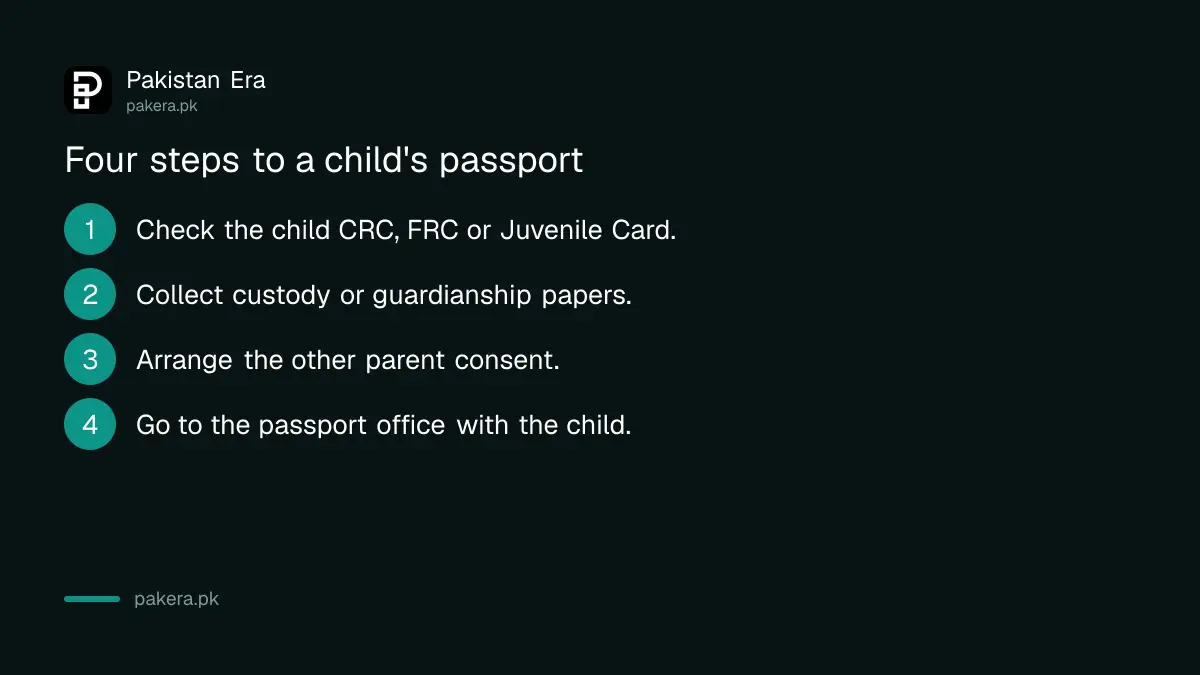
- Check the child's CRC, FRC or Juvenile Card is current, and fix it at NADRA first if it is not.
- Get the court custody papers or guardianship certificate, with attested copies.
- Ask the other parent to come, or prepare consent on attested non-judicial stamp paper.
- Bring original CNICs or passports of both parents, and photocopies.
- Go to the passport office with the child, and keep your token and receipt.
The step by step counter flow is in our walk-through of a passport application at the counter. If a parent is abroad and cannot attend, ask the office whether a consent signed before a Pakistani mission or notary is accepted. DGI&P's page only names attested non-judicial stamp paper, so we cannot confirm other forms.
Validity and fee for a child's passport
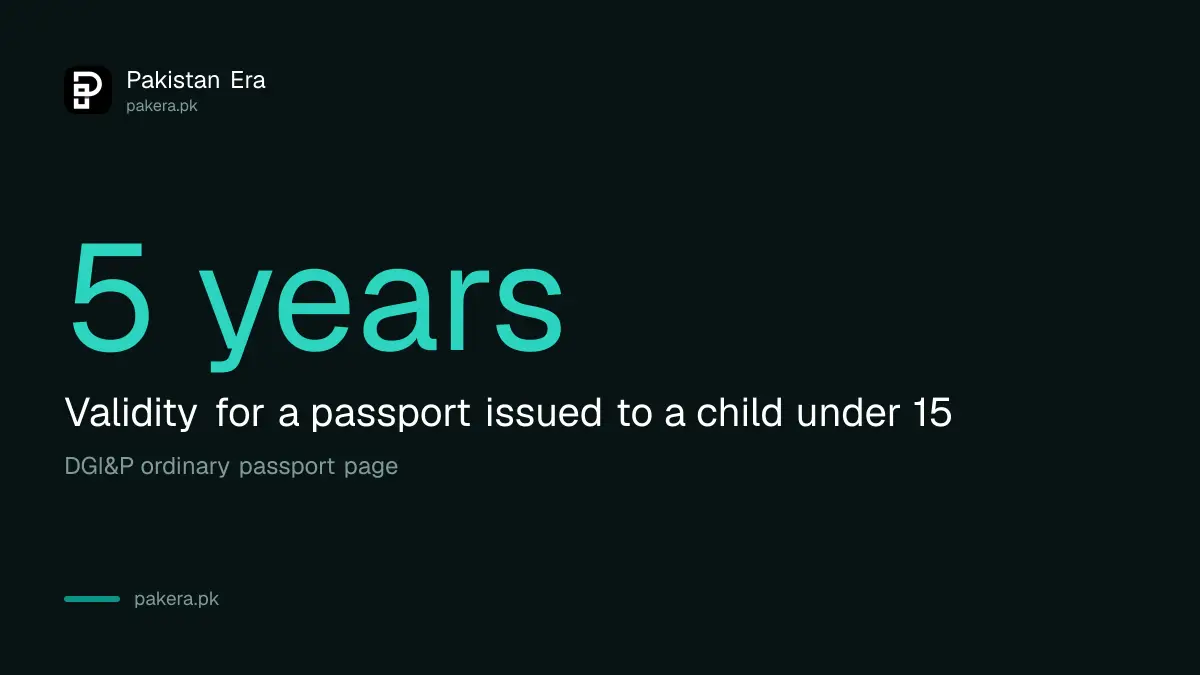
DGI&P says children under 15 get a passport valid for five years only. On the fee table we read, a 36-page e-Passport for five years costs Rs 9,000 normal or Rs 15,000 urgent. That page also says normal passports take 21 working days and urgent ones 5.
Since 15 October, reports say new applications are e-Passports only. Our note on the end of machine-readable passports explains the change, so confirm the current fee with the office on the day. Fast Track is not available for the e-Passport, according to the same DGI&P page.
Common questions
Can one parent get a passport for the child alone?
Only with the other parent's presence or written consent. DGI&P says that if the parents are divorced or separated and one applies, the other must attend, or give consent on attested non-judicial stamp paper.
What if I have sole custody?
Bring the court order granting custody. DGI&P lists custody papers for separated or divorced parents. Ask the office if the order alone is enough in your case.
What if the other parent will not cooperate?
DGI&P's page does not set out a refusal route. A court order on custody or guardianship is the paper it names, so speak to a family lawyer.
Does a guardian need to be at the counter?
Yes. DGI&P says the appointed guardian must visit the passport office personally with the child and bring an original CNIC and a photocopy.
How long is a child's passport valid?
Children under 15 get five years only, according to DGI&P.
How we verified this
What we checked, where we read it, and what we could not confirm.
Last checked on 14 October 2026, Pakistan time. We read DGI&P's ordinary passport page and its FAQ. We did not read the full Passport Rules 2021, and we could not confirm what the office does when a parent refuses consent. Ask the regional office before you travel with the child.
About the author

Tax, Bills and Technology Writer
Ali Akhtar is a young and curious voice here at Pakistan Era. He is currently pursuing his A-Levels and has a growing interest in Pakistan’s changing industrial landscape and educational trends. Ali likes to write in a way that helps him explain and explore the world around him. His writing reflects the perspective of the new generation navigating the evolving trends of Pakistan where technology, youth innovation, and shifting opportunities are reshaping the country’s future.