Child Guardianship in Pakistan and How It Differs From Custody
A mother with custody may still need a guardianship order to deal with a child's property, bank account or documents. Two separate things.
Custody and guardianship are two different things, and a mother with custody may still need a guardianship order to sell property, open a bank account or sign for a passport.
Families discover this at the bank counter or the passport office, long after the custody question was settled.
We read the Family Courts Act, 1964 on 4 September 2026, in the text published by the Law and Parliamentary Affairs Department of the Government of the Punjab on its own law portal.
Two separate things the same court decides
| Custody | Guardianship | |
|---|---|---|
| What it settles | Who the child lives with | Who acts for the child in law |
| Typical use | Day to day care and residence | Property, banking, travel documents |
| In the Schedule | Custody of children, and visitation | Guardianship, listed separately |
| Where it is heard | Family Court | Family Court |
Part I of the Schedule to the Act lists custody of children and the visitation rights of parents to meet them as one entry, and guardianship as another. They are separate matters, decided in the same forum.
Our guide to child custody in a Punjab family court covers the custody side, and our guide to claiming maintenance covers the money.
The family court has the powers of a District Court
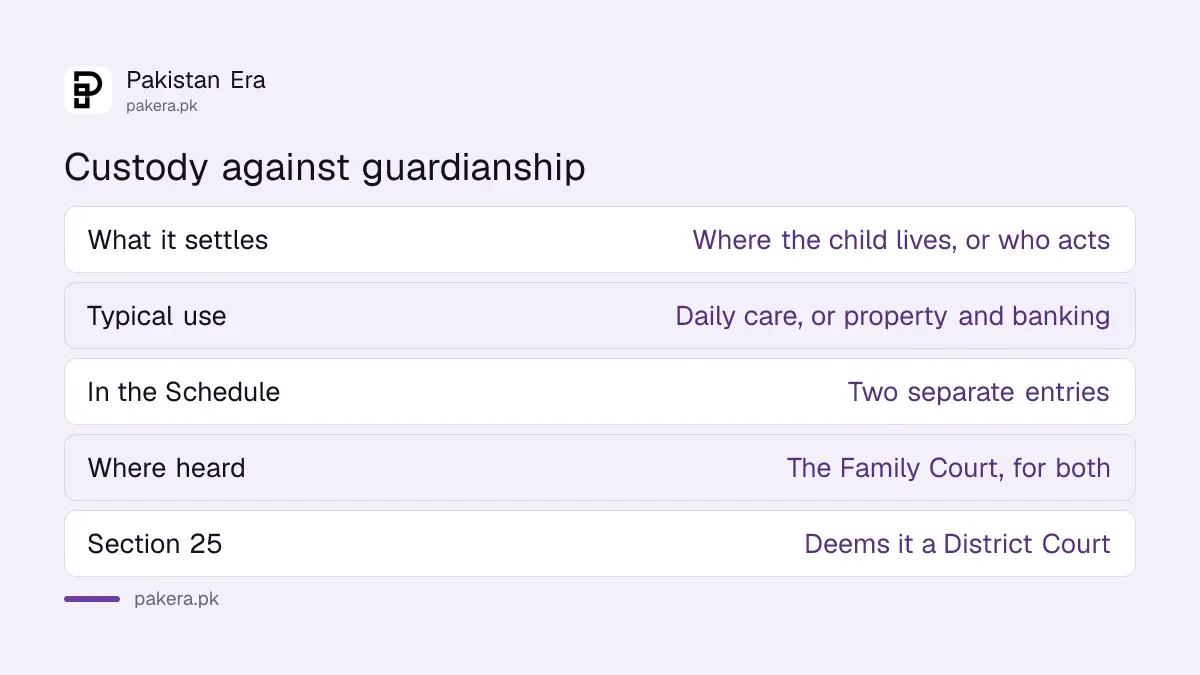
Section 25 of the Act is short and it matters. A Family Court is deemed to be a District Court for the purposes of the Guardians and Wards Act, 1890.
That is the reason you do not go to a separate court for a guardianship certificate. The family court exercises the District Court's powers under the 1890 Act, so custody and guardianship can be dealt with in the same place.
The Act also deals with cases that were already running when it came into force. A suit or application under the Guardians and Wards Act, 1890 pending immediately before the Act commenced continues as if the Act were not in force, and one dismissed only on the ground that a Family Court should hear it can, on a party's petition, be tried by that court from the stage it had reached.
When guardianship is what you actually need
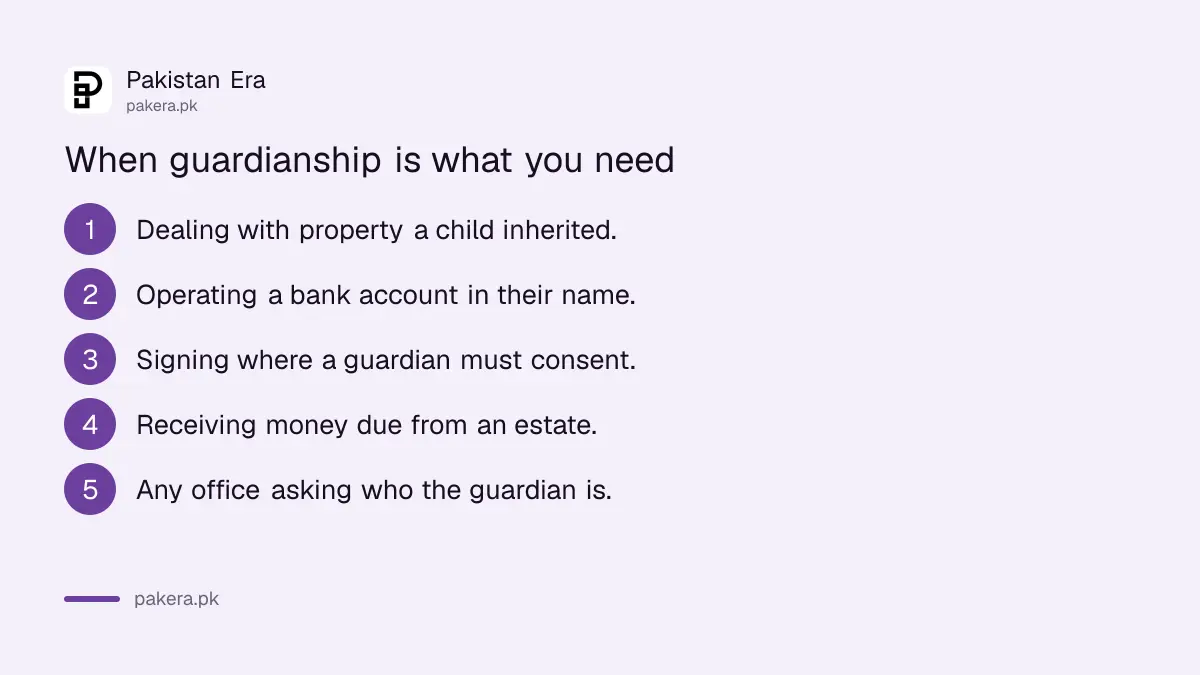
Custody answers where the child sleeps. Guardianship answers who can act on the child's behalf, and institutions ask for it.
- Dealing with property a child has inherited.
- Operating or closing a bank account in the child's name.
- Signing for documents where a guardian's consent is required.
- Receiving money due to the child from an estate or a scheme.
- Any matter where a bank or office asks who the legal guardian is.
This comes up most often after a father's death, where the mother has the children living with her and assumes nothing further is required. She may hold custody in fact, and still be asked to produce an order before a bank will let her act.
Our guide to how inheritance shares are worked out covers what a child is entitled to, which is a separate question from who may deal with it on their behalf.
The court can freeze property while the case runs
Section 21A allows a Family Court to pass an interim order to preserve and protect any property in dispute in a suit, and any other property of a party, where preserving it is considered necessary to satisfy the decree if and when it is passed.
In a guardianship dispute over a child's inheritance, that is the provision to raise early. An order made after the property has been sold is worth much less than one made before.
What to bring
The court is deciding who should act for a child, so the file should answer that question rather than argue about adults.
Bring the child's birth registration or B Form, your CNIC, the death certificate where a parent has died, evidence of the property or account in question, and anything showing your existing role in the child's life such as school records naming you.
Our guides to the NADRA B Form and applying for a death certificate cover two of those documents. Nothing here is legal advice, and a guardianship application is a matter for a family lawyer.
Where the child's own view fits
The Act does not set out an age at which a child chooses, and we are not going to invent one, because the sections we read do not contain it.
What we can say is that both custody and guardianship sit in the same Schedule and are decided by the same court, and that welfare considerations run through this area of law. Ask a family lawyer how a child's preference is treated in your specific circumstances rather than relying on a figure repeated online.
This is the Punjab statute
The Act we read states that it extends to the whole of the Punjab. Family law is administered provincially, and each province has its own family courts legislation with its own amendments and numbering.
The broad structure is similar across the country, but do not quote a section number outside Punjab without checking the version that applies there.
Common questions
Is custody the same as guardianship?
No. Custody concerns where the child lives. Guardianship concerns who may act for the child in law. Both appear separately in Part I of the Schedule.
Which court hears a guardianship case?
The Family Court, which section 25 deems to be a District Court for the purposes of the Guardians and Wards Act, 1890.
I have custody. Do I still need guardianship?
Often yes, if you need to deal with the child's property, bank account or documents. Institutions ask for the legal guardian.
Can property be protected while the case runs?
Section 21A allows an interim order to preserve and protect property in dispute and other property of a party.
At what age does a child choose?
The sections we read do not state an age, so we do not quote one. Ask a family lawyer about your circumstances.
Does this apply outside Punjab?
The Act extends to the whole of the Punjab. Other provinces administer their own family courts legislation.
How we verified this
What we checked, where we read it, and what we could not confirm.
Last checked 4 September 2026. We read the Family Courts Act, 1964, Act XXXV of 1964, in the text published by the Law and Parliamentary Affairs Department, Government of the Punjab, on the Punjab Code portal, having downloaded the department's own PDF of the Act. Section 25, deeming a Family Court to be a District Court for the purposes of the Guardians and Wards Act, 1890, the transitional provisions on suits and applications under that Act pending or dismissed when the Act came into force, section 21A on interim orders preserving and protecting property in dispute and other property of a party where necessary to satisfy the decree, and the Part I Schedule listing custody of children and visitation rights and guardianship as separate entries, are all taken from that text. The Act states that it extends to the whole of the Punjab. We did not read the Guardians and Wards Act, 1890 itself, so no section, age, procedure or fee from that Act is quoted here, and the article does not state an age at which a child's preference is taken, because the text we read does not contain one. This is a summary of what the statute says and not legal advice.
About the author

Public Services and Education Journalist
Fajr Riaz is a journalist and content writer at Pakistan Era, based in Lahore. She covers the questions people meet in everyday life in Pakistan: how a public service works, what a change in the rules means, and where to find a reliable answer.