Women Facilitation Centres in Pakistan's Courts: First 4 Planned, One per Province, Plus an E-Filing Pilot for Family Cases
The Chief Justice said on 12 November 2026 that four Women Facilitation Centres will open in courts, one per province, and family case e-filing is coming.
یہ صفحہ اردو میں پڑھیں
Short answer: The Chief Justice of Pakistan said on 12 November 2026 that the first four Women Facilitation Centres will open in courts, one in each province, as a one-window desk for women using the justice system. Space for all four has been found and NESPAK has been told to start work. The same day, he discussed an e-filing pilot for family cases with bar councils. Neither has a launch date yet.
We read both Press Information Department releases, PR No. 140 and PR No. 141, on pid.gov.pk on the evening of 12 November. The two meetings were held at the Supreme Court in Islamabad. One was under the Law and Justice Commission, which the Chief Justice chairs. The other was under the National Judicial (Policy Making) Committee, which he also chairs. Here is what each plan means for a woman with a case in court, and what is still missing.
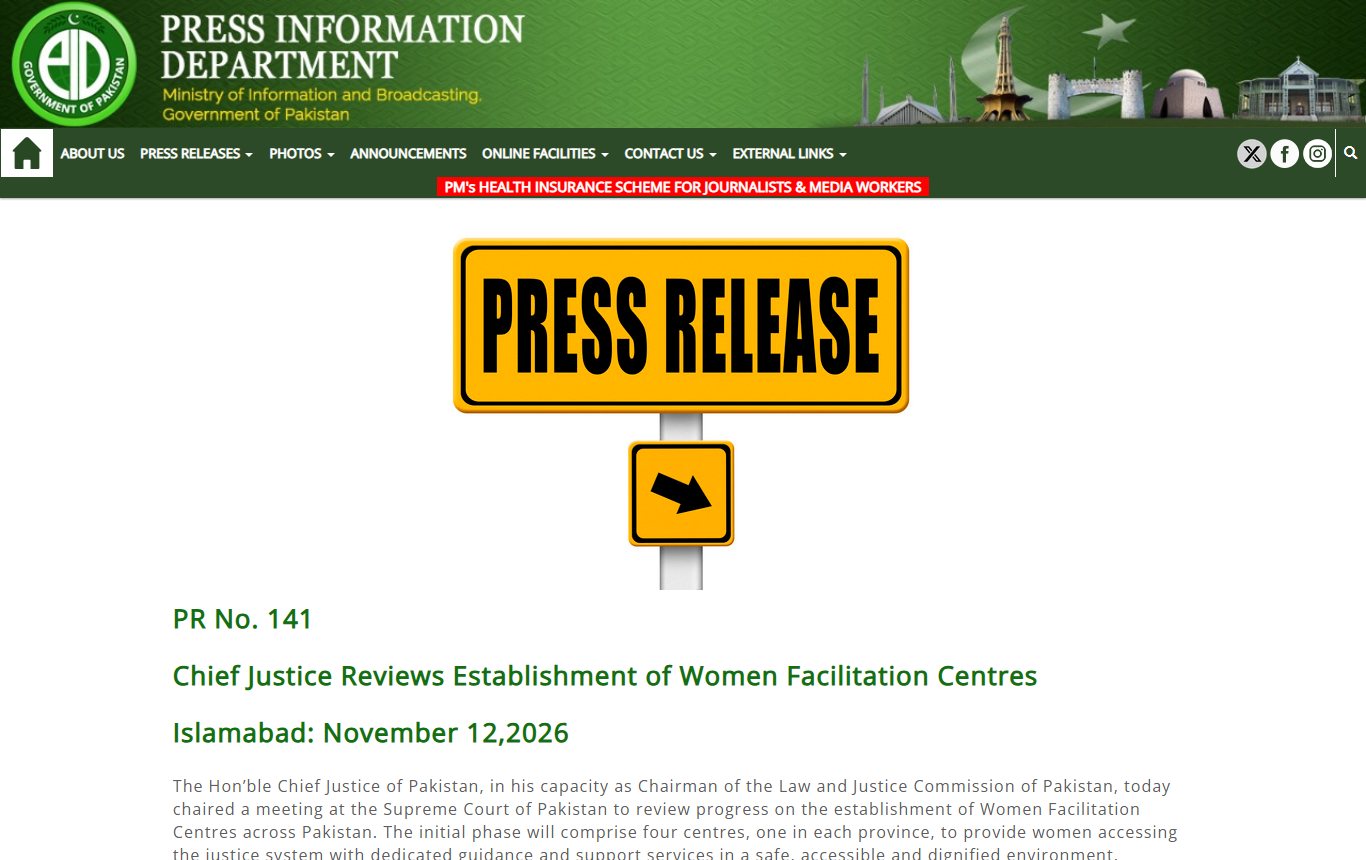
Four Women Facilitation Centres come first, one in each province
The first phase has four centres, one in each province. The release says consultations with the High Courts are complete and space has been identified for all four. It does not name the cities or the court buildings. The Chief Justice set centres in all four provinces and Islamabad as the priority for 2026-27.
A "one-window facility" means a woman can get information, guidance and help in one place, instead of walking from office to office in a court complex. Anyone who has been to a district court knows how much that matters. Finding the right room, the right clerk and the right form can take a whole morning.
The centres will offer legal advice, mediation and private rooms
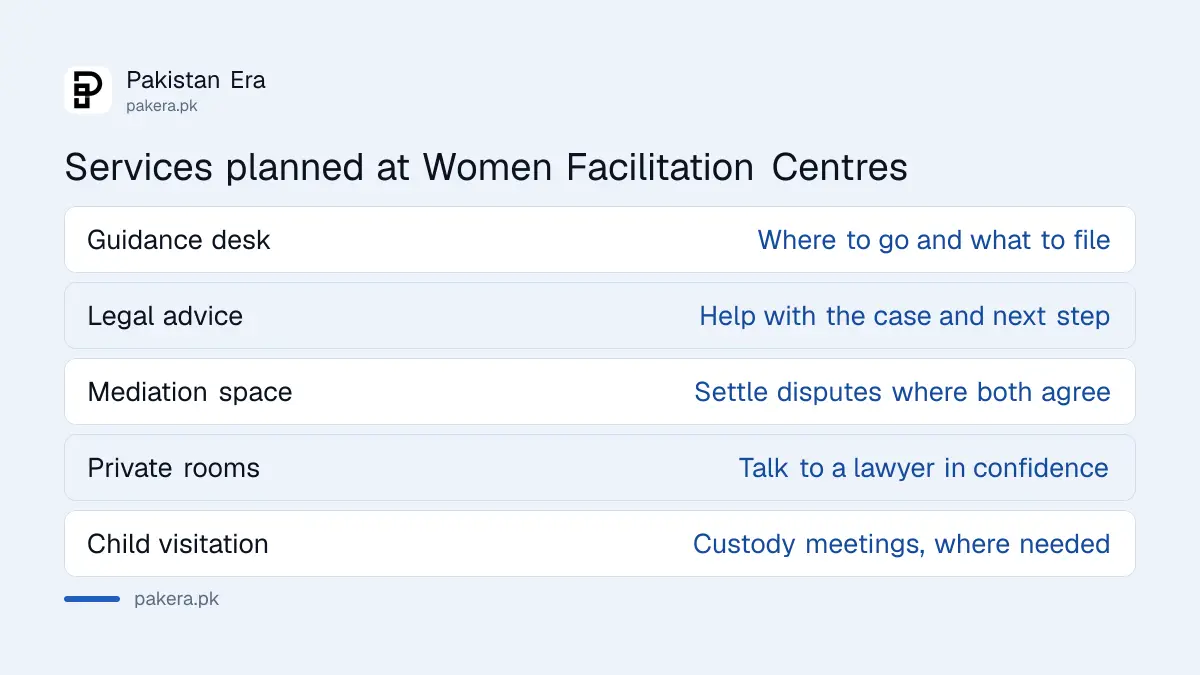
The release lists the services each centre should have. They go well beyond a help desk.
| Facility | What it is for |
|---|---|
| Reception and guidance desk | Information on where to go and what to file |
| Legal advice and assistance | Help understanding a case and the next step |
| Mediation and dispute resolution space | Settling disputes outside the courtroom where both sides agree |
| Private consultation rooms | Talking to a lawyer or officer without being overheard |
| Psychosocial support and referral | Counselling, and referral to shelters or other services |
| Child visitation space | Meetings between a child and a parent in custody cases, where needed |
| Ramps, waiting area, washrooms | Access for women with disabilities and basic comfort |
The child visitation space is a practical point. In custody cases, family courts often order a parent to meet the child at the court, and today that meeting usually happens in a corridor. Our guide to child custody in a family court explains how those orders work.
NESPAK has been told to start work on the design
The Chief Justice directed NESPAK, the state engineering consultancy, to start work on the centres. It will coordinate with the High Courts and the Islamabad-Rawalpindi chapter of the Institute of Architects Pakistan. An all-Pakistan design competition was held through the Institute, and the three winning designs have gone to every High Court.
No completion date is given. The release only asks for "timely completion". So, for now, a woman with a case in court should rely on the existing routes: the court's own help desk, the district legal aid committee, or a lawyer.
An e-filing pilot for family cases is being designed with bar councils
In a second meeting on 12 November, the Chief Justice discussed draft templates for filing family cases online. They are part of a proposed "National Unified E-Filing and Electronic Judicial Record System". The pilot will start in family cases at "selected judicial stations", which are not named.
Each provincial bar council and the Islamabad Bar Council was asked to nominate two members to review the templates before launch. Leaders of the Punjab, Sindh, Islamabad, Khyber Pakhtunkhwa and Balochistan bar councils and of the Supreme Court Bar Association took part, some on Zoom. Bar representatives also welcomed the facilitation centres.
Family cases are a sensible place to start. They include maintenance, dowry, haq mehr, custody and divorce, and many of the people filing them are women. Our guide to filing a family court case explains the current process and the Rs 15 court fee.
What happens next
Neither plan is open to the public yet. The steps the releases describe are:
- Bar councils nominate two members each to review the e-filing templates.
- The templates are revised before the pilot starts at chosen court stations.
- NESPAK and the architects finish designs with each High Court.
- The four first-phase centres are built in the spaces already found.
- Centres for Islamabad and further sites follow as the 2026-27 priority.
We will add the city names and launch dates when the Law and Justice Commission or the High Courts publish them. For a domestic violence case in Islamabad, the route that already works is set out in our guide to the domestic violence petition under the 2026 Act.
Common questions
What is a Women Facilitation Centre?
A one-window facility in court where women can get information, legal advice, mediation and support without visiting several offices, according to the Law and Justice Commission.
Where will the first centres open?
One in each of the four provinces. The release of 12 November 2026 does not name the cities or courts.
When will they open?
No date has been announced. NESPAK has been directed to start work, and the release asks for timely completion.
Can I file a family case online in Pakistan now?
Not yet under this system. An e-filing pilot for family cases is being designed, and bar councils are reviewing the templates first.
Which courts will run the e-filing pilot?
"Selected judicial stations", which have not been named yet.
Will Islamabad get a centre?
The Chief Justice named centres in all four provinces and Islamabad as the priority for 2026-27. Islamabad is not in the first four.
Sources: Press Information Department, PR No. 140 and PR No. 141, Islamabad, 12 November 2026, on pid.gov.pk. Last checked 12 November 2026.
About the author

Global Affairs & Political Economy Writer
Muhammad Hatim is a book lover who started writing because he enjoys it. At Pakistan Era he writes about international relations, geopolitics and the global economy, with a particular interest in South Asia and the forces behind current events.