How to File a Domestic Violence Petition in Islamabad Under the 2026 Act
Islamabad's Domestic Violence Act 2026 lets any household victim file in family court. See who can file, the 7-day first hearing, orders and the 90-day limit.
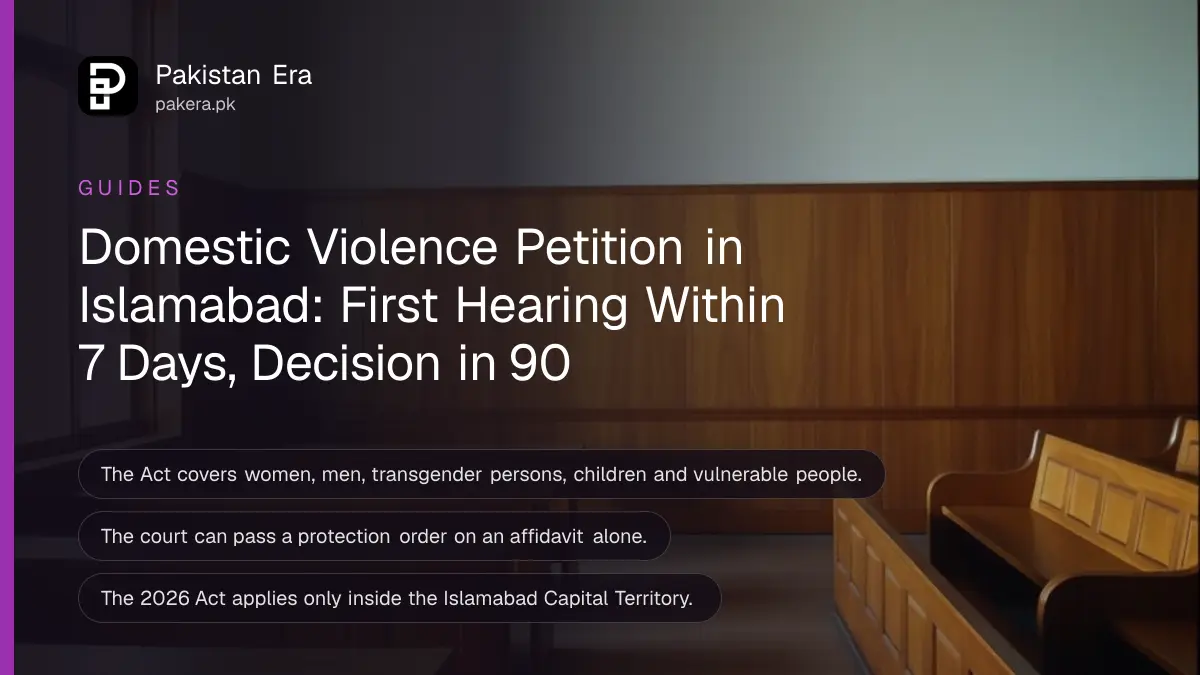
To get protection from domestic violence in Islamabad, a victim files a petition in the family court, usually through a Protection Officer. Under the Domestic Violence (Prevention and Protection) Act, 2026, the court must fix the first hearing within 7 days and decide the petition within 90 days. It can pass a protection order on an affidavit alone.
The Act received the President's assent on 26 January 2026 and was published in the Gazette on 27 January 2026. It applies only to the Islamabad Capital Territory. We read the Gazette text of the Act on 22 October 2026. A woman in Lahore or Karachi follows a different provincial law, such as the one in Punjab's protection order guide or the Sindh route.
The family court hears the petition and fixes the first hearing within 7 days
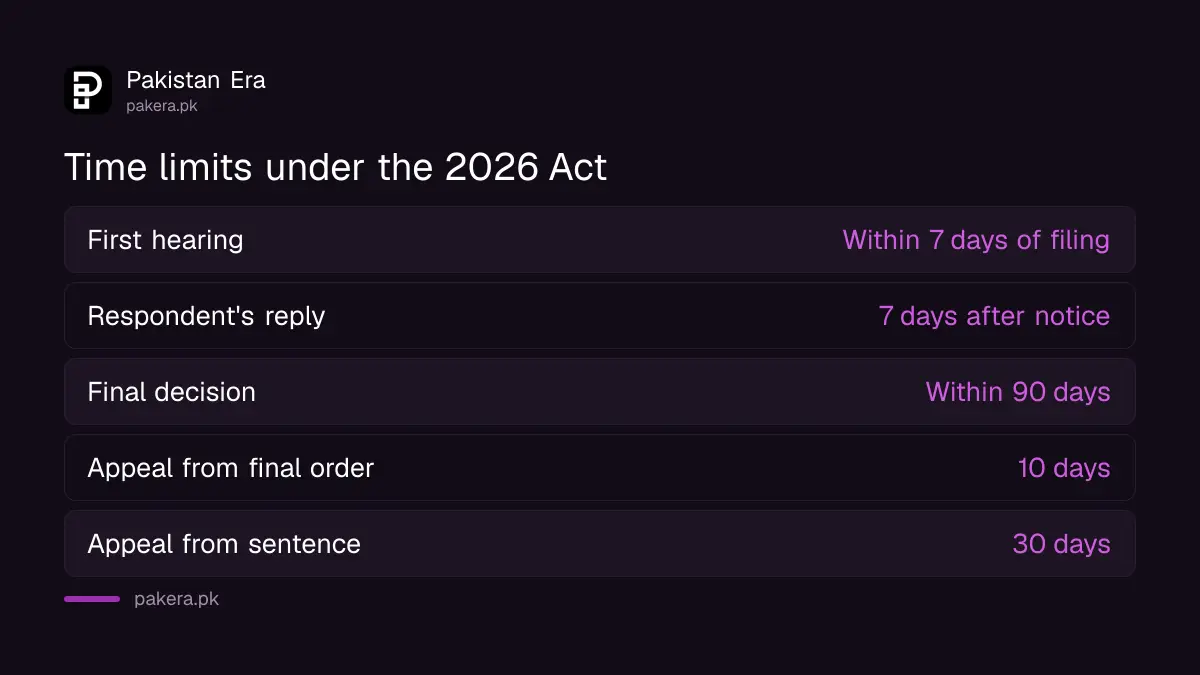
Section 5 sends the petition to the family court. That court has the powers of a first class magistrate for this Act. The first hearing cannot be later than 7 days after the court receives the petition. The court then sends a notice to the other side.
The petition goes to the court where the victim lives or works, or where the victim and the respondent last lived together. The respondent is the person accused of the violence. He or she gets 7 days after the notice to explain why a protection order should not be made.
Anyone in a shared household can file, not only wives
The Act protects women, men, transgender persons, children and any vulnerable person, such as an elderly person or a person with a disability, who lives or has lived with the respondent. The relationship can be by blood, marriage, adoption or simply living in the same household.
A child under 18 living in the household counts, including an adopted, step or foster child. An authorised person can file for a victim who cannot go to court herself. The Act requires the petition to come through a Protection Officer, so ask for one first.
A Protection Officer prepares the petition and arranges help
The Act gives the Protection Officer the job of filing the application, writing a domestic incident report, arranging legal aid, a medical examination and a safe place to stay. The Ministry of Human Rights designates one male and one female officer by Gazette notification.
Here is the gap. The Act says officers are appointed within one month of the rules being framed. We did not find a notification of rules or of named officers on 22 October 2026. We could not confirm who is in post today. Before you travel, call the Shaheed Benazir Bhutto Centre for Women or the Ministry of Human Rights, which the Act names for the secretariat and the officers, and ask who is acting. If no officer is available, a lawyer can still draft the petition. Free help is listed in the Islamabad free legal aid guide.
What the court can order on the first day
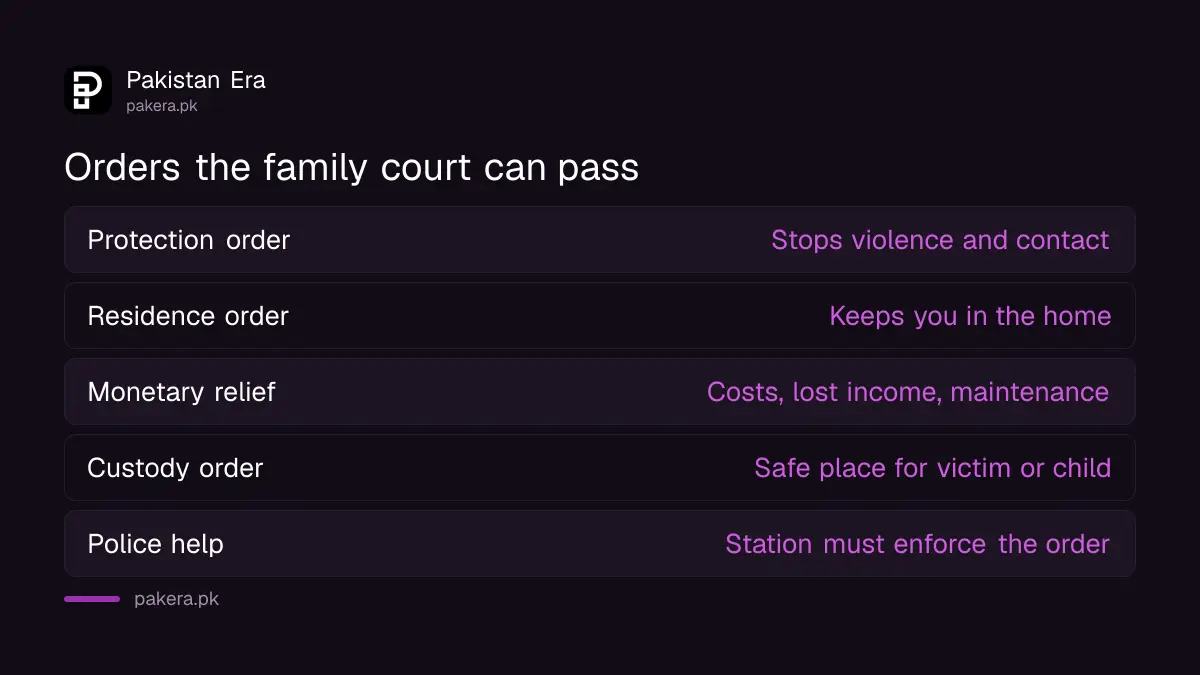
On a prima facie showing, meaning at first sight, the court can pass interim orders on the victim's affidavit. It does not have to wait for a full trial. The orders can start before the respondent has even replied.
| Order | What it does | Section |
|---|---|---|
| Protection order | Stops violence, contact and approach, can order the respondent out of the house | 8 |
| Residence order | Stops the respondent or relatives from dispossessing you or entering | 8 |
| Police help | Directs the nearest police station to protect you and enforce the order | 8 |
| Monetary relief | Pays medical costs, lost earnings, damaged property and maintenance | 9 |
| Custody order | Places the victim, or a child, with a safe person or service provider | 10 |
Section 6 also gives the victim the right to stay in the shared household, whether or not her name is on the property. She can instead choose a shelter home arranged by a service provider.
Money and children can be ordered in the same case
Section 9 lets the court order the respondent to pay money for losses caused by the violence. If he does not pay, the court can direct his employer to pay part of his salary straight to the victim or into court. Maintenance for children can be included.
That sits alongside any ordinary maintenance claim. The Act says it adds to other laws and does not replace them. A parallel claim is explained in the family court maintenance guide, which describes the Punjab process. Islamabad family courts use the same Family Courts Act, 1964.
How to file, step by step
The Act sets the court steps, not a printed form. We found no prescribed petition form in the Gazette text, so use plain written grounds.
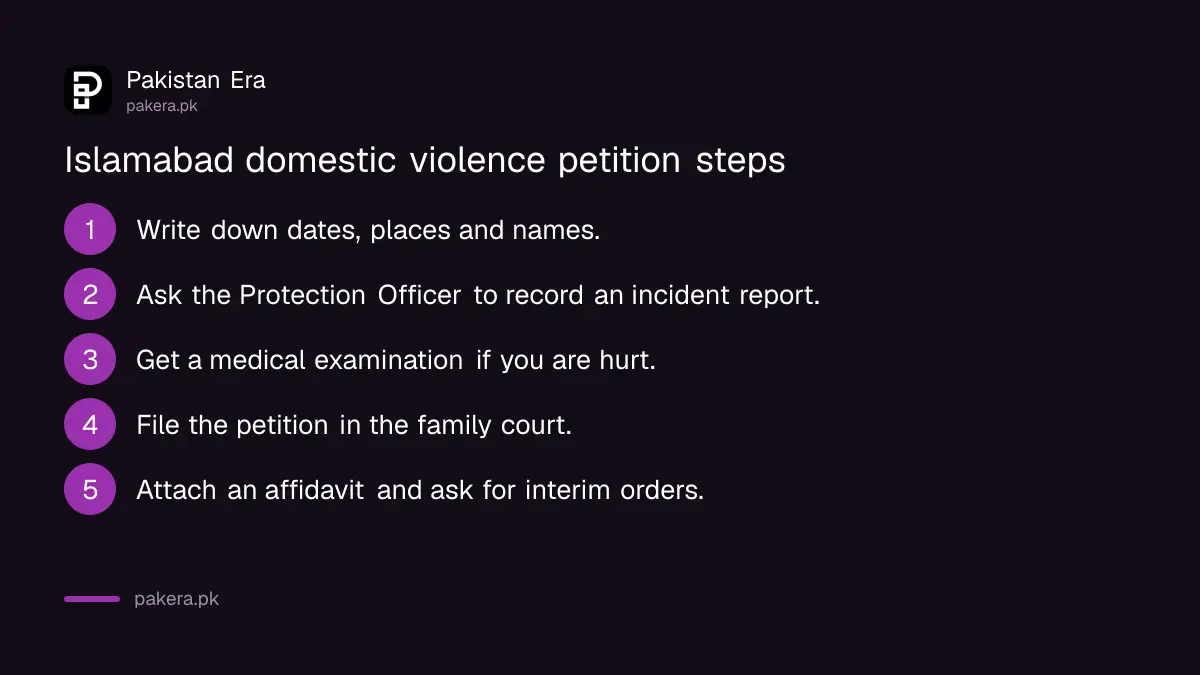
- Write what happened, with dates, places and names, and keep medical papers and messages.
- Contact the Protection Officer or a service provider to record a domestic incident report.
- Get a medical examination if you are hurt. The officer must arrange it.
- File the petition in the family court of the area where you live or last lived with the respondent.
- Attach an affidavit and ask for interim protection and residence orders.
- Attend the first hearing, which must be within 7 days of the court receiving the petition.
If you are in danger now, do not wait for the petition. Go to the nearest police station or an emergency service. A crime such as assault is dealt with under the Pakistan Penal Code, and the Act says so directly. For how an FIR is registered when police hesitate, see what to do when police refuse an FIR.
Common questions
Does the Domestic Violence Act 2026 apply in Lahore or Karachi?
No. Section 1 limits it to the Islamabad Capital Territory. Punjab, Sindh, Khyber Pakhtunkhwa and Balochistan have their own laws.
Can a man file a petition under this Act?
Yes. The definition of aggrieved person includes women, men, transgender persons, children and vulnerable persons who live or lived with the respondent.
How long does the court take to decide?
Section 5 says the petition must be decided within 90 days, and any adjournment needs written reasons. Interim orders can come earlier.
Do I need a lawyer?
The Act does not say a lawyer is compulsory. It does make the Protection Officer responsible for arranging legal aid. A lawyer still helps with the affidavit.
Is there a court fee?
We found no fee in the Act. Proceedings follow the Family Courts Act, 1964, so ask the court office what applies. We did not verify a figure.
How long does a protection order last?
Under section 11 an interim, protection or custody order stays in force until the aggrieved person applies to discharge it. The court can change it later for recorded reasons.
How we verified this
What we checked, where we read it, and what we could not confirm.
Last checked 22 October 2026. We read the Gazette of Pakistan Extraordinary of 27 January 2026 (Act No. X of 2026) on the National Assembly website, and the entry for the Act on the Pakistan Code portal. We did not find rules, a Protection Committee notification or named Protection Officers, and could not confirm they exist. No court fee or form is stated in the Act. This page is general information, not legal advice.
About the author

Senior Writer, Public Services and Technology
Shahid joined us in 2024 as an author. He is a senior contributor to Pakistan's leading technology websites. He writes detailed articles, mostly covering his expertise in the latest tech, mobiles, apps, gadgets, and step-by-step guides. His ideology is to help people understand the latest trends and explain complex methods through very easy-to-understand guides.