5G Phones Made in Pakistan: The Numbers Behind the Shift
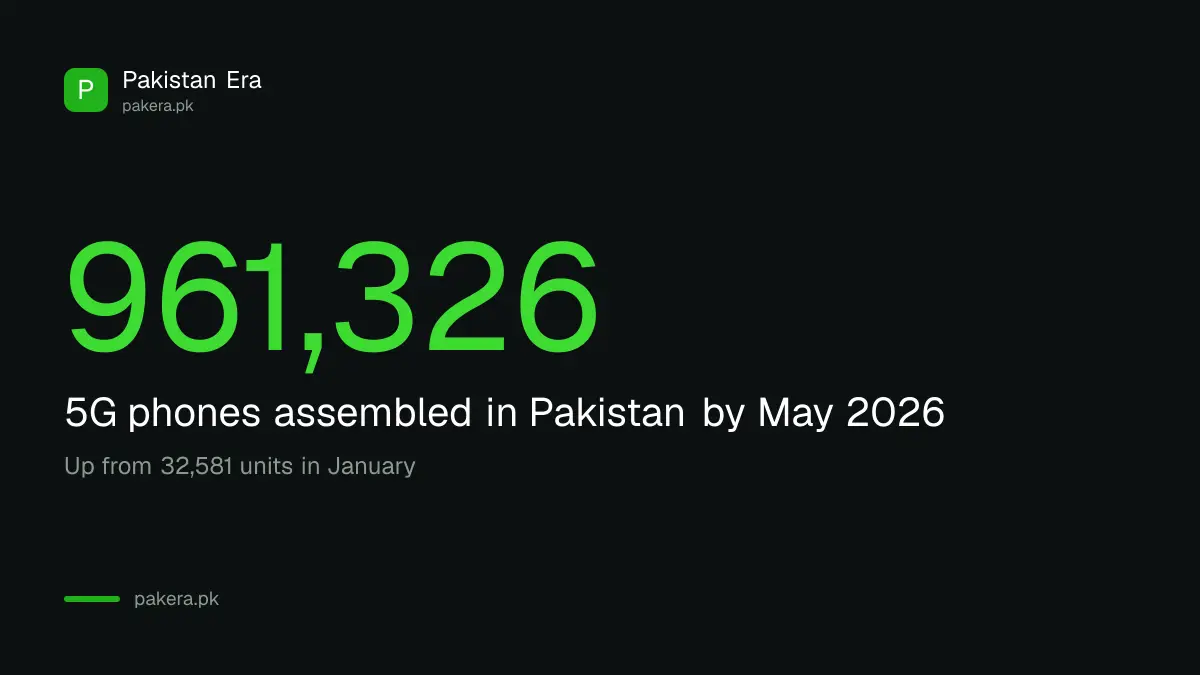
Local 5G assembly hit 961,326 units by May 2026, up from 32,581 in January. Which brands build here, and why prices follow.
In January, Pakistani plants put out 32,581 phones. By April the figure was 162,040. Five times the output in four months, and almost nobody outside the industry noticed.
That is the quiet story behind 5G phones made in Pakistan. While the argument about import taxes carried on, assembly lines here went from a rounding error to something that genuinely moves prices. PTA put locally manufactured 5G devices at 961,326 units by May 2026.
Nearly a million 5G handsets, built here, in a country that was arguing about whether it was ready for 5G at all.
How many 5G phones are made in Pakistan?
Local 5G assembly reached 961,326 units by May 2026, according to PTA figures released on 15 July. Six brands account for effectively all of it, with Samsung alone responsible for more than a third.
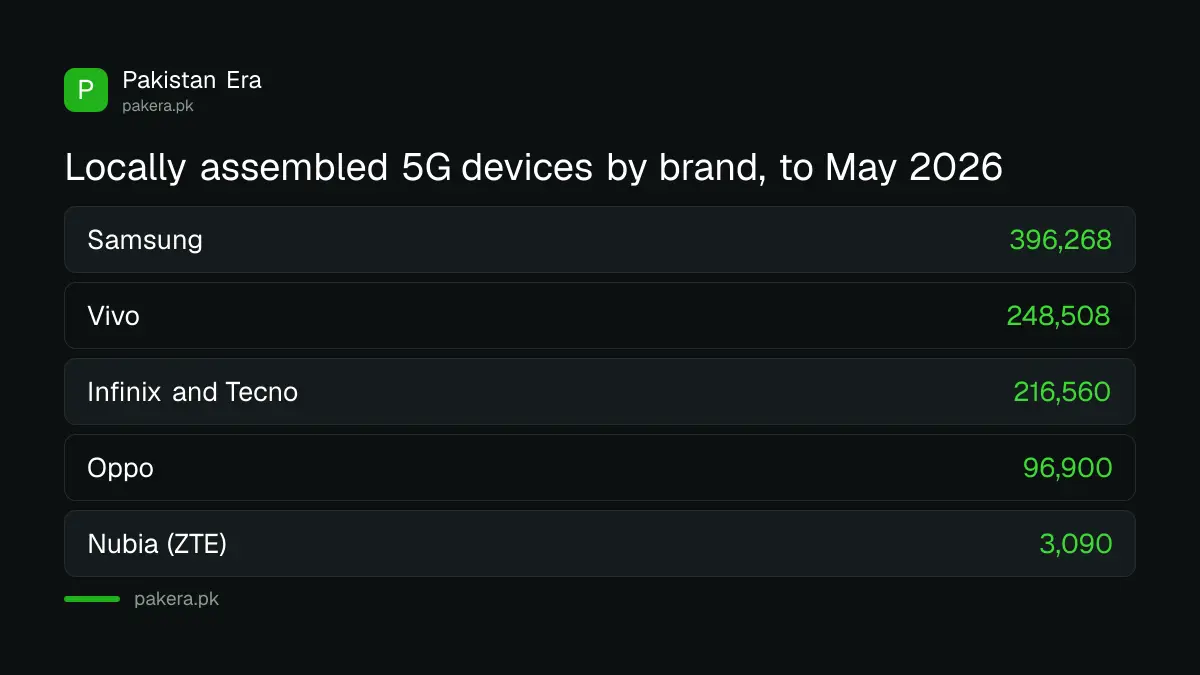
The brand split is worth sitting with, because it is not what most people would guess:
| Brand | Devices assembled | Share |
|---|---|---|
| Samsung | 396,268 | 41% |
| Vivo | 248,508 | 26% |
| Infinix and Tecno | 216,560 | 23% |
| Oppo | 96,900 | 10% |
| Nubia (ZTE) | 3,090 | 0.3% |
| Total | 961,326 | 100% |
Samsung building four in ten locally assembled 5G phones here surprises people who still think of local assembly as a budget brand exercise. It is not, and has not been for a while.
Why does local assembly make phones cheaper?
A locally assembled phone skips the charges that hit an imported one at the border. No import duty, no regulatory duty on a finished handset, and a different tax treatment throughout. Those charges compound, so removing them early removes more than their face value.
The cascade is the part that gets underestimated. Each duty is worked out on a base that already contains the ones before it, which is how a device that should retail near Rs 40,000 ends up closer to Rs 48,000. Take the first few charges out of the chain and everything downstream shrinks with them.
That is why PTA expects growing local availability to improve affordability, and why the mid range is where you see it first. A flagship import can absorb duty because its buyer can. A Rs 45,000 phone cannot.
How many people can actually use 5G?
PTA counts 3.81 million 5G capable devices registered in Pakistan. Services are live in 22 cities across the first rollout phase, running on 440 activated towers.
Those two numbers together explain the strategy. Nearly four million compatible handsets already in people's hands is a real base, but 440 towers is not national coverage by any measure. Operators are lighting up demand ahead of the infrastructure rather than the other way round.
New dedicated infrastructure is expected to roll out gradually over the following six to eight months. Until then, whether 5G works for you is mostly a question of which street you are standing on. Our guide to 5G coverage across Pakistani cities has the current picture.
Does a locally made phone need PTA registration?
No. A handset assembled and sold here is already compliant, so there is nothing to register and no tax to pay on it. Registration is a question for imported devices only.
People get caught out on this constantly. The 60 day clock that blocks an unregistered phone applies to something brought in from abroad, whether in your luggage or through a courier. Buy locally from a proper retailer and none of it touches you.
That absence of hassle is worth counting as part of the price. If you do go the imported route, our guide to calculating PTA tax explains what you are taking on, and you should check the IMEI before paying for anything second hand.
Is a locally assembled 5G phone worth buying?
For most people, yes, and the reasoning is simpler than the debate suggests. You get the same chipset and the same 5G bands at a lower price, with warranty support that exists inside the country.
What to weigh up:
- Warranty is handled locally rather than through a grey market seller who disappears, which matters more than spec sheet differences.
- Model availability is narrower. Not every variant a brand sells globally gets assembled here.
- No registration, no PTA tax, no 60 day countdown, no risk of a blocked handset.
- Resale is easier, because buyers know a locally sold phone has no registration history to inherit.
- Software and band support are identical on the models that are built here.
The case for importing has narrowed to flagships that simply are not assembled locally, and even there the July duty cut on imported handsets changed the arithmetic. For anything mid range, the local option now usually wins on price before you have considered the convenience.
Checking whether a phone was built here takes a minute:
- Look at the retail box for a country of manufacture line, which on locally assembled units names Pakistan rather than China or Vietnam.
- Open Settings, then About phone, and check the model number against the brand's Pakistani listing.
- Ask the retailer directly whether the unit is locally assembled or imported, since the price should differ noticeably.
- Confirm the warranty card names a Pakistani service network, because that is the practical difference when something breaks.
- If the seller claims local assembly but the price matches an import, treat the claim with suspicion.
Frequently asked questions
Which 5G phones are made in Pakistan?
Samsung, Vivo, Infinix, Tecno, Oppo and Nubia all assemble 5G handsets locally. Samsung leads with 396,268 devices to May 2026, followed by Vivo at 248,508.
Are locally assembled phones lower quality?
No. They use the same components and specifications as the equivalent imported model. What differs is where final assembly happens and which duties apply.
Do I pay PTA tax on a phone made in Pakistan?
No. Locally manufactured handsets are already compliant. PTA registration and its tax apply only to devices imported from abroad.
How many 5G phones are in Pakistan?
PTA counts 3.81 million 5G capable devices registered nationwide as of July 2026, of which 961,326 were assembled locally by May.
Will local manufacturing bring prices down further?
PTA expects growing local availability to improve affordability, and output rose fivefold between January and April. Whether that reaches retail depends on how much of the saving brands pass on.
Can I use a locally made 5G phone on any network?
Yes. Locally assembled 5G handsets support the bands Jazz, Zong and Ufone use, so the limit is coverage in your area rather than the phone.
Work it out yourself
Comparing a local unit against an import? See what FBR has assessed the imported model at before you call one cheaper.
PTA Tax Value Checker →Moving to 5G tends to push data use up. Work out what your habits actually need.
Data Usage Calculator →About the author

Public Services and Education Journalist
Fajr Riaz is a journalist and content writer at Pakistan Era, based in Lahore. She covers the questions people meet in everyday life in Pakistan: how a public service works, what a change in the rules means, and where to find a reliable answer.