What’s going on right now
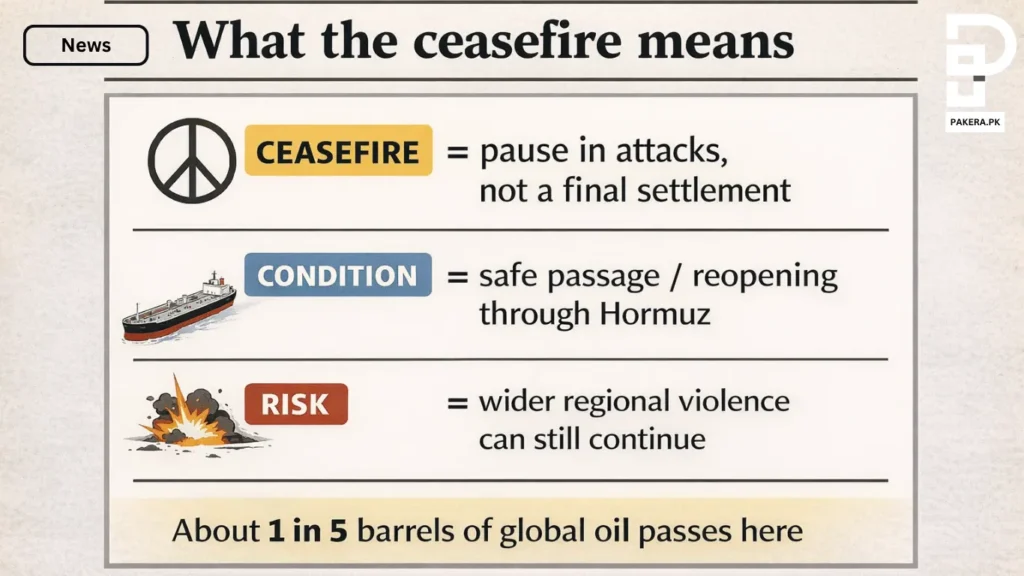
As of today (April 8, 2026, Pakistan time), the US and Iran have announced a temporary ceasefire meant to last two weeks, and it’s linked to one big condition: Iran must allow complete, immediate, and safe passage through the Strait of Hormuz.
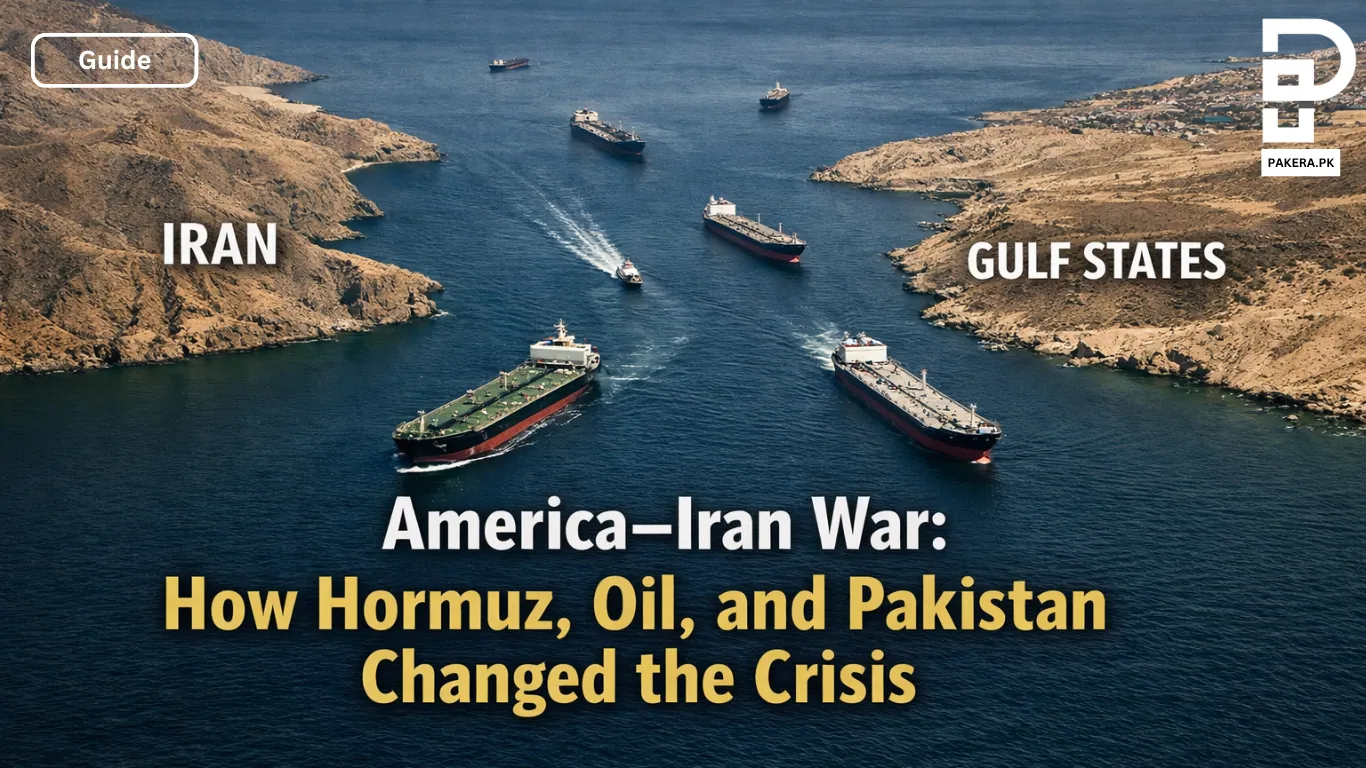
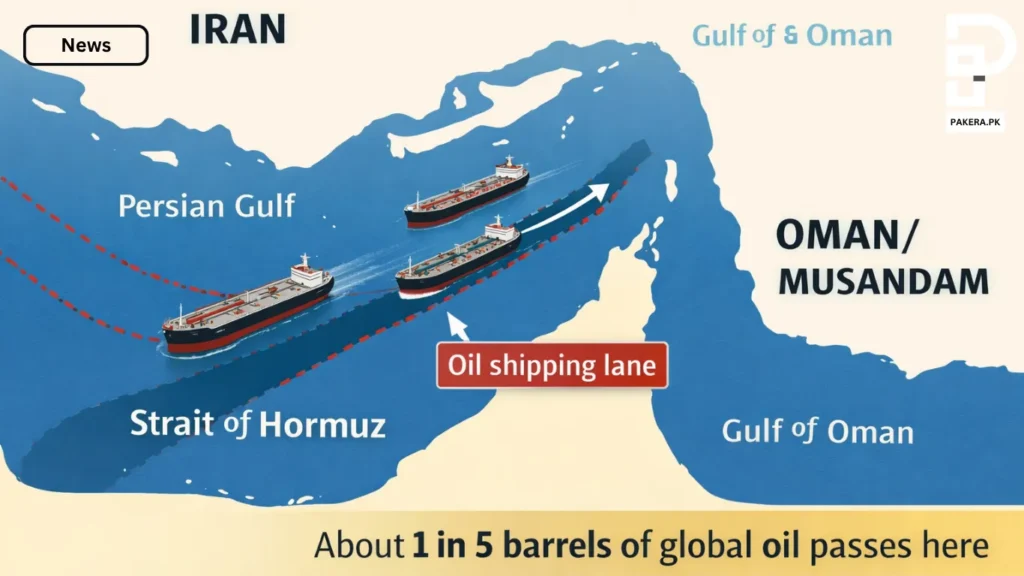
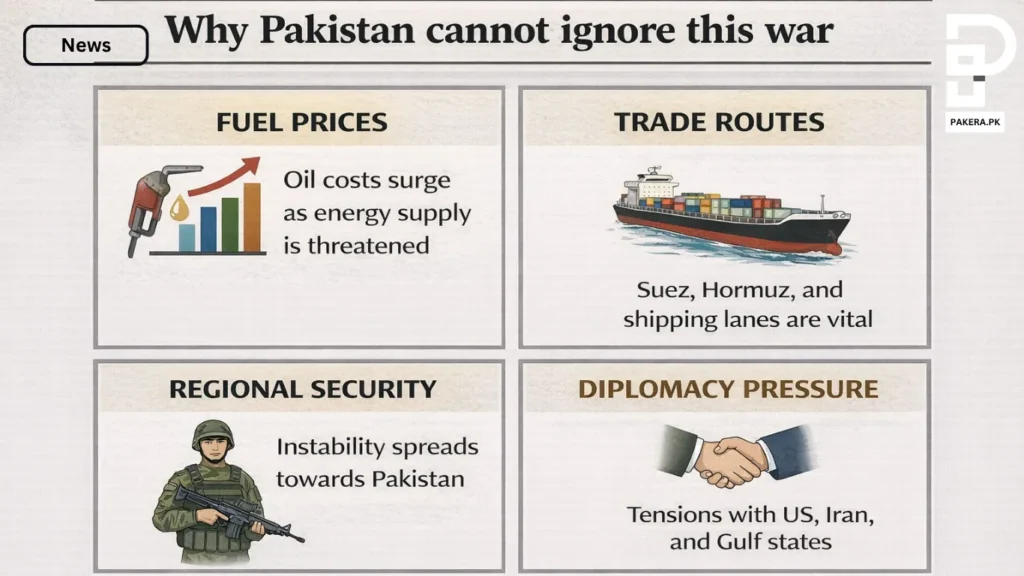
This matters because that sea route normally carries about one-fifth of the world’s oil shipments, and Iran’s blockade turned the war into a global energy and cost-of-living shock, not just a battlefield story.
Pakistan didn’t “appear” in the story at the end. It has been acting as a go-between since the war began. In the last stretch, hours before the US deadline, Pakistan’s leadership pushed for time, pushed for a pause, and (according to multiple reports) carried messages and draft frameworks back and forth until both sides took the off-ramp.
But here’s the blunt truth: even after the ceasefire announcement, missiles were still launched and air defenses were still activated in parts of the region. So this is not a “we hugged and went home” moment. It’s a fragile pause that could hold or collapse, fast.
Jump to Events
- What’s going on right now
- How the war started and why it spread so fast
- The escalation playbook: chokepoints, energy targets, and widening fronts
- Pakistan’s role from day one to the ceasefire
- The past day: the deadline, the ceasefire announcement, and the aftershocks
- What happens next: Islamabad talks and the hard issues still unresolved
How the war started and why it spread so fast
The war started on February 28, 2026, when the US and Israel launched major strikes on Iran. The US military operation was publicly named Operation Epic Fury.
In its first official description, U.S. Central Command said strikes began around 1:15 a.m. ET and targeted, among other things, Islamic Revolutionary Guard Corps command-and-control facilities, air defenses, missile/drone launch sites, and military airfields, framed as “imminent threat” targets.
Early reporting also indicated that Iran’s Supreme Leader Ali Khamenei was killed in the opening strikes, a shock event that instantly raised the stakes from “pressure campaign” to “regime-level war.”
Iran responded in the way modern regional wars usually escalate: not just by hitting the direct attacker, but by firing missiles and drones across the wider region, including toward US-linked military sites and partners and by squeezing global trade and energy routes.
On day one, the United Nations, through Antonio Guterres warned that this kind of escalation can ignite a chain of events “no one can control,” and called for de-escalation and a return to talks under international law and the UN Charter.
From there, the logic of “why it spread” is simple:
- The region is packed with critical bases, ports, refineries, and shipping chokepoints.
- Iran’s fastest leverage is economic: threaten energy routes and make everyone feel the cost.
- The US goal (as stated publicly by the White House) included degrading Iran’s missile capability, navy, and proxy networks, and preventing a nuclear weapon, goals that tend to widen, not shrink, a target list.
The escalation playbook: chokepoints, energy targets, and widening fronts
In early phases, US military briefings described strikes aimed at Iran’s command systems, naval forces, missile sites, and intelligence infrastructure to “daze and confuse” and establish air superiority.
After that, the war’s engine became economic warfare plus long-range strikes.
One side tried to break Iran’s military ability and force concessions. Iran tried to raise the cost so high that the US and its partners would accept mediation or limits.
A few major triggers pushed this conflict toward “it could get even worse” territory:
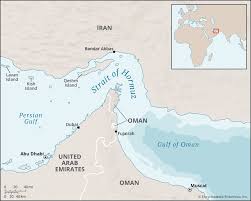
The first trigger was the near-closure of Hormuz and the spillover into maritime attacks. Reuters tracking and analysis described civilian shipping being attacked and warned that trade through Hormuz, already under threat, was becoming a direct target set, not just a bargaining chip.
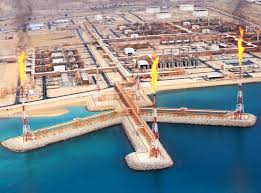
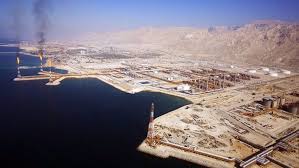
The second trigger was attacks on major energy infrastructure. Reuters reporting noted that strikes on Iran’s South Pars gas field and the nearby Asaluyeh processing hub produced a wave of retaliatory hits across the Gulf affecting refineries, gas plants, and export terminals in multiple Gulf states.
The third trigger was widening “fronts” through allied or aligned groups. Coverage across major outlets repeatedly tied parts of the regional escalation to armed groups such as Hezbollah and the Houthis, which expanded the conflict geography and made “a clean ceasefire line” harder to draw.
The fourth trigger was rhetoric and threatened targeting of civilian infrastructure. Reuters and AP both reported that as the deadline pressure grew, Trump’s warnings included strikes on bridges and power plants, which brought international condemnation and warnings from legal experts that indiscriminate attacks on civilian infrastructure could violate international law and could amount to war crimes.
The human cost also kept climbing. The International Federation of Red Cross and Red Crescent Societies launched a major emergency appeal, saying needs were growing sharply, and describing large-scale mobilization by the Iranian Red Crescent Society across many provinces.
Reuters later reported the IFRC’s on-the-ground concerns: rising casualties, strained trauma supplies, repeated disruptions from alarms, and serious logistics problems intensified by the Hormuz shutdown.
And information itself became a battlefield. Reporting described Iran’s internet shutdown that began when the war started, limiting access to outside reporting and raising the risk of rumor-driven panic and propaganda-driven “parallel reality.”
Finally, the pressure didn’t stay in the Middle East. The International Energy Agency said the conflict created the largest supply disruption in global oil market history, with flows through Hormuz plunging, regional production cuts, and emergency reserve releases by IEA member countries.
Pakistan’s role from day one to the ceasefire
People online are acting like Pakistan only entered the story at the ceasefire. That’s not how it happened.
Pakistan’s role moved in phases: official stance, citizen protection, and then backchannel diplomacy.
On the day the war began, Pakistan’s foreign ministry publicly condemned the attacks on Iran, warned about regional consequences, and called for diplomacy. In the same statement, it also condemned Iran’s retaliatory strikes on Gulf states and emphasized restraint and international law. That statement also noted the reported death of a Pakistani national in the United Arab Emirates during attacks.
Then came the “real life” part: evacuations and citizens stuck in a war zone. Reuters reported Pakistanis leaving Iran by land, describing strikes and the fear on the ground, and citing Pakistan’s ambassador saying thousands of Pakistanis were in Iran and that the situation included major challenges like loss of internet access.
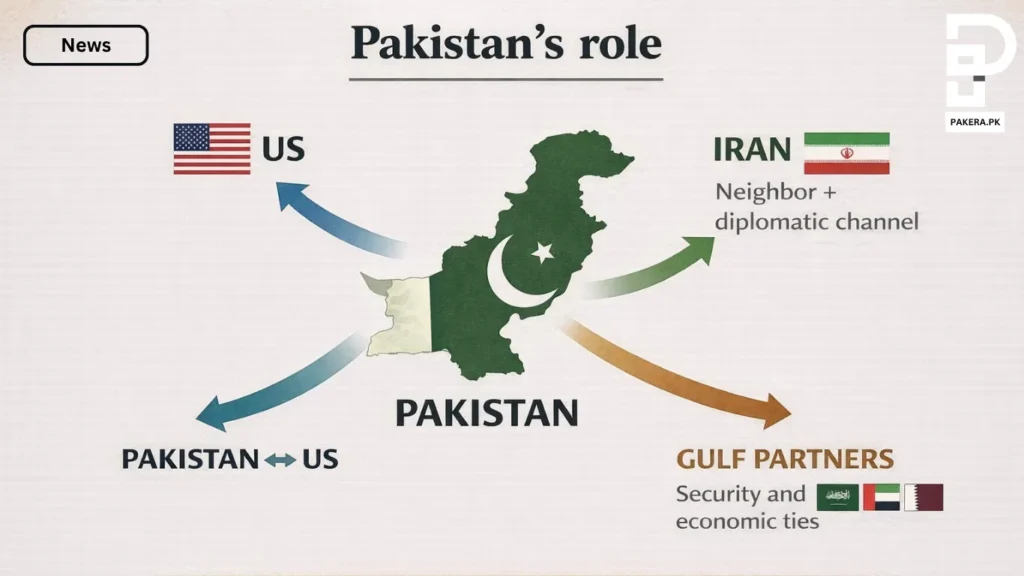
At the same time, Pakistan was walking what Reuters called a diplomatic tightrope: warming ties with Washington while signaling solidarity with Iran because domestic stability and border security were on the line.
Here’s the key point most people miss: Pakistan has long been positioned to pass messages because it has a working relationship with Tehran and a reopened relationship with Washington. Reuters also noted a specific diplomatic fact: Iran’s de-facto diplomatic mission in the US has been hosted at Pakistan’s embassy in Washington since US–Iran relations ruptured in 1979.
In late March, Reuters described Pakistan as a potential peacebroker because it can talk to both sides, is seen by some analysts as Iran’s least adversarial neighbor, and unlike some Gulf states does not host US military bases, which can affect “neutrality optics.”
That same Reuters reporting said Pakistani sources described the government shuttling messages between the US and Iran since the conflict began, and that Pakistan’s diplomatic outreach in the region became almost nonstop.
Another big reason Pakistan had access: the relationship between Trump and Pakistan’s military leadership. Reuters reported that Asim Munir had built close relations with Trump, and that Trump had referred to him as his “favourite field marshal.”
Reuters also described Pakistan’s broader “makeover” in Washington from being isolated to becoming a mediator, driven in large part by the military’s channel with Trump and recent cooperation steps that rebuilt trust.
But none of this was “risk-free” for Pakistan.
Reuters reporting made the risks very clear: Pakistan has a close defense relationship with Saudi Arabia and a mutual defense agreement, and Iranian strikes on Saudi industrial targets created a nightmare scenario where Saudi retaliation could derail talks and even pull Pakistan toward the conflict under pact pressure.
Reuters also repeatedly highlighted internal pressure points that Islamabad had to keep in mind: a long border with Iran, domestic sectarian sensitivity (Pakistan has one of the world’s largest Shia populations), and fear that a prolonged war next door could spill over.
Then, in the final days before the ceasefire, Pakistan’s mediation became more structured.
On April 6, Reuters reported a Pakistan-built framework for ending hostilities with a two-tier approach, an immediate ceasefire, then a broader agreement, described as being exchanged with Iran and the US, and conducted through Pakistan as a central communication channel. Reuters said Munir had been in contact through the night with JD Vance, Steve Witkoff, and Abbas Araqchi.
That’s the backbone of “how Pakistan helped create space for a ceasefire”: not magic, not vibes—a channel, plus pressure, plus a deadline-driven moment where both sides needed a pause.
The past day: the deadline, the ceasefire announcement, and the aftershocks
Now let’s talk about what most people actually came here for: what happened in the last day, and why it looked like it was about to blow up.
The build-up was a ticking clock. Reuters reported that Trump set a deadline of 8 p.m. EDT in Washington for Iran to reopen Hormuz or face major strikes on infrastructure, including bridges and power plants.
Before that deadline, talks were not smooth. Reuters reported that Iranian strikes on Saudi industrial facilities, including the Jubail petrochemical complex, threatened to derail negotiations being mediated by Pakistan, because Saudi retaliation would likely kill the diplomatic track.
At the same time, Trump’s public messaging escalated hard. Multiple major outlets reported his threat language about civilization and planned strikes on infrastructure.
Pakistan’s prime minister went public in the final hours. Reuters and Al Jazeera both reported that Shehbaz Sharif asked Trump to extend the deadline by two weeks, urged Iran to open Hormuz for the same period as a goodwill gesture, and called for a broad ceasefire to let diplomacy “run its course.”
Then came the switch.
Late on April 7 (Washington time), Reuters reported that Trump agreed to suspend bombing for two weeks, explicitly saying it was based on conversations with Shehbaz Sharif and Munir, and conditional on Iran allowing the “complete, immediate, and safe opening” of Hormuz. Reuters reported Trump posted this on Truth Social and framed it as a “double sided ceasefire.”
Iran’s response was also conditional. Reuters reported Araqchi said Iran would cease counter-attacks and provide safe passage through the strait if attacks against Iran stop. Iran’s Supreme National Security Council portrayed the outcome as a victory and said it reflected Iran’s conditions being met.
Pakistan said delegations were invited to Islamabad for talks on Friday. This was reported across Reuters, AP, and Al Jazeera.
And this is where people got confused: Pakistan’s messaging suggested a broader “everywhere” ceasefire, including Lebanon but Reuters and AP reported Israel’s position was that Lebanon was excluded, and strikes there continued.
Even more important: the ceasefire announcement did not instantly stop missiles. Reuters reported that more than an hour after Trump’s announcement, Israel identified missiles launched from Iran, and multiple Gulf countries activated air defenses with near-simultaneous alerts.
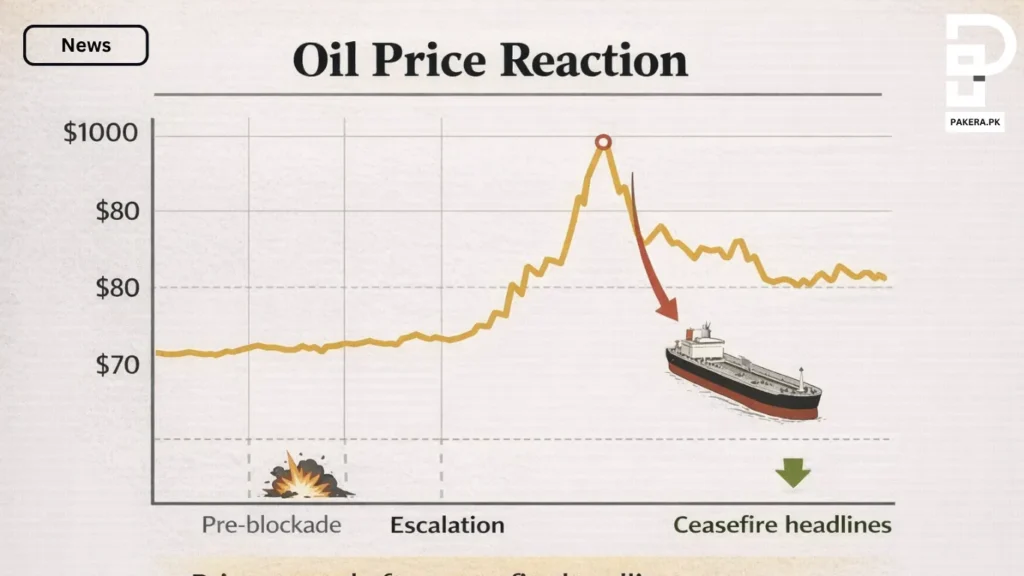
Economically, the relief was immediate but the damage isn’t “over.” Reuters reported the U.S. Energy Information Administration warned fuel prices could stay elevated for months even after Hormuz reopens, because restoring flows and production normalcy takes time and uncertainty keeps a “risk premium” in prices.
Reuters also reported the International Air Transport Association, through Willie Walsh warning jet fuel supply could take months to recover even if Hormuz reopens, due to refining disruptions.
AP reported markets reacted with oil dropping and stocks rising, but emphasized the ceasefire’s short duration still leaves major uncertainty.
One more piece the Pakistan audience specifically asks about: how Trump spoke about Shehbaz Sharif. The Washington Post reported Trump described Sharif as “a highly respected man all over,” in the context of the mediation push, and said the ceasefire move was influenced by appeals from Pakistan’s leadership.
Also, about the “tweets”: the key public messages were on social platforms, Trump on Truth Social, and Pakistan’s leadership and Iran’s foreign minister on X and those posts were widely quoted in major reporting as the public-facing layer of the negotiations.
What happens next: Islamabad talks and the hard issues still unresolved
The ceasefire is a pause. The next fight is over the terms of whatever comes after.
The planned talks in Islamabad are supposed to focus on a longer agreement. Reuters and other outlets reported that Trump said Iran provided a “10-point proposal” he called a workable basis for negotiation, and that he believed many key points of contention were close to settled though details remain disputed and politically explosive.
Iran’s side, as reported by Al Jazeera, frames its 10-point proposal around demands including oversight/dominance of Hormuz, lifting sanctions, compensation, and changes to the regional posture of US forces and allied operations.
AP and the Washington Post both emphasized the reality check: core disagreements appear unresolved in public, especially around Iran’s nuclear program and enrichment, missiles, sanctions, and regional armed groups.
The ceasefire’s “scope problem” is also real: Israel’s stance that Lebanon is excluded means strikes there can continue, which can trigger retaliation, which can trigger wider escalation again. Reuters and AP both highlighted this contradiction.
On the humanitarian side, the pause, if it holds matters because needs inside Iran are already described as severe. The IFRC’s emergency appeal laid out a massive response and a large affected population, and Reuters reported the operational strain and supply delays.
And even “peace talks” don’t instantly fix the reality that many Iranians have faced limited access to information due to extended internet shutdown conditions reported in April.
Finally, expect hard pressure from the economy. The IEA’s March oil market analysis described a historic supply disruption, emergency reserves being mobilized, and disruptions across crude and refined products, conditions that force governments to push for stability even if the politics are ugly.
So the next few days come down to three simple questions that even a second-grade kid can understand:
Will ships actually move safely through Hormuz again?
Will the missiles stop, not just slow down?
Will the talks produce a real deal or just buy time for the next round?