Pakistan and Saudi Arabia Signed a Mutual Defence Pact, and It Was Left Open to Others
The Strategic Mutual Defence Agreement signed in Riyadh, what it actually commits, and why Qatar and the UAE were said to be watching.
Pakistan and Saudi Arabia signed a Strategic Mutual Defence Agreement in Riyadh in September 2025. The detail that made it more than a bilateral formality was what Pakistan's defence minister said afterwards: the pact is open to other Arab states joining it.
We have consolidated three short pieces we published at the time into this one, because three stubs saying overlapping things served nobody, and because the parts worth keeping fit in one place.
What was signed and what was said
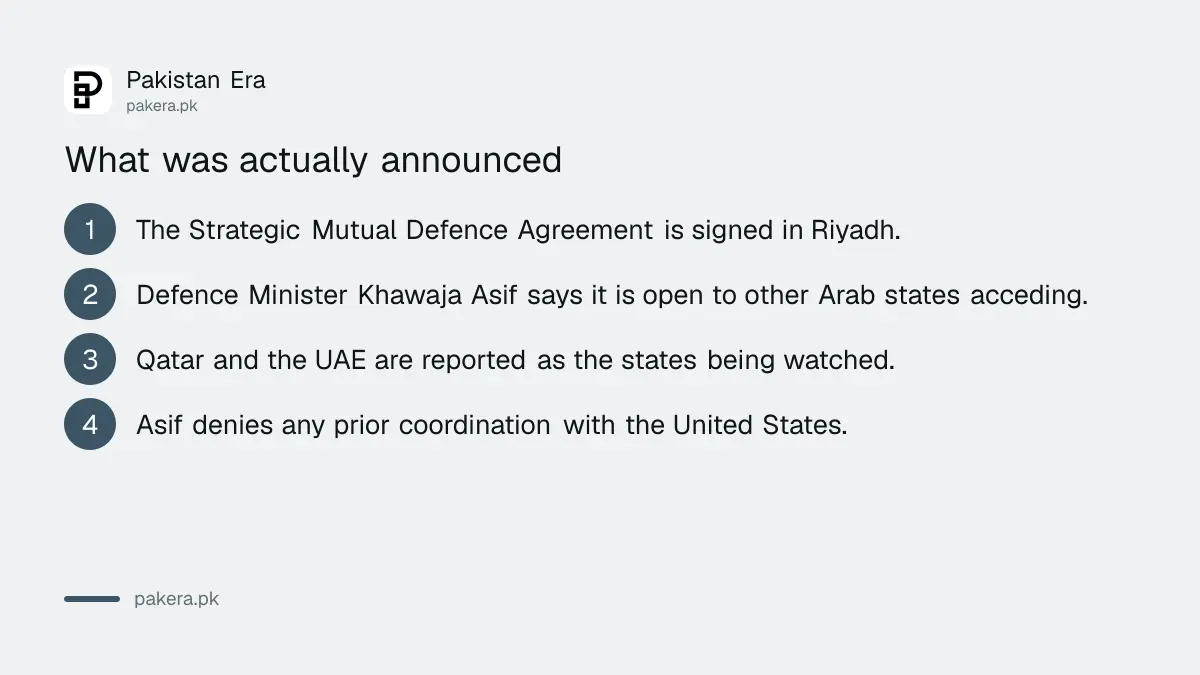
The agreement was signed in Riyadh on a Wednesday in September 2025. Speaking to Geo TV in an interview the following night, Defence Minister Khawaja Muhammad Asif said the pact was open to accession by other Arab states, and named the possibility of others joining as a live one.
Asif also denied any prior coordination with the United States over the agreement, which was the question being put to him at the time.
The states most often mentioned as watching were Qatar and the United Arab Emirates. We want to be precise here, because the original version of one of our pieces was not: those states were reported as possible future signatories. That is different from either of them having joined, and as far as we can establish, neither has.
This is older than it looks
Coverage at the time treated the agreement as a new alignment. It is better understood as the formalisation of a very old one.
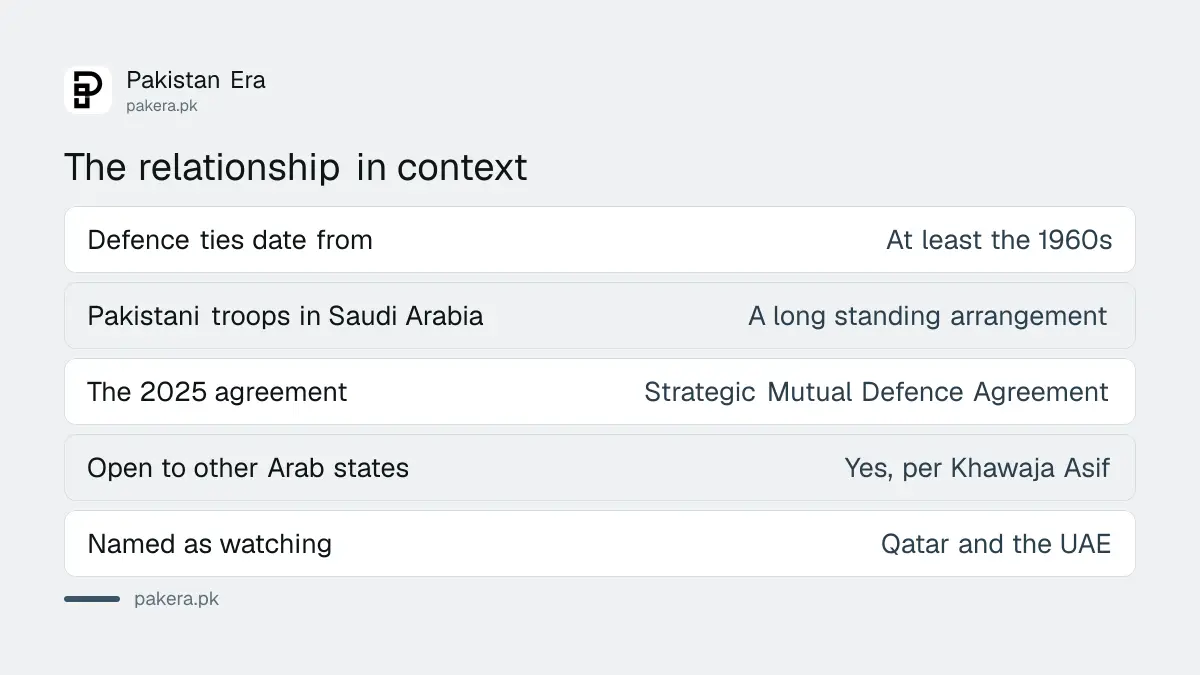
Defence ties between Islamabad and Riyadh go back to at least the 1960s, and Pakistani troops have been stationed in the kingdom under various arrangements for decades. Pakistani officers have trained Saudi forces. The relationship has survived governments on both sides changing repeatedly.
| Position | |
|---|---|
| Defence ties date from | At least the 1960s |
| Pakistani troops in the kingdom | A long standing arrangement |
| What was signed in 2025 | Strategic Mutual Defence Agreement |
| Open to other Arab states | Yes, per Khawaja Asif |
| Reported as watching | Qatar and the UAE |
| Any state acceded since | Not that we can establish |
What the agreement did was put a written commitment where an understanding had been. That is not nothing, but it is a smaller step than a new alliance forming out of clear air.
Why an open door changes the calculation
A bilateral pact is a bilateral pact. A bilateral pact designed to be joined is the beginning of a framework, and those are read very differently by everyone else in the region.
For Pakistan the appeal is straightforward. Deeper security ties with Gulf states mean deeper economic ties, and Pakistan's need for investment and for reliable energy supply has only grown since. It also positions Pakistan as a security provider rather than an aid recipient, which is a materially different relationship to be in.
The risk runs the same direction. A mutual defence commitment means being obliged to act when somebody else is attacked, and the Gulf is not a quiet neighbourhood. A pact with an open door is a pact whose obligations can grow without renegotiation.
How this reads now
Nearly a year on, two things have happened that make this agreement look more consequential rather than less.
The first is the US and Iran conflict, which has disrupted Gulf shipping, blocked Pakistan's Qatari LNG cargoes and forced expensive spot purchases. We covered what that did to prices in the RLNG increase and to the power mix in the shift to coal. A country that depends on Gulf energy has an obvious interest in Gulf security arrangements.
The second is money. A Jeddah based group has told Pakistan's Board of Investment it has earmarked up to ten billion dollars for potential projects here, which we wrote about in the Falcon Vision announcement. Defence relationships and investment conversations are not the same thing, and it would be lazy to draw a straight line between them. They do run in the same channel.
What would tell you this is actually a framework
The test is accession. If another Arab state signs, the pact becomes a structure. If none does, it remains what it has been since the 1960s, a close bilateral relationship with paperwork attached.
Watch for a named state rather than a briefing about interest, and watch for what any accession actually commits its signatory to, because a mutual defence clause and a consultation clause are very different documents wearing the same name.
Questions readers are asking
What did Pakistan and Saudi Arabia sign?
A Strategic Mutual Defence Agreement, signed in Riyadh in September 2025.
Can other countries join it?
Defence Minister Khawaja Asif said the pact is open to accession by other Arab states. Qatar and the UAE were the two most often reported as watching.
Have Qatar or the UAE joined?
Not that we can establish. They were reported as possible future signatories, which is a different claim from having signed, and one of our earlier articles blurred that distinction.
Is this a new relationship?
No. Defence ties go back to at least the 1960s and Pakistani troops have been stationed in Saudi Arabia for decades. The agreement formalised an existing relationship.
Was the United States involved?
Khawaja Asif denied any prior coordination with the United States when asked about it in a Geo TV interview.
Why does this matter to Pakistan economically?
Because Gulf security and Gulf energy supply are connected, as the disruption to Qatari LNG cargoes has since demonstrated, and because security relationships and investment conversations tend to run through the same channels.
About the author

Author
Shahid joined us in 2024 as an author. He is a senior contributor to Pakistan's leading technology websites. He writes detailed articles, mostly covering his expertise in the latest tech, mobiles, apps, gadgets, and step-by-step guides. His ideology is to help people understand the latest trends and explain complex methods through very easy-to-understand guides.