Advance Income Tax Due 15 December 2026 in Pakistan: Who Pays, the Formula and How to Pay by PSID
Advance income tax for the December quarter is due on 15 December 2026 for individuals and 25 December for firms. See who pays, the formula and how to pay.
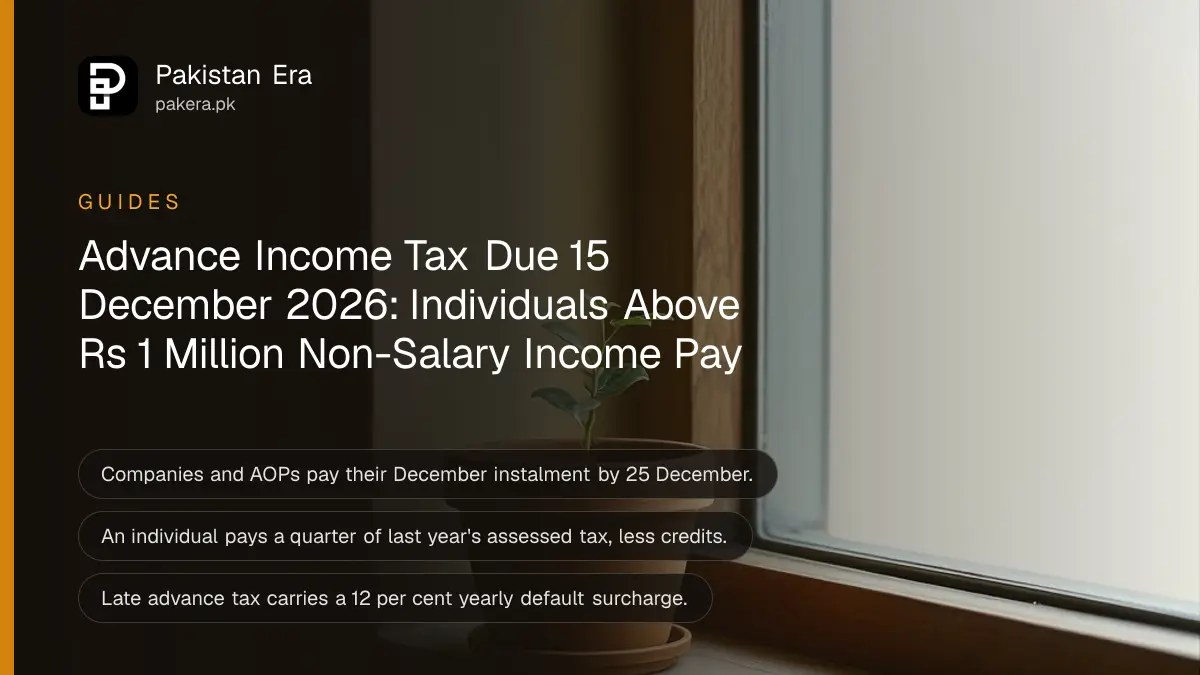
Individuals who owe advance income tax in Pakistan must pay the December quarter instalment by 15 December 2026, and companies and associations of persons by 25 December, under section 147 of the Income Tax Ordinance. An individual pays only if last year's assessed taxable income, leaving out salary and final-tax income, was Rs 1 million or more. The instalment is a quarter of last year's assessed tax, less tax already credited in the quarter.
Advance tax catches business owners, landlords and freelancers who have no employer to deduct tax each month. Miss it and FBR adds a 12 per cent yearly surcharge on the unpaid amount. Here is the test for who pays, the formula with a worked example, how to pay with a PSID, and how to pay less if this year is worse than last.
Individuals pay advance tax only above Rs 1 million of non-salary income
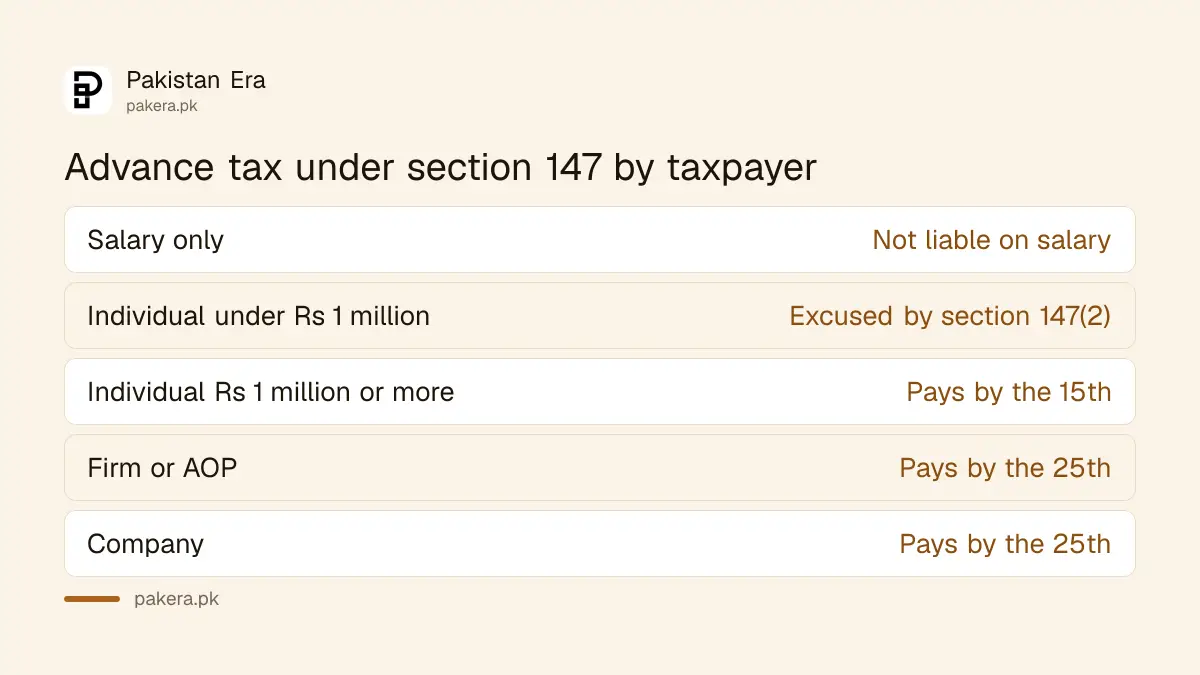
Section 147(1) applies to every taxpayer whose income was taxed in the latest tax year. Section 147(2) then excuses an individual whose latest assessed taxable income is under Rs 1 million, counting without salary, income taxed at source under the final regime and certain other income.
| Your situation | Advance tax under section 147? |
|---|---|
| Salary only, tax deducted by employer | No, salary is left out |
| Business or freelance income, last assessed under Rs 1 million | No, section 147(2) excuses you |
| Business or freelance income, last assessed Rs 1 million or more | Yes, quarterly by the 15th |
| Association of persons (firm) | Yes, quarterly by the 25th |
| Company | Yes, quarterly by the 25th |
The income left out of the test is listed in section 147(1): income charged under sections 5, 6 and 7, salary taxed under section 149, and income on which tax was deducted or collected with no credit allowed, which is the final tax regime. If all your income is of these kinds, section 147 does not reach you.
The December instalment is due on 15 December for individuals
Section 147(5) sets four dates for individuals: 15 September, 15 December, 15 March and 15 June. Section 147(5A) sets 25 September, 25 December, 25 March and 15 June for companies and AOPs. The December quarter covers 1 October to 31 December.
| Quarter | Period | Individuals | Companies and AOPs |
|---|---|---|---|
| September | 1 July to 30 September | 15 September | 25 September |
| December | 1 October to 31 December | 15 December 2026 | 25 December 2026 |
| March | 1 January to 31 March | 15 March 2027 | 25 March 2027 |
| June | 1 April to 30 June | 15 June 2027 | 15 June 2027 |
15 December 2026 is a Tuesday. 25 December is Quaid-e-Azam Day, a public holiday, so firms and companies should pay by 24 December. The rest of the year's dates sit in FBR tax deadlines after 31 October.
The formula is a quarter of last year's tax, less credits
For an individual, section 147(4B) uses (A/4) minus B. A is the tax assessed for the latest tax year. B is tax paid in the quarter that counts as a credit under section 168, other than salary tax. Companies and AOPs use a turnover-based formula instead.
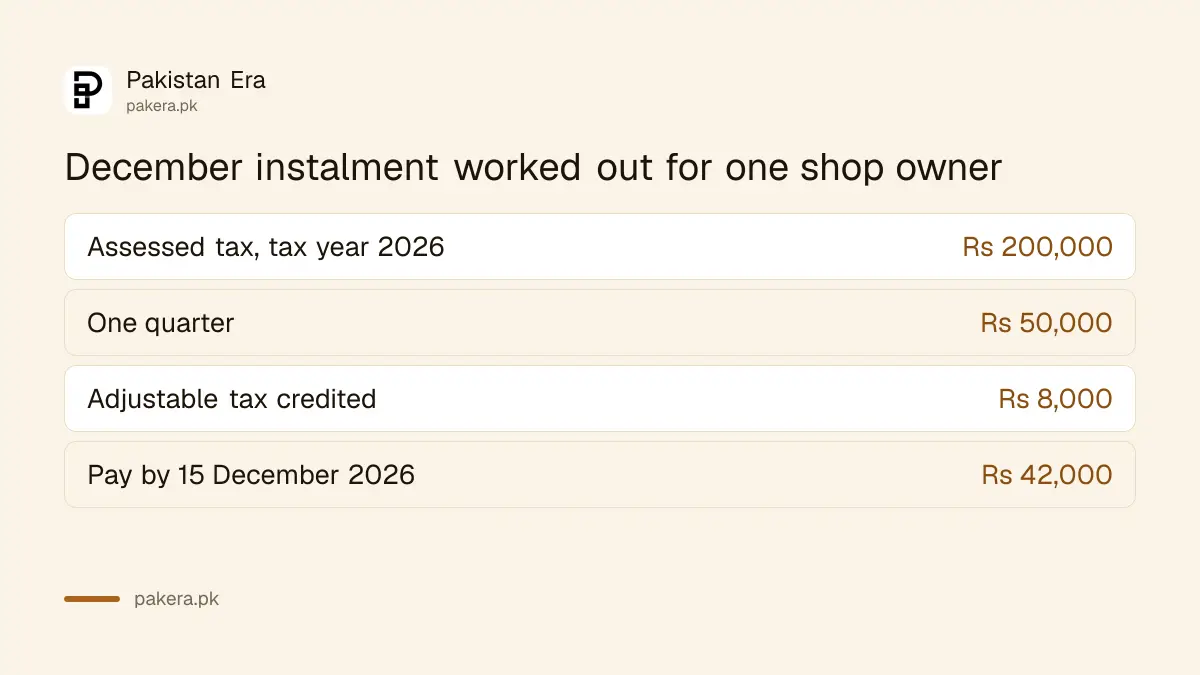
Here is a worked example with round numbers, our own arithmetic. A shop owner's assessed tax for tax year 2026 was Rs 200,000. A quarter of that is Rs 50,000. Between October and December, Rs 8,000 of adjustable tax was collected from him on business bills, which counts as a credit.
- Tax assessed for tax year 2026 (A): Rs 200,000.
- A divided by 4: Rs 50,000.
- Adjustable tax credited in October to December (B): Rs 8,000.
- December instalment: Rs 50,000 minus Rs 8,000, which is Rs 42,000.
- Pay by 15 December 2026.
Only adjustable tax reduces the instalment. Tax collected as a final tax does not count as a credit. If you are not sure which of your deductions are adjustable, the FBR withholding tax rate card marks each one.
For companies and AOPs, section 147(4) uses (A x B/C) minus D. A is turnover for the quarter, B is last year's assessed tax, C is last year's turnover, and D is tax credited in the quarter. So a firm whose sales fall pays less, without filing anything.
Pay the instalment with a PSID from IRIS
Advance tax is paid like any other income tax: create a payment slip ID (PSID) in IRIS for the right tax year and payment section, then pay it through your bank app, ATM or branch. Keep the payment receipt, because it is your proof of payment and your credit in the return.
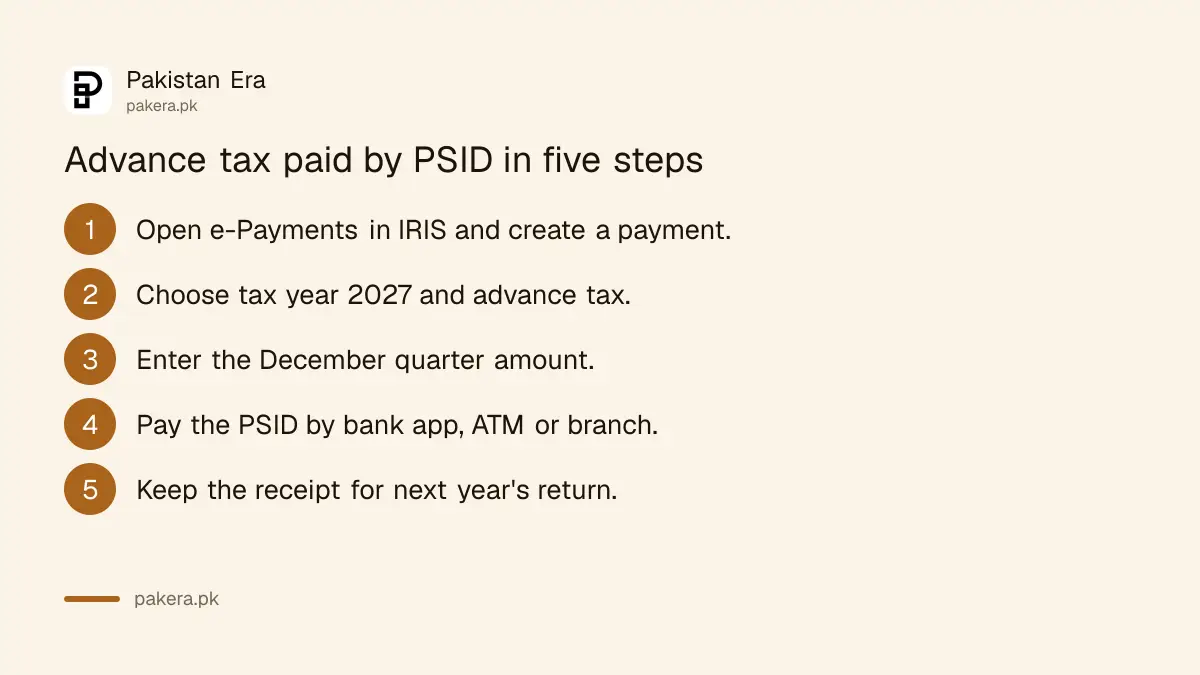
- Log in to IRIS and open e-Payments, then Create Payment.
- Choose income tax, tax year 2027, and the advance tax payment under section 147.
- Enter the amount for the December quarter.
- Create the PSID and note its number.
- Pay it through internet banking, a bank app, an ATM or a branch before the date.
- Keep the computerised payment receipt for your tax year 2027 return.
FBR's own payment page describes the Create Payment route and deposit at a National Bank or State Bank branch. We did not create a live PSID, so the exact payment section label may differ. Paying income tax online with a PSID shows the screens step by step.
You can pay less if this year will be lower
Section 147(6) lets a taxpayer who expects this year's tax to be lower file an estimate with the Commissioner before the last instalment is due, and then pay the estimated amount in equal parts on the dates still left. The estimate needs evidence.
The proviso asks for turnover of the completed quarters, estimated turnover for the rest with reasons for any fall, proof of expected expenses or deductions, and a computation of estimated taxable income. A shop that lost its main customer can use it. A guess will not do.
Late or short payment costs 12 per cent a year
Section 205(1A) charges default surcharge at 12 per cent a year on advance tax not paid by its date. It runs from the due date until you pay, or until the return date for that tax year, whichever comes first. Paying late is cheaper than not paying at all.
On the Rs 42,000 in the example, two months late would cost about Rs 840, our arithmetic at 12 per cent a year. That is small next to the trouble of an FBR notice. If FBR's recovery reaches your bank account, what to do about a section 140 notice explains your options.
Common questions
When is the December 2026 advance tax due?
By 15 December 2026 for individuals and by 25 December 2026 for companies and AOPs, under section 147.
Do salaried people pay advance tax?
Not on salary. Section 147(1) leaves out income taxed under section 149, which is salary.
Who is exempt from advance tax?
An individual whose latest assessed taxable income, without salary and final-tax income, was under Rs 1 million, under section 147(2).
How is an individual's instalment worked out?
A quarter of last year's assessed tax, minus adjustable tax credited in the quarter other than salary tax. That is section 147(4B).
What is the surcharge for late advance tax?
12 per cent a year under section 205(1A), until payment or the return date, whichever is earlier.
Can I pay less than the formula says?
Yes, by filing an estimate with evidence under section 147(6) before the last instalment is due.
How we verified this
What we checked, where we read it, and what we could not confirm.
Last checked 31 October 2026. We read sections 147, 168 and 205 of the Income Tax Ordinance amended up to 30 June 2026 FBR's e-payment instructions on its income tax pages, and FBR's income tax due dates page. The worked example and the surcharge figure are our own arithmetic. We did not create a PSID for advance tax, so the payment section label in IRIS may differ from our wording.
About the author

Global Affairs & Political Economy Writer
Muhammad Hatim is a book lover who started writing because he enjoys it. At Pakistan Era he writes about international relations, geopolitics and the global economy, with a particular interest in South Asia and the forces behind current events.