What to Do When FBR Sends Your Bank a Section 140 Recovery Notice in Pakistan
FBR can order your bank or employer to pay unpaid tax under section 140. See the limits, how an appeal with 10 per cent paid stops it, and what to do first.
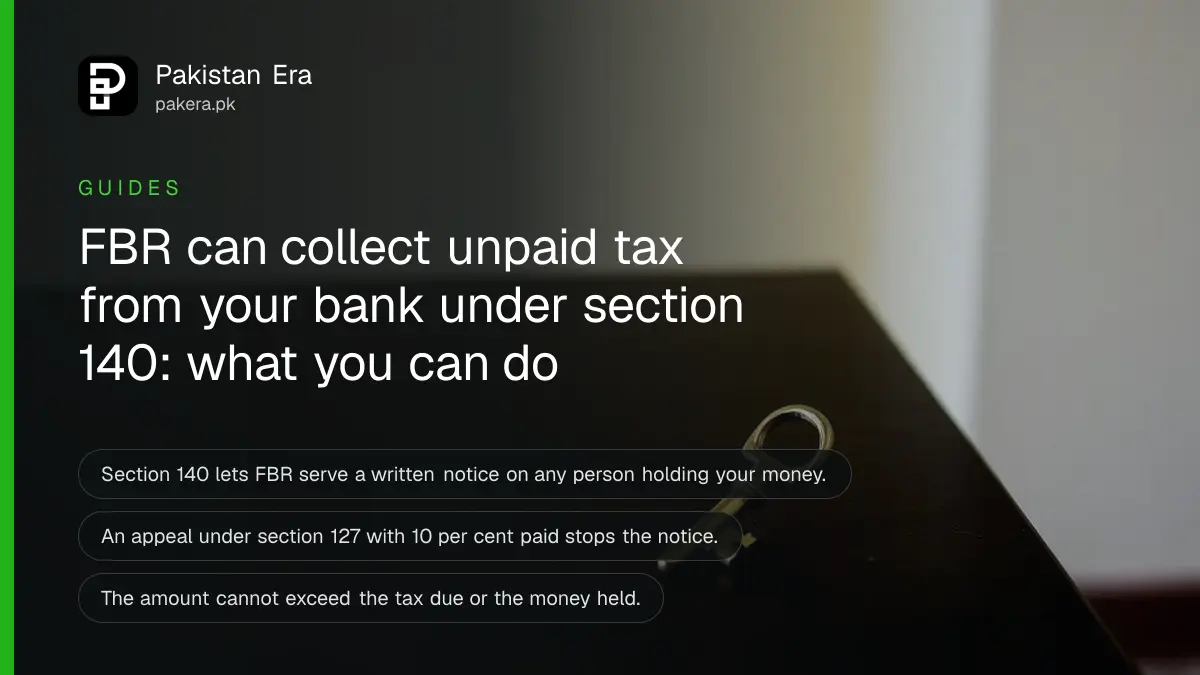
Short answer: Under section 140 of the Income Tax Ordinance, FBR can order your bank, your employer or a customer who owes you money to pay your unpaid tax straight to the Commissioner. If you have already appealed the tax order to the Commissioner (Appeals) and paid 10 per cent of the tax due, the Commissioner cannot issue this notice while the appeal is pending.
The first sign is often a bank clerk saying your balance cannot be used. Or an employer says part of your salary will go to FBR. Both can come from the same section of the law, and both have a legal way out.
We read the Income Tax Ordinance, 2001, as amended up to 30 June 2026, on FBR's website on 12 October 2026. Section 140 is the text this page follows.
Section 140 lets FBR collect unpaid tax from whoever holds your money
The Commissioner may serve a written notice on any person who owes you money, holds money for you, holds money on someone else's account for payment to you, or has authority to pay you. That person must pay the Commissioner the amount stated, by the date stated.
That list covers a bank holding your deposits, a company that owes you an invoice and an employer that pays your salary. The law even says "person" includes a court, a tribunal or any other authority.
The notice is a recovery step. It comes after tax has become due, not before. Check which order the demand comes from before you do anything else.
The notice has limits on amount, timing and series of payments
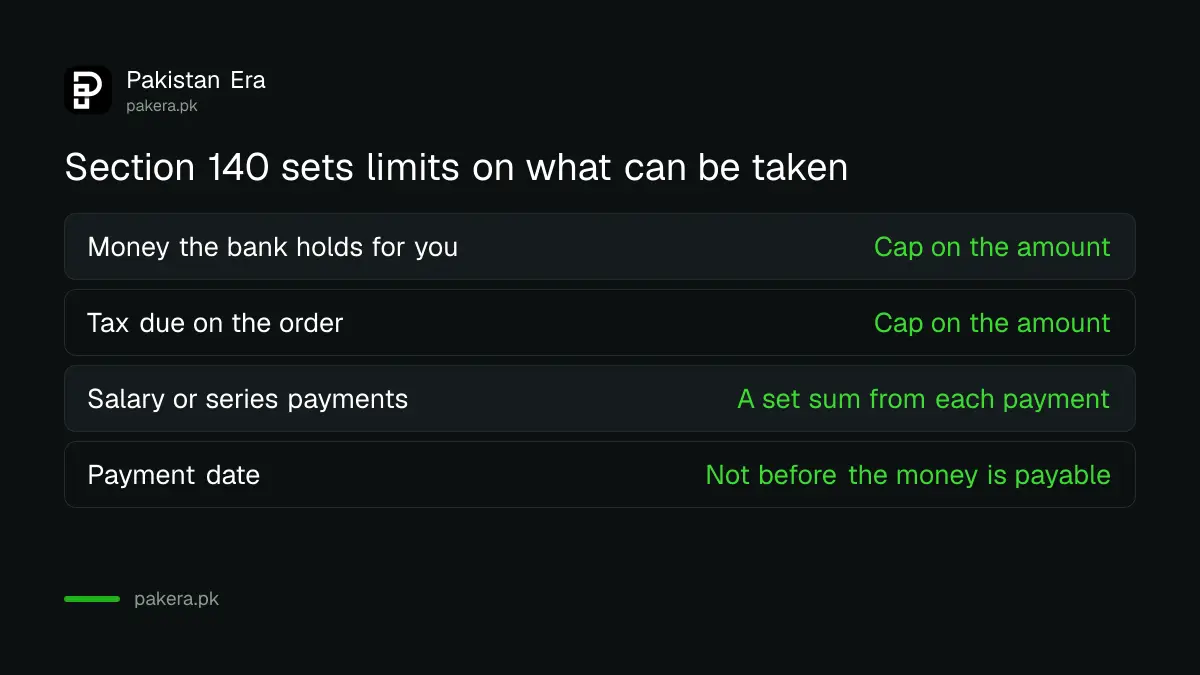
The amount in the notice cannot be more than the money the holder has for you, and cannot be more than the tax due. If you are paid in a series, such as a salary, the notice can name a fixed amount to be taken from each payment until the tax is cleared.
| Limit in section 140 | What it means for you |
|---|---|
| Amount cannot exceed the money held | Only what the bank or payer actually has for you can be taken |
| Amount cannot exceed the tax due | The notice should be for the demand, not your whole balance |
| Series of payments, such as salary | A set amount can be taken from each payment until the tax is paid |
| Payment date | It cannot be earlier than the date the money becomes payable to you |
| Payer who complies | Treated as paying with your authority, and the Commissioner's receipt discharges the payer |
If the bank has taken more than the notice names, the difference is yours to claim back. Ask the bank for a written copy of the notice and compare the amounts.
An appeal with 10 per cent paid stops the notice
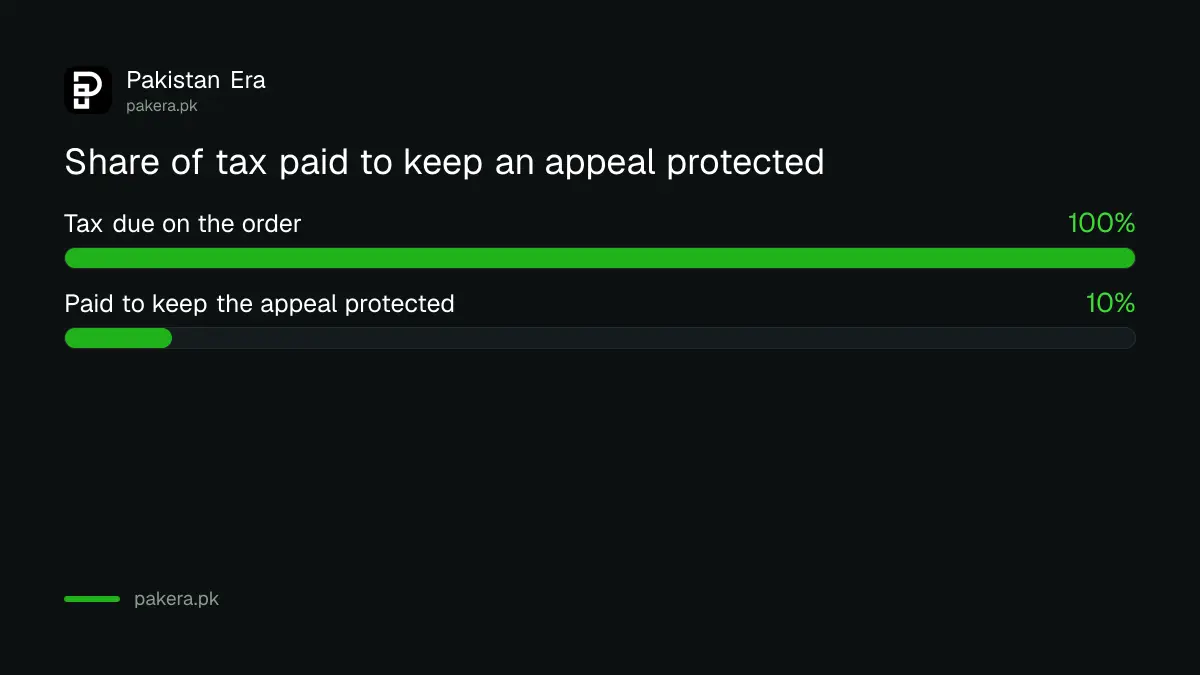
The Commissioner may not issue a section 140 notice for tax from an order if you have filed an appeal under section 127 and it is not yet decided by the Commissioner (Appeals), provided 10 per cent of the tax due has been paid. This is the main protection in the section.
So the order of events matters. The 10 per cent is not a fine. It is a condition that lets the appeal protect your account. If you have not appealed yet, the steps and time limit are in how to appeal an FBR income tax order to the Commissioner (Appeals).
The proviso does not cover every case. A separate rule, added by the Finance Act, 2025, makes tax immediately payable once the department has won at three appellate forums including the High Court. It applies only to the lowest demand confirmed by any of the three and only where the tax is above Rs 200 million. It does not touch an ordinary individual's pending first appeal.
What to do in the first three days after you learn of a notice
Get the notice in writing, check the tax year and amount, then work out which route fits. Paying the correct amount, appealing with 10 per cent paid or asking for a correction are the three routes the law leaves open.
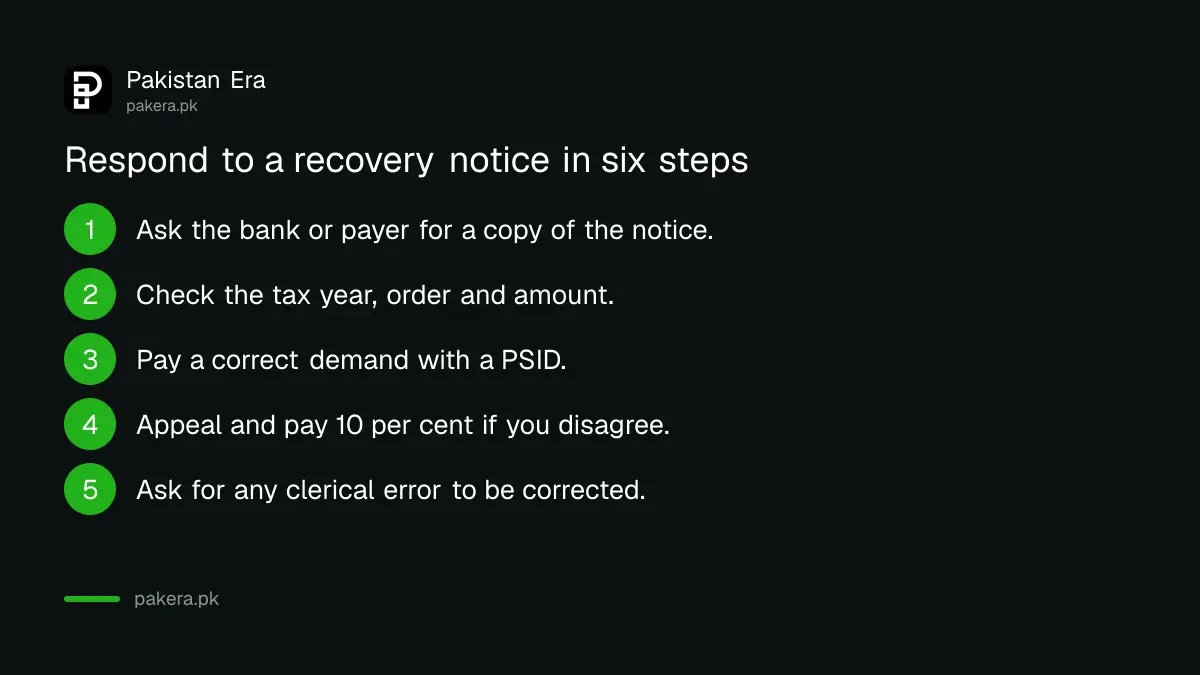
- Ask the bank or payer for a copy of the section 140 notice, or the Commissioner for the recovery notice.
- Check the tax year, the order number and the amount against your own records.
- If the demand is correct, pay it with a PSID and send the receipt to the Commissioner and the bank.
- If you disagree and have not appealed, file the appeal and pay 10 per cent of the tax due.
- If the order has an arithmetic or clerical mistake, ask for it to be corrected in writing.
- Send the appeal acknowledgement and the 10 per cent receipt to the bank and to the Commissioner, and keep copies.
A clerical error in the order is a separate fix, as set out in asking FBR to correct a mistake in a tax order under section 221. Paying through the correct channel is covered in paying income tax online with a PSID.
A bank that ignores the notice becomes liable itself
Section 140 applies sections 160 to 163 to the amount, as if it were tax a payer was required to deduct. That is why banks and employers comply quickly. Not paying the Commissioner puts the payer's own money at risk.
Do not ask your bank to ignore a valid notice. A bank that ignores a valid notice carries the risk itself, so it will not do so. Take the dispute to the Commissioner, the Commissioner (Appeals) or the Federal Tax Ombudsman.
For delays and maladministration rather than the tax itself, see how to complain to the Federal Tax Ombudsman about FBR delays. If your account is frozen for another reason, such as a court order, the route is different and is covered in how to get a frozen bank account released.
Common questions
Can FBR take money from my bank account without a court order?
Yes, for tax that is already due. Section 140 lets the Commissioner serve a written notice on the bank. The Commissioner does not need a court order to do it.
Can FBR empty my account?
No. The notice cannot be for more than the tax due, and cannot be for more than the money the bank holds for you.
Does an appeal stop a section 140 notice?
Yes, if the appeal is filed under section 127, is still pending before the Commissioner (Appeals) and 10 per cent of the tax due has been paid.
Can my salary be taken?
Yes. For a series of payments such as salary, the notice can name an amount to be taken out of each payment until the tax is cleared.
Does the bank have to tell me?
The law does not say the bank must warn you first. Ask the bank for a written copy of the notice as soon as you see the hold.
What if the tax has already been paid?
Send the Commissioner and the bank the payment receipt and the order reference. Then ask in writing for the notice to be withdrawn.
How we verified this
What we checked, where we read it, and what we could not confirm.
We read section 140 of the Income Tax Ordinance, 2001, amended up to 30 June 2026, published by the Federal Board of Revenue, on 12 October 2026. The official text and the notice you receive decide your case. This page is general information, not tax advice.
About the author

Global Affairs & Political Economy Writer
Muhammad Hatim is a book lover who started writing because he enjoys it. At Pakistan Era he writes about international relations, geopolitics and the global economy, with a particular interest in South Asia and the forces behind current events.