How to Appeal an SRB Order in Sindh: 30 Days, Form SST-5A and a 20% Deposit
Appeal an SRB order to the Commissioner (Appeals) in 30 days on Form SST-5A. Fees, the 20 per cent deposit that stops recovery, stays and the Tribunal step.
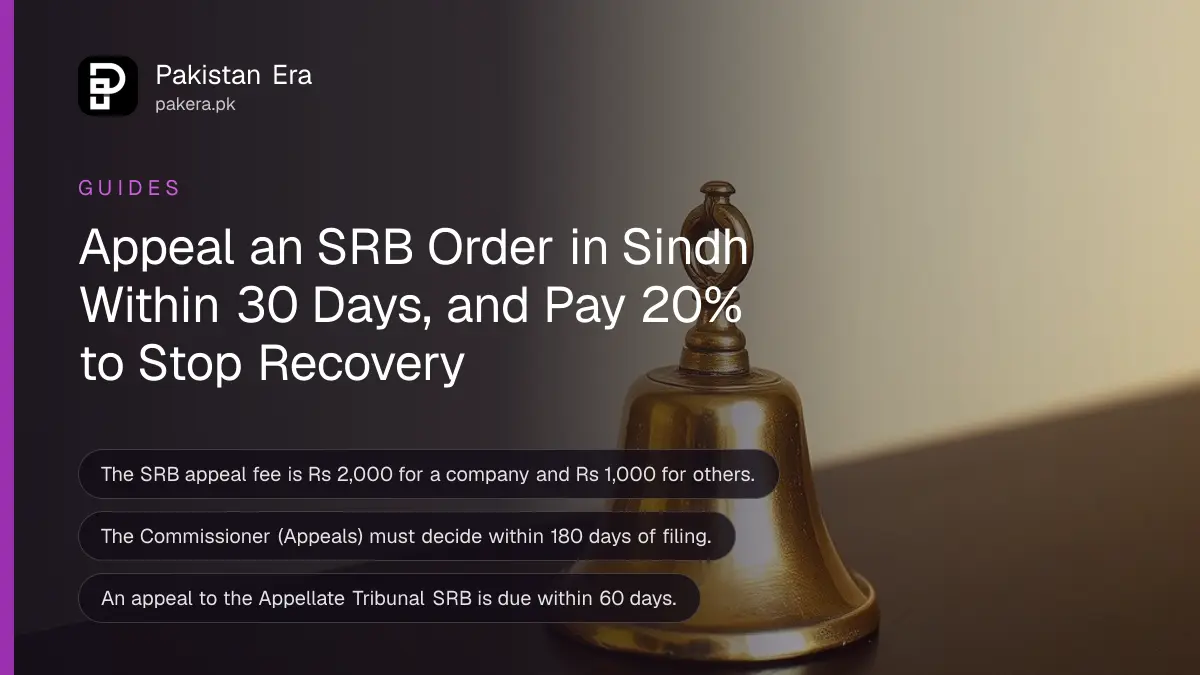
Short answer: To appeal an SRB order in Sindh, file Form SST-5A with the Commissioner (Appeals), SRB, within 30 days of receiving the order. The fee is Rs 2,000 for a company and Rs 1,000 for anyone else. Pay 20 per cent of the tax demanded and SRB cannot use recovery notices against you while the appeal is pending, under section 66 as changed by the Sindh Finance Act, 2026.
An SRB assessment, penalty or default surcharge order can be challenged, but the clock is short and the paperwork is strict. We read Chapter IX of the Sindh Sales Tax on Services Act, 2011 and Chapter X of the Rules, both as amended up to 1 July 2026, on SRB's website. The protection deposit went up this year, from 10 to 20 per cent, which many filers have missed.
You have 30 days from the order to appeal
Section 57 gives any person hurt by an SRB officer's decision 30 days from the date the order is served to appeal to the Commissioner (Appeals), SRB. Orders that can be appealed include assessments, penalties, default surcharge, recovery of short-levied tax, compulsory registration and cancellation.
In the Act's terms, the covered orders are those under sections 22, 23, 24B, 25(5), 25A, 43, 44, 47, 68 and 76. Section 23 is assessment of tax. Section 47 is recovery of tax not levied or short-levied. Sections 43 and 44 are penalties and default surcharge. Section 25(5) covers cancellation after a suspension. Many of these orders start from a late or missing SST-03 return.
Missed the 30 days? Section 57(5) lets the Commissioner (Appeals) admit a late appeal if you show sufficient cause, such as illness or not receiving the order. Apply in writing with the appeal and explain the delay. Do not count on it, though.
Paying 20 per cent stops recovery while the appeal runs
Under the first proviso to section 66(1), SRB may not issue recovery notices for tax under an order you have appealed if you have paid 20 per cent of the tax due. The Sindh Finance Act, 2026 raised this from 10 per cent and extended it to appeals before the Appellate Tribunal.
Recovery can be harsh. Section 66 lets SRB take money owed to you, attach your bank accounts, stop your business or seal your premises. So the 20 per cent payment is often the cheapest protection you can buy. On a demand of Rs 2 million, it is Rs 400,000.
There is also a short breathing space. For an assessment under section 23 or a short-levy order under section 47, SRB cannot start recovery for 30 days from the order's date. That lines up with your 30 days to appeal.
Section 64 adds a rule that sounds tougher: an appellant should deposit the tax in the order, unless the Commissioner (Appeals) or the Tribunal stays it. That is one more reason to ask for a stay when you file, as the next part explains.
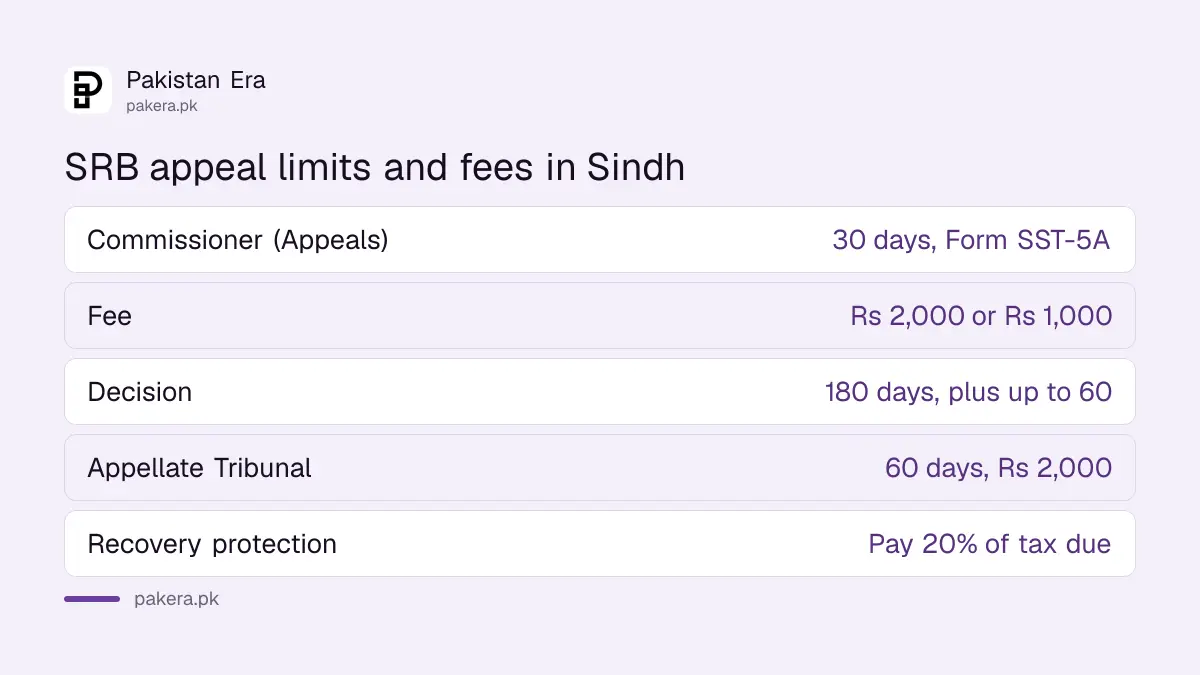
| Stage | File within | Fee | Decision due | Stay of recovery |
|---|---|---|---|---|
| Commissioner (Appeals), Form SST-5A | 30 days of the order | Rs 2,000 company, Rs 1,000 others | 180 days, plus up to 60 more | 15 days, then up to 180 days in all |
| Appellate Tribunal SRB, Form SST-5B | 60 days of the appeal order | Rs 2,000 | Six months | 30 days, then up to 90 days in all |
| High Court reference, Form SST-5C | As set in section 63 | Under section 63 | Court decides | Court decides |
File Form SST-5A as a full paper book
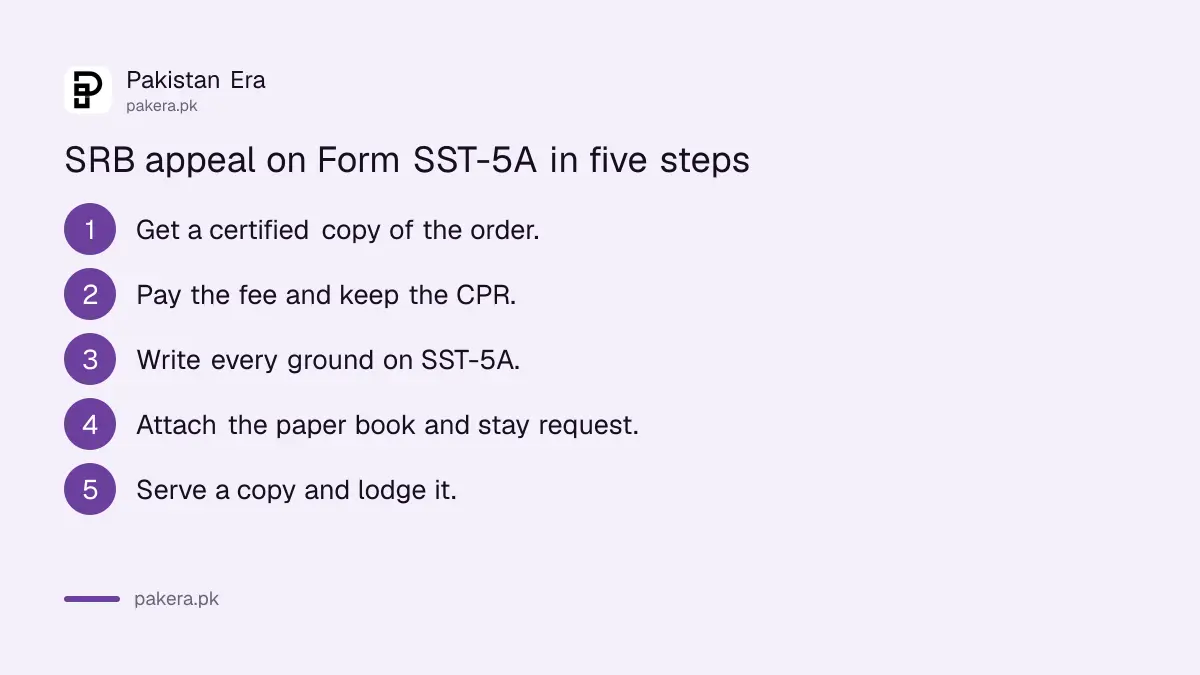
Rule 57 requires the appeal on Form SST-5A, signed by the right person, with a set of attachments called a paper book. You must also give the SRB officer whose order you challenge a complete copy. Missing papers lead to an objection memo and delay.
- Get a certified copy of the order and the show cause notice behind it.
- Pay the appeal fee on a PSID and keep the original computerised payment receipt (CPR).
- Fill Form SST-5A with every ground of appeal. Rule 57E says the appeal must include the whole claim.
- Have it signed by the right person: the individual, the managing partner, or for a company a director or an employee authorised by board resolution.
- Build the paper book: an index with page numbers, the order, the notice, any recovery notice, the fee CPR, your Letter of Authorization on Form II if an adviser appears for you, and any judgments you rely on.
- Add an application for a stay of recovery under section 58(4), or proof of the 20 per cent payment.
- Give a full copy to the respondent officer and attach a signed certificate saying you did.
- Lodge it with the Commissionerate (Appeals), SRB, and note the appeal number and date it writes on your form.
Want to add a ground later? Rule 57E lets you apply under section 58(3), with reasons, but not after the final hearing.
The Commissioner (Appeals) must decide within 180 days
The Commissioner (Appeals) must pass an order within 180 days of the appeal being filed, extendable by up to 60 days with written reasons. If not, the appeal moves to the Appellate Tribunal automatically. The Commissioner can confirm, change or cancel the order, but cannot send it back for a fresh hearing.
A stay of recovery first runs for up to 15 days. After hearing both sides, it can be confirmed or changed, but it lasts no more than 180 days in all. Any further inquiry the Commissioner orders must finish within 60 days. And the Commissioner cannot raise your tax without first giving you a chance to show cause.
Time lost to a stay, an inquiry or your own adjournments does not count towards the 180 days. So asking for repeated adjournments slows your own case.
The next step is the Appellate Tribunal, within 60 days
If you lose, appeal to the Appellate Tribunal SRB on Form SST-5B within 60 days of being served the Commissioner (Appeals) order. The fee is Rs 2,000. The Tribunal must decide within six months and can stay recovery for 30 days, extendable to 90 days in all.
The Tribunal can also hear appeals against revision orders by the Commissioner under section 55 or by the Board under section 56. It posts cause lists and orders on its own website, atsrb.gos.pk, so you can follow your hearing date there. A question of law after that goes to the High Court as a reference on Form SST-5C.
Federal sales tax and income tax disputes take a different route. For those, see how to appeal an FBR income tax order. If your SRB problem is a suspended registration rather than a tax demand, start with the steps to restore an SRB registration, since fixing the default is faster than an appeal.
Common questions
How many days do I have to appeal an SRB order?
30 days from the date the order is served on you, under section 57(4) of the Sindh Sales Tax on Services Act, 2011.
What is the SRB appeal fee?
Rs 2,000 for a company and Rs 1,000 for anyone else before the Commissioner (Appeals). Before the Appellate Tribunal it is Rs 2,000.
Which form is used for an SRB appeal?
Form SST-5A for the Commissioner (Appeals), Form SST-5B for the Appellate Tribunal and Form SST-5C for a High Court reference.
How do I stop SRB recovering tax while I appeal?
Pay 20 per cent of the tax due, under section 66(1) as changed in 2026, or ask the Commissioner (Appeals) for a stay under section 58(4).
How long does the Commissioner (Appeals) take?
The law allows 180 days from filing, plus up to 60 more. Undecided appeals then move to the Appellate Tribunal.
Can the Commissioner (Appeals) increase my tax?
Only after giving you a chance to show cause against the increase, under section 59(3).
How we verified this
What we checked, where we read it, and what we could not confirm.
Last checked 20 October 2026. We read sections 57 to 59, 61 to 62, 64 and 66 of the Sindh Sales Tax on Services Act, 2011 (amended up to 1 July 2026), including the Sindh Finance Act, 2026 footnotes on section 66, and rules 57 to 59 of the Sindh Sales Tax on Services Rules, 2011 on SRB's site. The Rs 2 million example is our own arithmetic. We did not check the time limit for a High Court reference under section 63, and we have not filed an appeal ourselves.
About the author

Senior Writer, Public Services and Technology
Shahid joined us in 2024 as an author. He is a senior contributor to Pakistan's leading technology websites. He writes detailed articles, mostly covering his expertise in the latest tech, mobiles, apps, gadgets, and step-by-step guides. His ideology is to help people understand the latest trends and explain complex methods through very easy-to-understand guides.