Pakistan Population by Religion: Census 2023 Figures by Province and District
Pakistan's 2023 census: 96.35% Muslim, 3.87 million Hindus, 3.30 million Christians, 15,998 Sikhs. See every province and the districts each community lives in.
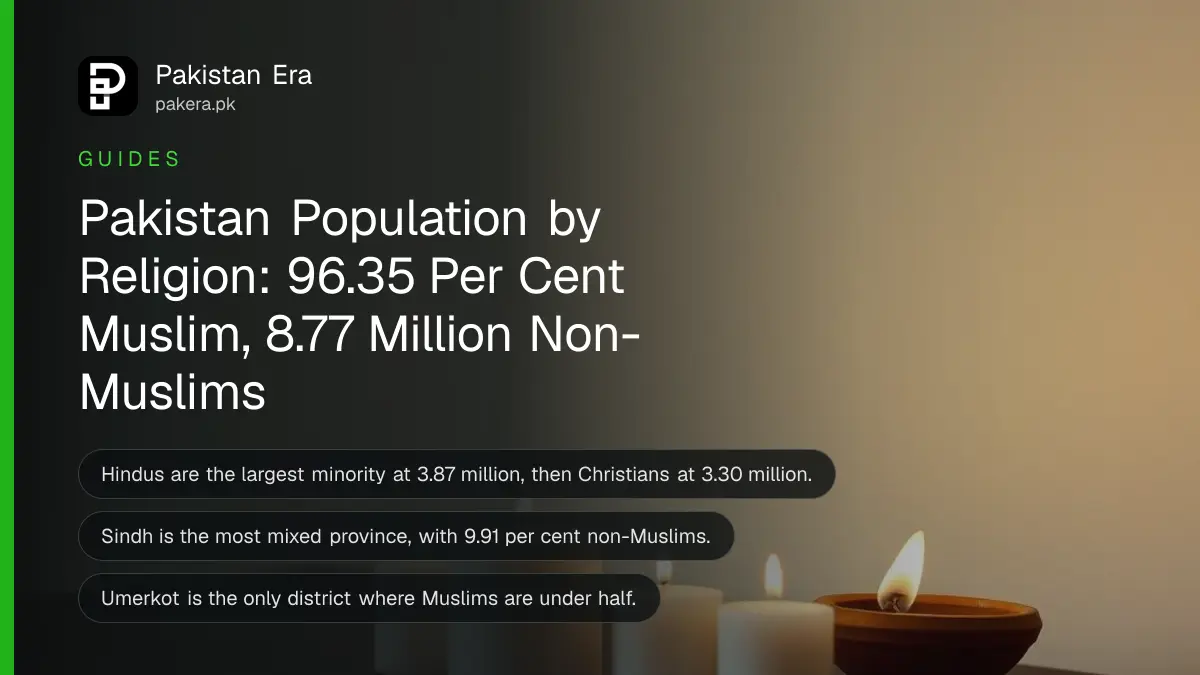
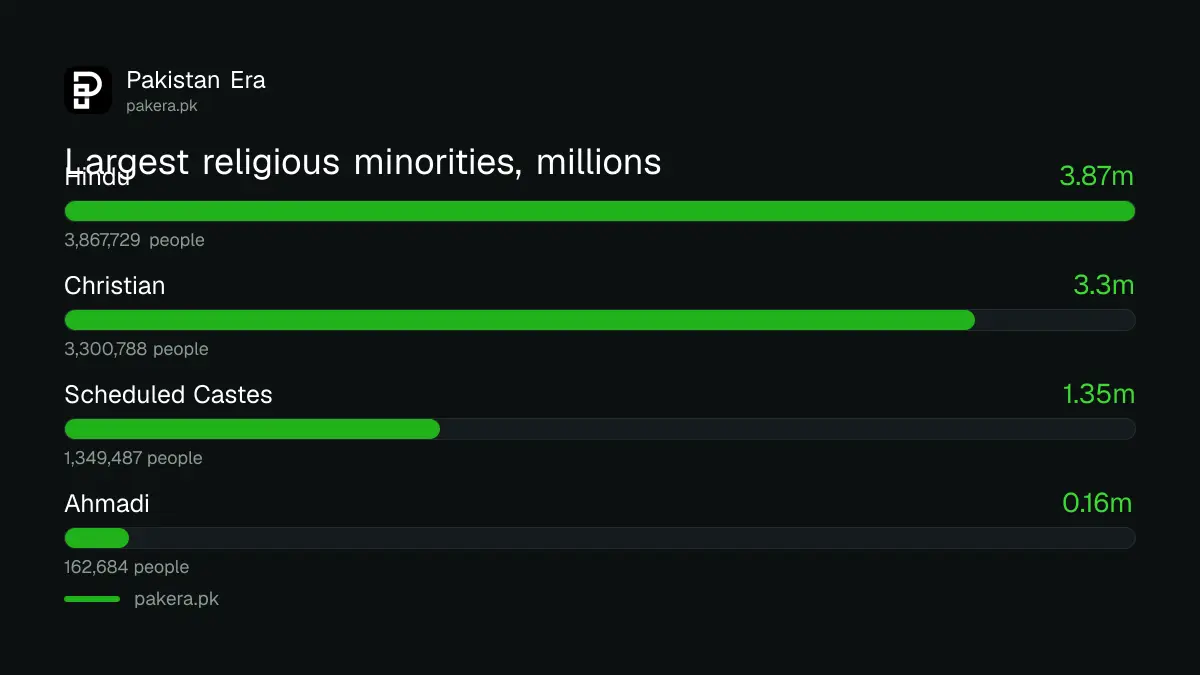
Pakistan's 2023 census counted 231.69 million Muslims, 96.35 per cent of the population of 240.46 million. The census found 8.77 million non-Muslims, or 3.65 per cent: 3.87 million Hindus, 3.30 million Christians, 1.35 million people of the Scheduled Castes, 162,684 Ahmadis, 15,998 Sikhs and 2,348 Parsis.
We went through the Pakistan Bureau of Statistics (PBS) religion tables for every province and district. Below are the national and provincial figures, the districts where each community lives, and the one district where Muslims are not the majority.
| Religion | People, 2023 census | Share of Pakistan |
|---|---|---|
| Muslim | 231,686,709 | 96.35% |
| Hindu | 3,867,729 | 1.61% |
| Christian | 3,300,788 | 1.37% |
| Scheduled Castes | 1,349,487 | 0.56% |
| Ahmadi | 162,684 | 0.07% |
| Sikh | 15,998 | 0.007% |
| Parsi | 2,348 | 0.001% |
| Others | 72,346 | 0.03% |
| Total | 240,458,089 | 100% |
Hindus are the largest religious minority in Pakistan
Hindus are the largest minority at 3.87 million, followed by Christians at 3.30 million. The census counts Scheduled Castes separately from Hindus. Taken together, the two groups come to 5.22 million people, or 2.17 per cent of Pakistan.
The PBS report says the 2023 count separated Hindus and Scheduled Castes more clearly than the 2017 census did. So a change in either group since 2017 partly reflects how people were recorded, not only real growth.
Sindh is the most religiously mixed province
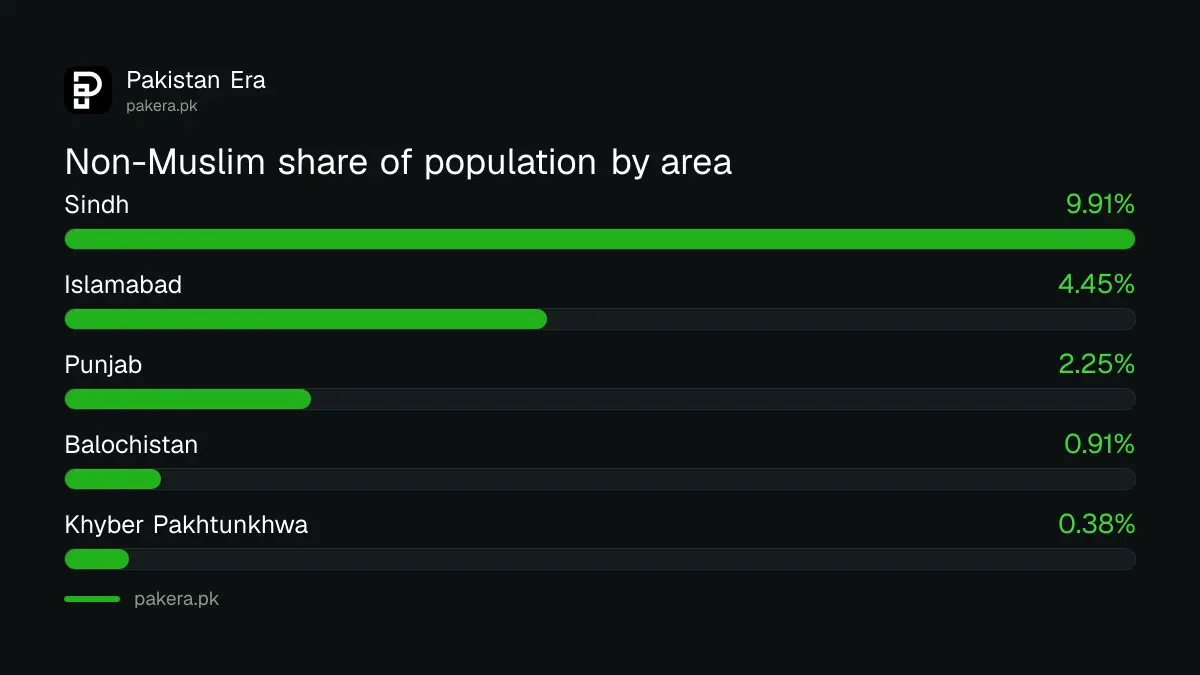
Sindh has the highest share of non-Muslims, at 9.91 per cent. Islamabad follows at 4.45 per cent, mostly Christians. Punjab is at 2.25 per cent. Balochistan and Khyber Pakhtunkhwa are both more than 99 per cent Muslim.
| Area | Muslim | Hindu | Christian | Scheduled Castes | Ahmadi | Sikh |
|---|---|---|---|---|---|---|
| Punjab | 97.75% | 228,559 | 2,458,924 | 21,157 | 140,512 | 5,649 |
| Sindh | 90.09% | 3,575,848 | 546,968 | 1,325,559 | 18,266 | 5,182 |
| Khyber Pakhtunkhwa | 99.62% | 5,473 | 134,884 | 629 | 951 | 4,050 |
| Balochistan | 99.09% | 57,010 | 62,731 | 2,097 | 557 | 1,057 |
| Islamabad | 95.55% | 839 | 97,281 | 45 | 2,398 | 60 |
Each community is concentrated in one place. By our arithmetic on the PBS tables, 92 per cent of Pakistan's Hindus and 98 per cent of the Scheduled Castes live in Sindh. Three in four Christians live in Punjab, and so do 86 per cent of Ahmadis. Three in four Parsis live in Sindh, almost all of them in Karachi.
Umerkot is the only district where Muslims are not the majority
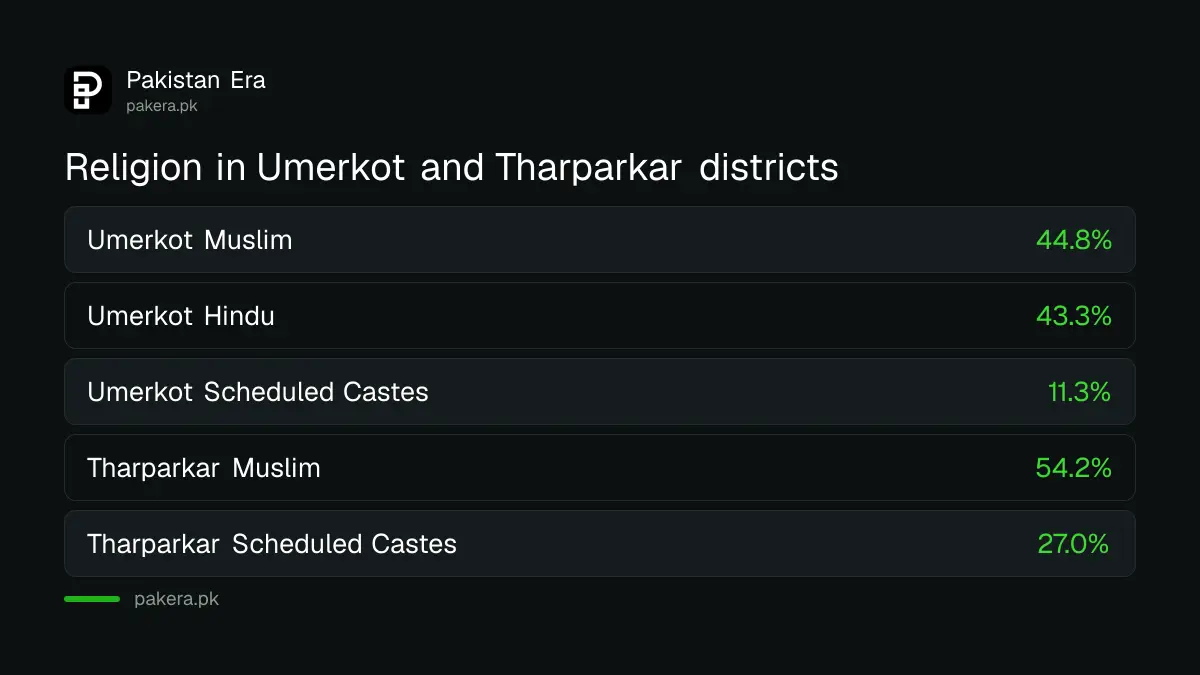
In Umerkot district of Sindh, Muslims are 44.83 per cent of the population. Hindus are 43.34 per cent and Scheduled Castes 11.32 per cent. It is the only district in Pakistan where Muslims are under half. Khyber Pakhtunkhwa and Balochistan as a whole are more than 99 per cent Muslim.
Lower Sindh, along the Indian border and around Hyderabad, holds most of Pakistan's Hindu population. Mirpur Khas has the largest number of Hindus of any district, 524,024.
| District (Sindh) | Hindu | Scheduled Castes | Together, share of district |
|---|---|---|---|
| Umerkot | 501,989 | 131,125 | 54.7% |
| Tharparkar | 331,579 | 479,928 | 45.6% |
| Mirpur Khas | 524,024 | 173,294 | 41.5% |
| Tando Allahyar | 216,567 | 120,836 | 36.6% |
| Badin | 393,306 | 95,217 | 25.1% |
| Sanghar | 377,177 | 187,471 | 24.5% |
| Tando Muhammad Khan | 159,722 | 14,383 | 24.0% |
Tharparkar stands out in a different way. It has more people recorded as Scheduled Castes (479,928) than as Hindus (331,579), the only district where that is true.
Lahore has more Christians than any other district
Lahore district has 602,431 Christians, 4.64 per cent of its people. That is the highest number of any district, and a higher share than Islamabad's 4.26 per cent.
| District | Christians | Share of district |
|---|---|---|
| Lahore | 602,431 | 4.64% |
| Karachi (7 districts) | 435,621 | 2.14% |
| Faisalabad | 308,580 | 3.40% |
| Gujranwala | 207,782 | 3.50% |
| Sialkot | 154,884 | 3.46% |
| Sheikhupura | 148,784 | 3.67% |
| Kasur | 140,136 | 3.43% |
| Rawalpindi | 112,822 | 1.86% |
| Islamabad | 97,281 | 4.26% |
Where Ahmadis, Sikhs and Parsis are counted
Chiniot district in Punjab has 67,223 Ahmadis, 4.30 per cent of the district and 41 per cent of all Ahmadis counted in Pakistan. The PBS tables label this group "Qadiani/Ahmadi".
Pakistan's 15,998 Sikhs are spread across all four provinces: 5,649 in Punjab, 5,182 in Sindh, 4,050 in Khyber Pakhtunkhwa and 1,057 in Balochistan. Nankana Sahib, home to the birthplace of Guru Nanak, has the most of any Punjab or Sindh district, 1,887.
Of 2,348 Parsis, 1,656 live in Karachi. Karachi South district alone has 952.
What these numbers are used for
Census religion figures feed into minority quotas in jobs and education, reserved seats and welfare budgets. If you belong to a minority community, these are the services that use your status.
- Government jobs keep a quota for minorities, as in the KP agriculture field assistant jobs on the minority quota.
- Students can apply for the minority scholarship for 2026 to 27.
- In Punjab, families can apply for the Punjab Minority Card.
- Hindu couples in Sindh can register a Hindu marriage at the union council.
- A rights complaint can go to the National Commission for Minorities.
Common questions
What is the Muslim population of Pakistan in the 2023 census?
231,686,709 people, or 96.35 per cent of Pakistan's 240,458,089.
How many Hindus are there in Pakistan?
The 2023 census counted 3,867,729 Hindus, 1.61 per cent of the population. A further 1,349,487 people were recorded as Scheduled Castes.
How many Christians are there in Pakistan?
3,300,788, or 1.37 per cent. About 2.46 million of them live in Punjab.
How many Sikhs live in Pakistan?
The 2023 census counted 15,998 Sikhs. Punjab has 5,649, Sindh 5,182, Khyber Pakhtunkhwa 4,050 and Balochistan 1,057.
Which district has the most Hindus?
Mirpur Khas in Sindh has the largest number, 524,024. Umerkot has the highest share, 43.34 per cent.
Which province has the most non-Muslims?
Sindh, both by number and share. About 5.51 million people in Sindh, 9.91 per cent, are not Muslim.
How we verified this
What we checked and where we read it.
We checked these figures on 25 November 2026 in the PBS census page: the National Census Report 2023, section 4.3.1 and Table 4.13, and the census Table 9 (population by sex, religion and rural/urban) at national, provincial and district level. Table 9 lists Sikhs and Parsis separately; the report groups them under "Others".
In Table 4.13 of the report, Punjab's Muslim population is printed as 24,462,897. The Table 9 file for Punjab gives 124,462,897, which is the figure that adds up to Punjab's total, so we use it. District shares, sums for Karachi's seven districts and each community's share by province are our own arithmetic on Table 9. Our district totals for Sindh and Punjab add up exactly to the provincial totals.
Free on WhatsApp
Get last dates and rule changes on WhatsApp
We post new last dates, fee changes and fixes for common problems, a few short posts a day.
Follow Pakera on WhatsAppOther followers cannot see your number.
Pakera Solves It
Which online process wasted your time this week?
A portal that will not load, a form nobody explains, a complaint that went nowhere. Tell us. Every week we pick one, solve it step by step and publish the answer.
About the author

Senior Writer, Public Services and Technology
Shahid joined us in 2024 as an author. He is a senior contributor to Pakistan's leading technology websites. He writes detailed articles, mostly covering his expertise in the latest tech, mobiles, apps, gadgets, and step-by-step guides. His ideology is to help people understand the latest trends and explain complex methods through very easy-to-understand guides.