How to Petition the National Commission for Minorities Rights in Pakistan
Pakistan's 2025 minorities commission law lets a victim or anyone for them file a petition. See its powers, identity protection and the one month reply rule.
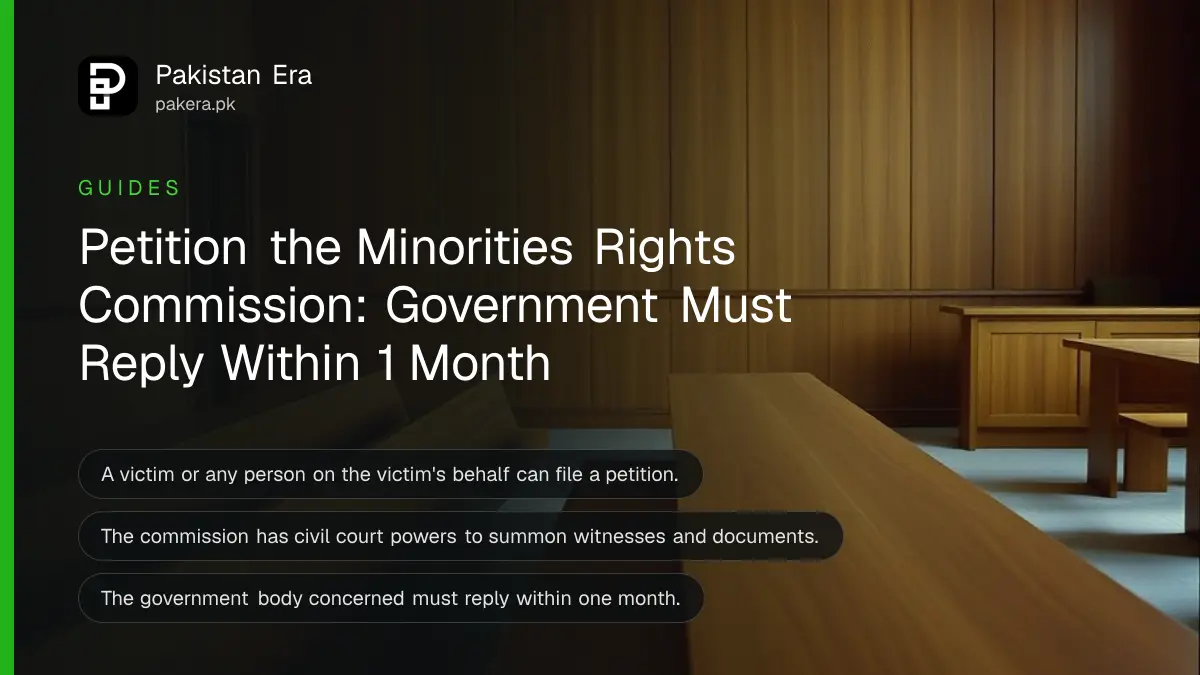
Under the National Commission for Minorities Rights Act, 2025, a victim, or anyone acting for the victim, can petition the Commission over a violation of minority rights. The Commission can summon witnesses, demand documents, hide a complainant's identity and recommend prosecution. The government body concerned must reply within one month.
Act No. XL of 2025 is dated 16 December 2025 and extends to the whole of Pakistan. We read it on the Pakistan Code portal on 22 October 2026. Here is the gap you should know about before you act: we could not find a public notice naming the Chairperson, the members, a postal address or an online complaint form. The Act says the headquarters is in Islamabad. It does not give a fee, a form or a deadline for a petition.
"Minorities" means non-Muslims as defined in Article 260 of the Constitution
Section 2 defines minorities as persons who are non-Muslims as defined in Article 260 of the Constitution. Minority rights are those laid down in Article 20 of the Constitution and in the laws on the subject.
The Commission can also act on discrimination more broadly. Its listed functions include monitoring private and public sector job quotas for minorities, and advising on removal of hate content on social media aimed at minorities. It acts through recommendations, not orders.
A victim or any person on the victim's behalf can present a petition
Section 12(h) says the Commission shall, on a petition presented by a victim or any person on his behalf, inquire into two kinds of complaint. One is a violation of minority rights, or helping it, by any public or private organisation or any federal, provincial or local government body.
The other is neglect or willful breach of law in preventing a violation, or in a fair and independent inquiry or investigation of one. An investigation that was not fair or independent is an example. The Commission can also begin an inquiry without a petition under section 20(2).
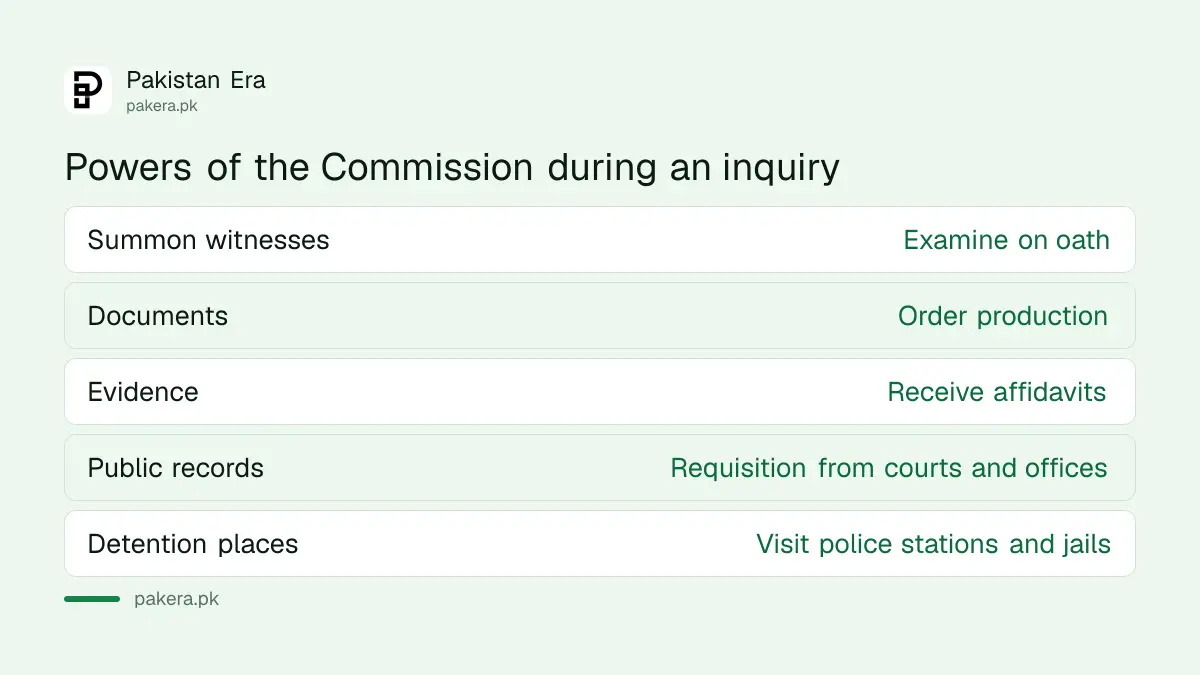
The Commission has the powers of a civil court during an inquiry
Section 21 gives it the powers of a civil court trying a suit for summoning and examining witnesses on oath, ordering production of documents, receiving evidence on affidavit, calling for public records and issuing commissions to examine witnesses. Section 20 lets it call for a report from the authority complained about.
If the authority does not answer in the time set, the Commission may proceed on its own. Anyone whose reputation may be harmed by the inquiry must be given a chance to be heard and to produce evidence. A statement made to the Commission cannot be used against the witness in a civil or criminal case, except a prosecution for false evidence.
| Stage | What the Act provides | Section |
|---|---|---|
| Petition | By victim or any person on his behalf | 12(h) |
| Inquiry | Calls for report, may start on its own | 20 |
| Evidence | Summons, documents, affidavits, civil court powers | 21(1) |
| Outcome | Recommends prosecution, interim relief, disciplinary action | 21(3), (4) |
| Reply | Authority replies in one month on action taken | 21(3)(d) |
| Publication | Report and reply placed on the Commission website | 21(3)(e) |
A complainant's identity can be protected
Section 23 lets the Commission direct that the identity of a person who complained, gave information, produced a document or gave evidence must not be disclosed. If the person or family is at risk of serious harm, it can order protection, including physical protection, security of employment and privacy.
This is a power, not a guarantee. Ask for it in your petition and say why you fear harm. Witness protection under provincial law is a separate path, see witness protection in Sindh.
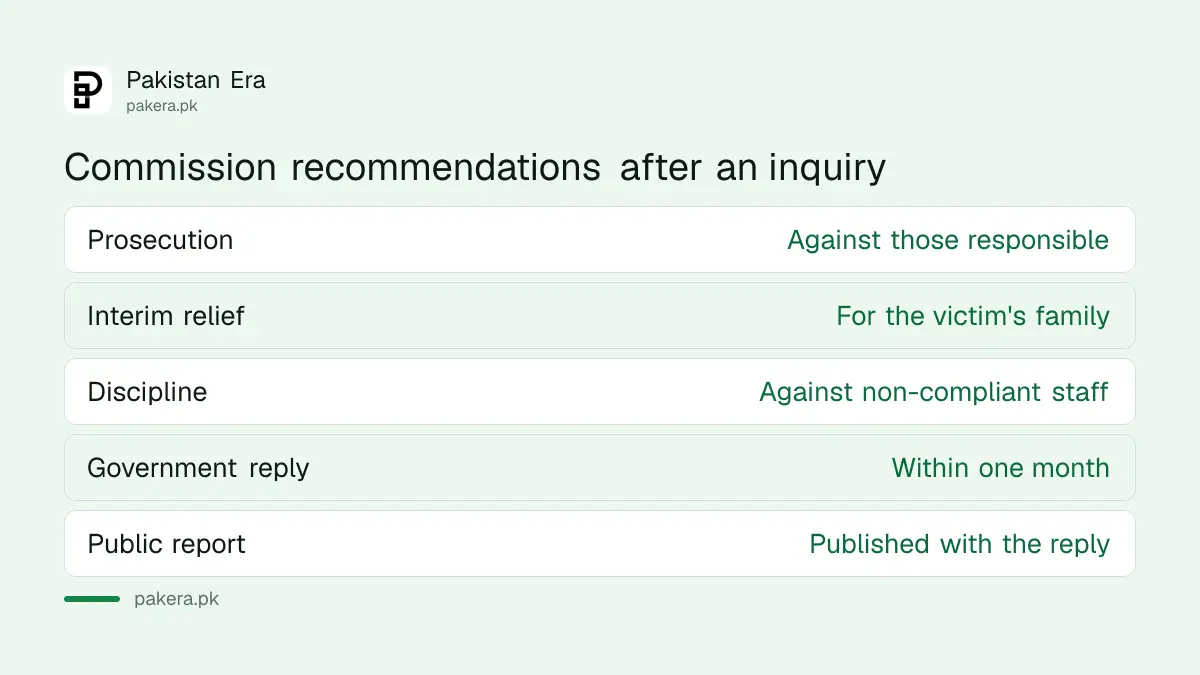
Outcomes are recommendations, and the government has a month to answer
After an inquiry the Commission can recommend prosecution or other action against those responsible, and immediate interim relief for the victim's family. It sends its report to the government concerned, which must say within one month what it did or why it will not. The report and reply are published online.
The Commission can also recommend disciplinary action against anyone who ignores its order. It cannot itself convict, jail or award damages. The Act says the Federal Government shall fund financial and legal aid for victims through the Commission, but it gives no amount. For existing support schemes, see the guides to the minorities welfare fund grant and Punjab minority card.
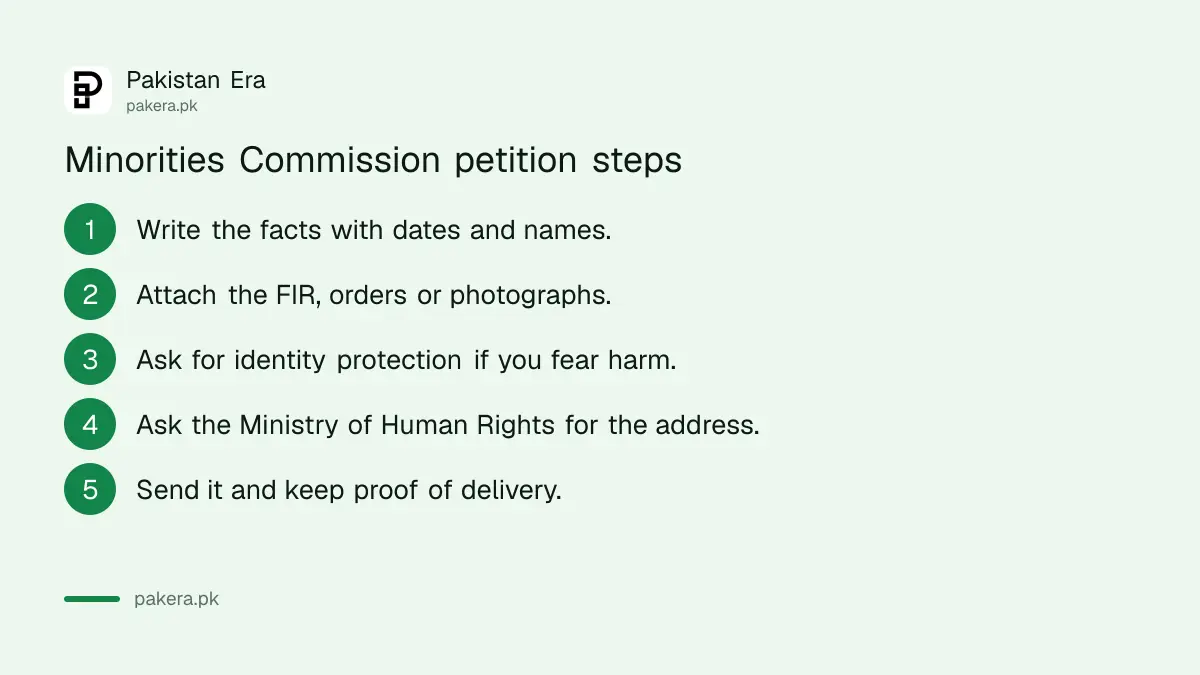
- Write the facts with dates, places, names and the office you complain about.
- Attach any FIR, application, order or photograph.
- State whether you want your identity protected and why.
- Ask for the Commission's current address and any form from the Ministry of Human Rights, which the Act names for the Commission's appointments.
- Send the petition and keep proof of delivery.
- Follow up after the authority's one month to reply.
Other routes still exist
Section 12 lets the Commission visit police stations and jails to check the legality of detention of minority prisoners. It does not take over the work of courts or the police. A criminal complaint still goes to the police, and the court route is described in what to do when police refuse an FIR. Marriage questions are covered in the guide to registering a Christian marriage. A broader human rights complaint is in the NCHR complaint guide.
Common questions
Who is a minority under the Act?
A non-Muslim as defined in Article 260 of the Constitution.
Is there a fee to petition the Commission?
The Act states none. We could not confirm a fee or form.
Can someone complain on my behalf?
Yes. Section 12(h) allows a petition by the victim or any person on his behalf.
Does the Commission have power to arrest or punish?
No. It has civil court powers for the inquiry and recommends prosecution or other action to the authorities.
Can I keep my name secret?
Section 23 lets the Commission direct that your identity not be disclosed, and order protection if you are at risk.
Is the Commission already working?
The Act says it stands established on commencement. We found no public notice of its members or office, so call the Ministry of Human Rights first.
How we verified this
What we checked, where we read it, and what we could not confirm.
Last checked 22 October 2026. We read the National Commission for Minorities Rights Act, 2025 (Act No. XL of 2025) on the Pakistan Code portal. We searched once for news of the Chairperson's appointment and found none, and we did not find the Commission's address, form, rules or regulations. We did not check whether any petition has yet been decided. This page is general information, not legal advice.
About the author

Senior Writer, Public Services and Technology
Shahid joined us in 2024 as an author. He is a senior contributor to Pakistan's leading technology websites. He writes detailed articles, mostly covering his expertise in the latest tech, mobiles, apps, gadgets, and step-by-step guides. His ideology is to help people understand the latest trends and explain complex methods through very easy-to-understand guides.