Apply for an OPF Internship in Pakistan: Rs 20,000 to Rs 30,000 a Month for Overseas Pakistani Graduates
OPF interns earn Rs 20,000, 25,000 or 30,000 a month by degree level. See who can apply, the eight eligible fields and where to find the open internship notice.
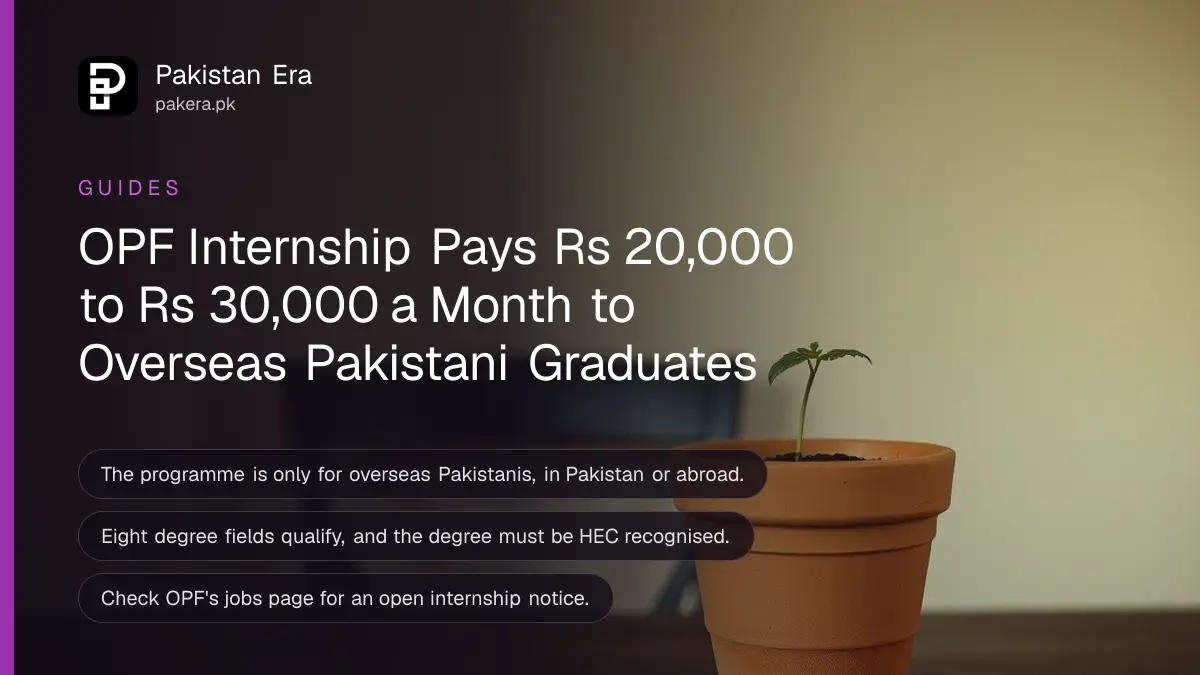
OPF pays interns Rs 20,000 a month for a 14 year degree, Rs 25,000 for a 16 year HEC recognised degree and Rs 30,000 for 18 years of education, but the programme is only for overseas Pakistanis. You must also hold a degree in one of eight listed fields from an HEC recognised university.
For a fresh graduate in an overseas family, a paid internship at a government linked body is a good first line on a CV. We read OPF's internship page and its jobs page on 21 October 2026. Seats open only when OPF posts a notice, so the first thing to check is whether one is open now.
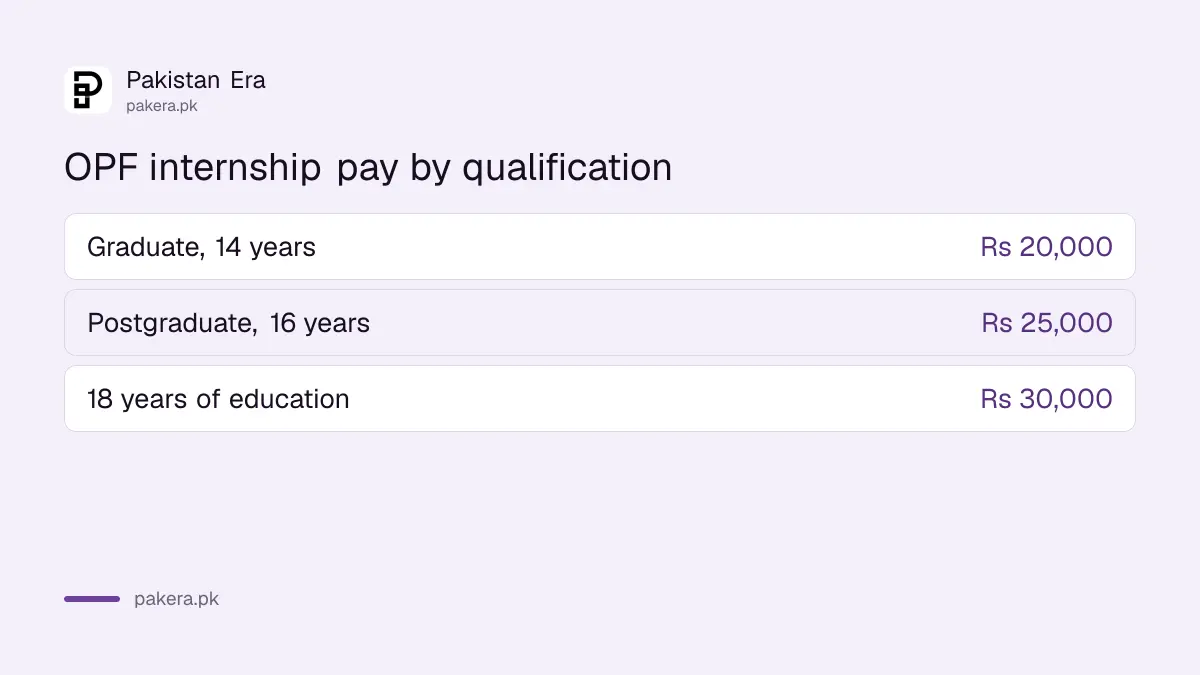
The honorarium is Rs 20,000, 25,000 or 30,000 a month by qualification
OPF pays a monthly honorarium based on your degree. A graduate with 14 years of education gets Rs 20,000. A postgraduate with a 16 year HEC recognised degree gets Rs 25,000. A candidate with 18 years of education gets Rs 30,000.
| Qualification | Honorarium per month |
|---|---|
| Graduate, 14 years of education | Rs 20,000 |
| Postgraduate, 16 year HEC recognised degree | Rs 25,000 |
| Specialisation after postgraduate, 18 years of education | Rs 30,000 |
The extra Rs 5,000 for each step up is our arithmetic. Over a six month placement, which is only an example because OPF does not state a duration on the page, a Rs 30,000 intern would earn Rs 180,000 against Rs 120,000 at the lowest level.
Only overseas Pakistanis can apply, from Pakistan or abroad
OPF says the programme is only for overseas Pakistanis residing in Pakistan or abroad. It is meant for educated youth from overseas Pakistani families. Your degree must be from a university recognised by the Higher Education Commission.
Before you apply, check that your degree is on the HEC list. The method is in how to check whether a university is HEC recognised. A degree from a source HEC does not recognise will be rejected at the first screen.
Eight fields are eligible
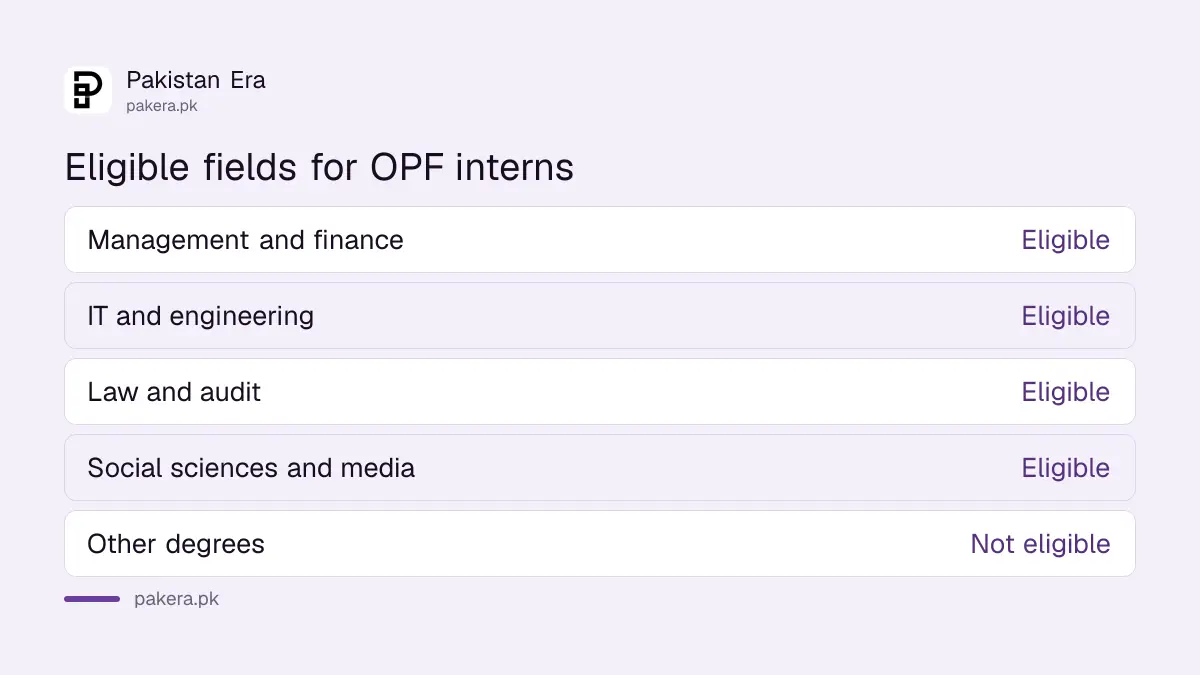
OPF considers only candidates with qualifications in management sciences, information technology, law, finance, accounting and economics, social sciences, journalism and mass communication, audit, and engineering in civil, architecture or computer science. Other degrees are not accepted for this programme.
- Management Sciences
- Information Technology
- Law
- Finance, Accounting and Economics
- Social Sciences: social work, sociology, anthropology, international relations, gender studies and political science
- Journalism and Mass Communication
- Audit
- Engineering: civil, architecture and computer science
Check the jobs page for an open notice
The internship page says "Internship Opening" and sends you to OPF's jobs page. On 21 October 2026 the only internship notice we saw there was for fresh graduates at the head office for the 24/7 complaint cell, dated 19 May 2026. We could not confirm it is still open.
The jobs page also lists other posts, such as a Company Secretary and a Director Finance. Those are paid jobs and have their own rules. They are not part of the internship programme.
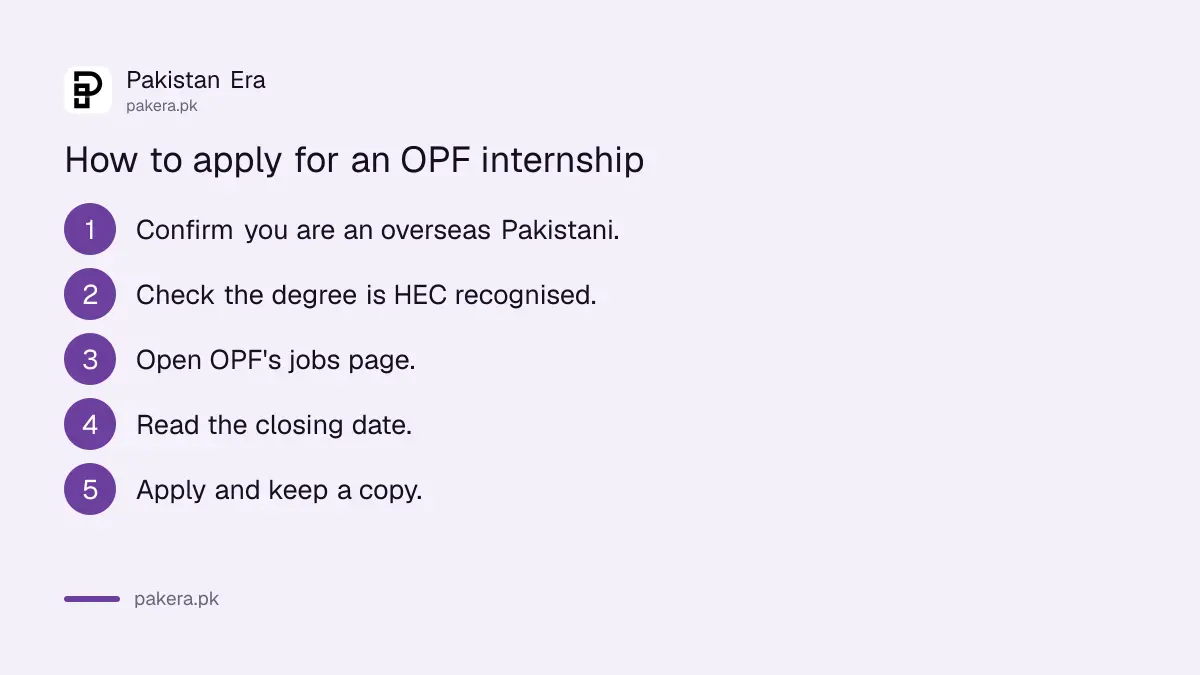
- Confirm you are an overseas Pakistani and hold OPF membership if you have it. See how to get an OPF membership card.
- Check that your degree is HEC recognised and in one of the eight fields.
- Open OPF's jobs page and look for a current internship notice.
- Read the notice for the closing date, the place and the way to apply.
- Apply before the closing date and keep a copy of what you sent.
Prepare your papers before a notice appears
Notices can close in a few days, so have your papers ready now. OPF does not list the documents on the internship page, so the notice itself is the only source. In general, keep your degree and transcript, your CNIC and any proof that your family is overseas, such as a parent's passport or NICOP, in one folder as scans.
If you hold your degree from a foreign university, check that HEC recognises it before you apply. A late discovery wastes the application window. And if you are already abroad, ask whether the placement can be done remotely, because the notice we saw named the head office in Islamabad.
What OPF says the programme is for
OPF lists five aims: to offer an internship to the overseas Pakistani community, to prepare degree holders through on the job training, to give fresh graduates a chance, to bring in fresh ideas, and to find talent for future hiring. The last aim is the one to watch, because a good intern may be noticed.
The page does not promise a job after the internship. For a wider search, the OEC Global Jobs portal lists posts with overseas employers.
Common questions
How much does an OPF intern get paid?
OPF pays Rs 20,000 a month for a 14 year degree, Rs 25,000 for a 16 year degree and Rs 30,000 for 18 years of education.
Can a Pakistani who does not live abroad apply?
Only if the applicant belongs to an overseas Pakistani family. OPF says the programme is for overseas Pakistanis residing in Pakistan or abroad.
Which degrees qualify for the internship?
Management sciences, IT, law, finance, accounting and economics, social sciences, journalism, audit and some engineering fields. The degree must come from an HEC recognised university.
How long does the internship last?
OPF does not state a duration on its internship page. Read the duration in the notice for the post you apply for.
Where do I find the current internship notice?
On OPF's jobs page. We saw one internship notice, dated 19 May 2026, and could not confirm it was still open on 21 October 2026.
How we verified this
What we checked, where we read it, and what we could not confirm.
We read OPF's internship page and its jobs listing on 21 October 2026. We did not open the May 2026 notice itself. We could not verify the internship length, the number of places or whether a notice is open today.
About the author

Public Services and Education Journalist
Fajr Riaz is a journalist and content writer at Pakistan Era, based in Lahore. She covers the questions people meet in everyday life in Pakistan: how a public service works, what a change in the rules means, and where to find a reliable answer.