Spot ATM Card Skimming in Pakistan: Signs at the Machine and What to Do Next
ATM skimmers copy your card stripe and PIN. See the signs at the machine, the SBP rules that block stripe use since 2021, and the steps if your card is copied.
Short answer: Card skimming copies the magnetic stripe on your card and records your PIN, usually with a fake slot and a hidden camera on an ATM. Since 30 June 2021, State Bank of Pakistan (SBP) rules have told banks to block magnetic stripe use on Pakistani cards, so a copied stripe should not work here. If you suspect skimming, block the card in your app at once and report it to your bank.
Skimming still matters because of one exception. Banks can switch the stripe back on when you ask before travelling abroad, and many people never switch it off. We read SBP's card security regulations of 2016 and its 2021 letter on stripe blocking on 20 October 2026. This page covers what to look for at the machine, what the rules make your bank do, and the steps to take if your card may have been copied.
Skimming copies your card stripe and your PIN
A skimmer is a small reader fitted over or inside an ATM's card slot. It copies the data on the magnetic stripe, the dark band on the back of the card. A tiny camera or a fake keypad on top of the real one records your PIN. With both, a criminal can make a copy card and withdraw cash.
SBP's own wording shows why it acted. Its PSD Circular Letter No. 02 of 2021 says the stripe block was ordered "to curtail the risk of card-skimming". The chip on your card is much harder to copy than the stripe, which is why the rules push every payment onto chip and PIN.
SBP told banks to block the stripe from 30 June 2021
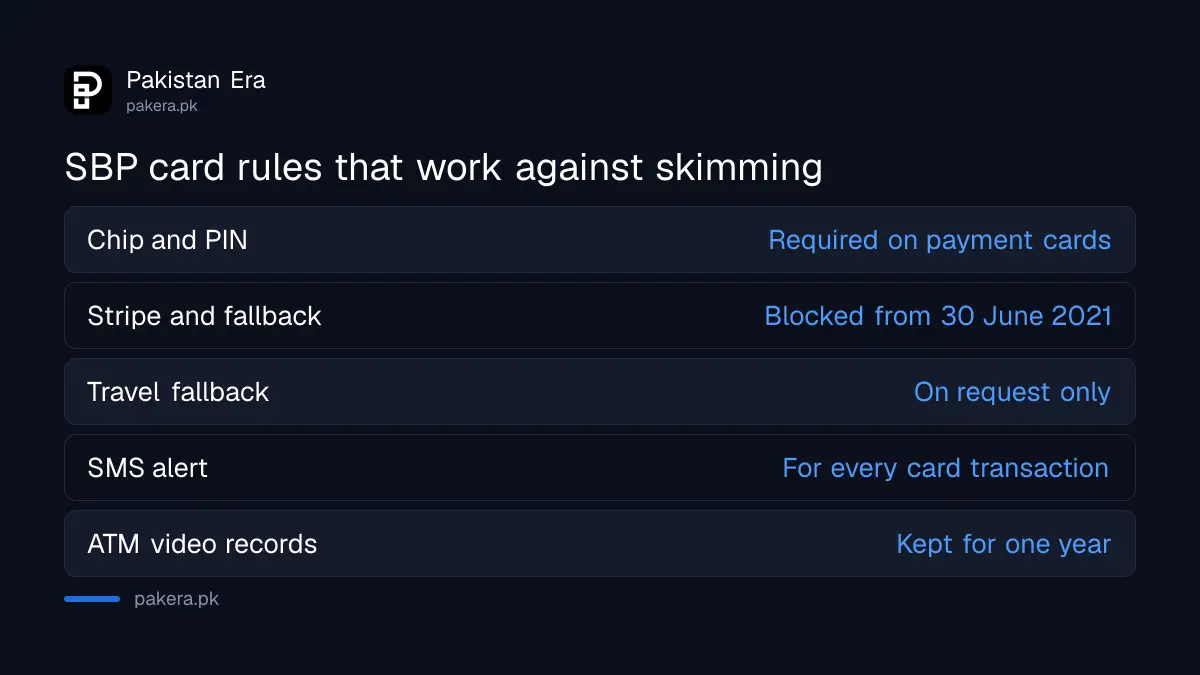
The 2021 letter told card issuers to block existing magnetic stripe cards, and the fallback to the stripe on chip cards, at their own end. The deadline was 30 June 2021. Fallback means a machine reading the stripe when the chip fails. With it blocked, a copied stripe should be refused.
The exception is travel. The same letter says issuers must be able to turn fallback back on when a customer asks before going abroad, because some foreign machines still read stripes. If you asked for that before a trip, ask your bank to turn it off again when you return. A copied stripe is useful to a criminal only while fallback is on.
| SBP rule | What it means for you |
|---|---|
| Chip cards on all payment cards, 2016 regulations | Your card should carry a chip and need a PIN |
| Stripe and fallback blocked, from 30 June 2021 | A copied stripe should not work in Pakistan |
| Fallback on request for travel abroad | Switch it off again when you are back |
| Anti-skimming devices on ATMs and POS machines | Banks must fit protection to their machines |
| SMS for every card transaction | You should hear about any use of your card at once |
| ATM video records kept for one year | Footage exists to check a disputed withdrawal |
The SMS rule is your best early warning. Every use of your card should send an SMS to your registered number. More on that and the other card rights is in our check of debit card rights under SBP rules.
Look for these signs before you insert your card
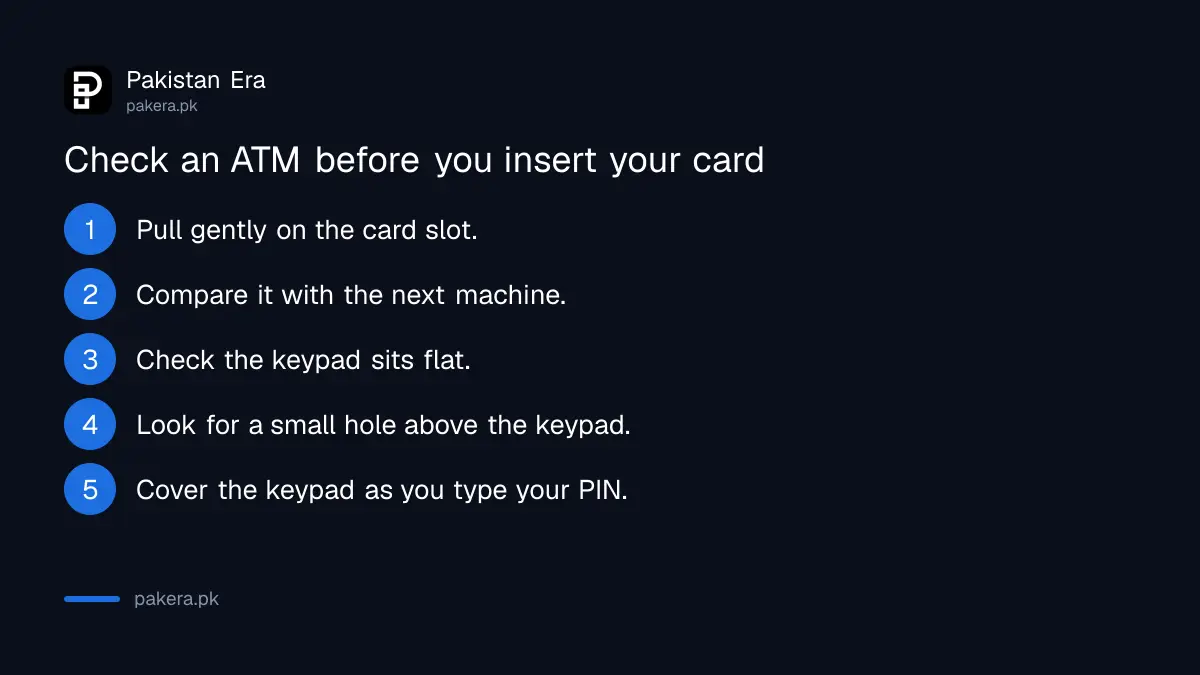
Before you use an ATM, look at the card slot and the keypad. A slot that sticks out, wobbles or looks bulkier than the one on the next machine is a warning. So is a keypad that sits higher than the frame or feels soft. A small hole or strip above the keypad may hide a camera.
- Pull gently on the card slot. It should not move.
- Compare the machine with others at the same branch.
- Cover the keypad with your other hand every time you type your PIN.
- Prefer ATMs inside bank branches during working hours.
- Walk away from any machine where a stranger offers help.
SBP's 2016 regulations tell banks to install anti-skimming devices on ATMs and point of sale machines. That lowers the risk, but it is not a guarantee, so the checks above are still worth the ten seconds. If an ATM keeps your card, the rules for getting it back are in what to do when an ATM captures your card.
If your card may be copied, block it and report it
Block the card first, then report. Most bank apps let you block or deactivate a card in a few taps, and SBP's regulations require a call centre open 24 hours a day, 7 days a week, to report fraud. Then lodge a written complaint, which the 2021 letter lets you do through the app or internet banking.
- Block the card in your bank app, or call the bank's helpline. Numbers are in our list of bank helpline numbers.
- Check your SMS alerts and app history for withdrawals you did not make.
- Lodge a complaint in the app or by phone, and write down the complaint number.
- Name the ATM, its location, the date and the time, and ask the bank to keep the video.
- Ask for the full transaction record, which SBP's rules say banks must give you on request.
- Ask for a replacement card, and check whether fallback was ever switched on for your old one.
SBP's 2016 regulations require banks to keep visual records of all ATM transactions for one year. That footage can show who used a copied card. Ask for it to be kept in the same complaint, so it is checked while it still exists. For blocking steps by bank, see how to block an ATM card.
Your bank has 30 days to answer a fraud complaint
SBP's complaint rules give banks 30 days to send a final reply in fraud cases. If the bank refuses or does not reply, you can take the complaint to the Banking Mohtasib. Keep every SMS, receipt and complaint number, because they prove when you reported it.
The timelines are set out in our explainer on the 30 day fraud complaint deadline. If an ATM gave you no cash but your account was charged, that is a different problem with its own process: see how to get money back when an ATM gives no cash. To cut your exposure online too, you can turn off online and international card payments when you do not need them.
Common questions
Can a skimmed card still be used in Pakistan?
It should not be, because SBP told banks to block the magnetic stripe and its fallback from 30 June 2021. The risk returns if fallback was switched on for travel and never switched off.
How do I know if my card has been skimmed?
Usually from an SMS or app alert for a withdrawal you did not make. SBP's rules require an SMS for every card transaction, so check that alerts are reaching your current number.
Will the bank show me the ATM video?
SBP's rules make banks keep ATM video records for one year. Ask the bank to check and keep the footage as part of your complaint. Whether it shows you the footage is up to the bank's own process.
Should I switch off magnetic stripe use after travelling?
Yes. Ask your bank to turn fallback off when you return. The 2021 SBP letter lets banks switch it on for travel at your request only.
Does a chip card make skimming impossible?
No, but it makes a copied card much less useful, because chip data is far harder to copy than the stripe. Your PIN still matters, so always cover the keypad.
Who do I complain to if my bank does not help?
The Banking Mohtasib, after the bank's 30 day window for fraud complaints, or SBP's Sunwai portal.
How we verified this
What we checked, where we read it, and what we could not confirm.
Last checked 20 October 2026. We read SBP's Regulations for Payment Card Security (PSD Circular No. 05 of 2016), including the chip, SMS, anti-skimming, 24 hour call centre, one year video and transaction data clauses, and PSD Circular Letter No. 02 of 2021 on stripe blocking, travel fallback and app complaints, on SBP's website on 20 October 2026. The checks at the machine are general safety advice, not SBP text. We did not test any ATM, and we could not check how quickly each bank turns fallback off after a trip.
About the author

Technology Journalist & Multimedia Producer
Ahmad Ali is a technology journalist and multimedia producer at Pakistan Era, joining the team in October 2026. He covers consumer technology and digital life for Pakistani readers, combining research with hands-on product testing.