Bank Account Blocked or Lien Marked in Pakistan? SBP Says the Bank Must Tell You
SBP says banks must tell you when an account is debit blocked, blocked or lien marked, give the way to fix it and keep proof of delivery. Here is what to do.
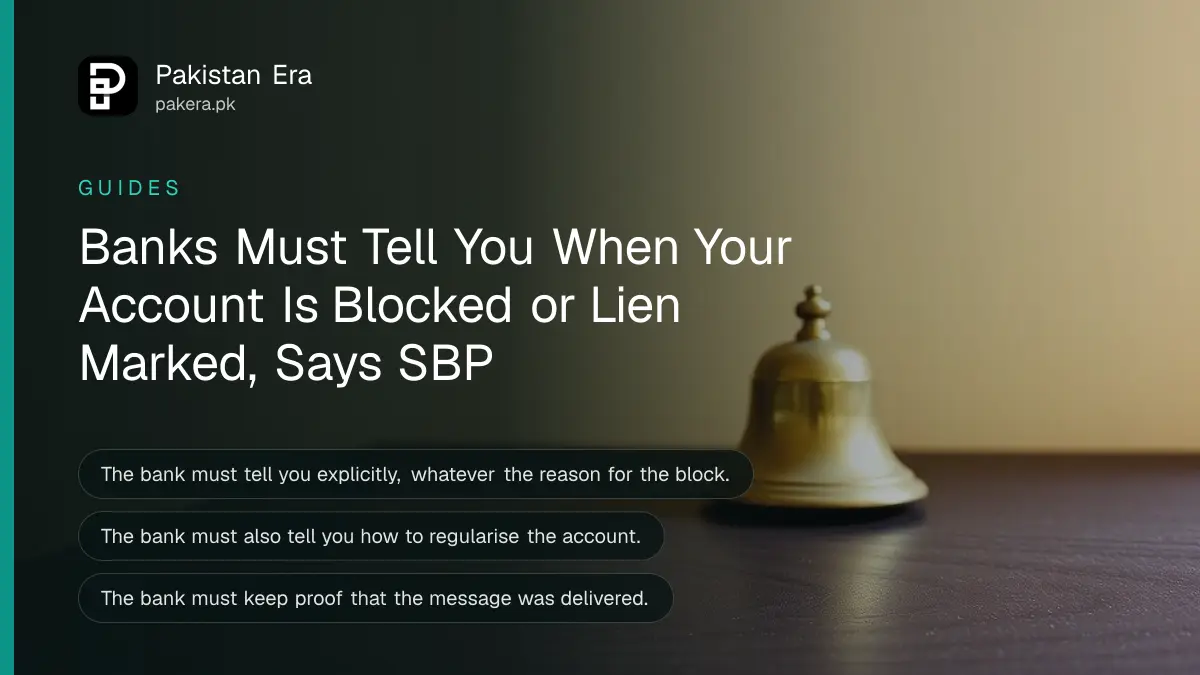
If your bank blocks your account, stops debits on it or marks a lien on it, SBP says the bank must tell you explicitly. This applies whatever the reason, including an action by a regulator or a law enforcement agency. The bank must also tell you what to do to get the account working again, and keep proof that it delivered that message.
Many account holders find out the hard way. A transfer fails, a card is declined and the branch says "the account is blocked". No letter, no SMS, no reason. That is not how the State Bank of Pakistan (SBP) says it should work. We read the rule in SBP's Business Conduct and Fair Treatment of Consumers Regulatory Framework on 14 October 2026. It is part of BPRD Circular No. 04 of 2025.
The bank must tell you when your account is blocked
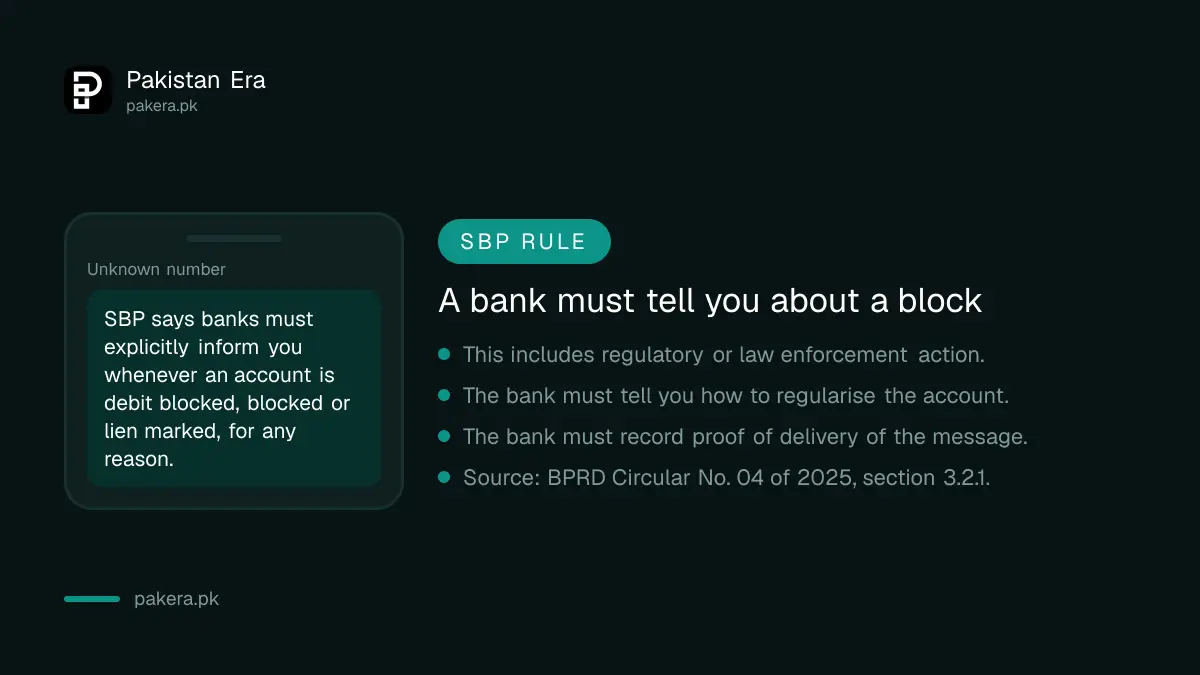
Section 3.2.1 of the framework, point 4, says banks and other financial institutions shall explicitly inform customers whenever an account is debit blocked, blocked or lien marked, "owing to any reason". It names regulatory or law enforcement action as reasons that are covered. So a bank cannot stay silent just because someone else ordered the block.
The same point says the bank must communicate the course of action to regularise the account. That means a reason and a next step, not only a refusal at the counter. If you were told neither, you have a complaint.
Debit block, block and lien mark are different things
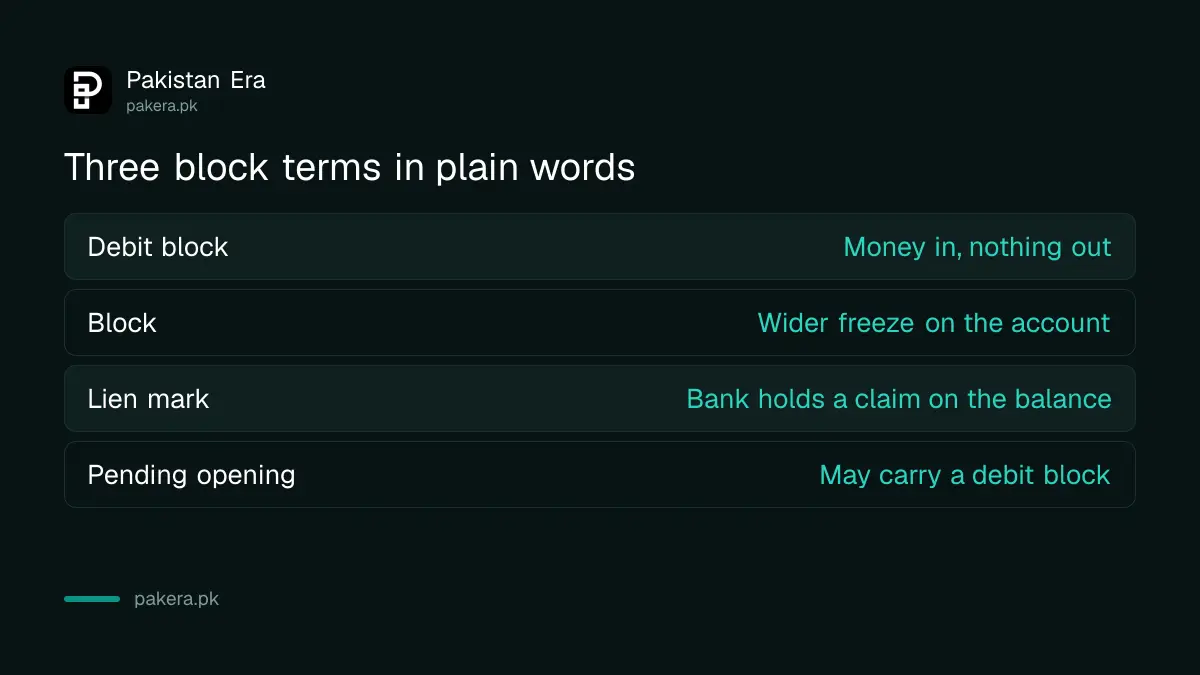
The framework uses three terms and does not define them in that section. The meanings below are our plain explanation of how banks commonly use them, not SBP wording. Ask your bank which one applies to you.
| Term | What it usually means for you |
|---|---|
| Debit block | Money can come in, but you cannot take it out or pay from the account |
| Block | The account is frozen more widely, so deposits or other services may stop too |
| Lien mark | The bank holds a claim over the balance or part of it, often against a loan or a demand |
A block can also be temporary. SBP's framework says a new account may open with a debit block until identity checks are done. Our guide on checking a pending account application explains that case. A block placed after a tax recovery notice is a different matter, covered in the guide on a Section 140 recovery notice from FBR.
The bank must keep proof that you were told
The framework adds that the bank must record proof of delivery for all such communications, regardless of the mode. The mode can be a letter, an SMS, an email or a call. Whatever the mode, the bank must be able to show it reached you.
That helps you. If the bank says "we informed you" and you saw nothing, ask for the proof of delivery in writing: the date, the number or address it used and the mode. A wrong number on file is the bank's own record to fix, so also update your contact details.
What to do when you find your account blocked
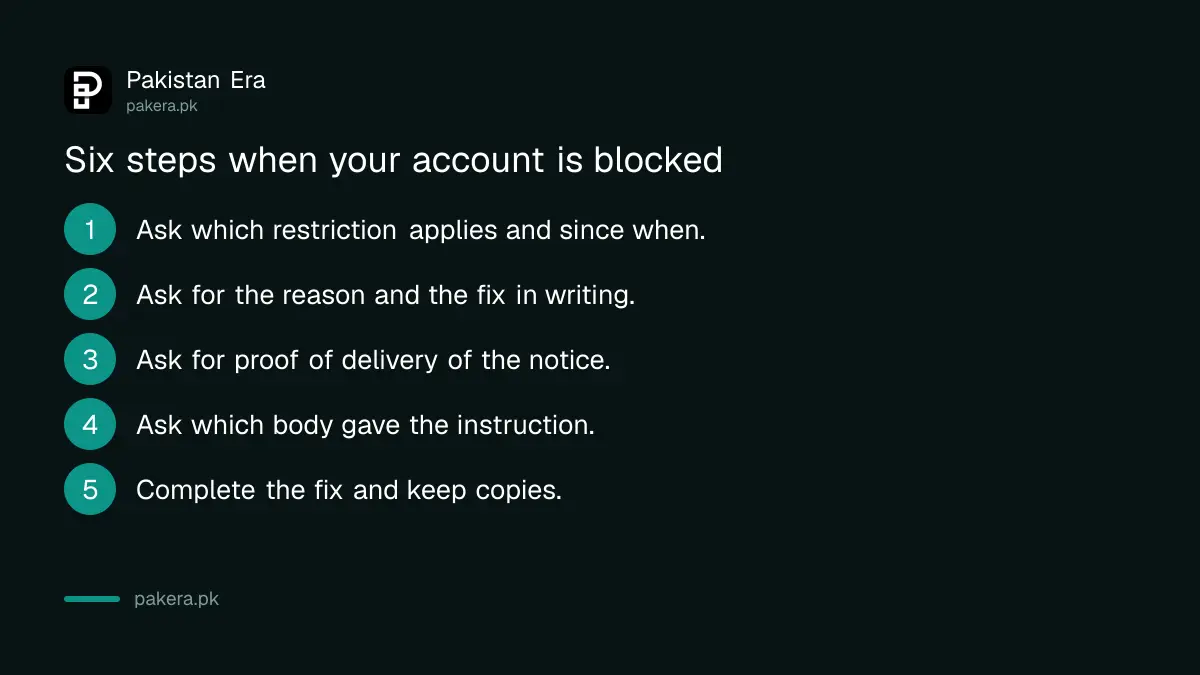
- Ask the branch or helpline which type of restriction is on the account and since which date.
- Ask for the reason in writing and for the course of action to regularise the account.
- Ask for the proof of delivery of the notice the bank says it sent.
- If the reason is a loan, a tax recovery or an order from an agency, ask for the name of the body that gave the instruction.
- Complete the course of action the bank gives you, and keep copies of everything you submit.
- If the bank gives no reply, complain in writing and keep the tracking number.
Complaint timelines give you a clock to follow
SBP says a bank must give every complaint a tracking number by SMS or email, not by call alone, and an acknowledgement within 48 hours. The framework sorts complaints into minor ones that take 7 working days or less and major ones that take longer. For a major complaint, the bank owes an interim reply after 10 working days and a final answer within 15 days.
If the bank does not answer in 45 days, or you are not happy with its reply, SBP's consumer page says you may go to the Banking Mohtasib Pakistan. The Banking Mohtasib complaint guide shows the form. SBP also says it handles urgent matters through its help desk.
Common questions about a blocked bank account in Pakistan
Must a bank tell me before it blocks my account?
SBP's wording says the bank must explicitly inform customers whenever an account is blocked. It does not say the notice must come before the block. Ask for the date of the block and of the notice.
Does this cover blocks ordered by a court or agency?
Yes. The framework names regulatory or law enforcement action as a reason that is covered. The bank must still tell you and explain the course of action to regularise the account.
What is the difference between a debit block and a lien?
SBP does not define them in this section. In common use, a debit block stops you taking money out, and a lien is a claim the bank holds over the balance. Ask your bank which applies.
Can the bank refuse to tell me the reason?
The framework requires the bank to communicate a course of action to regularise the account. If you get no reason and no next step, make a written complaint and quote section 3.2.1, point 4.
Who do I complain to if my bank ignores me?
First the bank's complaint unit. After 45 days without a reply, or an unsatisfactory one, the Banking Mohtasib Pakistan. SBP's help desk handles urgent matters.
How we verified this
What we checked, where we read it, and what we could not confirm.
Last checked 14 October 2026. The blocked account rule is section 3.2.1, point 4, of SBP's Business Conduct and Fair Treatment of Consumers Regulatory Framework. Complaint timelines are in section 5.1.1.5 of the same document. The escalation steps come from SBP's consumer protection page. The framework does not define debit block, block or lien mark, so the table is our own plain explanation. Your bank's own terms and the order behind the block decide how long it lasts.
About the author

Global Affairs & Political Economy Writer
Muhammad Hatim is a book lover who started writing because he enjoys it. At Pakistan Era he writes about international relations, geopolitics and the global economy, with a particular interest in South Asia and the forces behind current events.