Pakistan Had Rs 12.66 Trillion of Banknotes in Circulation on 30 June 2026: What Backs Them
The SBP's FY26 accounts show Rs 12,659.5 billion of banknotes in circulation, up 12.3%. See which assets stand behind them, and how that mix changed in a year.
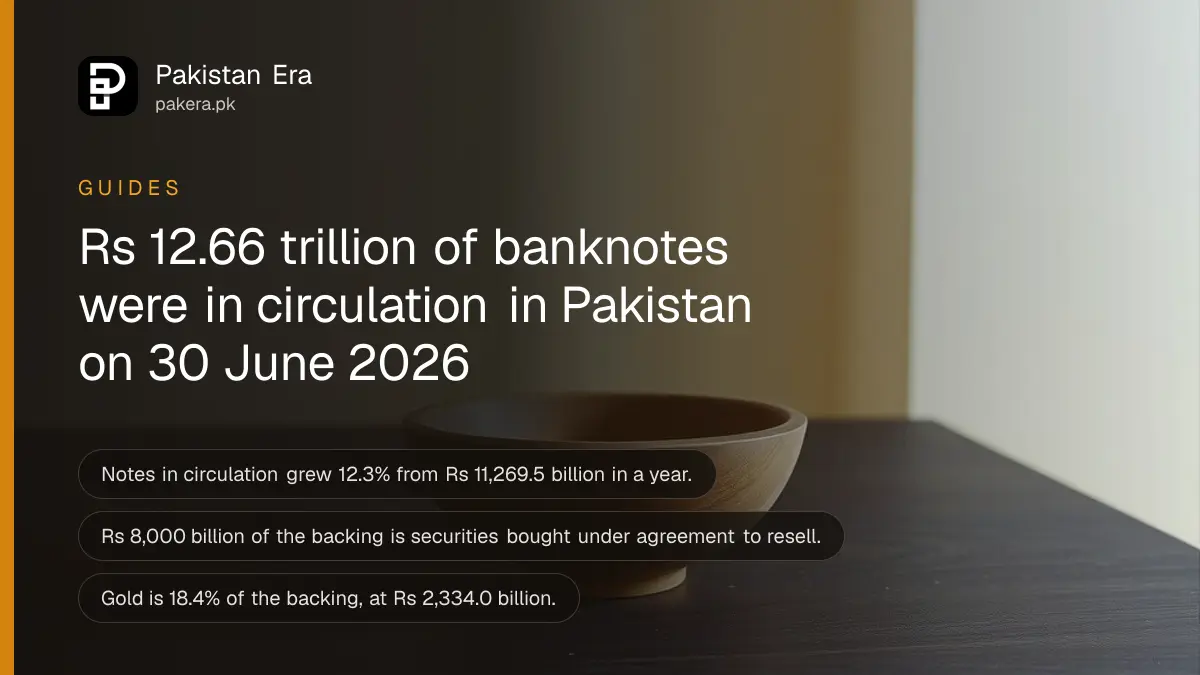
Short answer: The State Bank of Pakistan's accounts show Rs 12,659.5 billion of banknotes in circulation on 30 June 2026, up 12.3 per cent in a year. The law ties those notes to a list of SBP assets. The largest item is Rs 8,000 billion of securities bought under agreement to resell, then Rs 2,334 billion of gold.
Every Rs 1,000 note in your wallet is a promise from the central bank. The SBP's annual accounts say what stands behind that promise. The list is short, and it has changed a lot in one year.
We downloaded the SBP's Annual Financial Statements 2025-26 on 12 October 2026 and read note 20, "Banknotes in circulation", and note 20.1 under it. The statements are audited and dated 27 August 2026. Amounts are printed in thousands of rupees. We converted them to billions.
Rs 12,659.5 billion of notes were in circulation on 30 June 2026
The SBP issued Rs 12,659.6 billion of notes in total. After subtracting Rs 112.9 million held in its own banking department, notes in circulation were Rs 12,659.5 billion. A year earlier the figure was Rs 11,269.5 billion, so it grew by Rs 1,390.0 billion.
That is a rise of 12.3 per cent. The figure counts the face value of notes outside the central bank, whether in wallets, shop tills, home cupboards or bank vaults.
The SBP also records the cost of making notes. Its accounts show banknote printing charges of Rs 29.6 billion in FY26, against Rs 27.9 billion in FY25. We cover those and the other profit lines in our piece on the SBP profit for FY26.
The law ties notes to a list of assets
Note 20.1 says the notes are a liability of the SBP's Issue Department, equal to the amount in circulation under section 32 of the SBP Act, 1956. Under section 26(1) of the Act, that liability is supported by a set list of assets. The note then lists them.
That is a different system from the old gold standard, where every note could be turned into a fixed weight of gold. Here the notes are backed by a mix of gold, foreign currency, securities and loans to banks.
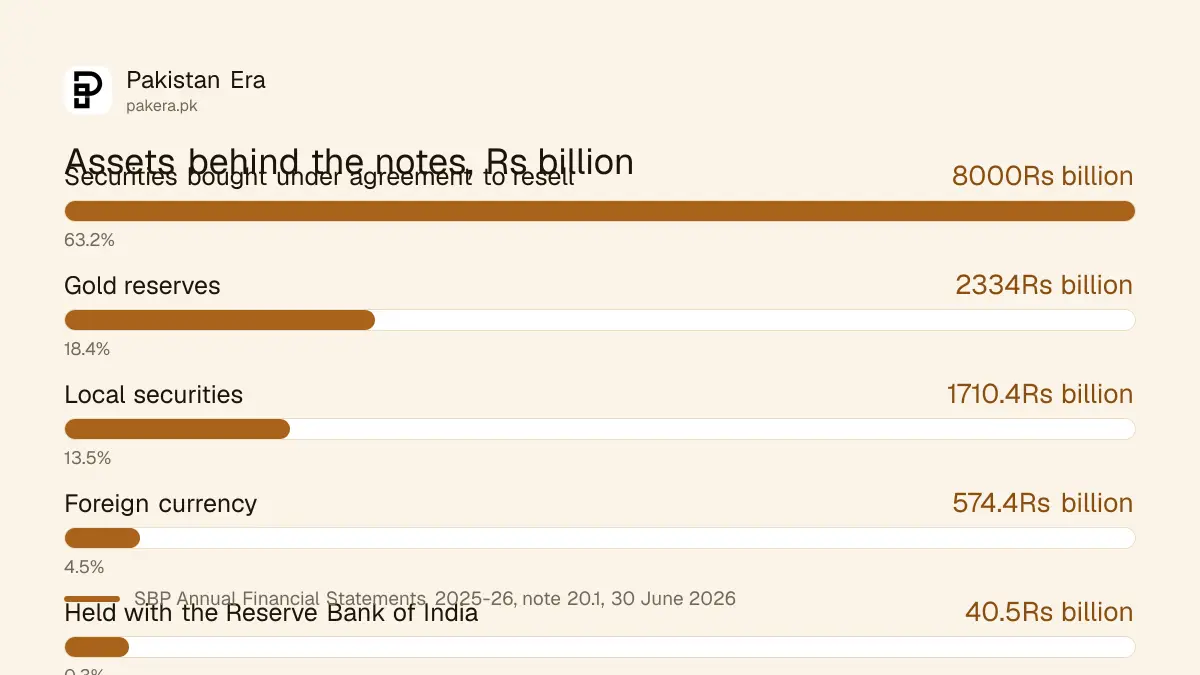
| Asset behind the notes | 30 June 2026 (Rs billion) | Share |
|---|---|---|
| Securities bought under agreement to resell | 8,000.0 | 63.2% |
| Gold reserves | 2,334.0 | 18.4% |
| Investments in local securities | 1,710.4 | 13.5% |
| Foreign currency accounts and investments | 574.4 | 4.5% |
| Assets held with the Reserve Bank of India | 40.5 | 0.3% |
| Coins | 0.3 | Under 0.01% |
| Total, equal to notes issued | 12,659.6 | 100% |
The mix of backing assets changed sharply in one year
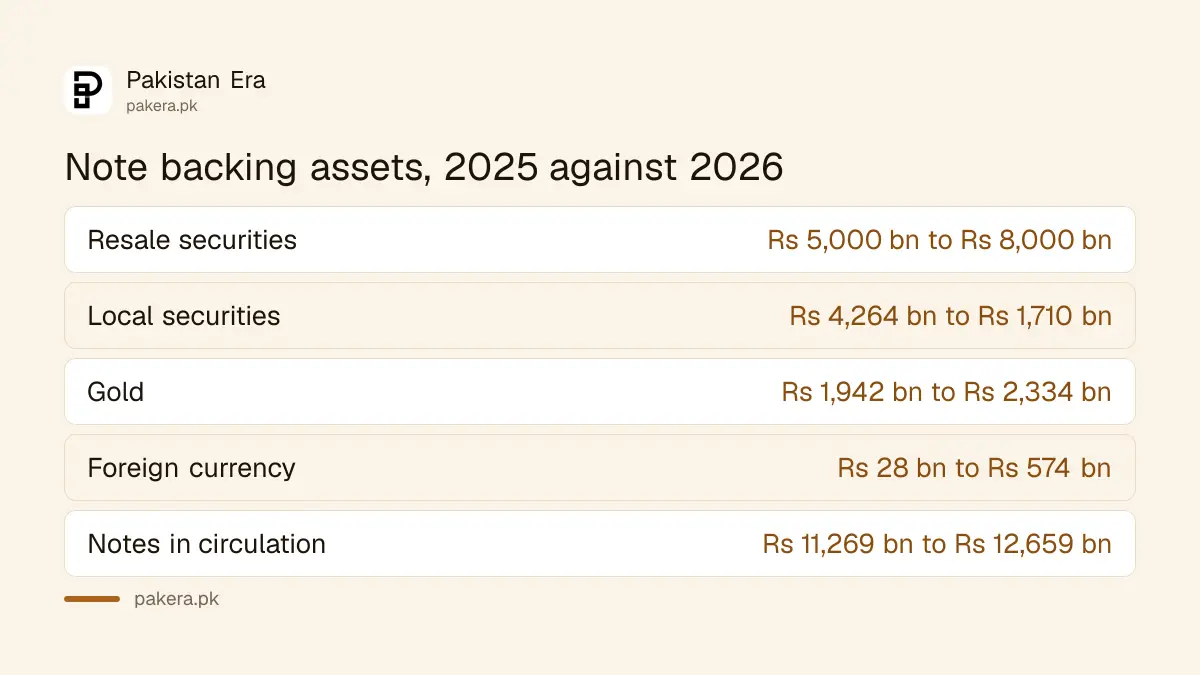
Securities bought under agreement to resell rose from Rs 5,000 billion to Rs 8,000 billion, and gold from Rs 1,942.1 billion to Rs 2,334.0 billion. Foreign currency rose from Rs 28.4 billion to Rs 574.4 billion. Local investments fell from Rs 4,264.2 billion to Rs 1,710.4 billion.
So the SBP moved the backing away from holdings of local securities and toward lending to banks, gold and foreign currency. The accounts do not explain the reason for the shift. For a sense of how large the SBP's daily lending to banks can be, see our piece on the SBP's Rs 10.39 trillion lending on 9 October.
| Asset | 30 June 2025 (Rs billion) | 30 June 2026 (Rs billion) |
|---|---|---|
| Securities bought under agreement to resell | 5,000.0 | 8,000.0 |
| Investments in local securities | 4,264.2 | 1,710.4 |
| Gold reserves | 1,942.1 | 2,334.0 |
| Foreign currency accounts and investments | 28.4 | 574.4 |
| Assets held with the Reserve Bank of India | 34.5 | 40.5 |
What "bought under agreement to resell" means
In this line, the SBP buys securities from a bank and agrees to sell them back at a set date. In effect it lends the bank cash, with the securities as collateral. The accounts call these "securities purchased under agreement to resell".
Put simply, the central bank hands cash to a counterparty for a short time and holds securities as security. The SBP's total holding of these agreements was Rs 15,600.9 billion on 30 June 2026. Rs 8,000 billion of it is assigned to the Issue Department and so backs the notes. The rest sits with the banking department.
These deals are part of how the SBP manages cash in the banking system every day. The policy rate that guides them stood at 11.5 per cent at the last decision, as set out in our piece on the SBP holding the rate. The accounts do not name the counterparties in the notes we read.
What this means for the notes in your wallet
Nothing changes for holders. Notes remain legal tender at face value, and the SBP's liability is stated at face value. The list of backing assets is a statement of what the central bank holds against its issued notes, not a promise that a note can be turned into gold.
If you hold a torn or damaged note, the SBP's rules for exchange apply, as explained in our guide to exchanging torn or damaged banknotes. And if you are asking about new notes, our page on the new SBP banknote series tracks the status.
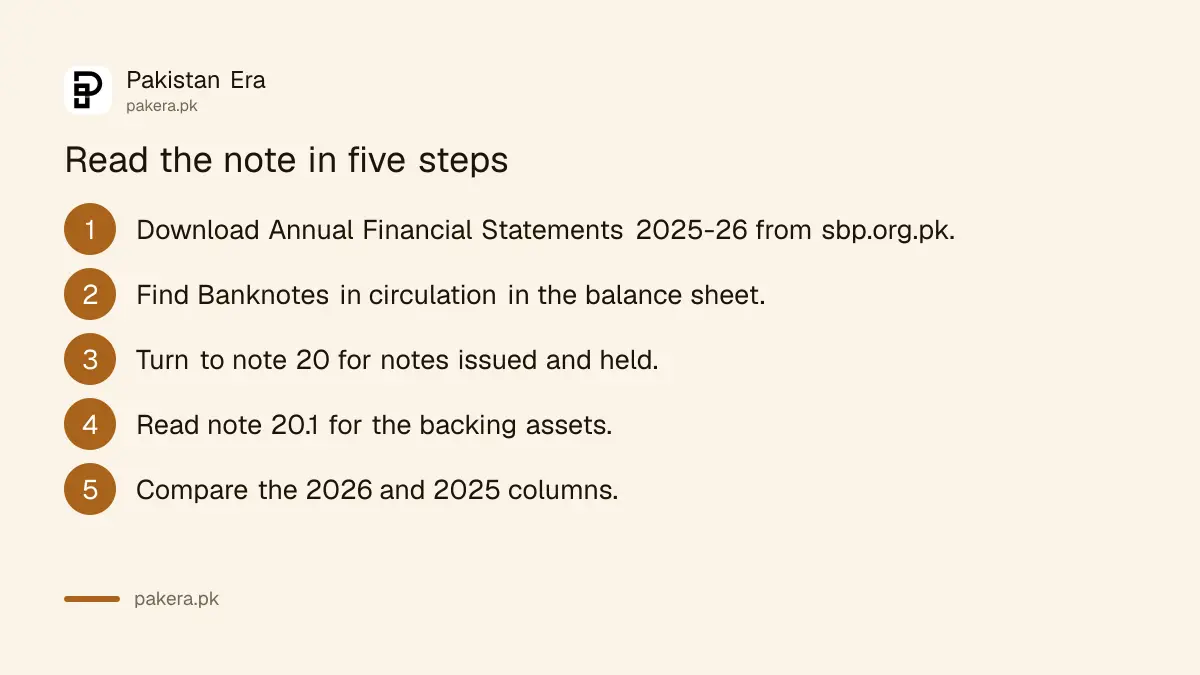
- Open the SBP Publications page and download Annual Financial Statements 2025-26.
- Go to the unconsolidated balance sheet and find "Banknotes in circulation".
- Turn to note 20 for the total issued and the notes held by the banking department.
- Read note 20.1 for the list of assets that support the issue.
- Compare the 2026 and 2025 columns and divide each asset by the total for its share.
Common questions
How much cash is in circulation in Pakistan?
The SBP's accounts show Rs 12,659.5 billion of banknotes in circulation on 30 June 2026. That is the face value of notes outside the central bank, and it excludes coins held as an asset of the Issue Department.
Is the Pakistani rupee backed by gold?
Partly. Gold is 18.4 per cent of the assets behind the notes, at Rs 2,334.0 billion. The rest is securities bought under agreement to resell, local securities, foreign currency and small items.
Who prints the banknotes?
The accounts show printing charges of Rs 29.6 billion for FY26 paid to Pakistan Security Printing Corporation, a wholly owned subsidiary of the SBP. The SBP is the issuer and the liability sits with it.
Did the amount of cash grow faster than the year before?
The accounts give both years, so the growth rate can be worked out for FY26 only from these figures: 12.3 per cent. We did not compute earlier years from this file.
What are the assets held with the Reserve Bank of India?
They are Pakistan's share of assets of the Reserve Bank of India under a 1947 order, worth Rs 40.5 billion in the accounts. The transfer to the SBP depends on a final settlement between the two governments.
Where is this in the accounts?
It is note 20 and note 20.1 of the unconsolidated statements in the Annual Financial Statements 2025-26 on the SBP Publications page.
How we verified this
What we checked, where we read it, and what we could not confirm.
We read note 20, note 20.1, note 6, note 15 and the related policy note 4.1 of the SBP Annual Financial Statements 2025-26 on 12 October 2026 at sbp.org.pk. The shares, the growth rate and the year-on-year changes are our arithmetic from the printed amounts. The accounts do not say why the mix of assets changed.
About the author

Global Affairs & Political Economy Writer
Muhammad Hatim is a book lover who started writing because he enjoys it. At Pakistan Era he writes about international relations, geopolitics and the global economy, with a particular interest in South Asia and the forces behind current events.