BISP New Payment of Rs 18,000 Starts January 2027, Rs 14,500 Until Then
The government has committed in writing to raise BISP Kafalat from Rs 14,500 to Rs 18,000 a quarter from January 2027. What to collect now.
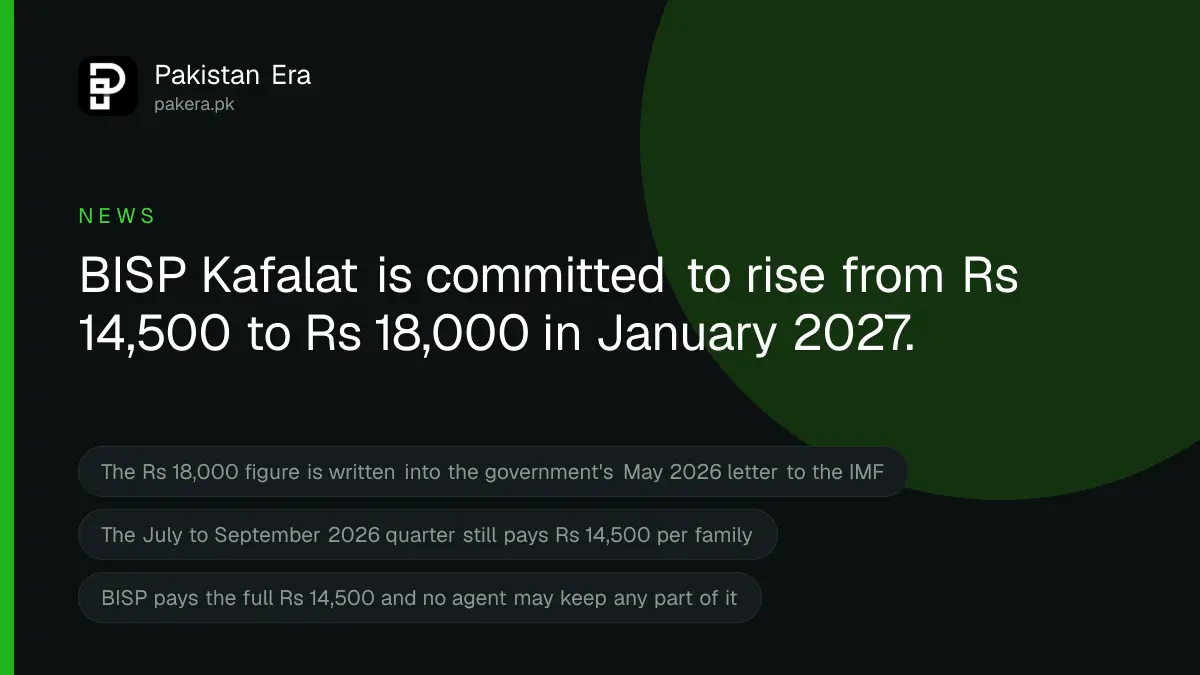
BISP's Kafalat payment is set to rise from Rs 14,500 to Rs 18,000 a quarter from January 2027. The figure is not a rumour: it is written into the Government of Pakistan's own letter to the IMF, published in May 2026, as a commitment the 2026-27 budget makes room for. Until then the payment stays at Rs 14,500, and the July to September 2026 quarter ends on 30 September.
Every few weeks a new number does the rounds on WhatsApp. Rs 18,000, Rs 19,500, sometimes Rs 20,000, always "approved" and always available if you send someone your CNIC. The BISP new payment of Rs 18,000 is real, but it is a date, not a switch, and the date is January 2027. We read the document it comes from, the budget papers, and BISP's own process for collecting a payment, and this is what they say.
Where does the Rs 18,000 figure actually come from?
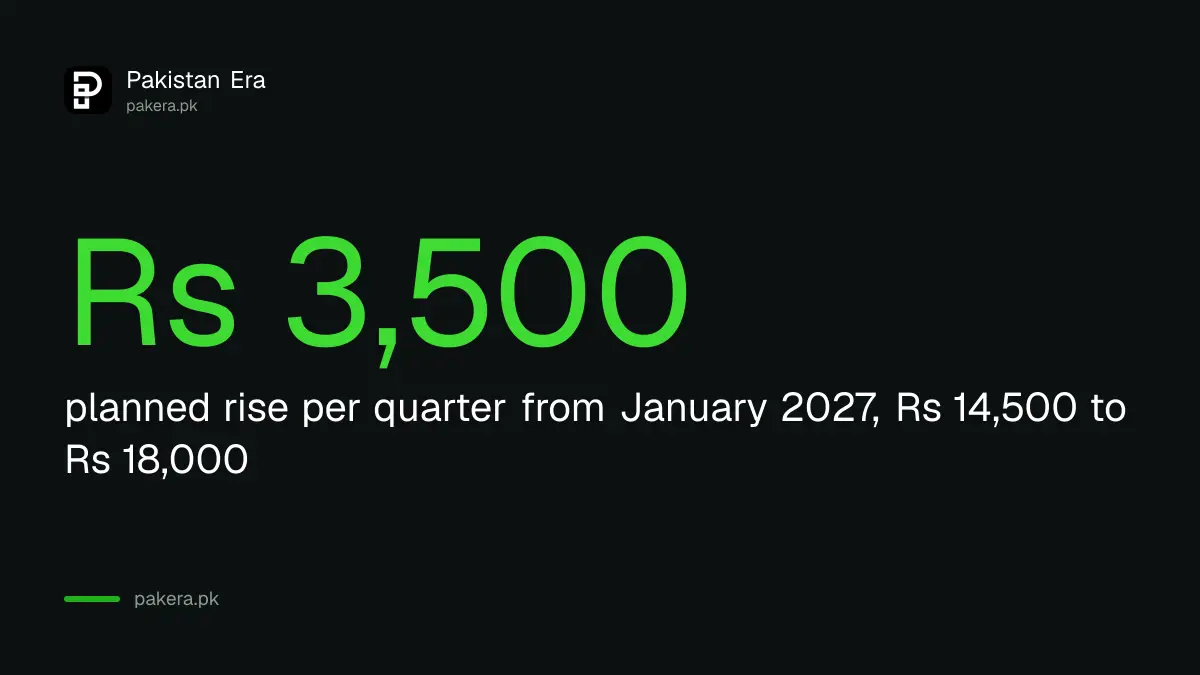
From the government's Memorandum of Economic and Financial Policies, published inside the IMF's Country Report on Pakistan in May 2026. It says the 2026-27 budget "will allow space for an increase in the Kafaalat benefit from PRs 14,500 to PRs 18,000 beginning in January 2027", and lists that as a new structural benchmark for end-January 2027.
The memorandum is the Finance Ministry's own text, signed off to the IMF, not a reporter's paraphrase. It says the rise covers projected 2026 inflation plus "an additional increase in generosity", moving the quarterly benefit closer to the government's goal of 15 per cent of what the poorest fifth of families spend. It also records that an inflation adjustment was already made in January 2026, that 200,000 families were being added by June 2026 to reach 10.2 million, and that the government intends to keep adjusting the benefit for inflation after 2027.
The IMF report is the primary source. The budget documents fit it. The Finance Division's Budget in Brief for 2026-27 puts the Benazir Income Support Programme at Rs 844,780 million. Business Recorder reported the allocation as Rs 838 billion, up 17 per cent, and did the arithmetic that Rs 18,000 for 10.2 million families would need closer to Rs 859 billion. TechJuice reported BISP officials briefing the First Lady in June that the stipend "is expected to increase to Rs 18,000 per quarter from January 2027".
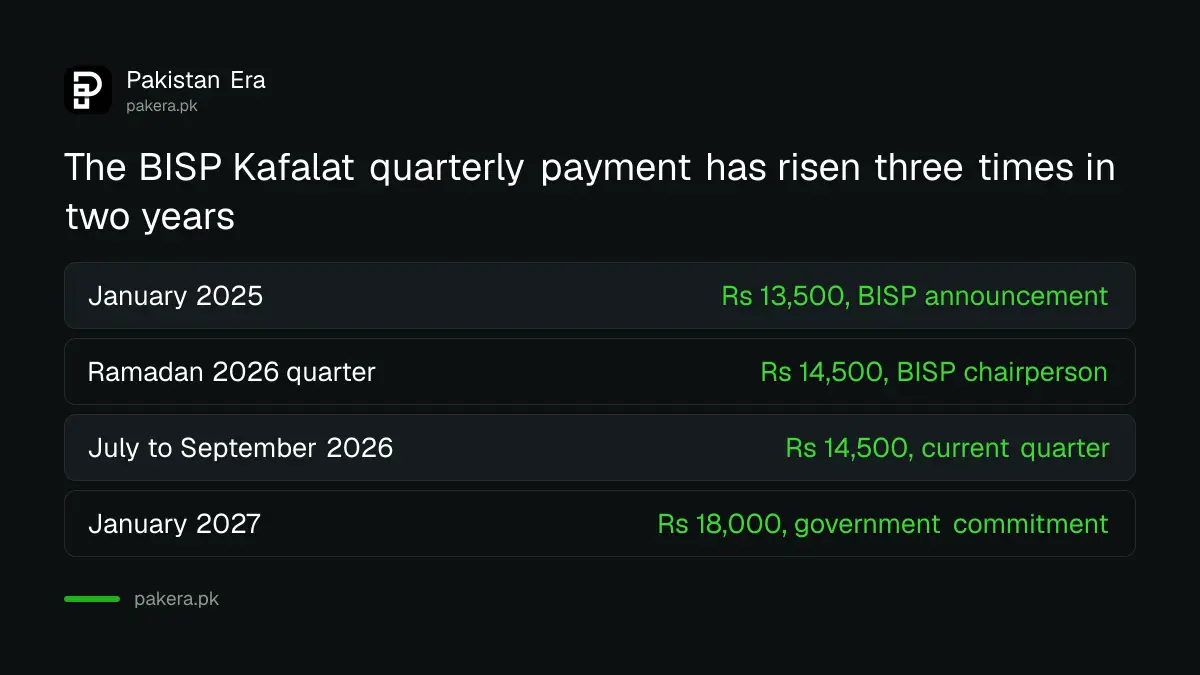
| Period | Quarterly payment | Where the figure comes from |
|---|---|---|
| From January 2025 | Rs 13,500 | BISP announcement on bisp.gov.pk |
| Ramadan 2026 quarter | Rs 14,500 | BISP chairperson, reported by INCPak |
| July to September 2026 | Rs 14,500 | Current quarter, reported |
| From January 2027 | Rs 18,000 | Government commitment in IMF Country Report 26/101 |
Rs 19,500 appears on some sites. It does not appear in the IMF document, the budget papers or anything BISP has said, so treat it as invented until someone shows a source. The other figures quoted for the BISP payment, including the Rs 8,500 still sitting on BISP's own programme page, are older amounts that never got taken down.
What should you collect before 30 September?
Your full Rs 14,500 for the July to September 2026 quarter, if the 8171 check shows it released against your CNIC. The quarter closes on 30 September, and reporting says payment points are working through the release in phases until then. BISP has not published a last collection date that we could read.
A quarter that ends does not normally cancel money already released to you, but an instalment that sits uncollected while the next one arrives is exactly the kind of thing that gets tangled in the switch to wallets. The government told the IMF it had created Social Protection Wallets for 7 million Kafalat families, distributed SIM cards to those with phones, and planned to pay through digital accounts from the last quarter of the financial year. If you were given a SIM for this, the payment may now be on the wallet rather than at the old point, and the SMS from 8171 tells you which.
Three things to have with you, taken from BISP's own Kafaalat process document:
- Your original CNIC, valid, because collection runs on biometric verification and an expired card fails it. If yours has lapsed, tracking a NADRA CNIC application comes before any trip to a payment point.
- The 8171 SMS that says the payment is released, or the portal result showing it.
- The phone number on record, because the wallet and the SMS both go to it.
BISP's document says the first instalment is collected at the nearest HBL or Bank Alfalah point of sale or retailer in the beneficiary's tehsil, after biometrics, and that later instalments can also be drawn at an ATM.
How do you check your payment on 8171?
Open 8171.bisp.gov.pk, type your 13 digit CNIC without dashes, copy the code in the picture and read the result. With no internet, send the CNIC number by SMS to 8171. Both are free, and both are the only official ways to check.
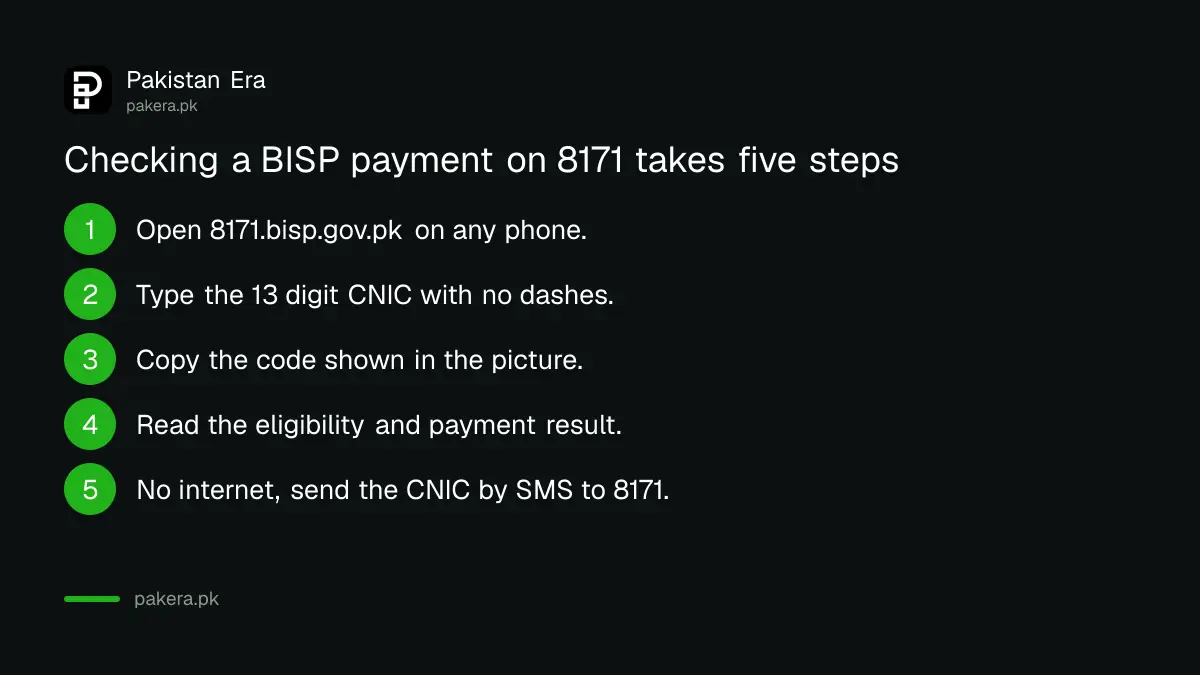
- Go to 8171.bisp.gov.pk. The page has two boxes, one for the CNIC and one for the code in the picture.
- Enter the CNIC of the woman who is the beneficiary, not the husband's, since Kafalat is paid to the ever married woman in the household.
- Type the picture code and submit. The result tells you whether the household is eligible and whether an instalment is released.
- If the portal is slow, send the CNIC by SMS to 8171 from any phone. The reply takes a few minutes.
- If the CNIC has no record at all, BISP's process is a household survey at the Benazir registration desk in the BISP tehsil office, not a phone call.
The portal answers a narrow question, whether you are eligible and whether money is released, and the two functions are easy to confuse. What each screen on the 8171 eligibility and payment check actually means is worth knowing before you conclude that a payment has been cut.
When exactly does the Rs 18,000 start, and is it certain?
January 2027, for the January to March 2027 quarter, is the date in the government's commitment. It is as firm as a written undertaking to the IMF can be, and less firm than a BISP notification, which does not yet exist.
Two things could still move it. The commitment says the budget "will allow space" for the increase, and Business Recorder's reading of the allocation is that Rs 838 billion is about Rs 21 billion short of what 10.2 million families at Rs 18,000 would cost over a full year. That may mean a supplementary grant, a slower enrolment count, or nothing at all, since the higher rate only runs for half of the financial year. The other is that the benchmark is dated end-January 2027, so a payment in the first week of January is not promised, only a payment in that quarter.
What is certain is what the number is not. It is not available now, it cannot be released early by anyone, and no form, agent or phone number can move you onto it before the quarter it belongs to.
What is the illegal deduction warning?
Nobody in the payment chain is entitled to keep any part of your Rs 14,500. A retailer, agent or bank point worker who asks for Rs 500 or Rs 2,000 to "release" the money is stealing it, and BISP's free helpline on 0800-26477 takes the complaint.
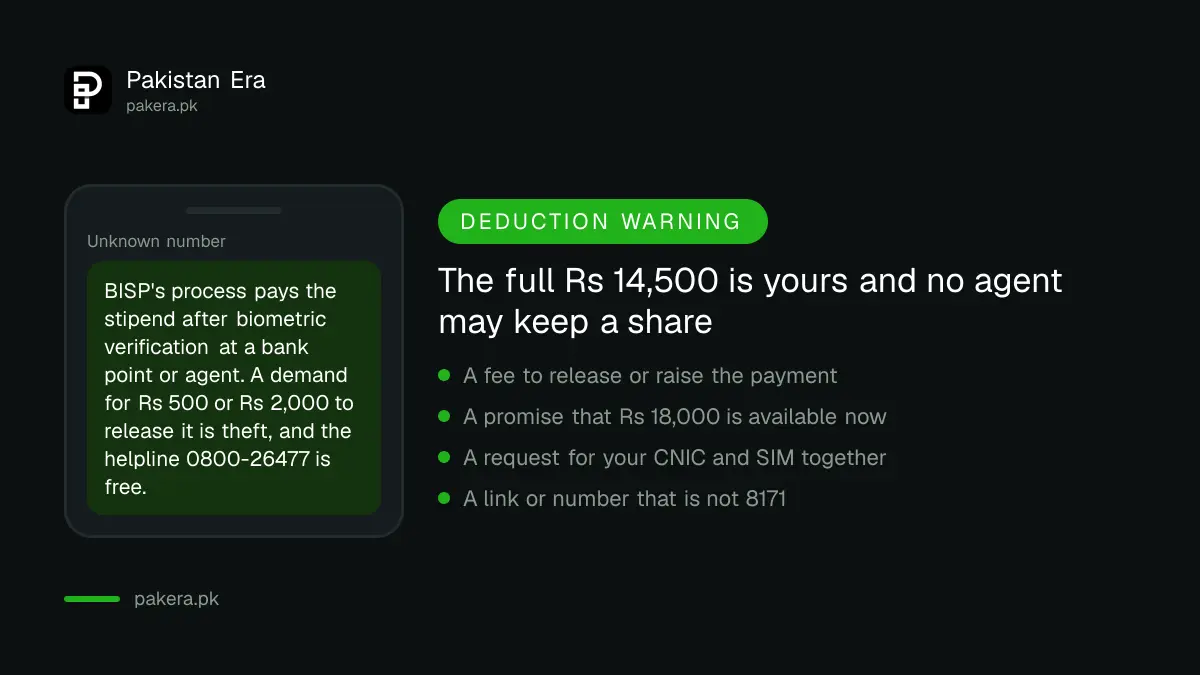
The Rs 18,000 news makes this worse, not better, because a bigger number is a better hook. The pattern to expect over the next three months is a call or a message saying the new amount has been approved for you, followed by a request for a small fee, or for your CNIC number and the SIM BISP gave you. The amount is set nationally, the date is January 2027, and neither can be changed by whoever is on the phone. How agents cut Rs 2,000 from BISP payments and how to report them is set out separately, and the short version is: note the place, the time and the amount, and ring 0800-26477 for a complaint number.
BISP's own process document puts grievances at the BISP tehsil office, so a written complaint there is the second route if the helpline does not resolve it.
Common questions about the BISP new payment of Rs 18,000
Is the BISP payment Rs 18,000 now?
No. The current quarterly payment is Rs 14,500. The government has committed to Rs 18,000 from January 2027.
Who confirmed the Rs 18,000 figure?
The Government of Pakistan, in its memorandum to the IMF published in Country Report 26/101 in May 2026. BISP officials also briefed it as expected, according to TechJuice.
What is the last date to collect the July to September payment?
The quarter ends on 30 September 2026. BISP has not published a last collection date that we could read, so collect a released payment before then rather than after.
Is Rs 19,500 correct?
We could not find it in any government or BISP document. The IMF document says Rs 18,000.
Can I get the increase early by registering again?
No. There is no re-registration for the increase and no fee for it. Anyone offering early access is running a scam.
How do I check if my payment is released?
Enter your CNIC at 8171.bisp.gov.pk or send it by SMS to 8171. Both are free.
How we verified this
What we checked, where we read it, and what we could not confirm.
Last checked 17 September 2026. We read IMF Country Report No. 26/101, Pakistan, Third Review under the Extended Arrangement under the Extended Fund Facility, May 2026, as a PDF from imf.org, including the Government of Pakistan's Memorandum of Economic and Financial Policies, which is the source for the commitment to raise the Kafaalat benefit from Rs 14,500 to Rs 18,000 beginning in January 2027 as a new end-January 2027 structural benchmark, the January 2026 inflation adjustment, enrolment of 10.2 million families, the 15 per cent consumption goal, and the Social Protection Wallets for 7 million families with SIM cards and digital disbursement. We read the Finance Division's Budget in Brief 2026-27 on finance.gov.pk, which shows Rs 844,780 million for the Benazir Income Support Programme. We read BISP's news item on bisp.gov.pk announcing the rise from Rs 10,500 to Rs 13,500 from January 2025, BISP's homepage giving the helpline 0800-26477, BISP's Benazir Kafaalat process document on bisp.gov.pk describing the 8171 check, the SMS, collection at HBL or Bank Alfalah points after biometric verification, ATM withdrawal of later instalments and grievances at the tehsil office, and the 8171.bisp.gov.pk portal. The Rs 14,500 figure from the Ramadan 2026 quarter is attributed to BISP Chairperson Senator Rubina Khalid by INCPak on 18 February 2026 and is reported. The statement that the July to September 2026 quarter pays Rs 14,500 and closes on 30 September is from reporting and content sites, and BISP has published no notice on it that we could find, which is why the article treats 30 September as the end of the quarter rather than a BISP deadline. Business Recorder of 12 June 2026 is the source for the Rs 838 billion allocation and the shortfall arithmetic; Express Tribune of 12 June 2026 for the budget speech's 12 million families; TechJuice of June 2026 for the BISP briefing to the First Lady. Pakistan Observer of 27 May 2026 gave Rs 19,500, which no government document supports. We did not find any BISP press release on the current quarter or on the January 2027 rate.
About the author
Public Services and Education Journalist
Fajr Riaz is a journalist and content writer at Pakistan Era, based in Lahore. She covers the questions people meet in everyday life in Pakistan: how a public service works, what a change in the rules means, and where to find a reliable answer.