Canada Study Permit From Pakistan: PAL, CAD 23,448 Funds and Fees
Canada study permit from Pakistan: the PAL and who is exempt, CAD 23,448 living funds from 1 September 2026, CAD 150 fee, CAD 85 biometrics and a 7-week wait.
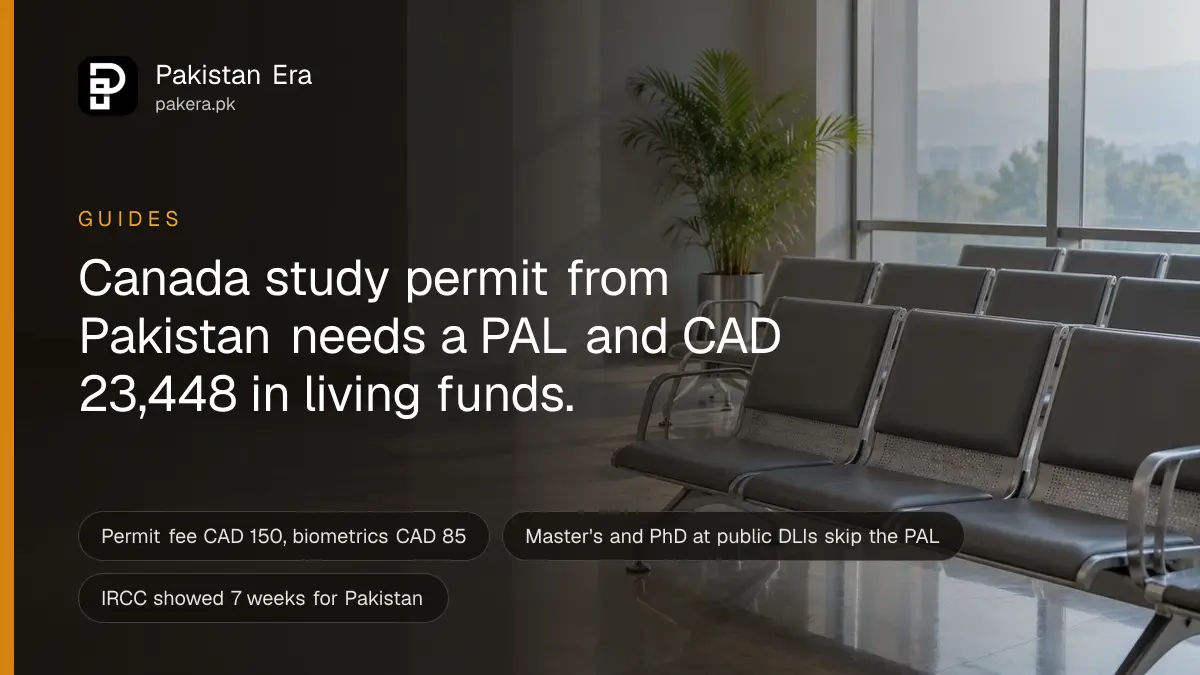
A Canada study permit from Pakistan costs CAD 150, plus CAD 85 for biometrics. You need a letter of acceptance, a provincial attestation letter (PAL) in most cases, and proof of CAD 23,448 for a year's living costs on top of tuition. IRCC's posted processing time for Pakistan was 7 weeks.
Every figure here comes from canada.ca, the site of Immigration, Refugees and Citizenship Canada (IRCC). We read the study permit pages, the PAL page, the proof of funds page and IRCC's fee list on 29 September 2026. The 7-week figure is from IRCC's processing time data, last updated on 22 September 2026.
The funds amount changed on 1 September 2026. If an agent quotes you CAD 22,895, that was the old number. A consultant who misses a change like this may miss others, which is a good reason for checking an education agent before you pay one.
The PAL is the first thing to get
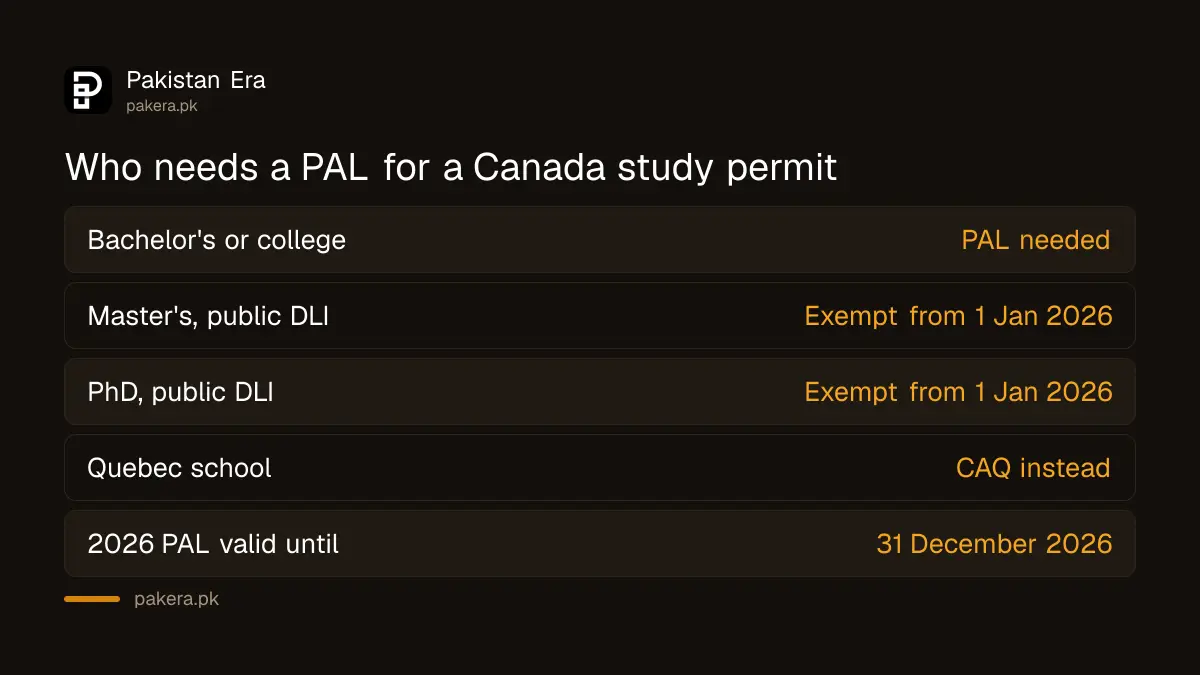
A provincial attestation letter, or PAL, confirms the province has given you one of its study permit spaces under Canada's cap. Your school arranges it. Most applicants need one, but master's and doctoral students at public institutions are exempt from 1 January 2026.
Canada limits how many study permits it hands out each year, and each province gets a share. The PAL is proof you are inside your province's share. In most cases, IRCC says, you must accept your offer and pay some or all of your tuition before the school can get you a PAL.
- Who issues it: the province or territory where you will study, through your school.
- How long it lasts: a PAL issued in 2026 is valid until 31 December 2026, unless it shows an earlier date.
- The trap: you cannot apply with a PAL from a previous cap year. It must be valid on the day you apply, not the day you start.
- Quebec is different: you need a Quebec Acceptance Certificate (CAQ) instead.
IRCC lists other exemptions, including school children, some exchange students and Global Affairs Canada scholarship holders. If you are exempt, you must upload proof of that with your application.
Proof of funds for a Canada study permit
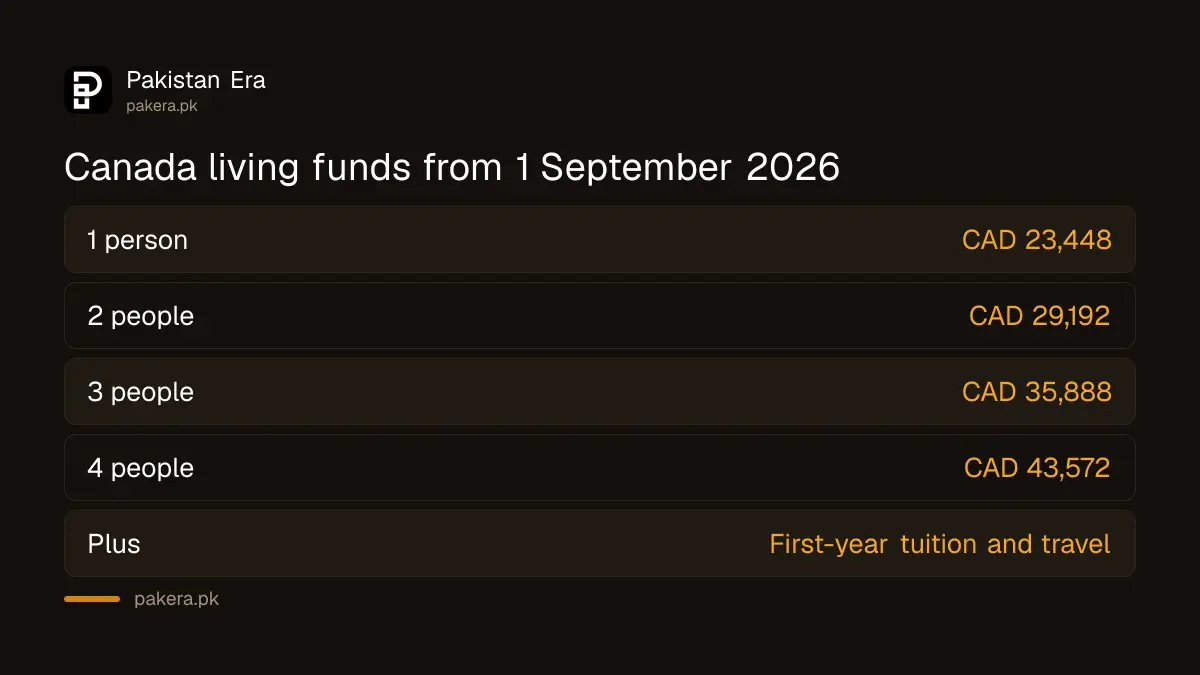
From 1 September 2026, a single student applying outside Quebec must show CAD 23,448 for one year's living costs. That does not include tuition or travel, which you must show as well. The money must be available without working in Canada.
IRCC wants to see the first year covered in full. For a longer programme, you must also explain how you will pay for the rest, for example a multi-year scholarship or a parent's steady job.
| People coming, including you | Living costs a year, applying on or after 1 Sept 2026 | Old amount, to 31 Aug 2026 |
|---|---|---|
| 1 | CAD 23,448 | CAD 22,895 |
| 2 | CAD 29,192 | CAD 28,502 |
| 3 | CAD 35,888 | CAD 35,040 |
| 4 | CAD 43,572 | CAD 42,543 |
What counts as proof? IRCC gives examples: a receipt for first-year tuition and housing, a bank loan letter, a scholarship letter, or your bank statements for the past 6 months with the source of the money shown. Show where each large deposit came from, because IRCC asks for the source.
If a parent is paying, include a letter with their job, their relationship to you, their number of dependants and the amount. Add a copy of their ID.
Canada study permit fee and biometrics
The study permit fee is CAD 150 per person and biometrics is CAD 85, or CAD 170 at most for a family applying together. Pay both online when you submit. If you need a visitor visa to enter Canada, it is issued with the permit at no extra fee.
Biometrics means your fingerprints and a photo. Most people aged 14 to 79 give them, and they last 10 years. IRCC sends a biometric instruction letter after you apply, and you book an appointment at a visa application centre once it arrives.
Pay the biometrics fee with the application, not later. IRCC warns that paying it separately causes delays. Other costs are paid to third parties, not to IRCC: the medical exam, a police certificate if asked (in Punjab, a Police Khidmat Markaz issues character certificates), and translations.
How to apply for a Canada study permit from Pakistan
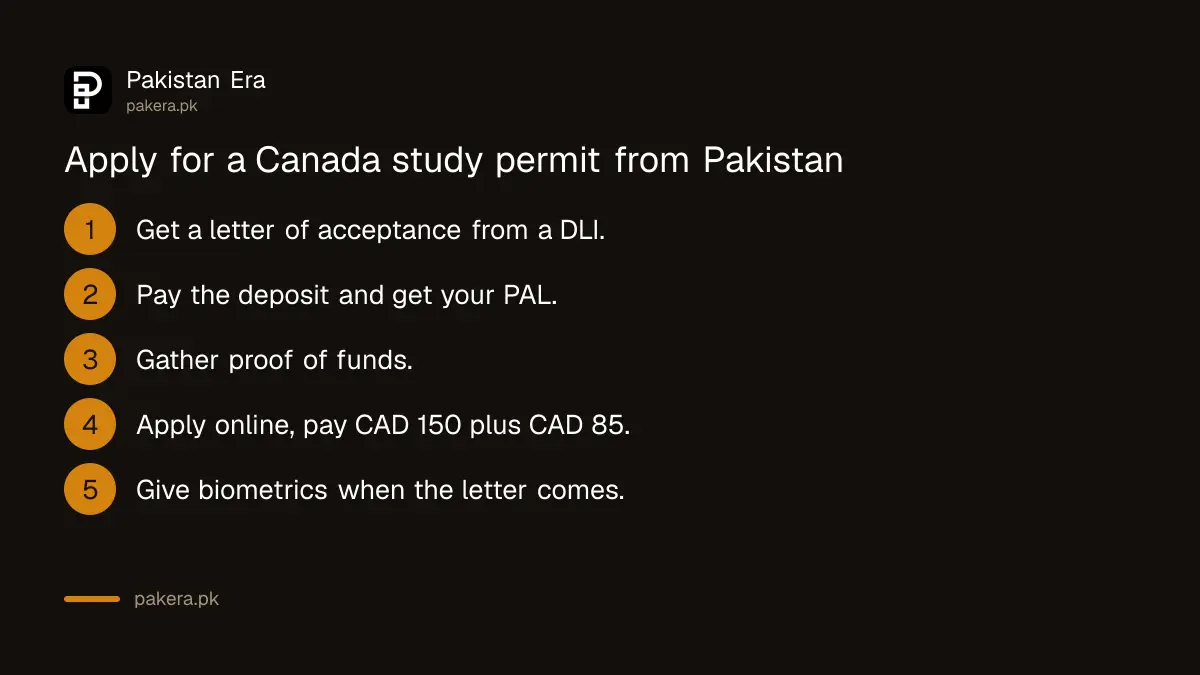
Get your letter of acceptance and PAL, gather funds evidence, check whether you need a medical exam, then apply online through your IRCC account. Pay CAD 235 in total for the permit and biometrics, and give biometrics when the letter arrives.
- Get a letter of acceptance from a designated learning institution (DLI), a school approved to take international students.
- Accept the offer, pay the tuition deposit the school asks for, and get your PAL.
- Collect proof of funds for tuition, CAD 23,448 of living costs and travel.
- Check if you need an immigration medical exam. Staying more than 6 months is one trigger.
- Write a short letter of explanation. IRCC recommends it, and it is your chance to explain your plan.
- Apply online, upload your passport's information page and 2 photos, and pay CAD 150 plus CAD 85.
- Give biometrics after you receive the instruction letter.
- If approved, send your original passport so IRCC can place the visa in it.
Your school must confirm your letter of acceptance with IRCC. If it does not respond in time, IRCC returns the application and refunds the fee. So confirm with the school that it will validate the letter before you submit.
Canada study permit processing time for Pakistan
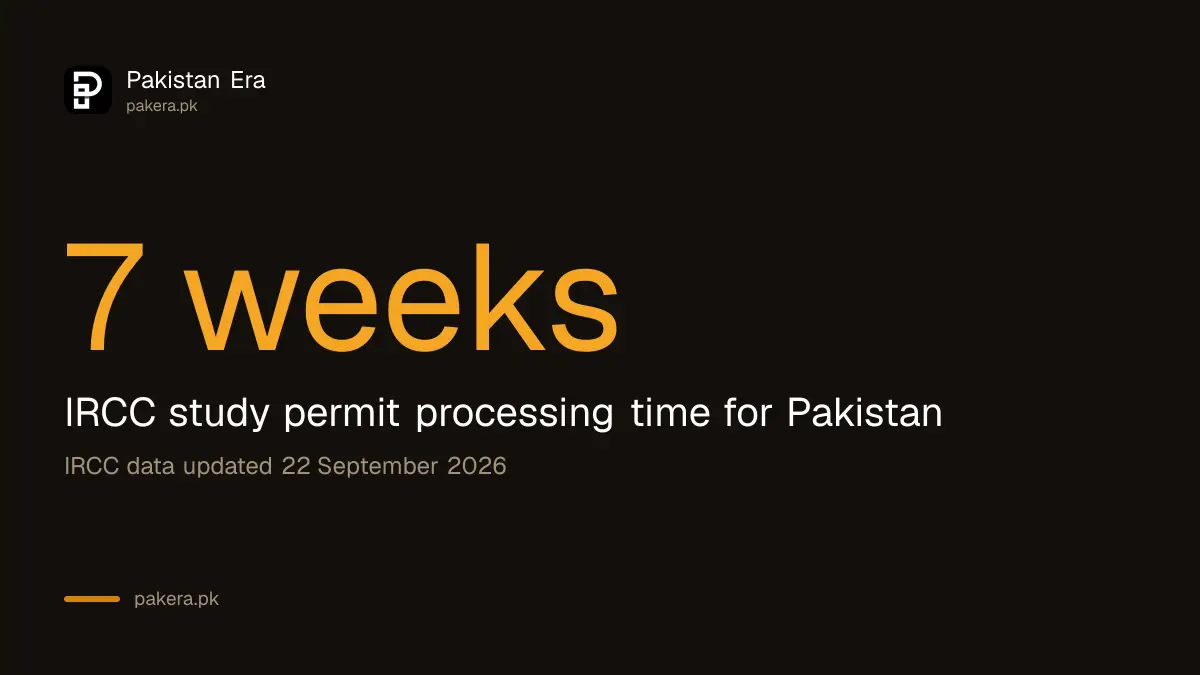
IRCC's processing time for study permits applied from Pakistan was 7 weeks in data last updated on 22 September 2026. The clock starts after IRCC gets your biometrics. IRCC updates the figure regularly, so check it on canada.ca before you plan dates.
Seven weeks is a posted average, not a promise. Missing documents, a medical exam or a request for more papers all add time. For a January intake, we would apply by October at the latest, with the PAL already in hand.
PhD students now have a faster route. IRCC says doctoral students and their families may get faster processing, and the page lists who qualifies.
If you are also weighing Britain, remember that the UK Graduate visa cut to 18 months changes the after-study picture there from 1 January 2027.
Common questions
How much bank balance is required for a Canada study permit from Pakistan?
First-year tuition, travel costs, and CAD 23,448 for one year's living costs if you apply on or after 1 September 2026. The amount rises with each family member who comes with you.
Do I need a PAL for a master's degree in Canada?
Not if it is a degree-granting master's or doctoral programme at a public DLI starting from 1 January 2026. You still upload proof that you are exempt.
What is the Canada study permit fee in 2026?
CAD 150 for the permit and CAD 85 for biometrics, so CAD 235 for one student. A family applying together pays at most CAD 170 for biometrics.
How long does a Canada study permit take from Pakistan?
IRCC showed 7 weeks for Pakistan on 22 September 2026. The time counts from when IRCC receives your biometrics.
Can I use a PAL from last year?
No. IRCC does not accept a PAL issued in a previous cap year. You need a new one from your school.
Do I need a separate visitor visa for Canada?
No. If you need one, IRCC issues it automatically with your study permit approval, with no extra fee.
How we verified this
What we checked, where we read it, and what we could not confirm.
Last checked on 29 September 2026. The PAL rules, its validity to 31 December 2026, the cap-year rule and the master's and doctoral exemption from 1 January 2026 are read on IRCC's provincial attestation letter page. The living cost table is read on IRCC's proof of financial support page. The CAD 150 and CAD 85 fees are read on IRCC's fee list and study permit apply page. The document list, LOA validation and passport steps are read on IRCC's "Get the right documents" page. The 7-week figure is IRCC's own processing time data for Pakistan, updated 22 September 2026. We did not submit an application, and we did not verify which visa application centres in Pakistan take biometrics.
About the author

Public Services and Education Journalist
Fajr Riaz is a journalist and content writer at Pakistan Era, based in Lahore. She covers the questions people meet in everyday life in Pakistan: how a public service works, what a change in the rules means, and where to find a reliable answer.