How to Change Your Employer in Bahrain: LMRA Transfer Rules, Notice and Fees
Pakistani workers in Bahrain can transfer to a new employer if the permit has 5 days left. See the 12 month rule, 30 to 90 day notice, fees and refusal cases.
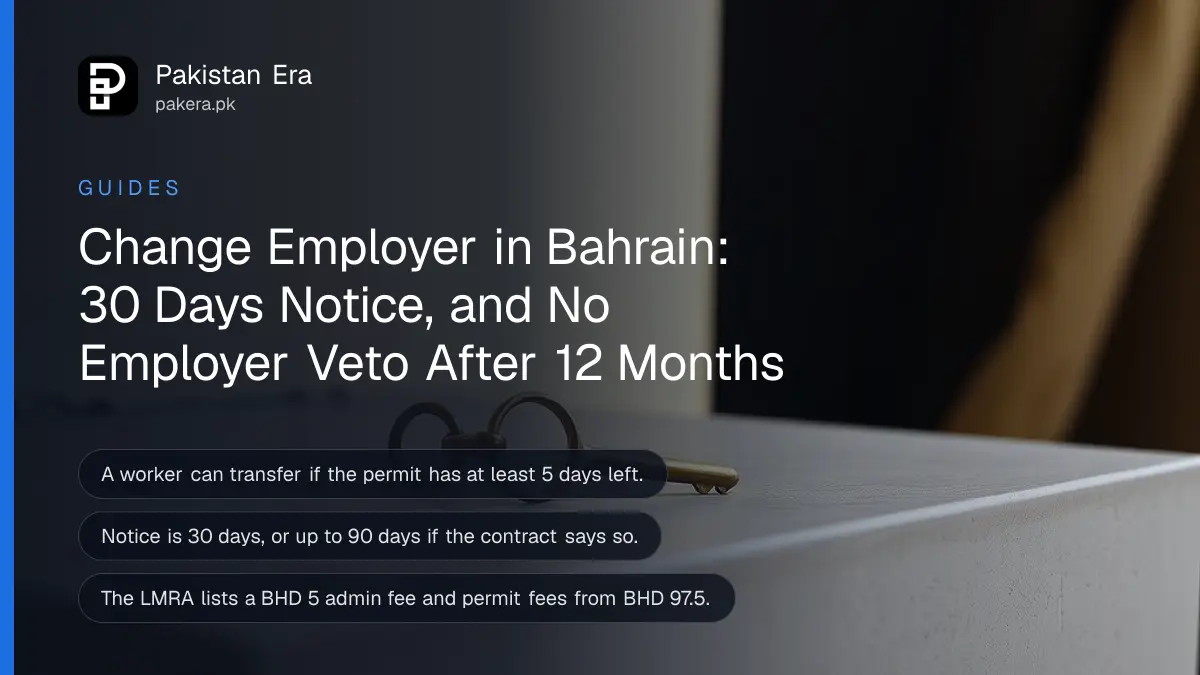
A Pakistani worker in Bahrain can move to a new employer without cancelling the work permit, if the permit has at least 5 days left and the current employer is told. The notice period is 30 days, or the contract period up to 90 days. After 12 months at the same job, the LMRA lists no option for the employer to reject the move.
Changing jobs in Bahrain runs through the Labour Market Regulatory Authority (LMRA) and its online Expat Management System. We read the LMRA's pages for the Expatriate Employee Transfer and Intention to Transfer services on 15 October 2026, and every rule below comes from them. If you came through the BHD 195 Bahrain work permit route, this is how you leave one employer for another without losing your status.
You can transfer without cancelling your permit if it has 5 days left
The LMRA says a worker can transfer to another employer without cancelling the current permit, as long as the permit is valid for at least five more days. A worker with an expired permit cannot transfer. That person needs a new work permit.
Once the transfer request is submitted, the current employer is notified in the Expat Management System. You must keep working for the current employer until the transfer is approved. The employer keeps paying the monthly permit fees until the new employer pays for the new permit.
The new employer starts the request. It must reach the LMRA at least one month before the transfer date.
Under 12 months, your employer can approve, delay or reject the move
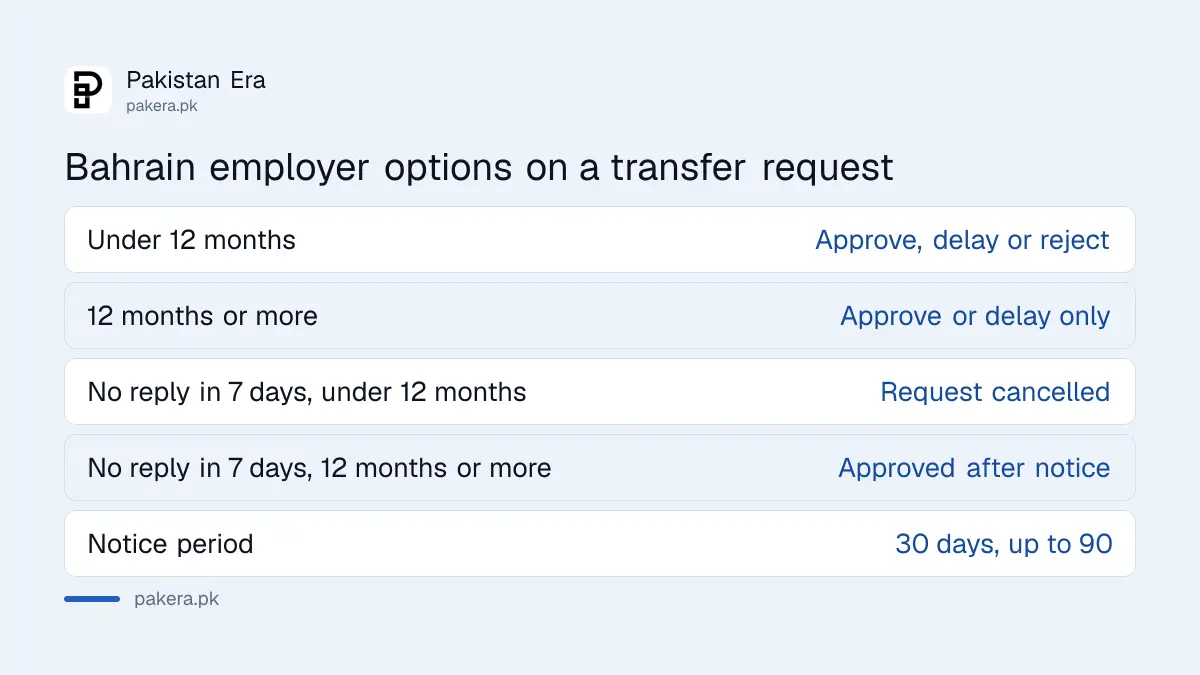
If you have not completed 12 months on the current permit, your employer has three choices. It can approve a direct transfer. It can approve after the notice period. Or it can reject. If it does nothing for seven days, the system cancels the application.
After 12 months the rule changes in your favour. The LMRA lists only two choices, a direct transfer or a transfer after the notice period. If the employer does not act within seven days, the system approves the transfer automatically once the notice period ends.
| Your time on the permit | Employer's options | If employer does nothing for 7 days |
|---|---|---|
| Under 12 months | Approve direct, approve after notice, or reject | The application is cancelled |
| 12 months or more | Approve direct or approve after notice | The transfer is approved after the notice period |
That seven day silence rule matters. An employer who ignores the request cannot keep a worker past 12 months. But under 12 months the same silence ends your request, and you must start again.
The notice period is 30 days, up to 90 if your contract says so
The notice period is 30 days, or the period written in your contract, as long as it does not pass 90 days from the date the previous employer was told. Read your contract before you resign, because the contract period decides how long you wait.
When the transfer is complete, the previous employer receives a credit note in the system for the unused part of the old permit. The old employer is credited for months you did not use.
The new employer has 30 days after approval to pay the new work permit fees. If it does not, the approval is revoked and you stay with the old employer.
Attach a release letter or send your resignation by registered mail
The LMRA asks for one of four documents: a no-objection letter from your current employer, a termination letter, a letter accepting your resignation, or your own resignation letter with notice. If you post the resignation, keep the registered mail receipt as proof it was sent.
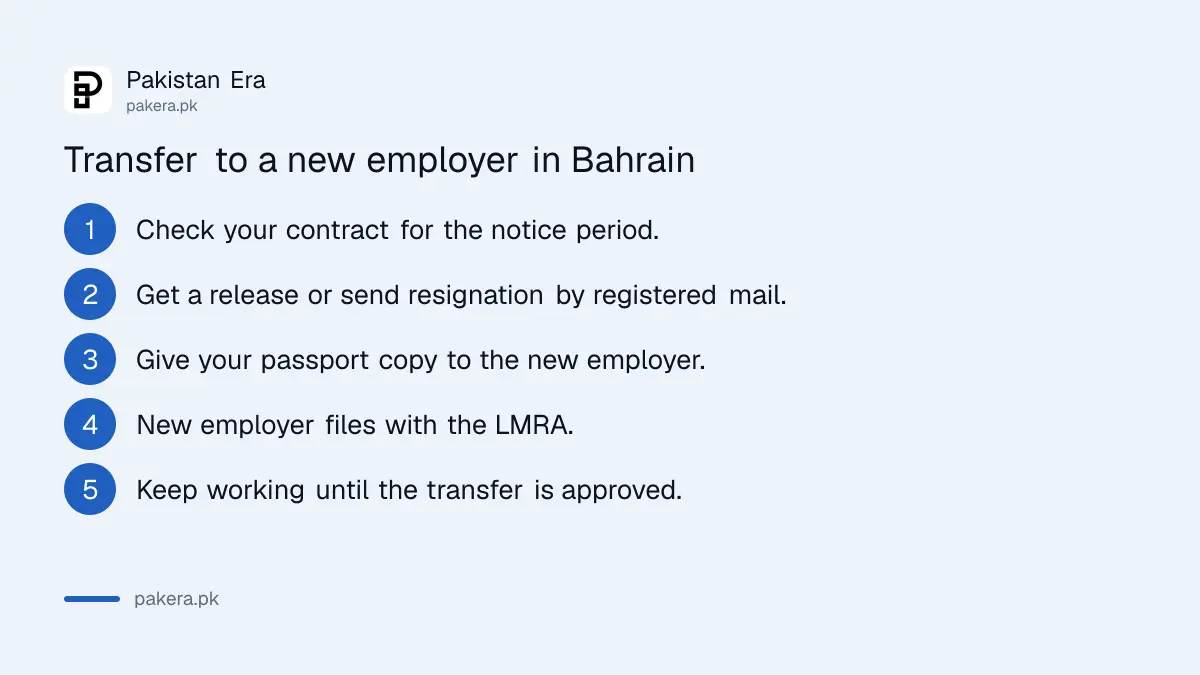
- Check your contract for the notice period.
- Ask your current employer for a no-objection or termination letter, or send your resignation by registered mail through Bahrain Post.
- Keep the receipt or the pink registered mail card.
- Give your passport copy, valid for at least six months, to the new employer.
- Ask the new employer to file the transfer request at least one month before the move.
Letters must be official, stamped and signed. For some specialised jobs, the LMRA also asks for an approval or no-objection certificate from the relevant authority, no older than six months. Dependants need a valid health insurance certificate.
Tell the LMRA your intention to transfer after half of your permit has passed
A separate service, Intention to Transfer, lets a worker announce plans to change employer. Once filed, your current employer is blocked from renewing your permit at its end. You can file it once, and only after half of the permit period has passed.
You file at workers.lmra.gov.bh with a copy of both sides of your ID card and a copy of your passport. You do not need it if your permit has already been terminated.
Changed your mind? The LMRA has an "Un-intend to Transfer" service to cancel the notice. It is done at the Expat Protection Centre counter in Northern Sehla, takes immediate effect and needs no documents, but your biometric data is collected.
Six cases where the LMRA will not allow a transfer
The LMRA lists six cases where a transfer is refused. They include a final criminal judgment for a felony, a violation of permit conditions, and a new employer without the Bahrainization quota. A request in the last three months of the permit needs consent.
- You or the new employer do not meet the conditions for a work permit.
- You have a final criminal judgment for a felony or a crime of honour or honesty.
- You have violated work permit conditions.
- The new employer lacks the Bahrainization quota or has a violation that blocks transfers.
- You have a violation that blocks your transfer.
- The request comes in the last three months of your permit, without your current employer's consent.
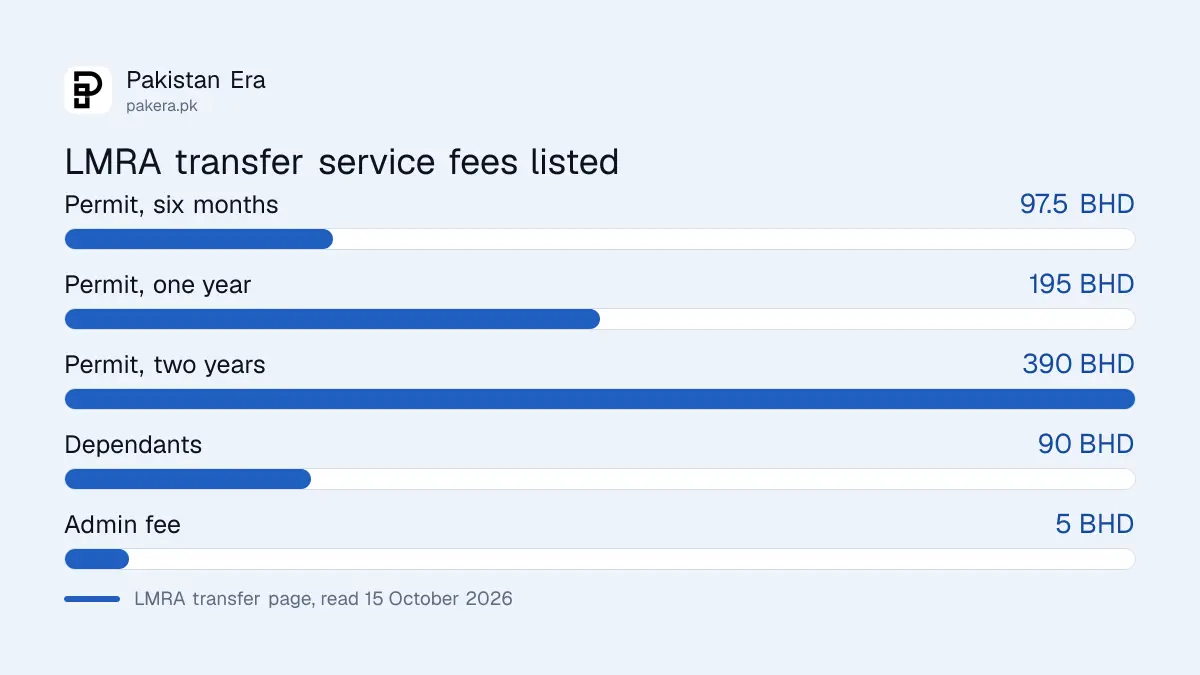
Fees are listed on the same LMRA page. The service fee is BHD 97.5 for six months, BHD 195 for one year and BHD 390 for two years, with BHD 90 for dependants and a BHD 5 admin fee. In the process described, the new employer pays the admin fee and the permit fee. No recruiter should ask you to pay these. Overseas job agents in Pakistan can charge only Rs 15,000, and you can check an overseas job agency before you pay anyone.
Common questions about changing employer in Bahrain
Can I change jobs in Bahrain without my employer's permission?
After 12 months, yes in most cases. The employer can only approve directly or after the notice period, and silence for seven days means automatic approval after notice. Under 12 months the employer can reject.
How long does an LMRA transfer take?
The LMRA lists 3 working days for processing. The notice period of 30 to 90 days comes on top, unless the employer approves a direct transfer.
Who pays the transfer fees?
In the LMRA's process, the new employer pays the admin fee and the new work permit fee. The previous employer gets a credit note for the unused permit.
What if my permit has expired?
You cannot transfer. The LMRA says workers with expired permits must apply for a new work permit instead.
Do I keep working for my old employer during the notice period?
Yes. The LMRA says you must continue working for the current employer, and that employer must keep paying the permit fee until the transfer is approved.
Is there an app or website to file?
The transfer runs through the LMRA Expat Management System, and the Intention to Transfer service runs at workers.lmra.gov.bh. The LMRA contact centre is +973 17506055.
How we verified this
What we checked, where we read it, and what we could not confirm.
Last checked 15 October 2026. Transfer rules, notice periods, fees, documents and refusal cases come from the LMRA Expatriate Employee Transfer page, last updated by the LMRA on 9 September 2026, and the Intention to Transfer page, which we opened on 15 October 2026. We did not file a transfer ourselves. The LMRA can change rules, so confirm with its contact centre before you resign.
About the author

Global Affairs & Political Economy Writer
Muhammad Hatim is a book lover who started writing because he enjoys it. At Pakistan Era he writes about international relations, geopolitics and the global economy, with a particular interest in South Asia and the forces behind current events.