How to Check If a BS Computer Science Programme Is NCEAC Accredited in Pakistan
HEC recognition is not enough for BS computing. Check your programme on the NCEAC website in five steps before you pay, and see what to do if it is missing.
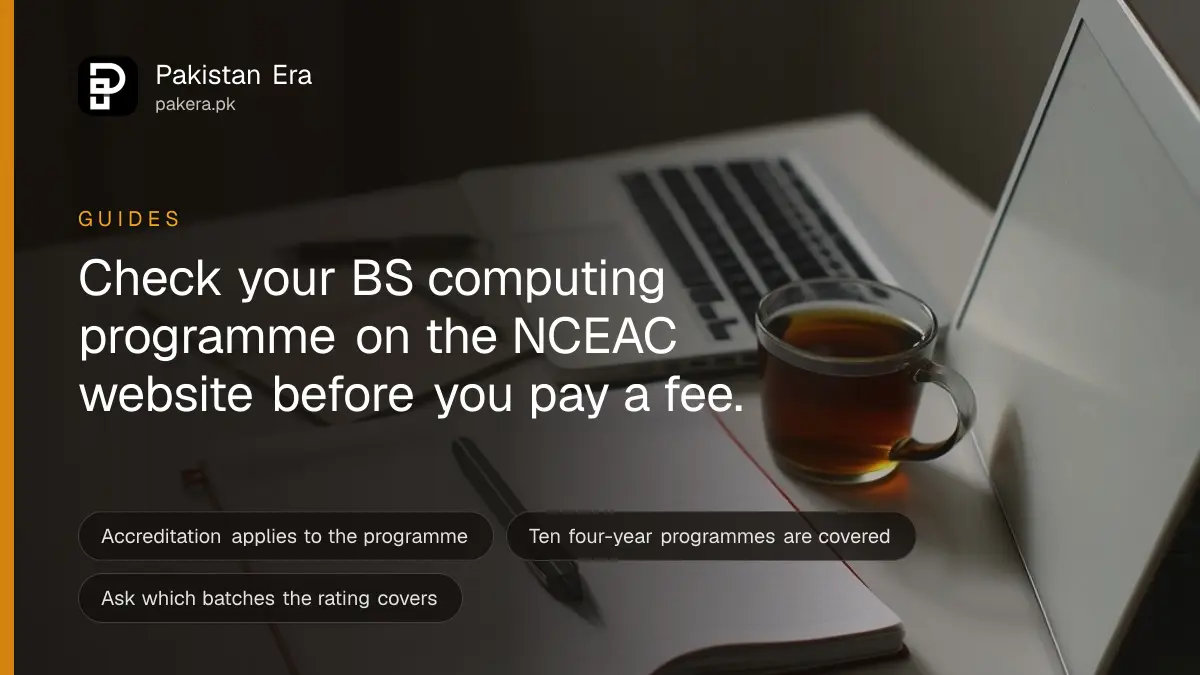
Before you pay a fee for BS Computer Science, IT, AI or Software Engineering in Pakistan, check the programme on the NCEAC website at nceac.org.pk. Being HEC recognised is not enough, because computing programmes are accredited one by one.
NCEAC is the National Computing Education Accreditation Council. It works under the Higher Education Commission. We opened its website on 8 October 2026, read its pages and its latest letters, and wrote the steps below from that.
NCEAC accredits bachelor computing programmes, not whole universities
NCEAC accredits bachelor level computing programmes and gives each one a rating of W, X, Y or Z. A university can be HEC recognised and still have a computing programme that NCEAC has not accredited. Check the programme, not only the campus.
That is the same idea as engineering. If you are weighing both, our guide to checking that an engineering programme is PEC accredited works the same way.
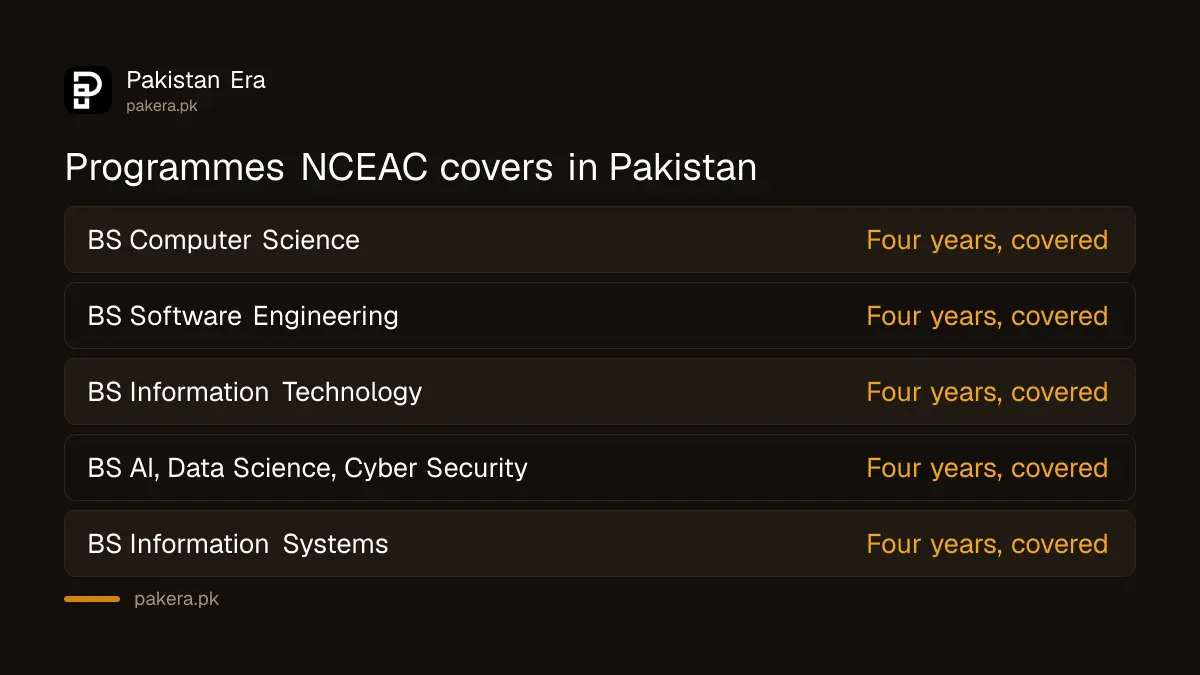
| Programme (four years) | Covered by NCEAC |
|---|---|
| BS Computer Science | Yes |
| BS Software Engineering | Yes |
| BS Information Technology | Yes |
| BS Artificial Intelligence, Data Science, Cyber Security | Yes |
| BS Information Systems, Bioinformatics, Computer Engineering, Multimedia and Gaming | Yes |
Why the check matters more from 2027
In a letter dated 5 October 2026, NCEAC said HEC will attest only accredited BS computing degrees from June 2027. A degree from an unaccredited programme may then be refused attestation, which employers and foreign universities usually ask for.
We cover the letter in full in our report on HEC attesting only NCEAC-accredited computing degrees. The short version: the programme you pick this autumn may decide whether your degree can be attested.
Five steps to check a programme before you pay
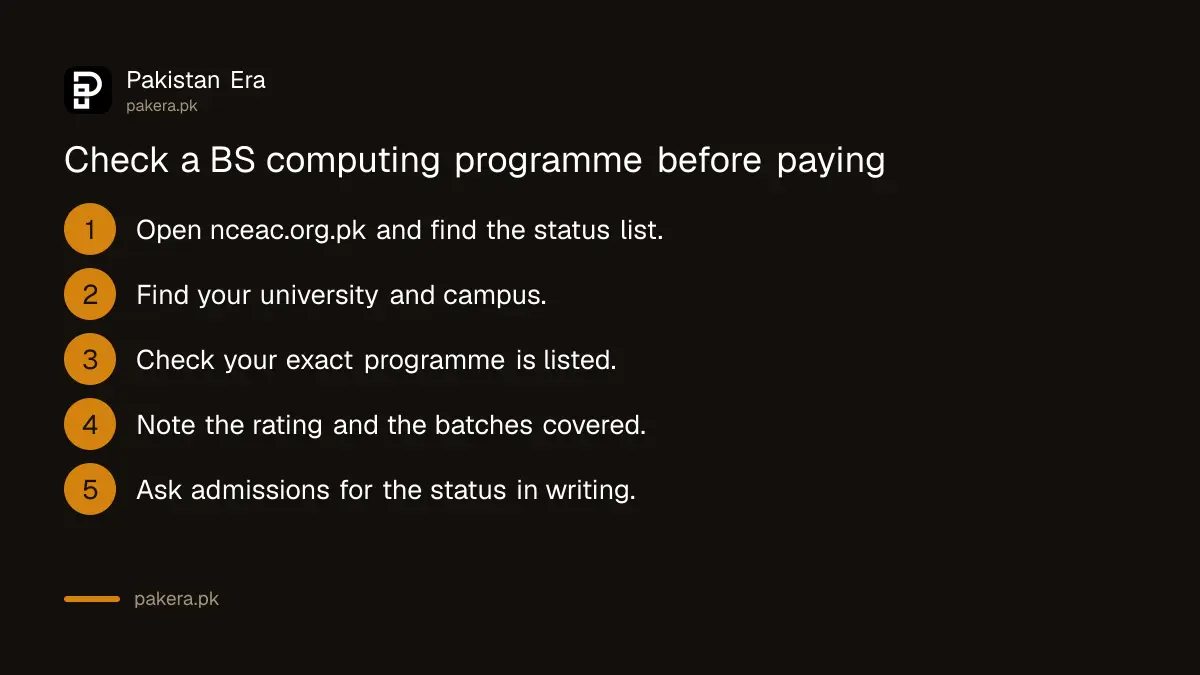
Open nceac.org.pk, find the university in the accreditation status for institutions, and check that your exact programme is listed. Then ask the admissions office for its accreditation status in writing, before you pay any fee.
- Open nceac.org.pk and go to the section for accredited programmes and the region-wise accreditation status.
- Find the university, and the campus if it has more than one.
- Check that your exact programme appears, for example BS Software Engineering and not only BS Computer Science.
- Note the rating shown, and note which batches are covered.
- Email or call the admissions office and ask for the accreditation status of your programme in writing.
The home page showed 203 institutions with accredited programmes when we looked. A missing name is worth asking about, because that list is the council's own record.
Batches and affiliated colleges need a closer look
NCEAC accredits by batch, and an institute can apply for up to three batches in one application, according to its FAQ. A programme listed this year may not cover the batch you join, so ask which batches the accreditation includes.
Affiliated colleges need extra care. NCEAC's October letter says some public universities affiliated colleges without checking faculty, labs or teaching standards. A degree may carry a public university's name while the classes run in a college that has not been visited.
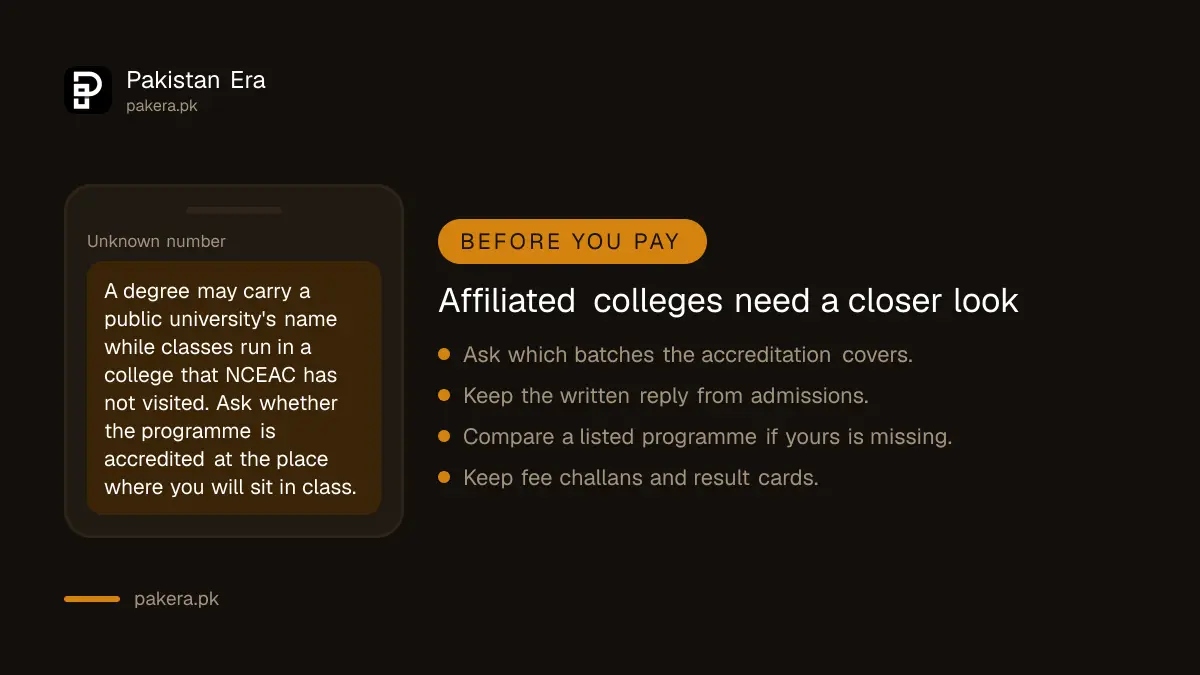
So ask two things. Is the programme accredited? And is it accredited at the place where you will actually sit in class?
Admission rules for BS computing apply to every university
NCEAC set a minimum for admission to BS computing programmes from the 2026 admission year: HSSC or A Levels with at least 50 per cent marks, with Mathematics studied or two extra Maths courses added. The council directs every institution to follow it.
If you did Pre-Medical, there is a route, and we explain it in our guide to BS Computer Science admission for Pre-Medical students.
What to do if your programme is not listed
If your programme is not listed, ask the university in writing whether it has applied and for which batches. Keep the reply. If you are not yet enrolled, compare another programme that is listed before paying the first semester's fee.
If you are already enrolled, do not panic and do not leave on the strength of a rumour. Keep your admission letter, fee challans and result cards, and write to the NCEAC secretariat. The contact details are on the council's website, and the October letter lists phone numbers 051-9080-2771, 2772 and 2773.
For the general check on the university itself, our guide to checking that a university is HEC recognised comes first. This guide is the second test, for the programme.
Common questions
Is an HEC recognised university the same as an NCEAC accredited programme?
No. HEC recognition applies to the university, while NCEAC accreditation applies to the computing programme, and a recognised university can still have an unaccredited one.
What do the ratings W, X, Y and Z mean?
NCEAC gives these ratings to accredited programmes. We could not find the meaning of each letter on the pages we read, so ask the council before you rely on one.
Does NCEAC accredit Virtual University programmes?
According to its FAQ, NCEAC does not accredit Virtual University computing programmes because they are online. Those students must pass an NCEAC competency test to register.
Which programmes does NCEAC cover?
Ten four-year programmes, including Computer Science, Software Engineering, IT, AI, Data Science and Cyber Security.
Who can become an NCEAC member?
According to the FAQ, graduates from batches accredited by NCEAC can apply for membership through its registration system.
How we verified this
What we checked, where we read it, and what we could not confirm.
Last checked 8 October 2026. We read the National Computing Education Accreditation Council website at nceac.org.pk, including its home page, about page, FAQ page and notifications list, and two of its letters: the mandatory accreditation letter dated 5 October 2026 and the admission criteria corrigendum dated 8 September 2026. The list of ten programmes in scope, the W, X, Y and Z ratings, the counts of 203 institutions with accredited programmes, the three-batch limit, the position on Virtual University programmes and the membership rule come from those pages. We could not open the programme list itself through our tools, so check it in your own browser. The meaning of each rating letter is not stated on the pages we read. The council can change its pages and rules, so confirm with the NCEAC secretariat before you pay a fee.
About the author

Senior Writer, Public Services and Technology
Shahid joined us in 2024 as an author. He is a senior contributor to Pakistan's leading technology websites. He writes detailed articles, mostly covering his expertise in the latest tech, mobiles, apps, gadgets, and step-by-step guides. His ideology is to help people understand the latest trends and explain complex methods through very easy-to-understand guides.