HEC to Attest Only NCEAC-Accredited BS Computing Degrees From June 2027
NCEAC says HEC will attest only accredited BS computing degrees from June 2027. See what the letter requires, its 31 October deadline and what students can do.

From June 2027, the Higher Education Commission will attest only those BS computing degrees that are accredited by the National Computing Education Accreditation Council. A degree without that accreditation will not be attested.
The rule sits in a letter dated 5 October 2026, sent to every public and private university and degree awarding institution. We read the letter on the council's own website on 8 October 2026. It affects every student now enrolled in a BS computing programme in Pakistan.
HEC will attest only accredited BS computing degrees from June 2027
The letter says that from June 2027 HEC will attest only BS-level computing degrees accredited by NCEAC. The computing graduate card issued through NCEAC accreditation becomes mandatory for attestation. Without the card, attestation of the degree can be refused.
Attestation is the HEC stamp that employers, embassies and foreign universities ask for. Without it, a degree is hard to use outside the classroom. Our guide to getting a degree attested by HEC online shows the current steps.
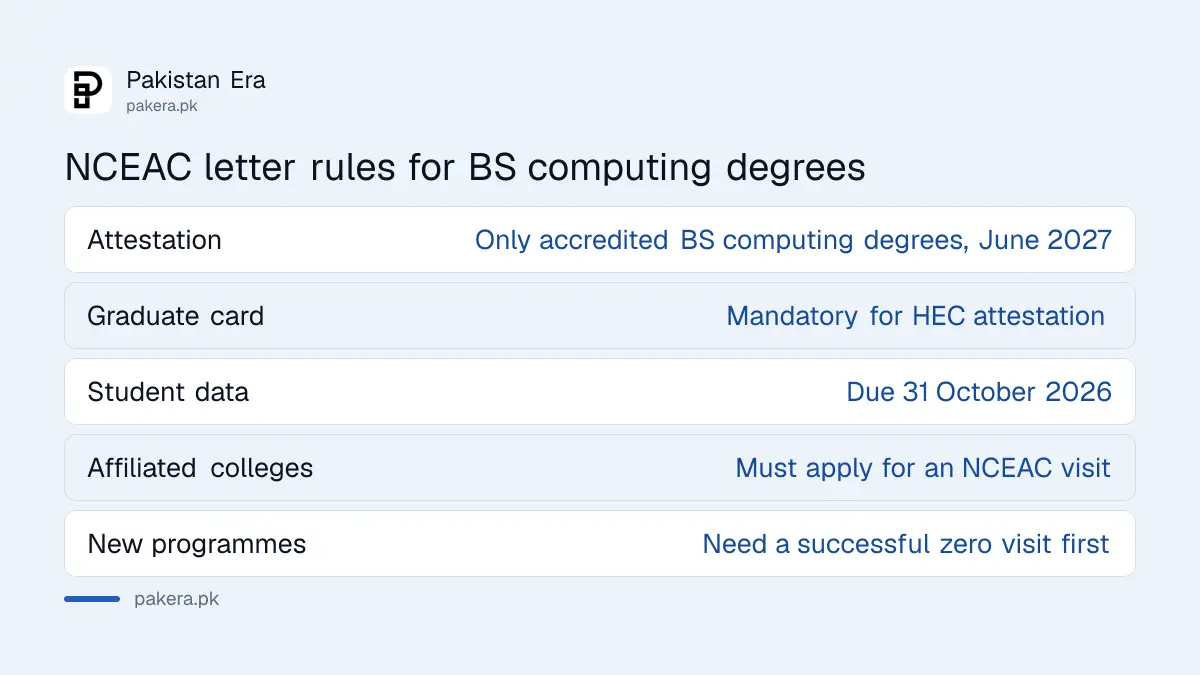
| Point in the letter | What it says |
|---|---|
| Date of the letter | 5 October 2026 |
| Attestation rule | From June 2027, only NCEAC-accredited BS computing degrees |
| Graduate card | Mandatory for attestation of every BS computing degree |
| Student data deadline | 31 October 2026, on the NCEAC accreditation system |
| Affiliated colleges | Must apply for an NCEAC visit now |
The letter names affiliated colleges as the main concern
NCEAC says several public universities gave affiliation to many colleges without checking minimum standards. The letter reports colleges that run without enough faculty, dedicated buildings, computing labs or outcome-based teaching, while producing many graduates every year.
That wording matters. The council is not describing every university. It is describing a pattern in affiliated colleges, where a degree carries the name of a public university but the classes happen somewhere else.
We are setting out what the letter says. We have not inspected any college, and we make no finding about any institution.
Universities must send student data by 31 October 2026
Every institution must upload data for all students enrolled in associate degree and BS computing programmes by 31 October 2026. This covers the main campus, sub-campuses and every affiliated college, and it goes on the NCEAC accreditation system.
For each college the upload must show the number of students per programme and batch, the full-time computing faculty with their qualifications, the classrooms set aside for computing, and the working labs with the exact count of computers.
This is the part a student can use. Once a college has to state its labs and faculty on record, the gap between what it advertised and what it has becomes visible to the council.
New computing programmes now need a zero visit first
Universities may not grant affiliation to a new computing programme, or let an affiliated college start one, until NCEAC has made a successful zero visit. Colleges that already teach computing must apply for an accreditation visit straight away.
The letter says evaluators will check faculty, labs, curriculum and understanding of outcome-based education. Later visits will follow the first one.
If your college started a new BS computing programme this autumn, ask it in writing whether the zero visit has happened. A clear answer is a good sign. A vague one is not.
What students already enrolled can do this month
Check your programme on the NCEAC website now, ask your department for its accreditation status in writing, and keep your admission and enrolment papers. The letter does not say how students who graduate before June 2027 are treated.
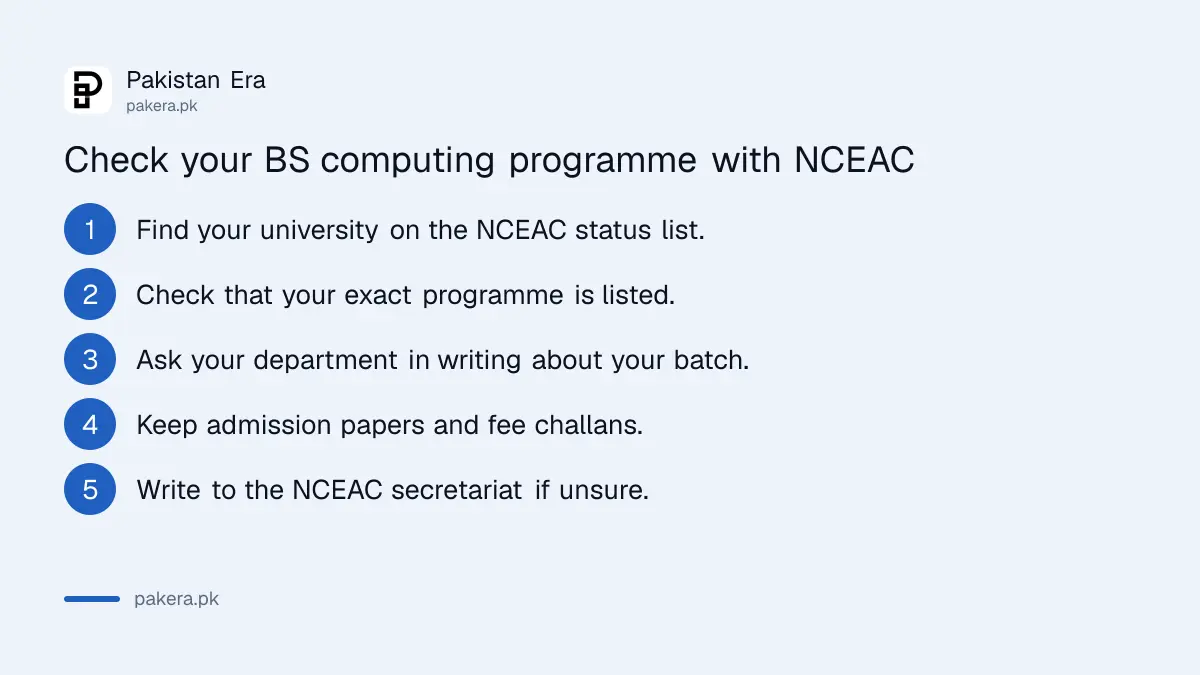
- Open the NCEAC website and find your university in the accreditation status list.
- Check that your exact programme and batch are listed, not only the university.
- Ask your department head in writing whether your batch is in the accreditation process.
- Keep your admission letter, fee challans and semester result cards.
- If the answer is unclear, write to the NCEAC secretariat at the email in the letter.
Our guide to checking that a university is HEC recognised covers the first test. Accreditation of a computing programme is a second, separate test, and we explain it in how to check a BS Computer Science programme with NCEAC.
What the letter does not say
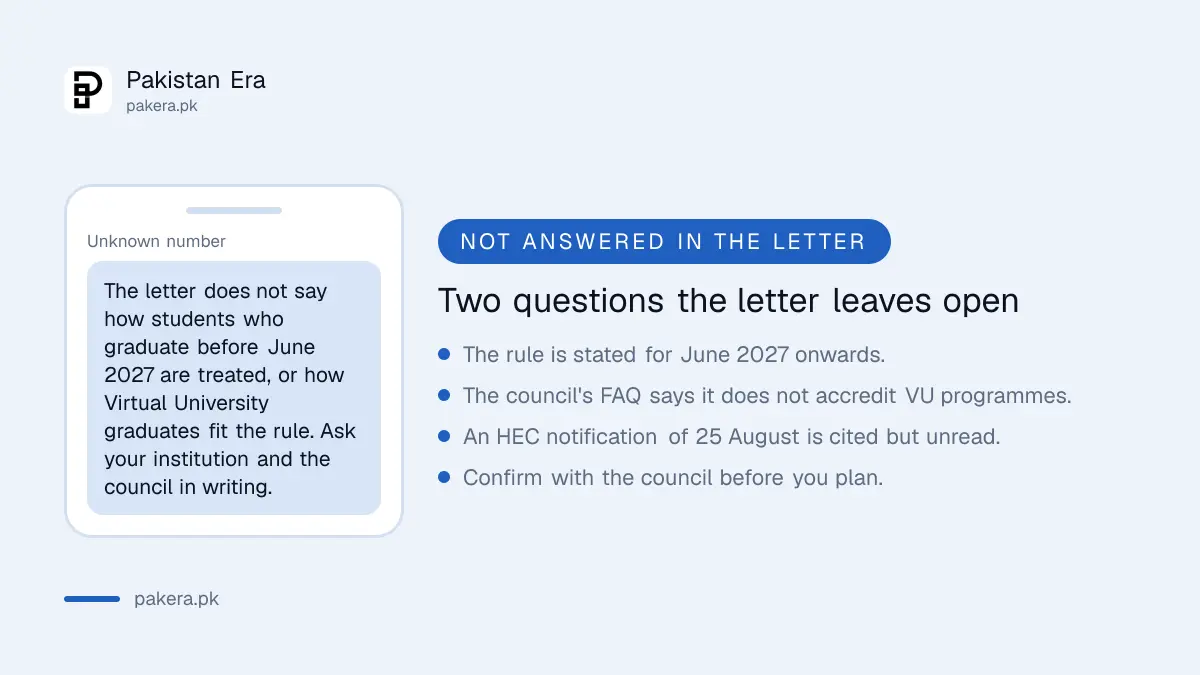
The letter does not say what happens to a student who finishes before June 2027, and it does not say how Virtual University graduates are treated. We could not find either point in the letter, so we cannot tell you the answer.
The council's own FAQ says it does not accredit Virtual University computing programmes because they are online, and that those students must pass a competency test to register. How that fits the June 2027 rule is not explained.
The letter also refers to an HEC notification dated 25 August 2026. We have not seen that notification, so everything here comes from the council's letter.
Common questions
Does this apply to BS Computer Science only?
No. The council's scope covers ten four-year programmes, including AI, cyber security, data science, information technology and software engineering.
When does the rule start?
The letter says effective June 2027, and the heading adds Fall 2027. Treat June 2027 as the earliest date.
Will my degree be refused if my college is not accredited?
The letter says HEC will attest only accredited BS computing degrees from June 2027, so refusal is the stated consequence. Ask your institution for its position in writing.
What is the computing graduate card?
It is the card issued through NCEAC accreditation, and the letter calls it mandatory for HEC attestation of BS computing degrees.
Who do I contact for questions?
The letter lists the NCEAC secretariat in Islamabad on 051-9080-2771, 2772 and 2773, with two HEC email addresses given on the letter.
How we verified this
What we checked, where we read it, and what we could not confirm.
Last checked 8 October 2026. We read the letter from the National Computing Education Accreditation Council, reference NCEAC/HEI/AFF/2026/09 dated 5 October 2026, on nceac.org.pk, along with the council's about page, FAQ page and notifications list. The June 2027 attestation rule, the mandatory graduate card, the 31 October 2026 data deadline, the zero visit requirement and the concern about affiliated colleges are all taken from that letter. The letter cites an HEC notification dated 25 August 2026, which we have not read. HEC can change the date or the detail, so confirm with the council and your institution before you plan around it.
About the author

Public Services and Education Journalist
Fajr Riaz is a journalist and content writer at Pakistan Era, based in Lahore. She covers the questions people meet in everyday life in Pakistan: how a public service works, what a change in the rules means, and where to find a reliable answer.