How to Check Your Dirham, Riyal or Dollar Rate in Pakistan Against SBP's Customer Rates
SBP's 15 October 2026 table shows the dirham at Rs 75.3108 buying, the riyal at Rs 73.6843 and the dollar at Rs 276.6081. Compare your offer in five steps.
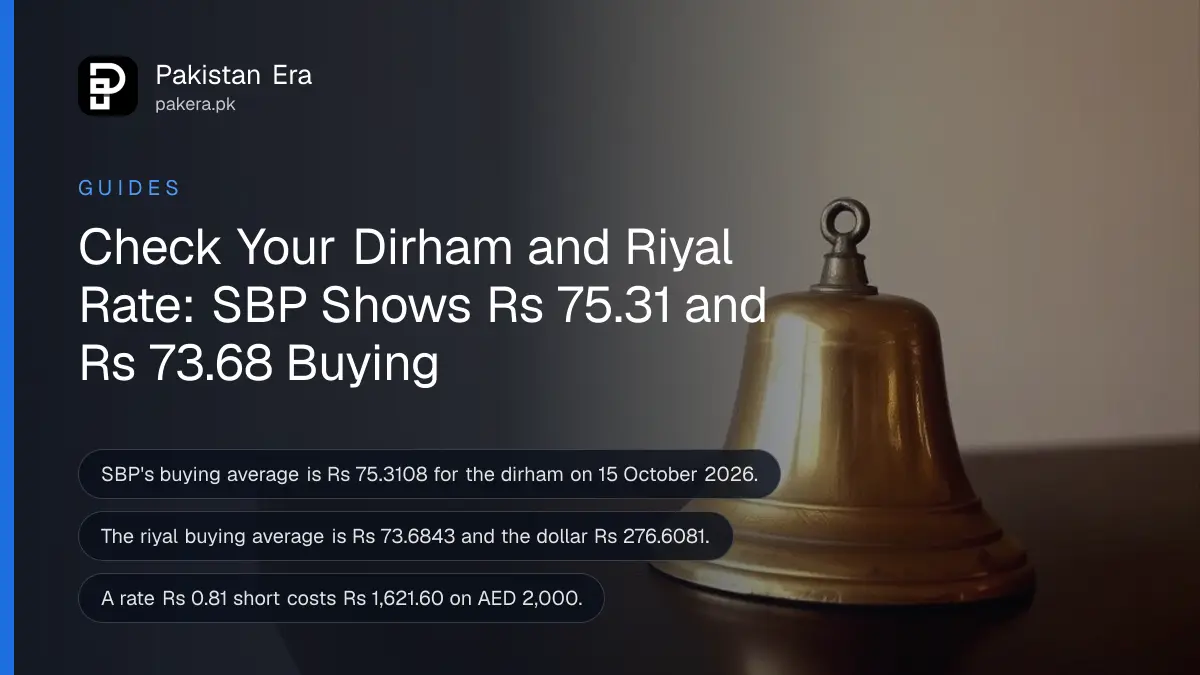
Short answer: SBP's weighted average customer rates for 15 October 2026 show the dirham at Rs 75.3108 buying and Rs 75.4244 selling, the riyal at Rs 73.6843 and Rs 73.8013, and the dollar at Rs 276.6081 and Rs 277.0649. Compare the rate you are offered with the buying column before you accept.
A family waiting for money from Dubai or Riyadh often hears one number at the counter and another on the news. The gap is real money. Every 50 paisa a dirham is short costs Rs 1,000 on a AED 2,000 transfer. We opened the State Bank of Pakistan (SBP) table for 15 October 2026 to give you a fixed point to check against.
SBP publishes an average of what banks quote their customers
SBP's table is called Weighted Average Customer Exchange Rates. SBP says the data is for information only and is an estimate of the rates commercial banks quote to clients. It is compiled from the daily rate sheets the banks issue. It is not a rate you can demand.
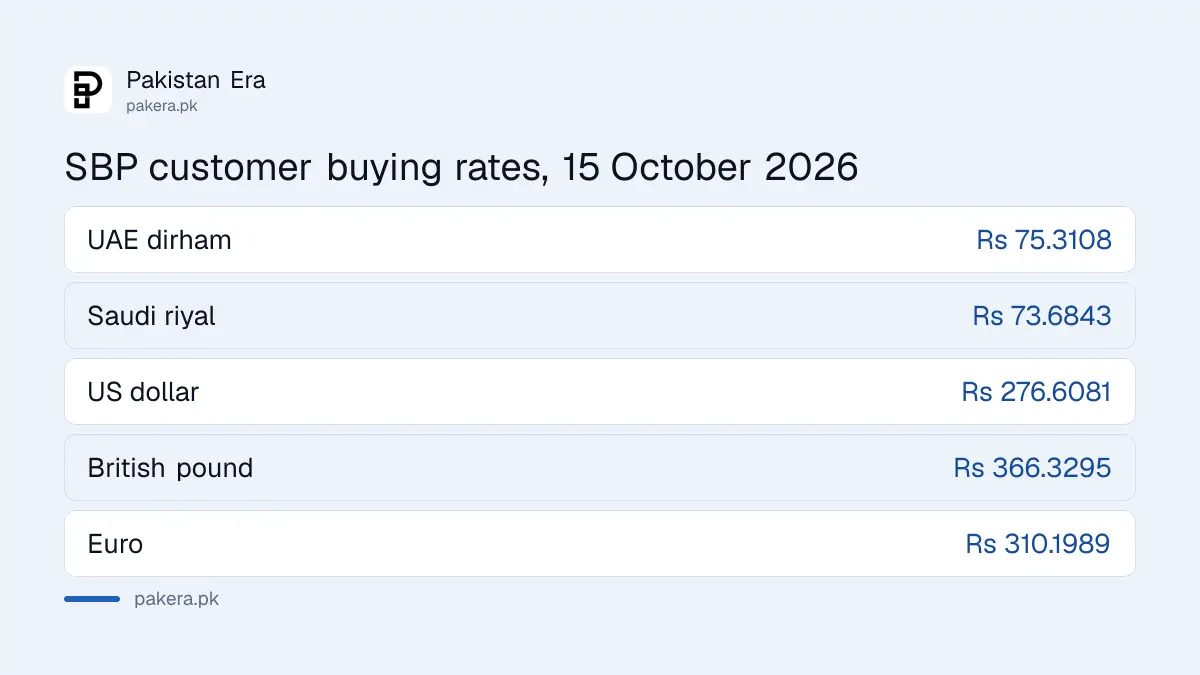
| Currency | Buying (Rs) | Selling (Rs) | Gap (Rs) |
|---|---|---|---|
| UAE dirham (AED) | 75.3108 | 75.4244 | 0.1136 |
| Saudi riyal (SAR) | 73.6843 | 73.8013 | 0.1170 |
| US dollar (USD) | 276.6081 | 277.0649 | 0.4568 |
| British pound (GBP) | 366.3295 | 366.9412 | 0.6117 |
| Euro (EUR) | 310.1989 | 310.7098 | 0.5109 |
The gap column is our arithmetic. It shows how far apart the buying and selling averages sit. The table also lists the Australian, Canadian and Swiss currencies, the Chinese yuan and the yen. Compare these with the daily rates in our dollar rate report.
The buying column is the one that matters when you receive money
The table does not define the two columns, so this is our reading. Buying is what a bank pays when it buys foreign currency from you. Selling is what it charges when you buy foreign currency. If you are receiving a dirham or riyal remittance, the buying side is the fair one to compare.
If the rate you are offered is below the buying average, you are being paid less than the average bank quote. That can be normal for a small difference or a particular channel. It is your cue to ask. Use the steps below.
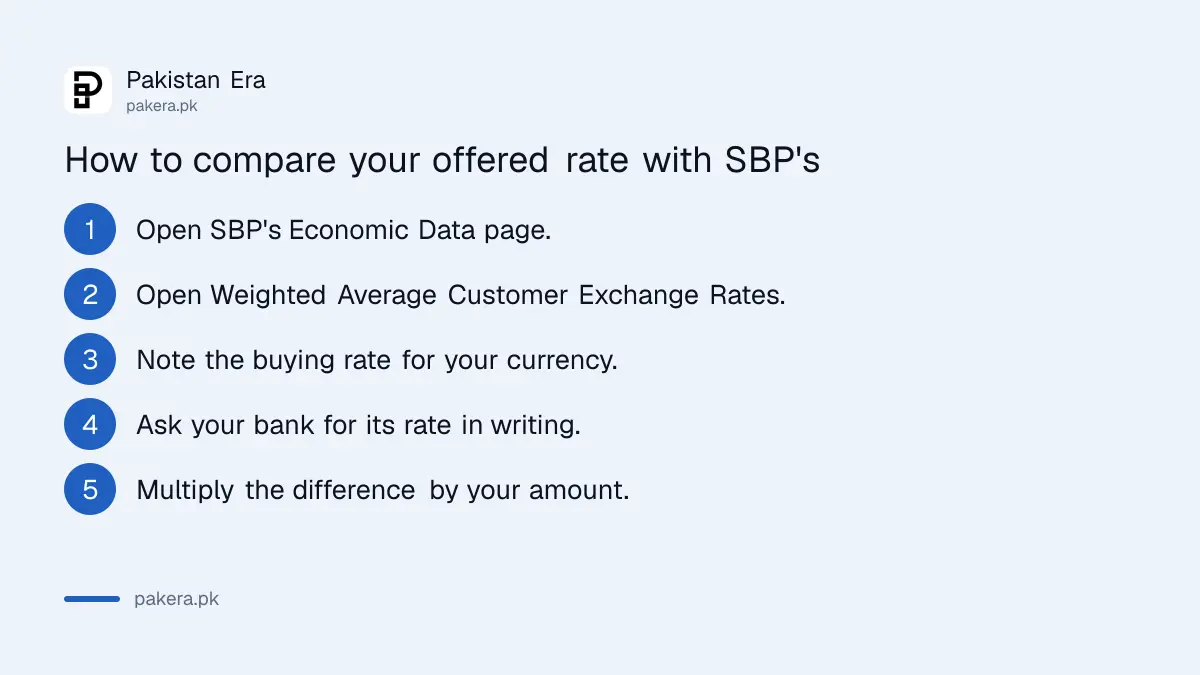
- Open SBP's Economic Data page and find "Weighted Average Customer Exchange Rates".
- Open the PDF for the latest date and find your currency.
- Note the buying rate.
- Ask your bank or exchange company for its rate, in writing or on the receipt.
- Multiply the difference by your amount to see the rupee loss.
A shortfall of Rs 0.81 a dirham costs Rs 1,621.60 on AED 2,000
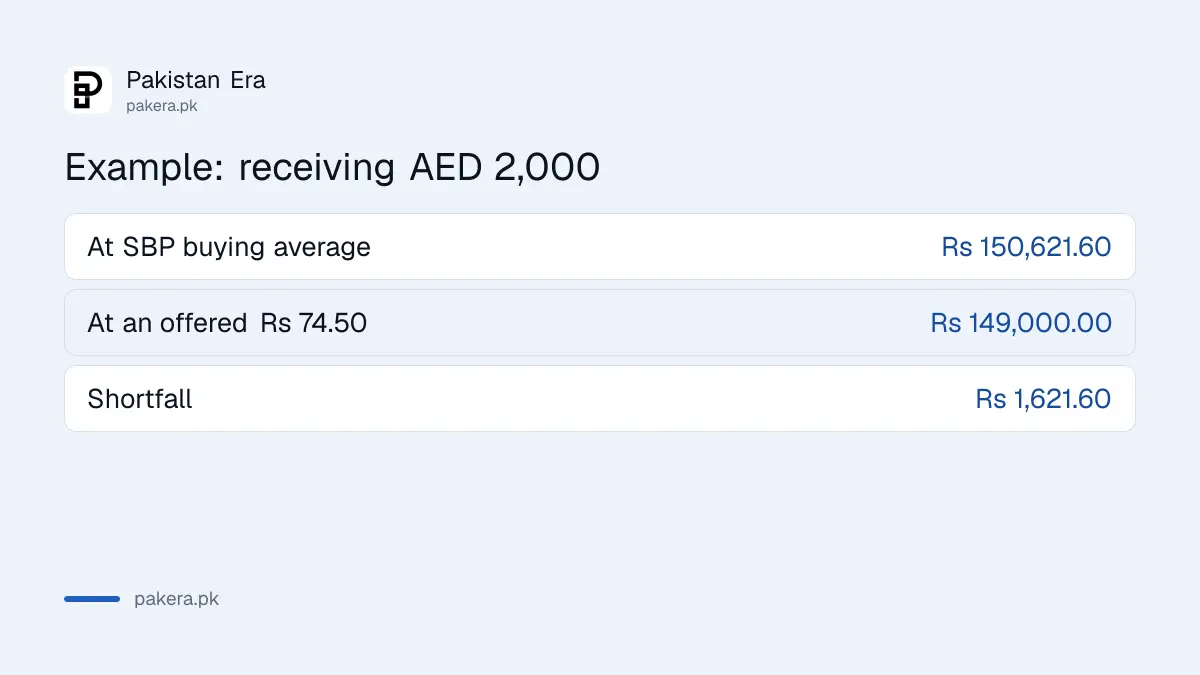
Here is an example, not a real quote. Say you are offered Rs 74.50 for each dirham and you are receiving AED 2,000. At the SBP buying average of 75.3108, you would get Rs 150,621.60. At Rs 74.50 you get Rs 149,000. The difference is Rs 1,621.60.
| Example: receiving AED 2,000 | Rupees |
|---|---|
| At the SBP buying average, Rs 75.3108 | Rs 150,621.60 |
| At an offered rate of Rs 74.50 | Rs 149,000.00 |
| Difference | Rs 1,621.60 |
The same sum works for a riyal or a dollar. For SAR 3,000 at the buying average of 73.6843, you would get Rs 221,052.90. Always do the sum in rupees, because a rate that looks close can hide a large amount. Fees are separate and can matter too.
Where this table helps and where it does not
Before you hand over a transfer slip or accept a payout, ask for three things: the rate per unit, any fee in rupees, and the total you will receive. Write them down or keep the receipt. A rate that looks fair can be undone by a flat fee, and a low fee can hide a poor rate. Only the total in rupees lets you compare two offers on the same day.
The table is an average of bank rate sheets. A single bank may quote above or below it. Exchange companies and mobile wallets set their own rates and may not appear in it. Use it as a reference line, not as a promise.
Before you sell dollars in cash, check that the exchange company is authorised by SBP.
Common questions about SBP customer exchange rates
What is the dirham rate in Pakistan today?
SBP's weighted average customer table for 15 October 2026 shows Rs 75.3108 buying and Rs 75.4244 selling for the UAE dirham.
What is the riyal rate in Pakistan today?
On the same table the Saudi riyal is Rs 73.6843 buying and Rs 73.8013 selling.
What does weighted average customer exchange rate mean?
SBP describes it as an estimate of the rates commercial banks quote to clients, compiled from their daily sheets, and issued for information only.
Is the SBP table the rate I will get?
Not necessarily. It is an average. Your bank or exchange company sets its own rate and may add fees.
Which column should I compare when I receive money from abroad?
Use the buying column, our reading of the rate a bank pays for foreign currency. The table itself does not define the columns.
How often does SBP update it?
Daily. SBP's Economic Data page lists the table as daily, and the file we opened was dated 15 October 2026.
How we verified this
What we checked, where we read it, and what we could not confirm.
Last checked 15 October 2026. All rates and SBP's description of the data come from the file "weighted-average-customer-exchange-rates-15-October-2026.pdf", listed under Exchange Rates on SBP's Economic Data page, which we opened on 15 October 2026. The gap column, the examples and our reading of the buying and selling columns are our own. The AED 2,000 and offered rate of Rs 74.50 are made-up figures to show the sum, not a quote from any bank.
About the author

Global Affairs & Political Economy Writer
Muhammad Hatim is a book lover who started writing because he enjoys it. At Pakistan Era he writes about international relations, geopolitics and the global economy, with a particular interest in South Asia and the forces behind current events.