How to Check Mandi Rates in Punjab on AMIS Before You Sell
Check wholesale crop prices from 135 Punjab markets free on amis.pk. Learn to read Rs per 100 kg, turn it into a maund rate and use the history before you sell.
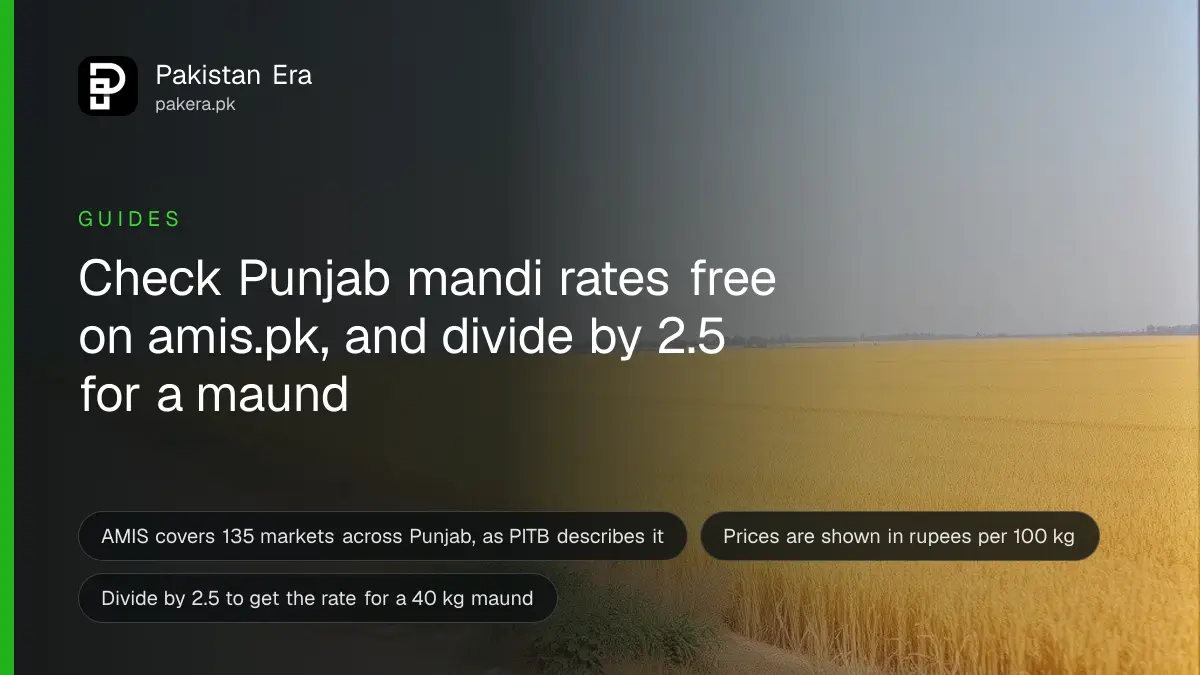
Open amis.pk, the Punjab government's Agriculture Marketing Information Service, to see wholesale crop and vegetable prices from Punjab markets before you sell. Prices are shown in rupees per 100 kg, not per maund. Divide by 2.5 to get the rate for one 40 kg maund.
We opened the AMIS home page on 8 October 2026 and read the service description published by the Punjab Information Technology Board (PITB), which runs it. The page loads in English and Urdu, and you do not need to log in to read prices.
Open amis.pk and pick your city's market
Go to amis.pk in any phone or computer browser. The home page lists the latest average wholesale prices, market by market, starting with Lahore, Faisalabad and Gujranwala, and then dozens of other cities and towns across Punjab.
PITB describes the service as covering 135 markets in Punjab. On the day we looked, the home page showed fruit, pulses, rice, vegetables and field crops. Faisalabad's list included wheat, maize, mustard seed and rapeseed (torya), which are the crops most farmers ask about in October.
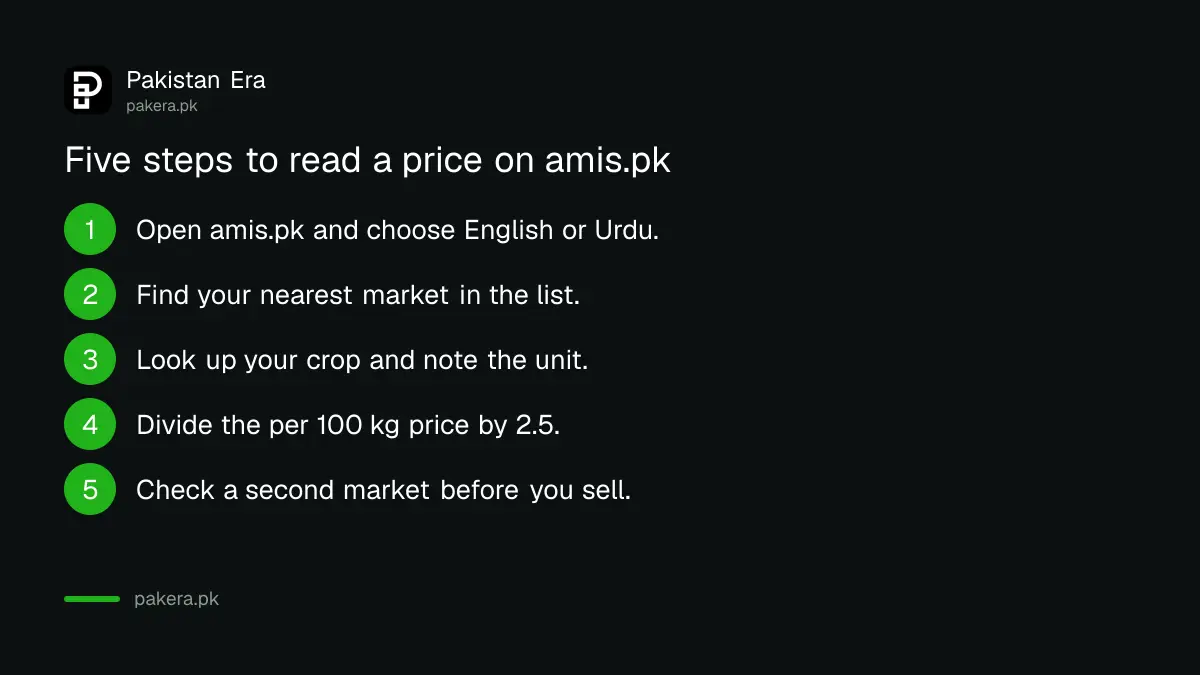
- Open amis.pk and choose English or Urdu at the top.
- Find your nearest market in the list. If your town is not there, use the nearest big city.
- Look for your crop in that market's list.
- Note the price and the unit shown beside it.
- Check a second market before you decide where to sell.
Read the unit before you read the price
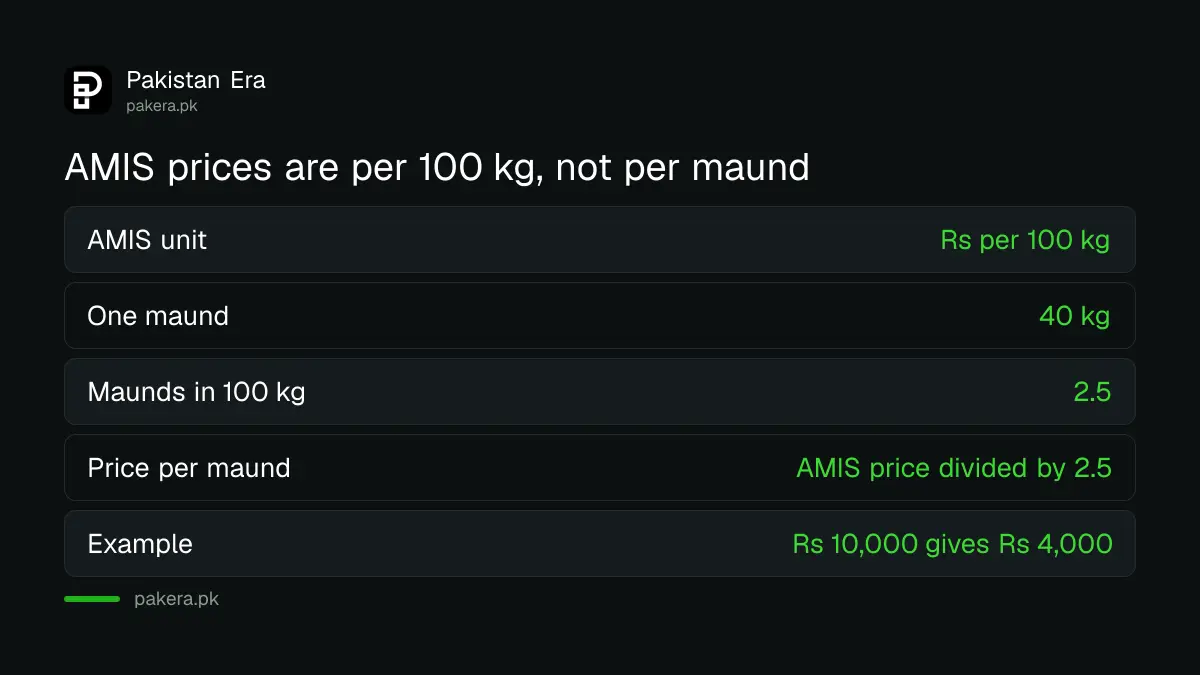
The home page heading says prices are average wholesale prices in "Rs/100Kg". Most farmers quote a price per maund of 40 kg. A price per 100 kg looks 2.5 times bigger, and that mistake makes people think they are being underpaid, or overpaid.
Use this simple rule. Divide the AMIS price by 2.5 to get the price per maund. The example below uses made up numbers to show the method, not today's prices.
| AMIS price (per 100 kg) | Per 40 kg maund |
|---|---|
| Rs 8,000 | Rs 3,200 |
| Rs 10,000 | Rs 4,000 |
| Rs 12,500 | Rs 5,000 |
A few items on the page use another unit, such as bananas per dozen or grapefruit per 100 pieces. The unit is written next to the name, so read it each time.
Use the other sections to judge the trend
The menu has more than the home page list. The links we saw lead to daily market changes, historical prices, arrival reports, support prices, forecasts and international commodity prices. A single day's price tells you little, so look at the movement.
PITB says the service also shows international prices for wheat, maize, rice, sugar and cotton, converted into rupees. Use the historical price section to see whether this week is high or low for the same month last year.
For wheat, the government support price is the floor to compare with. Our guide to the 2026 to 27 wheat support price explains what it is and what it is not.
Remember what an average price does not tell you
An AMIS price is an average wholesale price for a market. Your own rate depends on the crop quality, moisture, bag size, the buyer, and when and where you deliver. The price you get can be lower or higher, so treat AMIS as a guide for bargaining.
Three habits help:
- Check the price on the morning you sell and again the day before.
- Compare two markets, not one. Transport costs may cancel a better price.
- Ask your buyer to write the rate and the weight before loading.
We could not see on the home page the exact time of day prices are updated, so we cannot say how fresh a figure is. If a price looks old or wrong, call the market committee office before you rely on it.
Plan your sowing and inputs with the same data
AMIS prices are for selling, but the same page helps you plan what to grow. If oilseeds or pulses are paying well compared with wheat, that can guide your rabi choices, although cost and water matter more.
Read our guide to the 2026 to 27 Rabi committee decisions on urea, DAP and water for inputs, and the guide to wheat sowing and the Punjab seed subsidy for the wheat season. If you plan oilseeds, our guide to canola and mustard sowing dates in Punjab covers the varieties.
Common questions about AMIS mandi prices
Is AMIS free to use?
Yes. We read the home page without logging in. A login and register link exists on the page, but price lists were visible to us without one.
Does AMIS cover Sindh, KP or Balochistan?
No. The service is for Punjab and its description says markets across the province of Punjab. Other provinces have their own market offices, and we did not verify an equal online service for them.
Is the AMIS price the price I will get?
Not exactly. It is an average wholesale price. Quality, quantity, distance and the buyer change what you receive.
Why does the price look so high?
Most likely the unit. AMIS shows Rs per 100 kg. Divide by 2.5 for a 40 kg maund.
Can I see old prices?
The menu has a historical prices link. We saw the link but did not test every chart, so check that section for the crop and years you need.
How we verified this
What we checked, where we read it, and what we could not confirm.
Last checked 8 October 2026. We read the AMIS home page at amis.pk, including its price heading, market list and menu links, and the PITB description of the service, which gives the 135 market figure and the international prices for five commodities. We did not read price figures into this article because the page shows no date next to them. The example conversion numbers are made up on purpose. We did not test the Urdu pages, the historical section or any mobile app.
About the author

Public Services and Education Journalist
Fajr Riaz is a journalist and content writer at Pakistan Era, based in Lahore. She covers the questions people meet in everyday life in Pakistan: how a public service works, what a change in the rules means, and where to find a reliable answer.