Check Pakistan's Crop Output: Wheat 29.61 Million Tonnes, Sugarcane 89.45 Million in 2025-26
Pakistan grew 29.61 million tonnes of wheat in 2025-26, up 4.3 percent. See sugarcane, rice, maize and cotton output in the Economic Survey and how to check it.
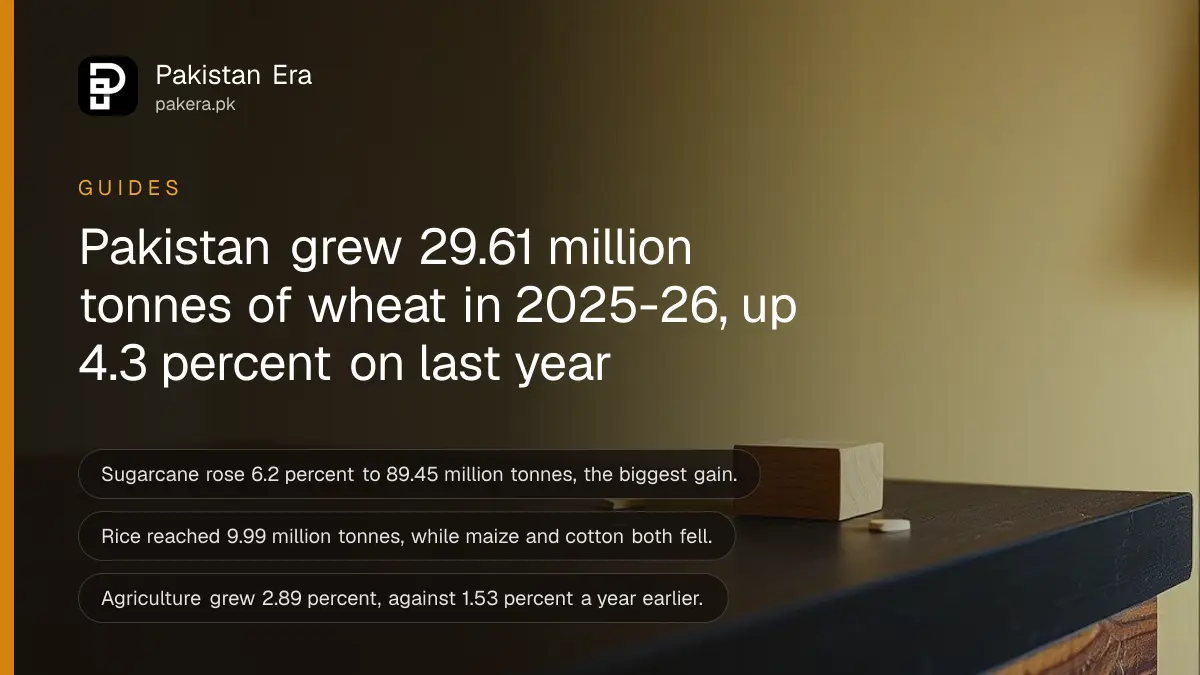
Short answer: Pakistan grew 29.61 million tonnes of wheat in 2025-26, up 4.3 percent. Sugarcane reached 89.45 million tonnes, rice 9.99 million tonnes and cotton 7.05 million bales. Maize and cotton fell. The Finance Division's Economic Survey puts farm growth at 2.89 percent.
Wheat is in the news every week. The price of a maund, the price of a bag of flour, the support price. Behind all of it sits one number, how much wheat the country actually grew last season. The government has now put that number, and the other main crops, in one official table.
We opened Chapter 2 on Agriculture of the Finance Division's Pakistan Economic Survey 2025-26 on 14 October 2026. The crop numbers are provisional figures from the Pakistan Bureau of Statistics. Ratios we worked out are marked "our sum".
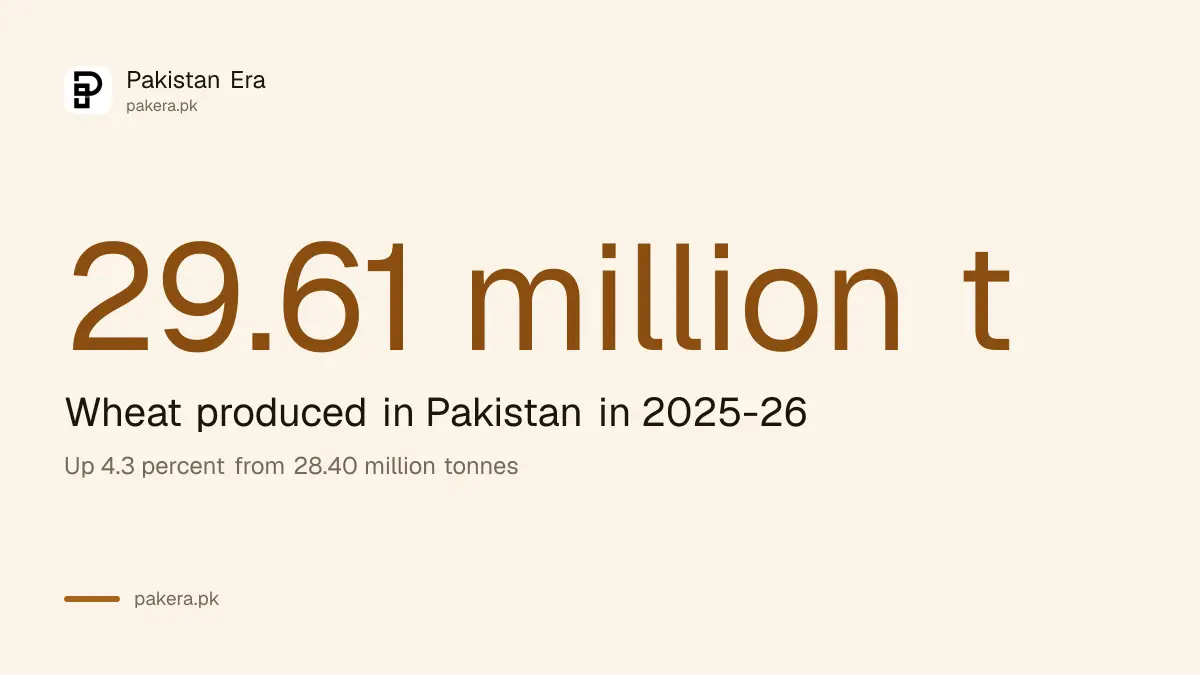
Wheat output rose 4.3 percent to 29.61 million tonnes
Wheat was sown on 9.48 million hectares in 2025-26, up 4.4 percent from 9.07 million. Production rose 4.3 percent to 29.61 million tonnes, from 28.40 million. The target was 29.7 million tonnes, so the crop came in just under it.
The Survey credits an expanded sown area, certified seed, fertiliser, irrigation water and an Interim Wheat Policy for 2025-26. It also says moisture left by the 2025 floods helped yields in some areas. Output per hectare was about 3,123 kg (our sum). Wheat is 7.7 percent of farm value added and 1.8 percent of GDP.
The new season is a separate story. Read the proposed 33 million tonne wheat target for Rabi 2026-27 for the plan, and this month's wheat price for what a maund costs now.
Sugarcane, rice, cotton and maize moved in different directions
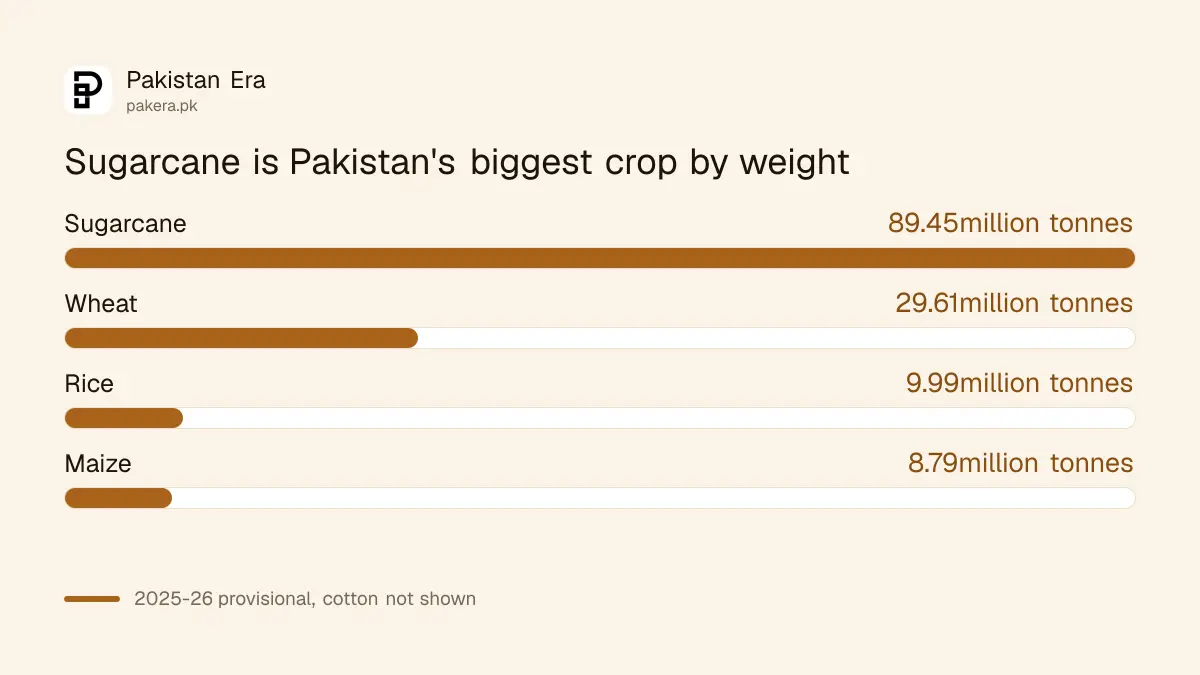
Sugarcane grew most, up 6.2 percent to 89.45 million tonnes, as farmers expected better returns than from cotton or maize. Rice rose 2.8 percent to 9.99 million tonnes. Maize fell 2.7 percent to 8.79 million tonnes, and cotton fell 0.5 percent to 7.05 million bales.
| Crop | 2024-25 | 2025-26 (provisional) | Change |
|---|---|---|---|
| Wheat (million tonnes) | 28.40 | 29.61 | +4.3% |
| Sugarcane (million tonnes) | 84.24 | 89.45 | +6.2% |
| Rice (million tonnes) | 9.72 | 9.99 | +2.8% |
| Maize (million tonnes) | 9.04 | 8.79 | -2.7% |
| Cotton (million bales) | 7.08 | 7.05 | -0.5% |
Rice is a good example of yield doing the work. Its area fell 3.6 percent, yet production rose because yield per hectare rose 6.6 percent. Cotton area fell 1.5 percent to 2.01 million hectares. Sugarcane area rose 2.4 percent to 1.22 million hectares.
A bigger cane crop is one reason sugar can get cheaper. That link is ours and not the Survey's, since price depends on mills, stocks and trade. See the latest sugar price for what retail sugar costs.
Farm growth doubled to 2.89 percent
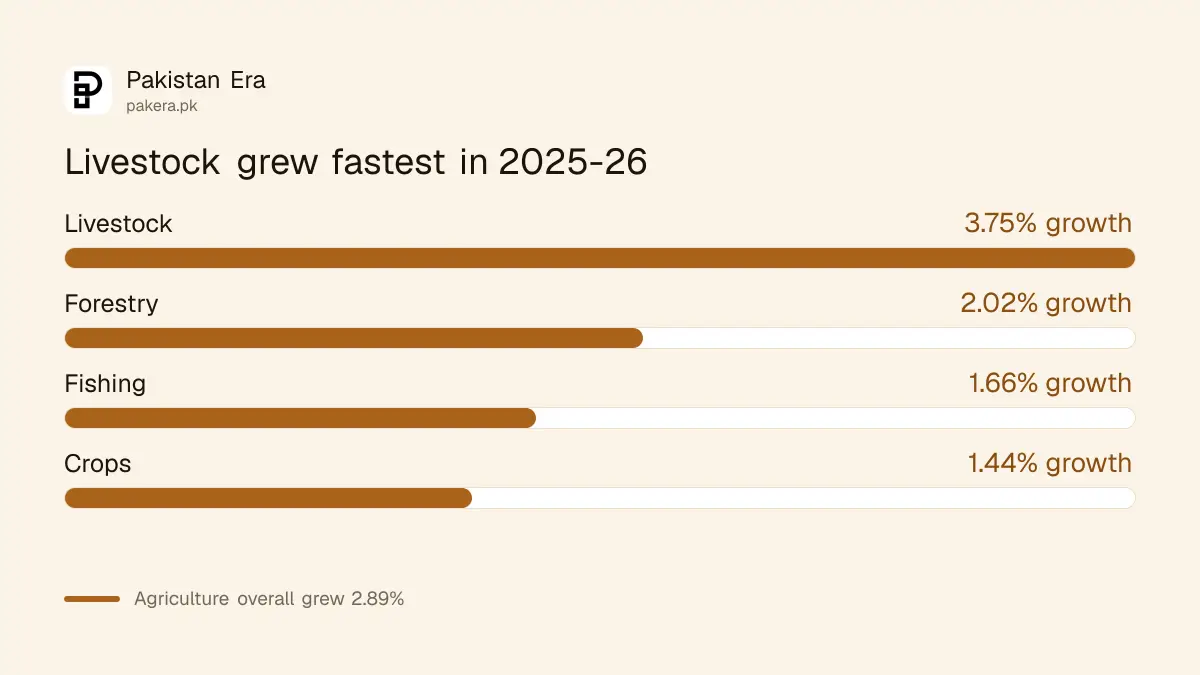
Agriculture grew 2.89 percent in 2025-26, against 1.53 percent a year earlier. Crops grew 1.44 percent after shrinking 1.01 percent. Livestock grew 3.75 percent. Forestry grew 2.02 percent and fishing 1.66 percent. Farming is 23.4 percent of GDP and 33.1 percent of jobs.
The five important crops together grew only 0.65 percent. Gains in sugarcane, wheat and rice cancelled out the falls in cotton and maize. Other crops grew 2.43 percent, helped by pulses, up 31.4 percent, vegetables, up 12.6 percent, and fruit, up 2.8 percent.
Gram rose 50.4 percent, potato 27.6 percent, chillies 23.5 percent and moong 15.2 percent, mainly because more land was sown. Onion fell 2.2 percent, masoor 8.0 percent and jowar 12.3 percent. The Survey adds that kharif crops did better than feared, since flood damage was lower than first expected.
Water was better in Rabi 2025-26 than a year before
The Survey reports 60.6 million acre-feet of water in Kharif 2025, close to Kharif 2024. In Rabi 2025-26 it rose to 31.4 million acre-feet from 29.4 million. An acre-foot is the water needed to cover one acre a foot deep.
Water matters for the next crop. The federal plan for Rabi 2026-27 expects less. See Pakistan's Rabi 2026-27 plan on urea, DAP and water. The Survey figure here covers last season, so do not use it to predict this one.
Check these numbers before you quote them
Provisional crop figures can be revised. You can check them yourself and avoid repeating a stale number. The steps take about fifteen minutes and use only official pages.
- Open the Finance Division's Economic Survey page and select "Survey 2025-26".
- Download Chapter 2, "Agriculture", and find Table 2.1 for growth and the crop figures in section 2.1.
- Note the label "P" for provisional beside the 2025-26 column.
- Compare with the crop reporting figures of your provincial agriculture department for your district.
- Use "about" when you quote a rounded number, and cite the Survey by name.
For farmers who want to act on the numbers, the Punjab Kissan Card is the route to inputs. The Survey says Punjab's card helped fertiliser application and nudged cotton yields up slightly.
Common questions
How much wheat did Pakistan produce in 2025-26?
The Survey gives 29.61 million tonnes, up 4.3 percent from 28.40 million tonnes the year before.
What was the wheat target?
The target was 29.7 million tonnes. Output came close to it but did not reach it.
Which crop grew the most?
Sugarcane, up 6.2 percent to 89.45 million tonnes. Among other crops, gram rose 50.4 percent.
Did cotton production fall?
Yes, slightly: 7.05 million bales against 7.08 million, a fall of 0.5 percent, mainly because less land was sown.
Are these final figures?
No. They are marked provisional and PBS can revise them.
Does the Survey say if food will be cheaper?
No. It reports output, not prices. Prices depend on stocks, trade and policy as well.
How we verified this
What we checked, where we read it, and what we could not confirm.
Last checked on 14 October 2026, Pakistan time. We read Chapter 2, "Agriculture", of the Pakistan Economic Survey 2025-26 on the Finance Division website. Its crop numbers carry the source "Pakistan Bureau of Statistics" and a provisional mark. The Survey gives reasons for each change; we repeat them as the Survey's view and have not checked them against field data. We did not use any other publisher's figures.
About the author

Global Affairs & Political Economy Writer
Muhammad Hatim is a book lover who started writing because he enjoys it. At Pakistan Era he writes about international relations, geopolitics and the global economy, with a particular interest in South Asia and the forces behind current events.