Pakistan Proposes 33 Million Tonne Wheat Target for Rabi 2026-27, Seed Meets 51% of Need
A Federal Committee on Agriculture document proposes 33 million tonnes of wheat for Rabi 2026-27 and puts seed at 51% of need. The target awaits the price.
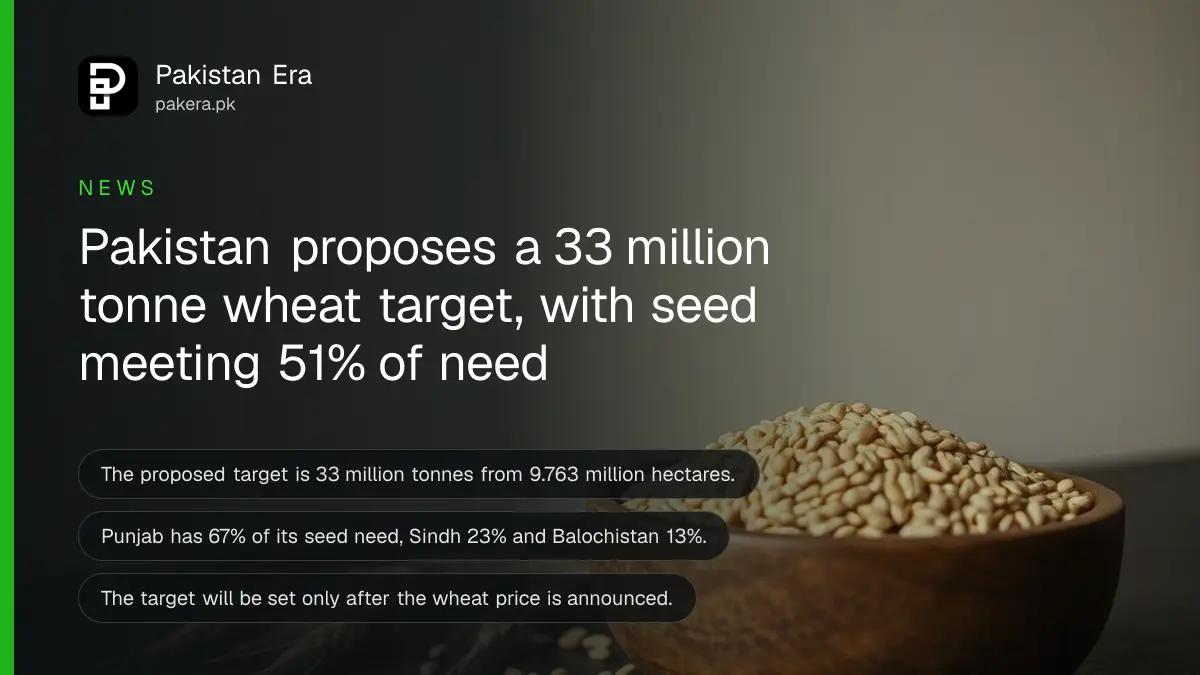
Short answer: Pakistan's proposed wheat target for Rabi 2026-27 is 33 million tonnes from 9.763 million hectares, according to a working document of the Federal Committee on Agriculture. The same document says seed supply of 0.612 million tonnes meets 51% of the 1.192 million tonnes needed. The target is not final.
A wheat farmer in Okara has fewer weeks than he thinks. Sowing starts in late October. The wheat support price, which tells him what the crop will fetch, has still not been announced. And the seed numbers now on the table say only half the national need is in certified or recorded stock.
These figures did not appear in the official press release of the committee's 7 October meeting. They come from a report of the committee's working document, so we mark each as reported. We could not read the document itself.
The proposed wheat target is 33 million tonnes from 9.763 million hectares
The working document proposes 33 million tonnes of wheat from 9.763 million hectares for Rabi 2026-27. The committee did not fix the target. It said targets for wheat and other Rabi crops will be set after the wheat indicative price is announced.
That order matters. A target without a price is a wish. Farmers decide how much land to give wheat after they see the price, and the committee appears to have accepted that. On our arithmetic the proposal implies about 3.4 tonnes a hectare, or about 1.4 tonnes an acre.
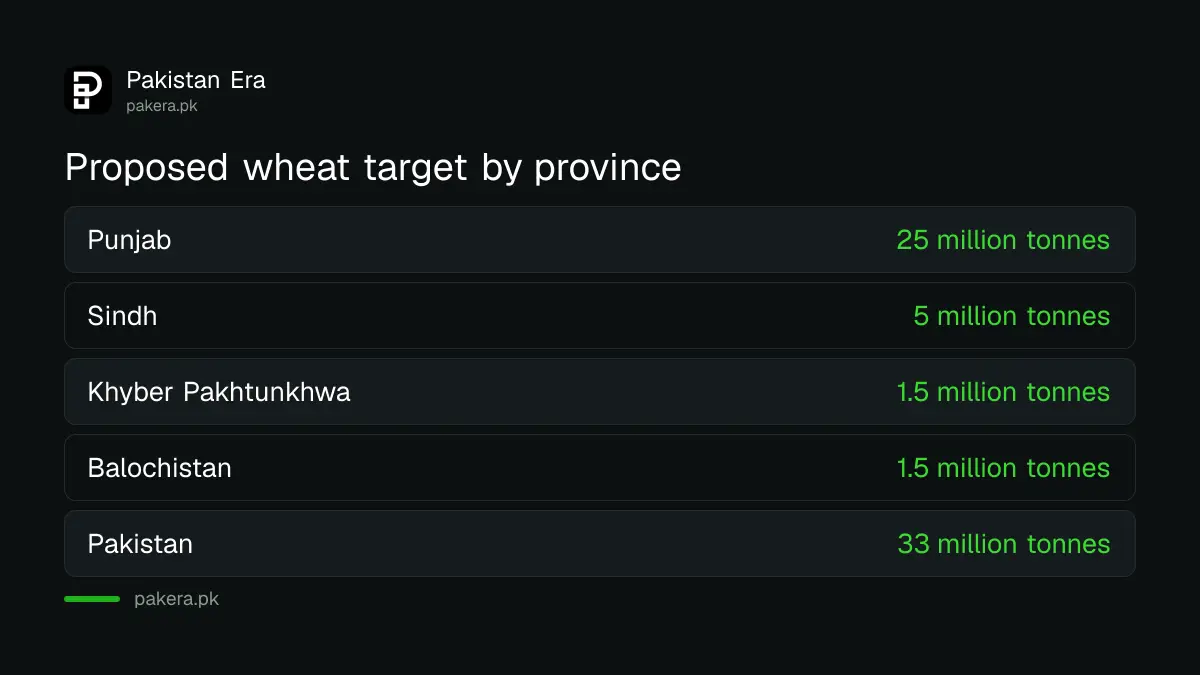
Punjab carries three quarters of the proposal. The document splits it by province as follows.
| Province | Proposed wheat target | Share of 33 million tonnes |
|---|---|---|
| Punjab | 25 million tonnes | About 76% |
| Sindh | 5 million tonnes | About 15% |
| Khyber Pakhtunkhwa | 1.5 million tonnes | About 5% |
| Balochistan | 1.5 million tonnes | About 5% |
Seed supply meets 51% of the national requirement
The document puts total seed availability at 0.611793 million tonnes against a requirement of 1.191555 million tonnes. That covers 51% of the need. The figure for last year's Rabi season was 0.574330 million tonnes, also 51%.
The provincial split is wide. Punjab has 0.553 million tonnes, or 67% of its requirement. Sindh has 0.041 million tonnes, or 23%. Balochistan has 0.010 million tonnes, or 13%. For Khyber Pakhtunkhwa the document gives 0.007 million tonnes and, in the report we saw, no percentage.
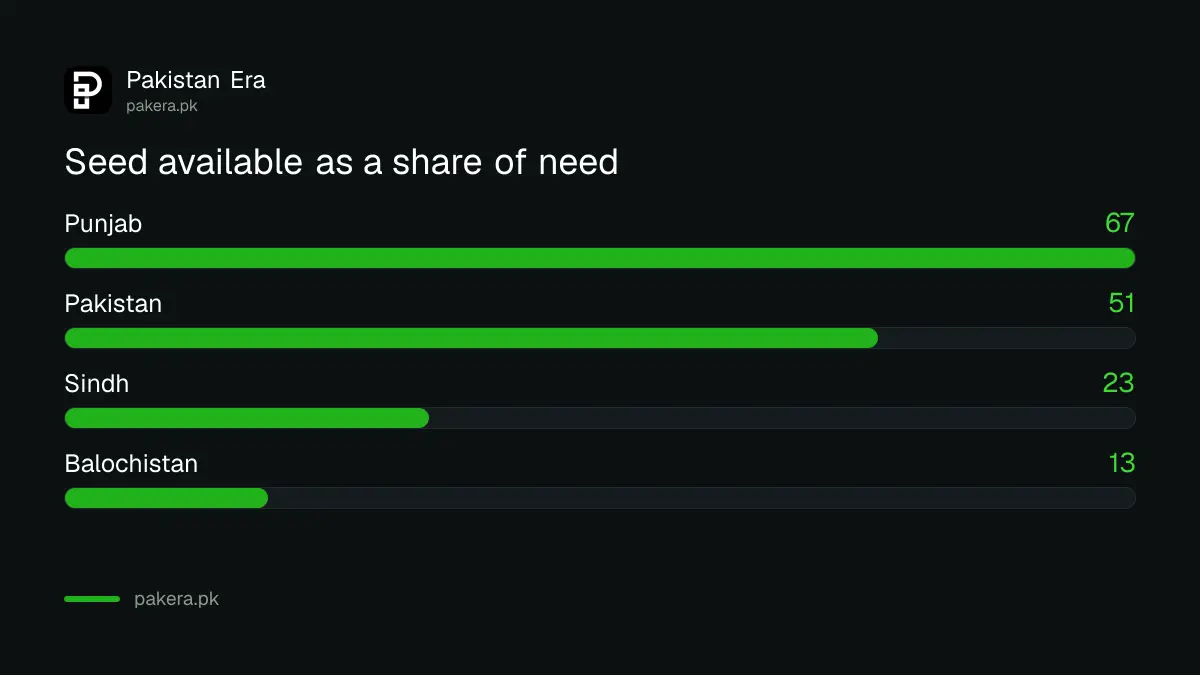
Do not read 51% as a shortage of 49%. The document does not say how the rest is met. Many farmers sow seed they saved from their own last harvest, and this number does not count it. What it does show is how much seed comes through the formal, registered channel, and that Sindh and Balochistan rely on it far less.
The seed rate in the document matches normal sowing practice
Divide the seed requirement by the target area and you get about 122 kg a hectare, or about 49 kg an acre. That sits inside the 40 to 50 kg an acre range in the Punjab wheat sowing plan. So the requirement looks built on a normal seed rate and is not inflated.
For sowing dates and varieties in Punjab, see our report on wheat sowing in Punjab in 2026. If you buy seed, buy it from a registered dealer and keep the bag tag and receipt. Our note on Kisan Card registered dealers in Punjab shows who sells under the card.
- Ask for the variety name, lot number and the date on the bag.
- Check that the bag is sealed and carries a tag.
- Take a receipt with the dealer's name.
- Keep one handful from the bag until the crop germinates.
The price that sets the target is still not announced
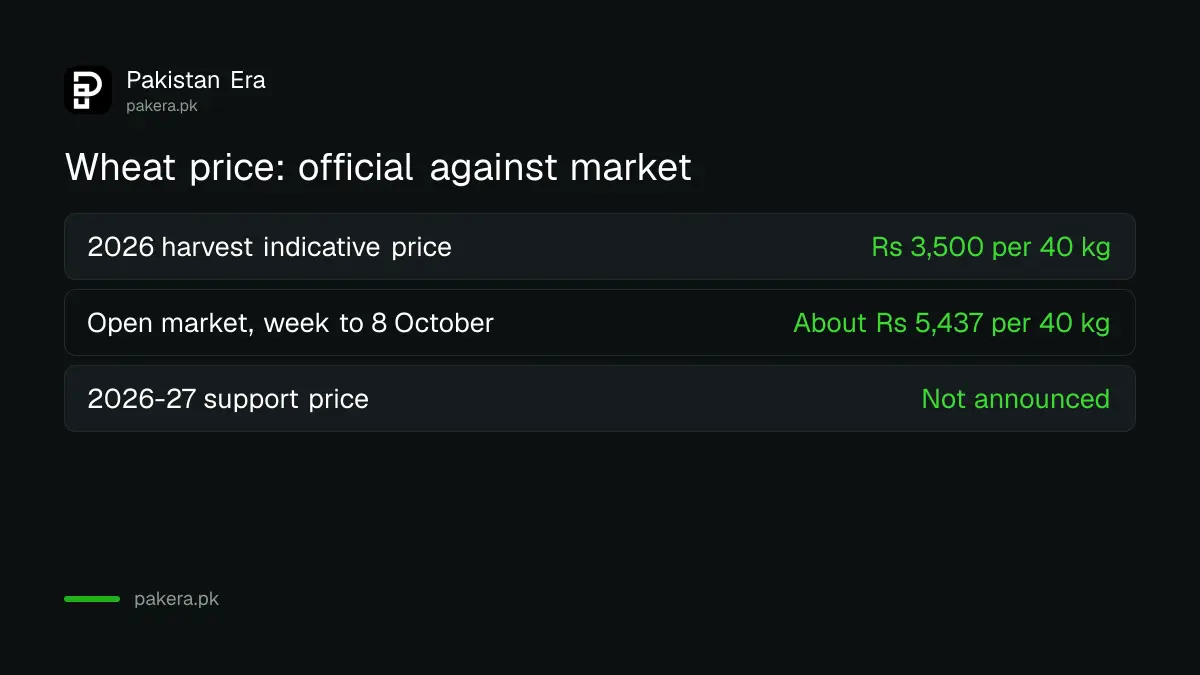
The minister told the committee the government is working on an "appropriate wheat illustrative price", as the official release said. No figure was given. The last indicative price, for the 2026 harvest, was Rs 3,500 per 40 kg, as our report on the wheat support price for 2026-27 records.
Open-market wheat is far above that. The Pakistan Bureau of Statistics put grain at about Rs 5,437 a maund in the week ended 8 October, which our wheat price report sets out city by city. The gap between last season's official figure and today's market is the reason the target waits.
Water is the other limit. The advisory committee of the Indus River System Authority expects a 22% shortage for Punjab and Sindh this Rabi, as covered in the Rabi 2026-27 plan report. The Met Office expects mostly above normal rain in October and November.
What farmers can do before the price is announced
Book seed and fertiliser now, from a registered dealer, and keep receipts. Do not leave seed buying to the last week, when stock moves fast. Prepare the land and plan your water turns while you wait for the price.
Nothing in the document changes a subsidy or a sowing date. Sindh's own wheat subsidy for farmers with up to 25 acres is covered in our Sindh wheat growers subsidy report.
Common questions
What is the wheat production target for Rabi 2026-27?
The proposed target is 33 million tonnes from 9.763 million hectares. It is not final, and the committee said it will be set after the indicative price is announced.
How much wheat seed is available in Pakistan?
0.611793 million tonnes, which meets 51% of the 1.191555 million tonnes required, according to the document as reported.
Which province has the least wheat seed?
Balochistan, with 13% of its requirement, then Sindh with 23%. Punjab has 67%.
Has the wheat support price been announced?
No. The government has spoken of an illustrative price but has given no figure so far.
Does 51% mean there is a seed shortage?
Not by itself. The document does not say how the rest is met, and farmers who save their own seed are not counted. It does show the formal supply is limited in Sindh and Balochistan.
How we verified this
What we checked, where we read it, and what we could not confirm.
We read the Press Information Department release of 7 October 2026 on the committee meeting and a report of the committee's working document on 12 October 2026. The target and seed figures are from the report and not from the release. Check the Ministry of National Food Security and Research at mnfsr.gov.pk for the final targets.
About the author

Tax, Bills and Technology Writer
Ali Akhtar is a young and curious voice here at Pakistan Era. He is currently pursuing his A-Levels and has a growing interest in Pakistan’s changing industrial landscape and educational trends. Ali likes to write in a way that helps him explain and explore the world around him. His writing reflects the perspective of the new generation navigating the evolving trends of Pakistan where technology, youth innovation, and shifting opportunities are reshaping the country’s future.