Check Housing, Health and Allowance Rights for Disabled People in Sindh Under the 2018 Act
The Sindh Disability Act 2018 lists a 5 percent housing quota at 50 percent concession, free aids and allowances. See which are rights and which await a scheme.
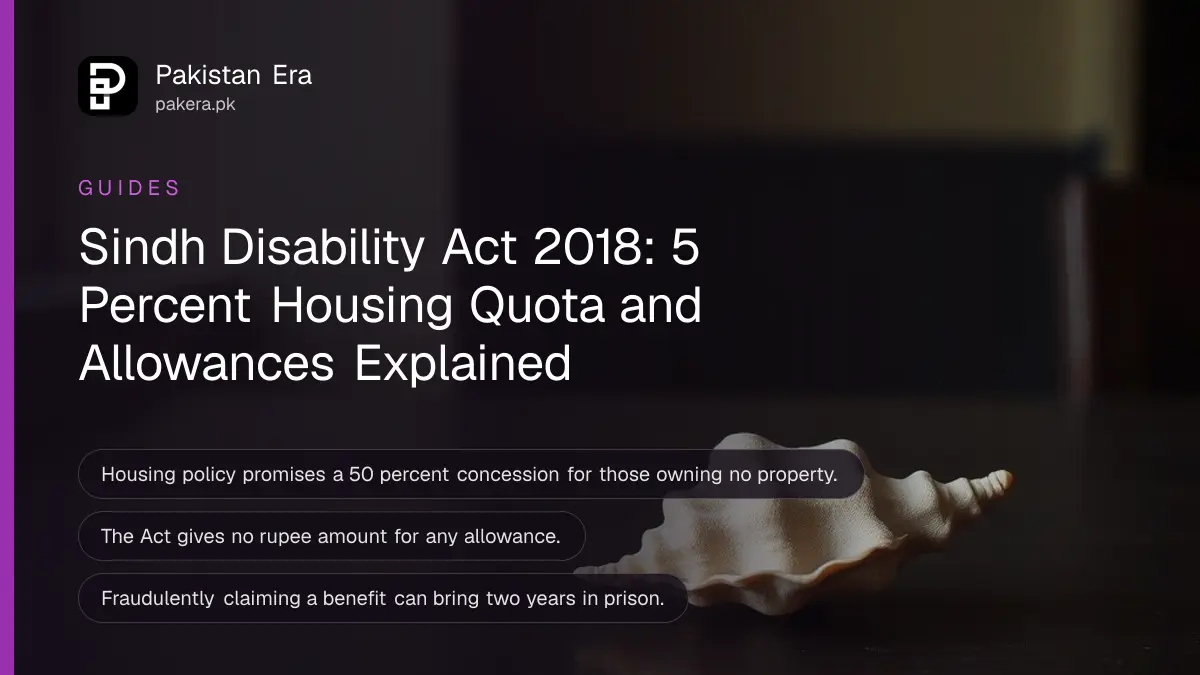
The Sindh Empowerment of Persons with Disabilities Act 2018 promises a 5 percent housing quota with a 50 percent concession for disabled people who own no property, free aids and medicines up to a notified income limit, and disability, unemployment and caregiver allowances. Most of these depend on policies the Government must still frame.
Families in Sindh ask what a disability certificate actually gets them. The honest answer is that the Act lists strong rights, but several need a notified scheme before you can claim them. We read the Act in full on 21 October 2026. This guide separates what is a right now from what is a promise. Start with the Sindh disability assessment certificate, which every claim needs.
Housing: a 5 percent quota with a 50 percent concession on easy instalments
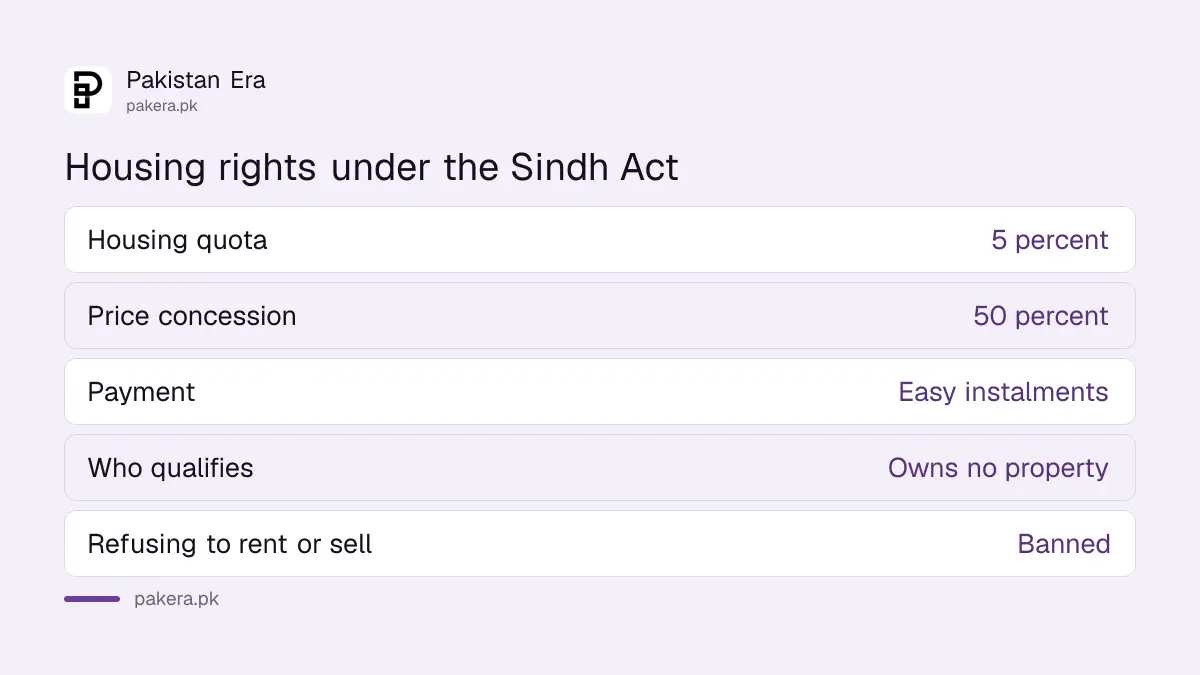
Section 14(2) says the Government shall evolve a policy of a 5 percent quota with a 50 percent concession on the total cost, payable in easy instalments, for persons with disabilities who own no property. It covers government, sponsored and private housing schemes.
Section 14(1) also bans refusing to rent or sell a home to someone because of a disability. Approving authorities must make sure new schemes include affordable units for them. The Government must also run hostels for those with no place to live. The quota policy itself is a duty, not a ready scheme, so ask the housing authority for its current notification.
Health: aids, medicines and surgery free up to an income limit
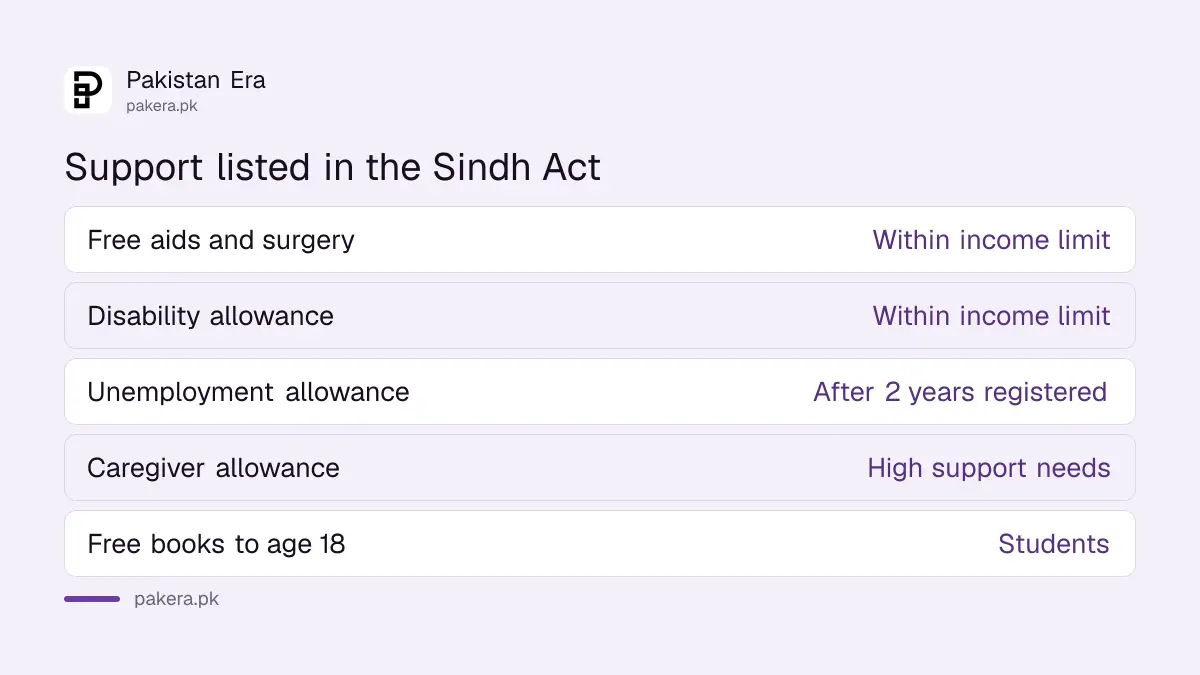
Section 10 says the Government shall provide aids and appliances, medicines, diagnostics and corrective surgery with follow up free of cost to persons with disabilities, within an income ceiling to be notified. Public health services must be barrier free and without charge to them.
Section 13(5) adds assistive technology at a subsidised rate and mobility training. The Government must also try to offer group medical and accident insurance under section 32. We could not find the income ceiling, so confirm it at the district health office before you apply.
Allowances: disability, unemployment and caregiver support are listed
Section 12(3) lists a disability allowance within a notified income ceiling, an unemployment allowance for people registered with the Special Employment Exchange for over two years and not placed, and a caregiver allowance for people with high support needs. It also lists shelter and support in disasters.
| Support | Condition in the Act | Section |
|---|---|---|
| Housing quota | 5 percent, 50 percent concession, owns no property | 14(2) |
| Free aids, medicine, surgery | Within a notified income ceiling | 10(2) |
| Disability allowance | Within a notified income ceiling | 12(3)(e) |
| Unemployment allowance | Registered over 2 years, not placed | 12(3)(f) |
| Caregiver allowance | For high support needs | 12(3)(g) |
| Free books and devices to age 18 | Students with disabilities | 9(2)(f) |
The Act gives no rupee amounts for any allowance. Do not rely on a figure you see on social media. For cash schemes that do exist, see the Punjab Himmat Card and the KP Ehsaas Umeed Card, which are in other provinces.
Education: free books and devices to age 18 and extra time in exams
Section 9 requires free books, learning materials and assistive devices for students with disabilities up to age 18, scholarships in suitable cases, and exam changes such as extra time, a scribe, exemption from second and third language courses and age relaxation.
Parents can ask the school or board for these in writing. For an example of an exam board rule on a writer, see our guide to the FBISE writer and extra time rule.
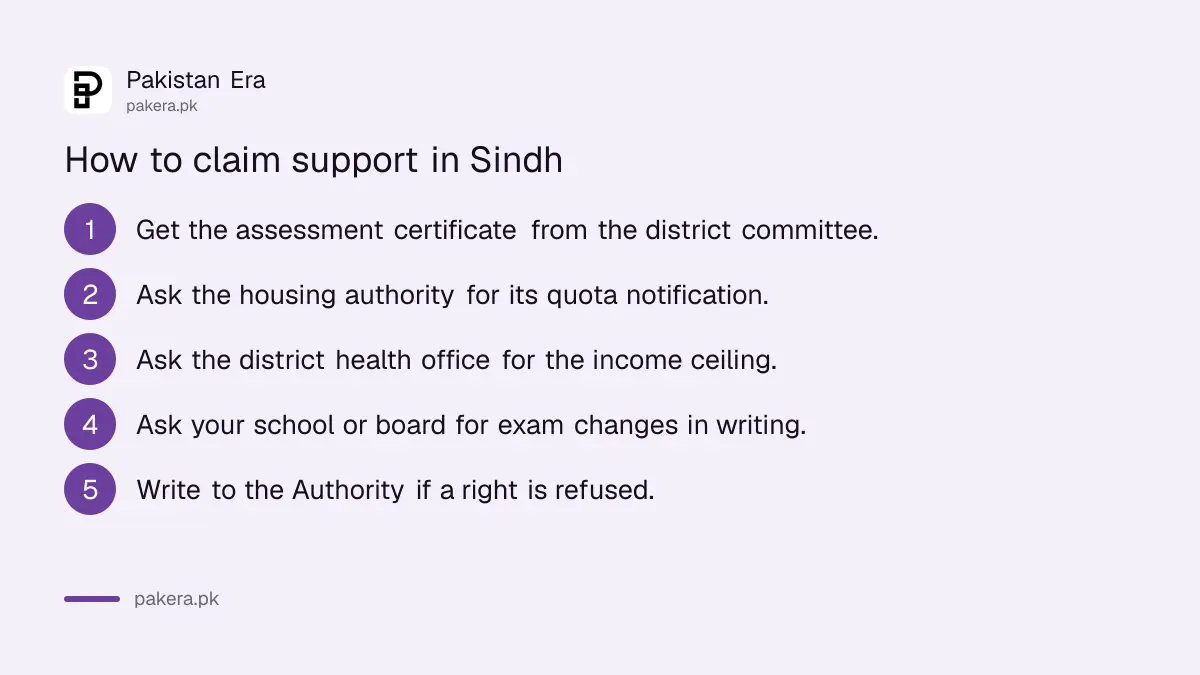
- Get the assessment certificate through the district committee.
- Ask the housing authority for its disability quota notification.
- Ask the district health office for the notified income ceiling.
- Ask your school or board for the exam changes in writing.
- If a right is refused, write to the Authority and keep the reply.
Abuse is punishable with 6 months to 5 years in prison and fraud with up to 2 years
Section 37 punishes insulting, assaulting, starving or exploiting a person with a disability with prison from 6 months to 5 years plus a fine. Section 36 punishes fraudulently claiming a disability benefit with up to 2 years, a fine up to Rs 1 lakh, or both.
A court that receives a complaint of abuse must tell the person of their rights, and the Authority must provide legal aid at public expense. Safe housing for victims is free under the Act. For the certificate itself, see also the disability certificate and special CNIC guide.
Common questions about disability benefits in Sindh
How much is the disability allowance in Sindh?
The Act gives no amount. It says an allowance subject to a notified income ceiling. We could not find a notified figure.
Do I get a house at half price?
The Act promises a policy of a 5 percent quota with a 50 percent concession for those who own no property. We could not confirm that a ready scheme exists.
Can a landlord refuse to rent to me because of my disability?
No. Section 14(1) bans refusing to rent or sell because of a disability.
Who can appeal if the certificate is refused?
Section 25(5) allows an appeal to an appellate authority the Government designates, within the time the rules set.
Is legal aid available for abuse victims?
Yes. The Authority must provide legal aid at public expense, and safe housing is free.
Is this the law for all of Pakistan?
No. It covers Sindh only. Disability is a provincial subject, and each province has its own law.
How we verified this
What we checked, where we read it, and what we could not confirm.
Last checked 21 October 2026. We read the Sindh Empowerment of Persons with Disabilities Act 2018 (Sindh Act XLVIII of 2018) in full, notified by the Provincial Assembly of Sindh on 11 June 2018. The Assembly publishes its Acts at pas.sindh.gov.pk. We could not verify any notified income ceiling, allowance amount, housing quota notification or the Authority's working status, so these are stated as promises in the Act, not as live schemes.
About the author

Tax, Bills and Technology Writer
Ali Akhtar is a young and curious voice here at Pakistan Era. He is currently pursuing his A-Levels and has a growing interest in Pakistan’s changing industrial landscape and educational trends. Ali likes to write in a way that helps him explain and explore the world around him. His writing reflects the perspective of the new generation navigating the evolving trends of Pakistan where technology, youth innovation, and shifting opportunities are reshaping the country’s future.