Claim a Deceased Person's National Savings Certificates in Pakistan
Claim National Savings after the holder dies: a nominee collects up to Rs 100,000 with a NADRA FRC; above that heirs need a succession certificate. Papers here.
When a National Savings investor dies, the money goes to the legal heirs. Under the rules CDNS publishes, a nominee can collect up to Rs 100,000 with a NADRA Family Registration Certificate and an affidavit. Above that, or with no nominee, the heirs need a succession certificate.
We read the Central Directorate of National Savings (CDNS) FAQs, its forms and rule 13 of the Defence Savings Certificates Rules 1966, which sets out "payment procedure in case of death of certificates' purchaser". The same nomination form, SC-3, covers Defence, Special Savings, Regular Income, Behbood and Short Term certificates. So the steps here apply to all five.
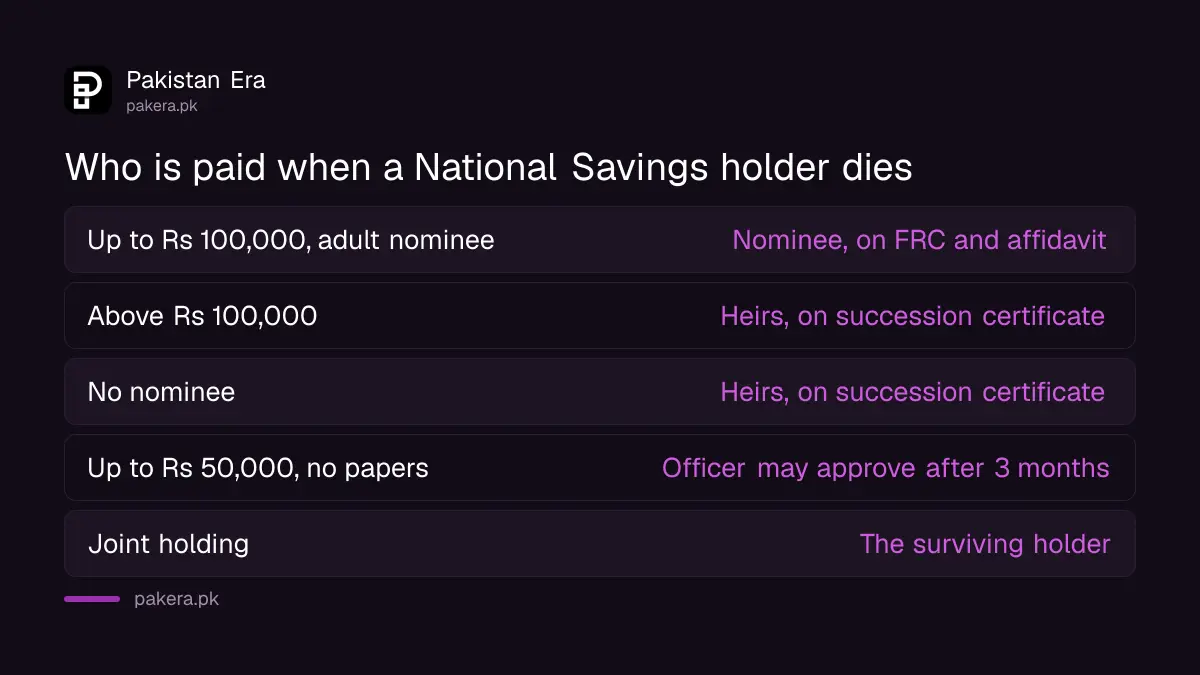
Three routes decide how the heirs are paid
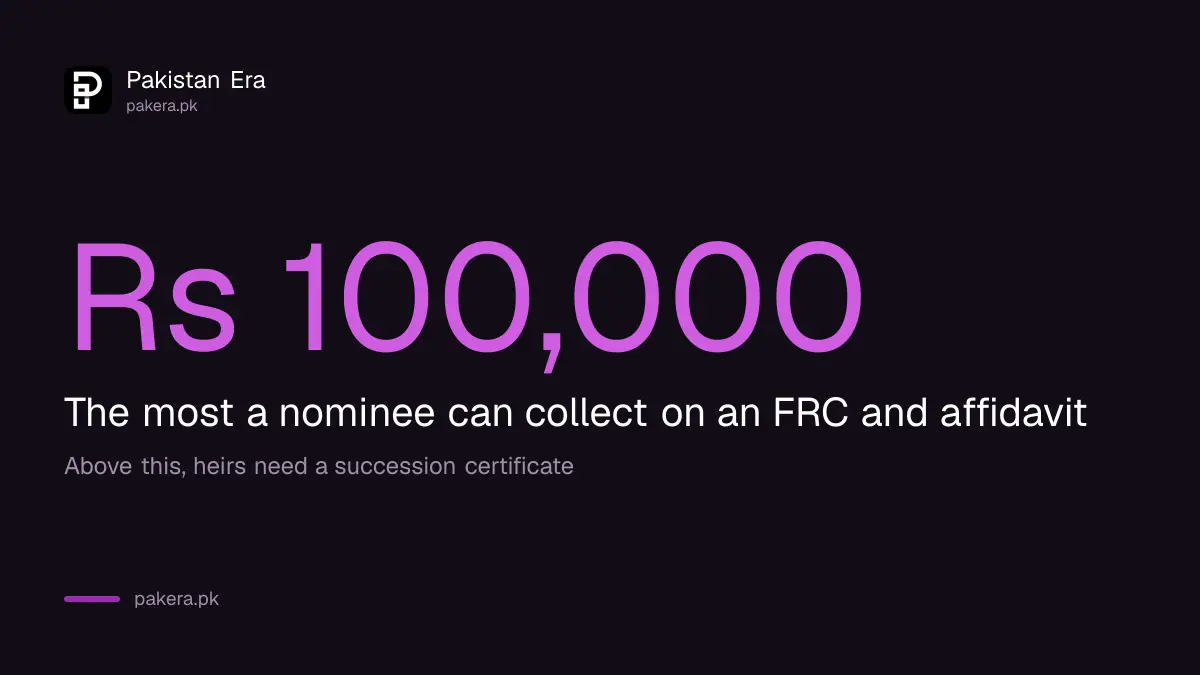
The amount and the nominee decide the route. Up to Rs 100,000 with a valid adult nominee, the nominee is paid on an FRC and affidavit. Above Rs 100,000, with no nominee, or with a minor or an institution as nominee, a succession certificate is needed.
| Situation | Who is paid | Main document |
|---|---|---|
| Net amount up to Rs 100,000, adult nominee named | The nominee, as trustee for all heirs | NADRA Family Registration Certificate and affidavit |
| Net amount above Rs 100,000 | Legal heirs | Succession certificate |
| No nominee, or nominee died first | Legal heirs | Succession certificate |
| Nominee is a minor or an institution | Legal heirs | Succession certificate |
| Up to Rs 50,000 and no succession papers within three months | The person who appears entitled | FRC and affidavit, approved by a CDNS officer |
| Joint certificate, one holder dies | The surviving holder | Death certificate |
The nominee does not own the money. The CDNS FAQ calls the nominee "basically a trustee on behalf of legal heirs". The affidavit binds the nominee to share the money among all the heirs by their due share under the law.
One conflict is worth knowing. The CDNS FAQ lists the papers a nominee should bring without mentioning any amount limit. Rule 13 sets the Rs 100,000 line. We follow the rule, since it is the law, and suggest asking the centre which applies to your case.
Papers the nominee or heirs take to the centre
Take a written application with full details of the investment to the National Savings Centre that issued it. Attach the death certificate, ID of the claimants, three attested specimen signatures and the original certificates or passbook. The centre may also ask for a stamp paper undertaking.
- Death certificate of the investor from the municipal authority or a government department. The union council death certificate is the usual one.
- Proof of address and photo ID of each legal heir, survivor or nominee, as the case may be.
- Three specimen signatures of the claimant, attested by a government gazetted officer with a name stamp.
- The originals: certificates, passbook, withdrawal slip and profit coupon book.
- An undertaking on stamp paper that National Savings will not be a party to any later dispute, if the centre asks for it.
- The FRC and affidavit, for a nominee claim up to Rs 100,000, or the succession certificate above that.

The Family Registration Certificate from NADRA lists the family tree the centre relies on. Get it early, because it also feeds the succession application.
A succession certificate is needed for larger amounts
Rule 13 says payment of a deceased holder's certificates goes to legal heirs "according to succession certificate issued in accordance with the law for the time being in force". That covers every amount above Rs 100,000 and every claim with no valid nominee.
NADRA now issues succession certificates for movable property through its succession facilitation units, so families can apply there instead of going to a civil court. The process, the fee and the time are set out under how to get a succession certificate from NADRA. A court certificate, probate of a will or letters of administration are also accepted under the rule.
Small amounts have a short cut. Where the total is Rs 50,000 or less and no succession papers arrive within three months of the death, a CDNS officer can authorise payment to the person who appears entitled, on an FRC and affidavit. The officer in charge of a centre can approve up to Rs 10,000, an assistant director at the regional directorate up to Rs 25,000, and the controlling officer up to Rs 50,000.
Joint holdings and pensioner accounts follow their own rules
Joint certificates are paid to the survivor when one holder dies, and to the nominee of the last survivor when both have died. A Pensioners' Benefit Account can pass to an eligible family member at the same rate. A non-eligible nominee earns the Savings Account rate for up to three months.
The Pensioners' Benefit Account rule is in the CDNS FAQ. If the nominee is an eligible family member, the account is transferred into their name after the formalities, and keeps the original holder's profit rate, unless a court case or order says otherwise. The Shuhada Family Welfare Account works the same way.
Behbood certificates cannot be transferred during the holder's life, but they still pass to the nominee or heirs on death.
Heirs living abroad can claim through an attorney
A nominee or successor abroad can appoint someone in Pakistan to collect the payment. The power of attorney is completed at a Pakistani embassy or consulate with biometrics. The attorney signs an indemnity bond with a grade 17 officer as surety, attested by a notary and countersigned by a first class magistrate.
The CDNS form "Payment to Investor(s)/Nominee(s) Living Abroad through Attorney" also asks for copies of the CNIC or NICOP and passport, attested by the embassy's first or second secretary. The attorney signs a further undertaking on Rs 100 stamp paper and is paid by crossed government cheque. The general steps for a power of attorney from abroad apply here too.
Change your nominee now to save your family the trouble
You can change or cancel a nomination at any time. Fill in form SC-3 at your centre with an application on stamp paper. A nomination ends on its own if the nominee dies before you, which pushes your heirs onto the succession certificate route.
Rule 13(1) lets the purchaser "change or cancel previous nomination at any time through a notice to the issuing authority". SC-3 lets you name more than one nominee and give each a share of the face value. For a minor's investment, only the father, mother, paternal grandfather or legal guardian can make the nomination, the FAQ says.
Check your nominee after any death, marriage or divorce in the family. It takes one visit.
Common questions
Does the nominee get to keep the National Savings money?
No. The nominee is a trustee and must share the money among all legal heirs by their due shares under the law.
Is a succession certificate always needed?
No. A valid adult nominee can collect up to Rs 100,000 with an FRC and affidavit. Above that, the rule requires a succession certificate.
What if there is no nominee?
The legal heirs claim with a succession certificate. For Rs 50,000 or less, an officer can approve payment on an FRC after three months.
How do I change my nominee for National Savings certificates?
Fill in form SC-3 at your National Savings Centre and attach an application on stamp paper. You can do it at any time.
Is profit paid after the holder's death?
Yes. Rule 13 pays principal and any profit accrued up to the date of payment.
Can a nominee abroad claim without travelling?
Yes. A power of attorney made at a Pakistani embassy or consulate lets someone in Pakistan collect the payment.
How we verified this
What we checked, where we read it, and what we could not confirm.
Last checked at about 2:30 am PKT on 3 October 2026. We read the CDNS FAQs on nomination, nominee claims and the Pensioners' Benefit Account; form SC-3 and the overseas attorney form on the CDNS public forms page; and rule 13 of the Defence Savings Certificates Rules 1966 in the CDNS version with amendments to May 2021. The FAQ and the rule differ on whether a nominee claim has an amount limit; we followed the rule. We did not read the separate rules for each other scheme, which SC-3 cites.
About the author

Senior Writer, Public Services and Technology
Shahid joined us in 2024 as an author. He is a senior contributor to Pakistan's leading technology websites. He writes detailed articles, mostly covering his expertise in the latest tech, mobiles, apps, gadgets, and step-by-step guides. His ideology is to help people understand the latest trends and explain complex methods through very easy-to-understand guides.