Clear a Duplicate CNIC: NADRA Charges Rs 1,000 or Rs 10,000
Two CNICs on one name? NADRA charges Rs 1,000 for near-identical records and Rs 10,000 for different ones. See the fee table, steps and the overseas route.
If two CNICs exist in your name, NADRA clears the extra record for Rs 1,000 when the details are the same or nearly the same. If the details differ, the fee is Rs 10,000. Those are the normal inland rates on NADRA's fee page.
The executive rate, which is NADRA's fastest tier, is Rs 20,000 in both cases. Most people with a duplicate do not know it exists until a bank, a SIM or a passport form stops on it.
We read NADRA's fee structure page at nadra.gov.pk on 8 October 2026. The figures below come from that page and nowhere else.
Two fee levels apply to duplicate cards
NADRA's table is called Clearance of Multiple Identity Cards. Inland, similar particulars cost Rs 1,000 normal and Rs 20,000 executive. Different particulars cost Rs 10,000 normal and Rs 20,000 executive. The test is how much the two records differ.
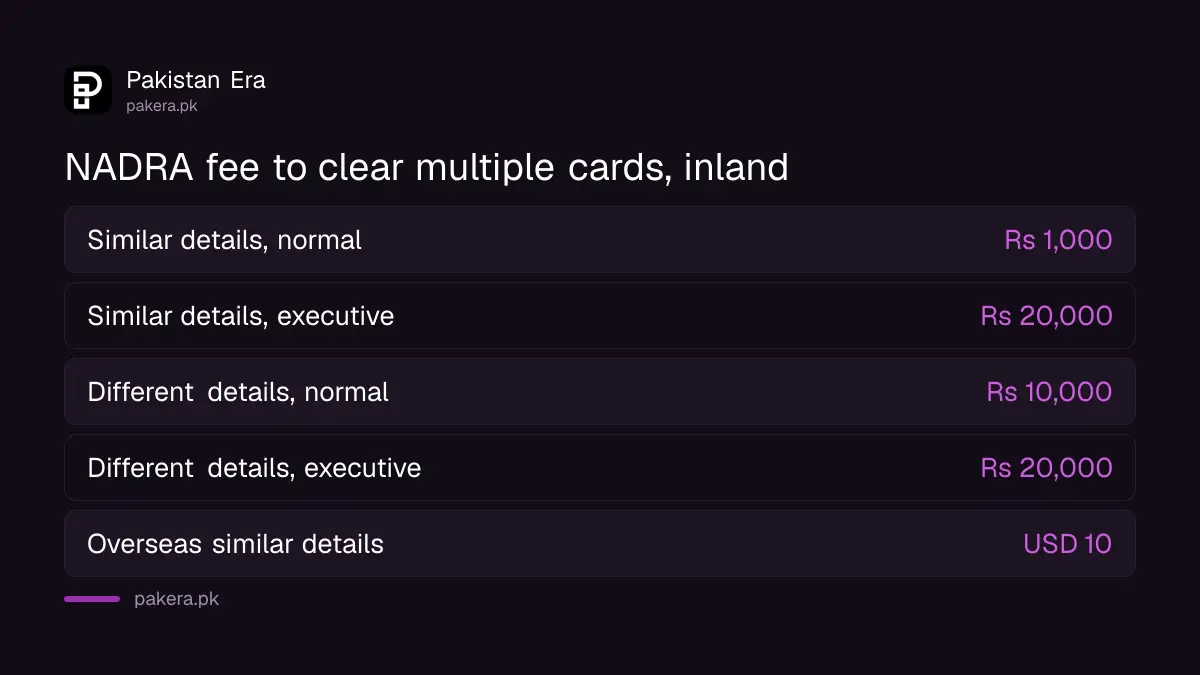
| Case | Normal | Executive | Region |
|---|---|---|---|
| Similar particulars, or a slight difference | Rs 1,000 | Rs 20,000 | Inland |
| Different particulars | Rs 10,000 | Rs 20,000 | Inland |
| Similar particulars | USD 10 | Not listed | Zone A and B |
| Different particulars | USD 250 | USD 500 | Zone A (USA, Europe) |
| Different particulars | USD 120 | USD 200 | Zone B (Middle East, Africa) |
The page does not define "similar" or "slight difference" in words. The officer reviewing your file makes that call. That makes it worth bringing proof of your correct details, not just your two cards.
How duplicates usually come about
NADRA does not publish a list of causes on the fee page, so we will not guess at numbers. We can say what the table implies: it has a cheap tier for near-identical records and a costly tier for records that disagree.
A card applied for twice with a slightly different spelling sits in the first group. Two applications with a different name, father's name or date of birth sit in the second.
If you are in the second group, the extra cost is a signal. The page gives no timeline. Bring everything that shows who you are.
What you pay for and what you do not know yet
The fee clears the multiple record. The page does not say how long it takes, and does not say which card survives. Ask both questions at the counter, and write the answers on your receipt copy.
We would not assume the older card is kept. Nor would we assume the newer one is. The page is silent on it.
We also could not find on the page what happens to the unused card in the meantime. Do not keep using two cards at once. Use one, and ask NADRA which.
Steps if you are inside Pakistan
Start by confirming that a second record exists. Then collect proof, visit a registration centre, pay the fee that matches your case, and keep the receipt. Ask for the fee tier in writing so there is no later dispute.
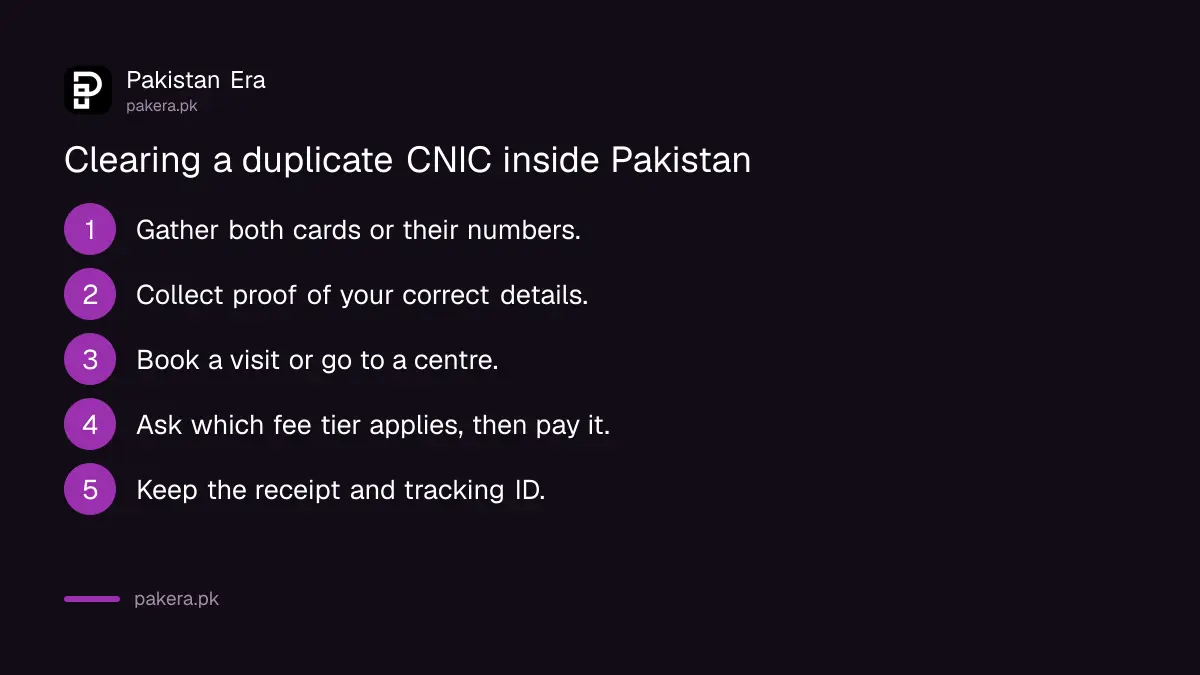
- Gather both cards, or the numbers if you have lost one.
- Collect proof of your correct name, father's name and date of birth.
- Book a visit on the PakID app, or go to a registration centre.
- Ask the officer which fee tier applies, and pay only that.
- Keep the receipt and tracking ID, then follow the file.
Our guide to booking a NADRA appointment on the PakID app saves a wasted trip. Our guide to tracking a NADRA application by text tells you when to go back.
Steps if you live abroad
NADRA lists a separate procedure for overseas applicants. You send an affidavit in NADRA's specimen form, deposit the fee, and email both to dup.op@nadra.gov.pk. The page lists email as the way to send them.
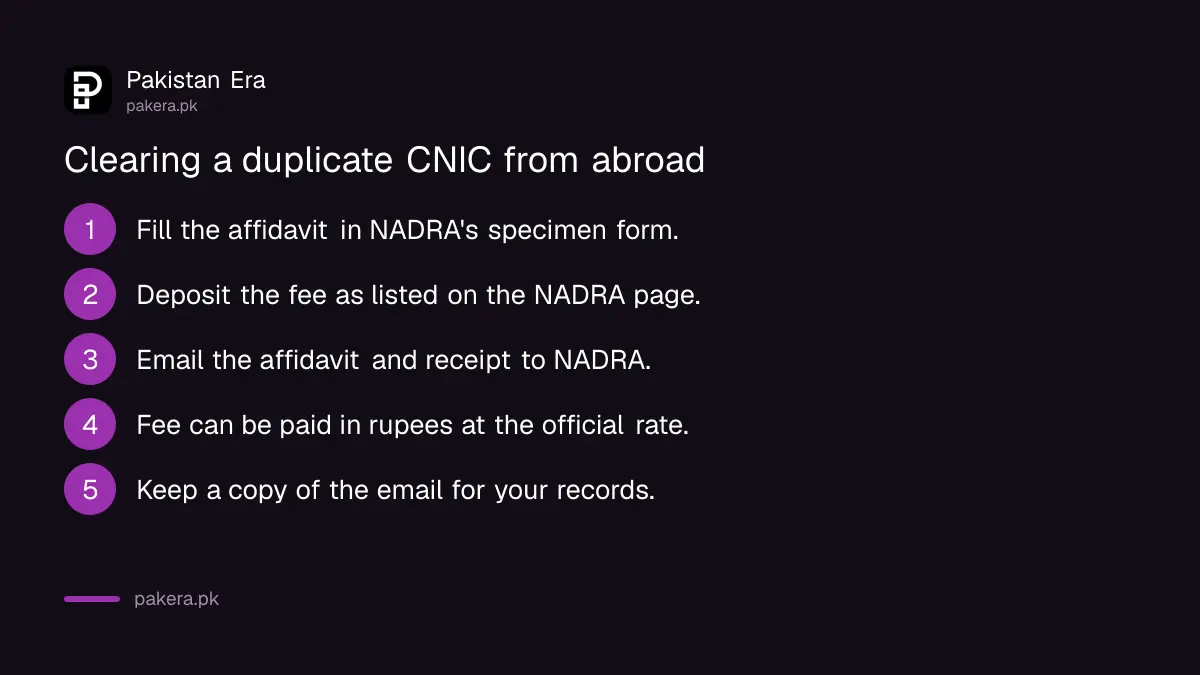
The fee page says it can be paid in rupees, using the official conversion rate on the date you apply. The bank details for the deposit are on the page itself. Copy them from nadra.gov.pk, not from a forwarded message.
Overseas Pakistanis with a NICOP or POC should also read our guide to which card overseas Pakistanis need, because the fees for those cards sit on the same page.
Beware of agents who promise to delete a record
The fee table is public. Any price above it for the same clearance is an agent's margin, and The fee page lists no other route. A file that is cleared through the proper route leaves a receipt and a tracking ID.
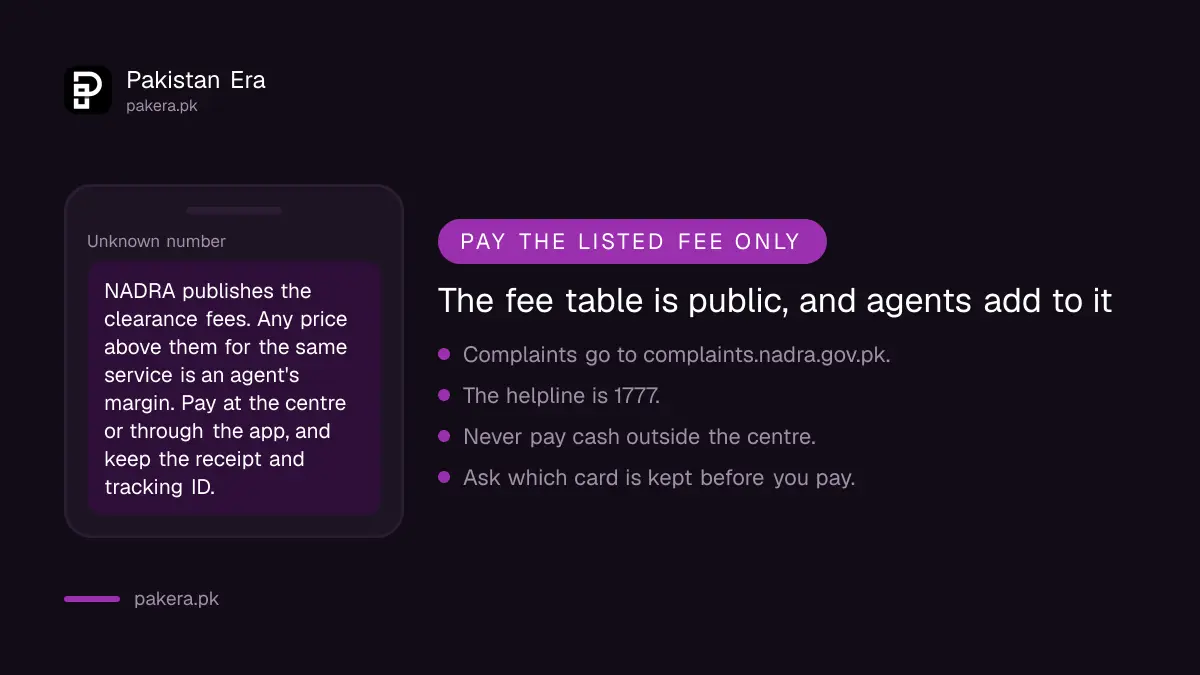
Pay at the registration centre or through the app. If anyone asks for cash outside, walk away. A complaint can be filed at complaints.nadra.gov.pk or on the helpline 1777.
If you also suspect misuse of your CNIC, start with checking the SIMs registered on your CNIC.
Common questions
How much does NADRA charge to clear a duplicate CNIC?
Rs 1,000 normal for similar particulars, and Rs 10,000 normal for different particulars. The executive rate is Rs 20,000 for both.
What counts as a slight difference?
NADRA's page does not define it. The officer who reviews your file decides, so bring proof of the correct details.
Which card is kept after clearance?
The fee page does not say. Ask the officer at the counter and note the answer on your receipt copy.
Can I do this from abroad?
Yes. NADRA lists an affidavit, a fee deposit and an email to dup.op@nadra.gov.pk for overseas applicants.
Is there a fee in rupees for overseas applicants?
NADRA says the fee may be paid in rupees at the official conversion rate on the application date.
How long does clearance take?
The page lists no timeline for this service. Ask at the counter and keep your tracking ID.
How we verified this
What we checked, where we read it, and what we could not confirm.
Last checked 8 October 2026. The clearance fees and the overseas procedure are on the fee structure page of the National Database and Registration Authority, nadra.gov.pk/feeStructure. The helpline, complaints portal and email were read from the footer of nadra.gov.pk. The page does not define similar and different particulars, give a processing time or say which card survives. We have marked each of those as unknown rather than guess. Fees can change, so confirm the figure on the NADRA page before you pay.
About the author
Public Services and Education Journalist
Fajr Riaz is a journalist and content writer at Pakistan Era, based in Lahore. She covers the questions people meet in everyday life in Pakistan: how a public service works, what a change in the rules means, and where to find a reliable answer.