Cyberbullying Law in Pakistan: PECA Section 24A Punishment, and How to Report It for a Child or Adult
PECA section 24A punishes child cyberbullying with 1 to 5 years in jail. See which section covers adults, bail status and how parents report and remove posts.
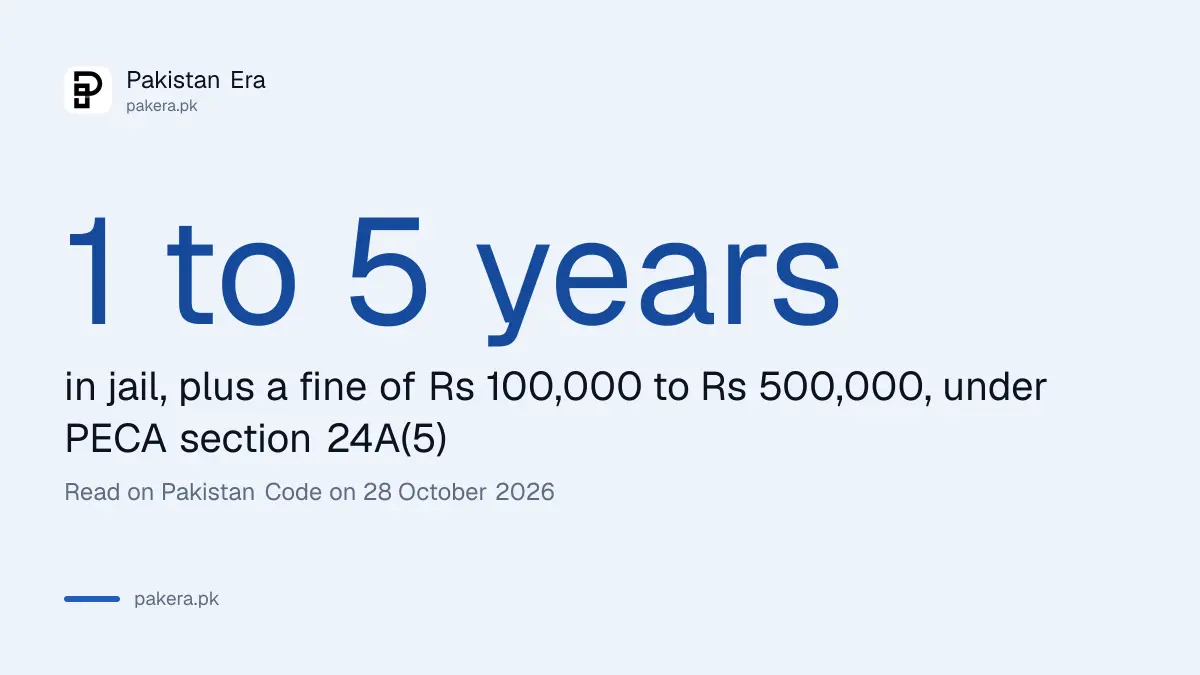
Cyberbullying a child in Pakistan is a crime under section 24A of the Prevention of Electronic Crimes Act (PECA), punishable with one to five years in jail and a fine of Rs 100,000 to Rs 500,000. For an adult victim, section 24A sets no punishment, so the case is filed under cyber stalking, false information or sexual image sections instead. Below is which section fits which act, and how to report it.
Parents usually find out late, from a change in a child's mood or a screenshot shared by a classmate. The law gives both a criminal case and a route to get the content taken down. We read section 24A and the related sections in the PECA text on Pakistan Code on 28 October 2026.
PECA section 24A defines cyberbullying and punishes it when the victim is a child
Section 24A, added in 2023, says a person commits cyberbullying when they post or send electronic messages, pictures or videos on any social media platform, chat room, blog or messaging app, with intent to harass, threaten or target another person. The punishment in sub-section (5) applies to child cyberbullying.
A child means anyone under 18. PECA's own definition of a minor in section 2 says so "notwithstanding anything contained in any other law". So a 17 year old bullied in a class WhatsApp group is covered.
The minimum matters here. Most PECA offences have only a maximum. Section 24A says the jail term "shall not be less than one year", and the fine cannot be below Rs 100,000. A court that convicts must give at least that.
Adults bullied online use sections 20, 21 or 24 instead
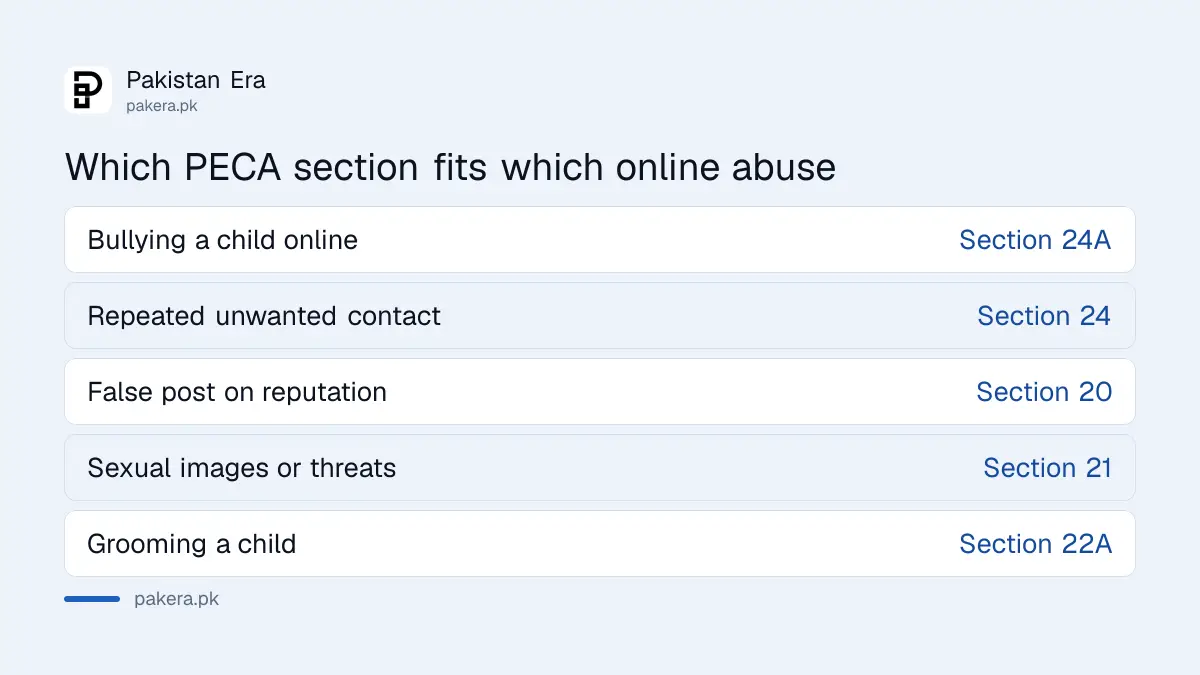
Section 24A defines cyberbullying of anyone, but its punishment covers only child cyberbullying. An adult who is harassed online files under the section that matches what was done: cyber stalking under section 24, false posts under section 20, or sexual images and threats under section 21.
| What happened | PECA section | Maximum punishment | Bail |
|---|---|---|---|
| A child is harassed or targeted online | 24A | 1 to 5 years and Rs 100,000 to Rs 500,000 | Bailable |
| Repeated unwanted contact, spying or sharing photos without consent | 24 | 3 years or Rs 1 million (5 years if a minor) | Bailable |
| False posts that harm reputation or privacy | 20 | 3 years or Rs 1 million | Non-bailable |
| Sexual images, fake edits or sexual blackmail | 21 | 5 years or Rs 5 million (7 years if a minor) | Non-bailable |
| An adult building trust with a child for sexual abuse | 22A | 5 to 10 years and up to Rs 10 million | Non-bailable |
Section 24 often fits school bullying too, because it covers taking a photo or video of someone and spreading it without consent in a way that harms them. Choosing the right section in your complaint helps the investigator. The full cyberstalking and fake account complaint steps apply to sections 20 and 24 cases.
Child cyberbullying is bailable and can be settled
Section 24A is not in the non-bailable list in section 43 of PECA. That makes it bailable, compoundable and non-cognizable. The accused can get bail as a right, and the family can settle the case. Police cannot arrest without a court warrant.
Many bullies are themselves children. A child accused has the rights of an arrested child under the Juvenile Justice System Act 2018, and PECA itself does not treat a child under ten as committing an offence. Between ten and fourteen, it depends on whether the child understood what they were doing.
That is why many families start with the school and the platform, and keep the criminal case for serious or repeated abuse, or abuse by an adult. Keep the evidence either way.
How to report cyberbullying of a child in Pakistan
A complaint goes to the National Cyber Crime Investigation Agency (NCCIA). PECA defines a complainant widely, including the victim and anyone with good reason to believe an offence is happening, so a parent, guardian or teacher can file. Collect evidence before anything is deleted.
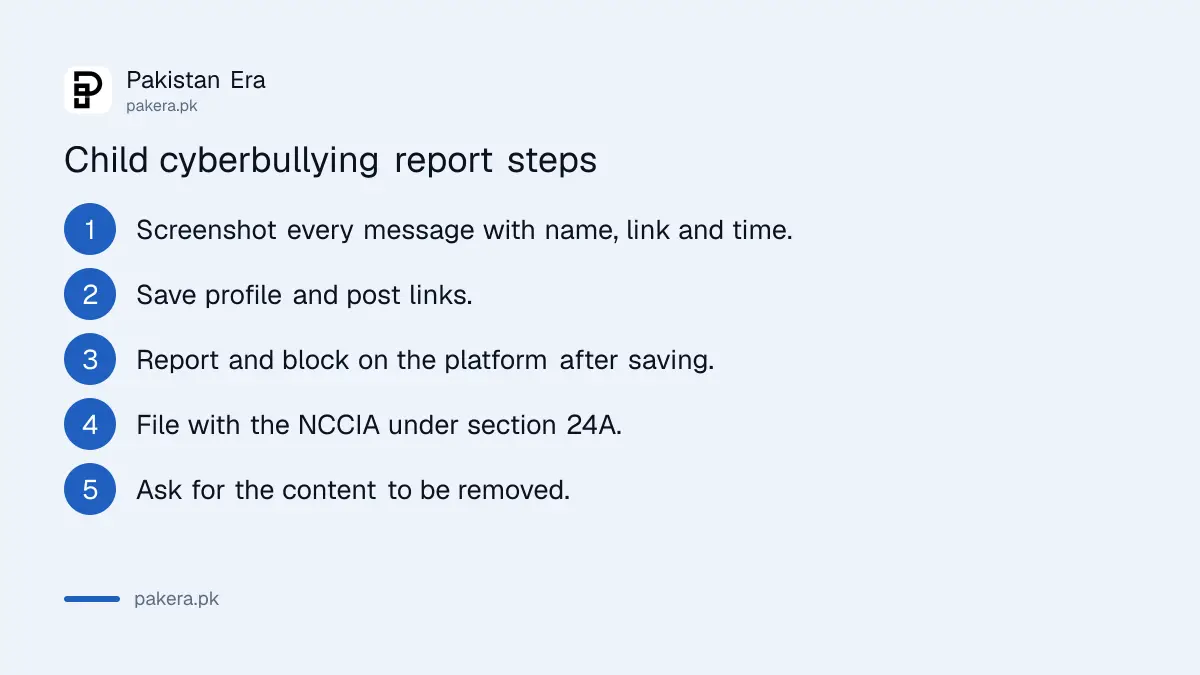
- Take screenshots of every message, post or video, showing the account name, profile link, date and time.
- Save the links to the profiles and posts, and note the names of any group chats.
- Report the content to the platform and block the account, but only after saving the evidence.
- File a complaint with the NCCIA online or at a cybercrime centre, naming section 24A, and attach the child's B-form and the parent's CNIC.
- Ask for the removal of the content under section 24A(2) through the Authority, which the NCCIA can advise on.
The NCCIA helpline and the 16 centre addresses are on the list of NCCIA office numbers and WhatsApp. The online route is the same as any cybercrime report in Pakistan.
The content can be removed through the Authority
Under section 24A(2) and (3), a minor, through a guardian, can apply to the Authority to remove or block the bullying content. The Authority must first ask the investigation agency whether the content is needed as evidence, then pass an order.
The Authority under PECA is now the Social Media Protection and Regulatory Authority created in 2025. Until it is set up, section 50A keeps the PTA doing this work. We could not confirm which body is handling these requests today.
Trials of offences against minors under PECA are held in camera under section 30C, which keeps the public out. Section 30B also provides for hiding a victim's identity and recording evidence by video link, once the governments make the rules.
Common questions
Is cyberbullying a crime in Pakistan?
Yes, when the victim is a child. Section 24A of PECA punishes child cyberbullying with one to five years in jail and a fine of Rs 100,000 to Rs 500,000.
What can an adult do about online bullying?
File under the section that matches the abuse: section 24 for cyber stalking, section 20 for false posts, or section 21 for sexual images or threats.
Who can file a complaint for a bullied child?
A parent, guardian or anyone with good reason to believe the offence is happening. PECA's definition of complainant includes all of them.
Is section 24A bailable?
Yes. It is not in the non-bailable list in section 43, so it is bailable, compoundable and non-cognizable.
What if the bully is also a child?
A child accused has the protections of the Juvenile Justice System Act 2018. PECA does not treat a child under ten as committing an offence.
How do I protect my child's accounts after bullying?
Make the accounts private, limit who can message or add the child to groups, and use the platform's teen settings. Steps to set parental controls on a child's phone help too.
How we verified this
What we checked, where we read it, and what we could not confirm.
We read sections 2, 20, 21, 22A, 24, 24A, 30B, 30C, 43, 43A and 50A of the Prevention of Electronic Crimes Act 2016, as amended by Act XXXVII of 2023 and Act II of 2025, on the Ministry of Law's Pakistan Code site on 28 October 2026. We could not confirm whether the Social Media Protection and Regulatory Authority has been notified and is handling removal requests, or whether the victim protection rules under section 30B have been made. Ask the NCCIA when you file.
About the author

Tax, Bills and Technology Writer
Ali Akhtar is a young and curious voice here at Pakistan Era. He is currently pursuing his A-Levels and has a growing interest in Pakistan’s changing industrial landscape and educational trends. Ali likes to write in a way that helps him explain and explore the world around him. His writing reflects the perspective of the new generation navigating the evolving trends of Pakistan where technology, youth innovation, and shifting opportunities are reshaping the country’s future.