Election Expenses Return in Pakistan: Form C, the 10 Day Deadline and the Rs 10 Million Limit
File the Form C election expenses return in Pakistan: winners in 10 days, others in 30 days of the Gazette. Limits Rs 10 million for MNA, Rs 4 million for MPA.
Every candidate in a Pakistani election must file a return of election expenses on Form C with the Returning Officer. The winner must file within 10 days of polling day, or the Election Commission of Pakistan (ECP) will not notify the result. Every other candidate has 30 days from the winner's Gazette notification. The spending limit is Rs 10 million for a National Assembly seat and Rs 4 million for a provincial seat.
We read the rules in the ECP's copies of the Elections Act 2017 and the Election Rules 2017 on 9 November 2026. That is the day after the NA-77 Gujranwala and PP-203 Sahiwal by-elections, so the clock is already running for 18 candidates. Here is who files, when, what goes in, and what happens if a candidate files late or spends too much.
The deadline depends on whether the candidate won
The returned candidate files within 10 days of the poll under Section 98(3). Every other contesting candidate files within 30 days of the Gazette notification of the winner under Section 134(1). Both file on Form C with the Returning Officer.
| Who | Deadline | Where | Legal basis |
|---|---|---|---|
| Returned candidate (winner) | Within 10 days of polling day | Returning Officer, on Form C | Section 98(3) |
| Every other candidate | Within 30 days of the winner's Gazette notification | Returning Officer, on Form C | Section 134(1) and (2) |
| Political party | Within 60 days of the Gazette notification | ECP, on Form-69 | Election Rules 2017, rule 161 |
The winner's deadline has teeth. Section 98(3) says the ECP "shall not notify" a winner who has not filed. So the expense return comes before the oath. Our guide to when a by-election winner is notified sets out every step.
The spending limit is Rs 10 million for MNA and Rs 4 million for MPA
Section 132(3) caps a candidate's election expenses. The cap includes money spent by anyone else, including the party, on the candidate's behalf. It covers the period from filing nomination papers to the final consolidated result.
| Seat | Spending limit |
|---|---|
| National Assembly | Rs 10 million |
| Provincial Assembly | Rs 4 million |
| Senate | Rs 1.5 million |
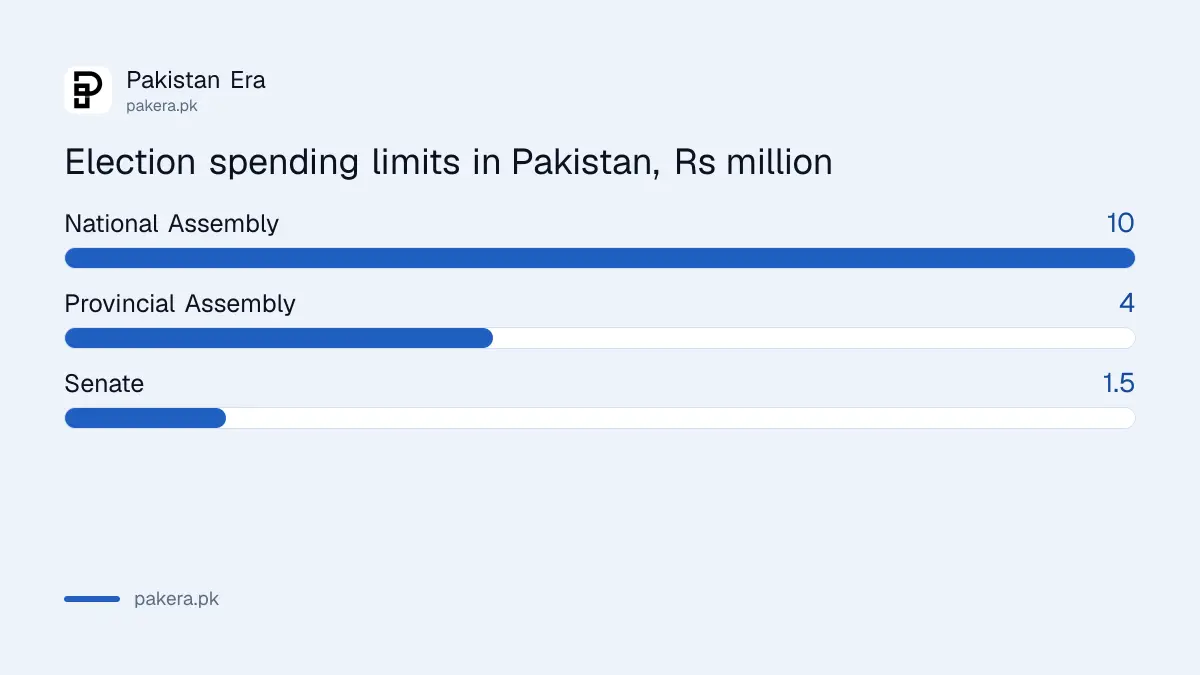
The limits apply the same way to a by-election as to a general election. Our page on how to contest an election covers the nomination fee and qualifications.
What counts as an election expense
- Anything paid for stationery, postage, advertising, transport or other campaign items, Section 132(2).
- Spending by a supporter or the party for the candidate. It is treated as the candidate's own.
- Every payment of Rs 1,000 or more needs a bill, receipt or other document, Section 132(4).
Form C has three parts, plus a bank statement
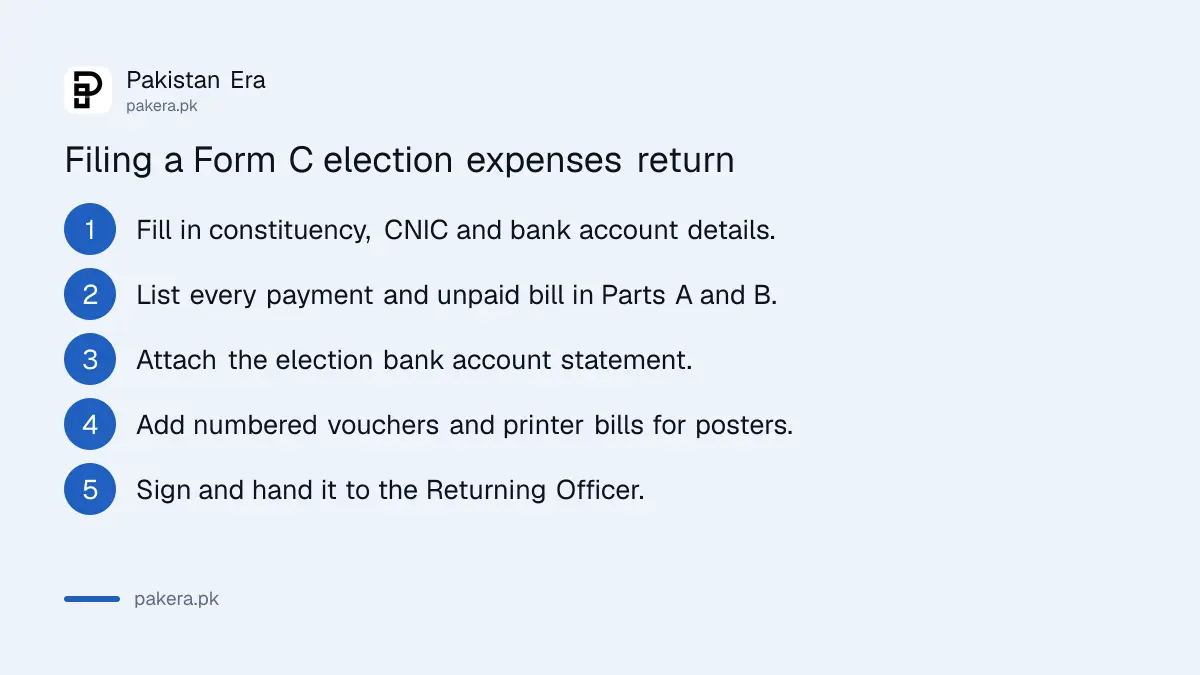
Form C, appended to the Elections Act, asks for the candidate's constituency, name, address, CNIC, bank and account number. Part A lists money spent, Part B lists unpaid bills, and Part C is the bank statement of the election account.
- Header. Constituency number and name, candidate's name, address, CNIC number, bank name and address, and account number or IBAN.
- Part A, account of election expenses. For each item: the date, what it was for, the amount paid, the amount still owed, and the total.
- Part B, unpaid claims. Each bill still outstanding, with its date and amount.
- Part C, bank statement. The statement of the election bank account, showing every transaction from it.
- Vouchers. Arrange them by date of payment and number them in order, rule 134(3) of the Election Rules.
- Printed material. Attach a copy of each poster, handbill or pamphlet with the printer's bill. Each must carry the printer's name and address.
- Sign, date and hand it to the Returning Officer. Keep a receipt.
The election bank account comes first
Section 133 requires each candidate to open a separate bank account, or dedicate an existing one, before scrutiny of nomination papers. Every campaign payment must go through it. Rule 134A says a dormant account must be revived before filing nomination papers. From filing until the expense return, the account cannot be used for anything else.
The ECP checks the return within 90 days
The Returning Officer sends the return to the ECP at once. The Commission scrutinises it within 90 days, and if it does not finish in time, the return is treated as accepted, Section 136(2). Anyone can inspect it for one year at Rs 10 a page.
| Situation | What happens | Legal basis |
|---|---|---|
| Return filed on time | Scrutiny within 90 days, else deemed accepted | Section 136(1) and (2) |
| Spending over the limit | An ECP officer files a complaint for corrupt practice | Section 136(3) |
| Corrupt practice proved | Up to 3 years in jail, a fine up to Rs 100,000, or both | Section 174 |
| Return not filed | Returning Officer's show cause notice, then a report to the ECP | Section 136(4) and (5) |
| Late return | The ECP may excuse the delay if it was in good faith; if not, an illegal practice complaint | Section 136(6) and (7) |
| Public inspection | At the ECP Secretariat for one year, Rs 10 a page for copies | Rule 135 |
Penalties for other election offences, including illegal practices, are in our election offences guide.
NA-77 and PP-203 candidates: what is due when
Polling was on 8 November 2026. By our count, the NA-77 and PP-203 winners must file their Form C by 18 November. The other 16 candidates have 30 days from whenever the ECP publishes the winners in the Gazette.
The ECP's provisional Form-47 shows PML-N's Raashid Bashir Virk leading NA-77 and Muhammad Asad Hanif leading PP-203. The ECP had not notified either winner when we checked on 9 November. Full figures are on our NA-77 and PP-203 result page.
Frequently asked questions
What is Form C in Pakistan elections?
Form C is the return of election expenses in the Elections Act 2017. Every contesting candidate files it with the Returning Officer, listing spending, unpaid bills and the election bank account statement.
How much can an MNA candidate spend?
Up to Rs 10 million, including spending by the party or supporters on the candidate's behalf, Section 132(3).
What happens if the winner does not file Form C?
The ECP will not notify the winner in the Gazette, so the winner cannot take the oath until the return is filed.
Do losing candidates have to file an expense return?
Yes. Every contesting candidate files within 30 days of the publication of the winner's name, Section 134(1).
Can I see a candidate's expense return?
Yes. Returns are open to public inspection at the ECP Secretariat for one year, and copies cost Rs 10 a page under rule 135.
Is the deadline the same for a by-election?
Yes. Sections 98 and 134 apply to every election to an assembly, so the 10 day and 30 day deadlines are the same.
Sources and last checked
We read Sections 98, 132 to 136 and 174 and Form C in the ECP's copy of the Elections Act 2017, updated to 5 August 2023, and rules 134, 134A, 135, 136 and 161 in the ECP's copy of the Election Rules 2017, updated to 31 December 2023, on 9 November 2026. For complaints about spending, see our ECP complaint guide.
About the author

Global Affairs & Political Economy Writer
Muhammad Hatim is a book lover who started writing because he enjoys it. At Pakistan Era he writes about international relations, geopolitics and the global economy, with a particular interest in South Asia and the forces behind current events.